Showing posts with label Central Catchment Area. Show all posts

Saturday, June 22, 2013

Chained to Our Roots (22nd-23rd June 2013): an appeal to protect Singapore's own rainforest

Chained to Our Roots - 1
Chained to our Roots - 2

Teresa Teo-Guttensohn, a Singaporean eco-artist and Dr. Vilma D'Rozario, Celine Low, and Andrew Tay, together with their group of nature-loving friends, will be part of an eco-performance where they will be chained to a tree for 24 hours, to appeal for the Cross Island Mass Rapid Transit Line to be re-routed such that it will not run through our precious rainforest at the Central Catchment Nature Reserve.

When: 3 pm Saturday, 22nd June to 3 pm Sunday, 23rd June 2013
Where: Speakers' Corner, Hong Lim Park

Wednesday, June 19, 2013

The Cross-Island Line: why does it have to go through a Nature Reserve?

HSBC Treetop Walk
(Photo by coolinsights)

Over the years, Singapore has lost more than 99.5% of its original forest cover. Whatever little that remains is now concentrated in a few key areas, and preserves much of our surviving native rainforest biodiversity. The Central Nature Reserves, encompassing the forests of Bukit Timah and those surrounding the reservoirs in the Central Catchment Area, form the final refuge of many plant and animal species that have since vanished elsewhere on the island. As Nature Reserves, they receive the highest level of protection that any green space in Singapore can have.

And yet, as many of us in the nature community found out earlier this year, even being gazetted as a Nature Reserve does not grant immunity from urbanisation and development.

Saturday, September 1, 2012

International Vulture Awareness Day: Vultures in Singapore

Gyps himalayensis , Himalayan Griffon, in Tibetan "mkha' la 'khor མཁའ་ལ་འཁོར་"
(Photo by reurinkjan)

Today is International Vulture Awareness Day, and I thought it would be appropriate to write about records of vultures in Singapore.

But why do we need a day to celebrate vultures? As stated on the International Vulture Awareness Day website:
Vultures are an ecologically vital group of birds that face a range of threats in many areas that they occur. Populations of many species are under pressure and some species are facing extinction.

The International Vulture Awareness Day has grown from Vulture Awareness Days run by the Birds of Prey Programme in South Africa and the Hawk Conservancy Trust in England, who decided to work together and expand the initiative into an international event.

It is now recognised that a co-ordinated international day will publicise the conservation of vultures to a wider audience and highlight the important work being carried out by the world's vulture conservationists.

Sunday, January 8, 2012

Monday, December 26, 2011

Ribbons: Terrestrial Nemerteans of Singapore

People with a fascination for marine life would probably have heard of nemerteans, commonly known as ribbon worms.

Ribbon worm (Baseodiscus delineatus)
Black and white ribbon worm (Baseodiscus delineatus), Terumbu Pempang Darat;

Red ribbon worm (Nemertea)
Red ribbon worm, Kusu Island;
(Photos by Ria)

Most ribbon worms live in marine environments, with a small proportion adapted to freshwater habitats. Just earlier today, I learnt that a small handful of nemertean species have actually managed to colonise the land, and that they can be found in Singapore!

Wednesday, September 15, 2010

Sunday, July 18, 2010

Raffles Museum Treasures: Banded leaf monkey

P1130843
Banded leaf monkey (Presbytis femoralis)
Collected from Bukit Timah Nature Reserve, October 1987
Native to Singapore: Critically Endangered

This elderly female was the last survivor of the troop which once inhabited the forests of the Bukit Timah Nature Reserve. One day in October 1987, she left the safety of the trees and descended to the ground, where she was set upon and fatally mauled by a pack of dogs.

In the 1920s, this monkey was reported to be present in various parts of Singapore, including Changi, Tampines, Bukit Timah, Pandan and Tuas. Today, the species still barely clings on in the forests of the Central Catchment Area, where at least 40 are known to roam the MacRitchie and Lower Peirce Reservoir areas.

Rare Singapore monkey species in better shape than thought
Wildlife Singapore
Singapore Red Data Book
NParks FaunaWeb
Ecology Asia
The Primata
IUCN Red List
ARKive


(Photo by hiker1974)

Saturday, July 25, 2009

Pangolin spotted on Hillcrest Road

Pangolin spotted on Hillcrest Road
A STOMPer came across this pangolin taking a nap when he was cycling along Hillcrest Road.

Peter told STOMP via email today (Jul 25):

"Just wanted to send a picture of a pangolin at the end of Hillcrest Road as I was cycling.

"It was all curled up sleeping."

Hillcrest Road is relatively close to the forests of the Central Catchment Area, so I'm not surprised to see a pangolin sighting in the area. Still, it is a nice sighting of the Sunda pangolin (Manis javanica), although I am a little puzzled as to why it was sleeping out in the open in broad daylight.

Sunday, June 28, 2009

Meet the carnivorous pitcher plant

Meet the carnivorous pitcher plant
STOMPer Botanist saw the pitcher plant at Bukit Batok Nature Park and shares his knowledge of it. He says:

"These pictures were taken at the Bukit Batok Nature Park at Bukit Batok East Ave 2.

"This particular species, the pitcher plant (Nepenthes gracilis) is common and widespread in Malaysia, Singapore and Indonesia.

"It is easily spotted on road banks and cleared areas and grows well up to altitudes of 1000m.

"These carnivorous plants contain traps that can hold up to 50 cubic cm of liquid.

"Each leaf of the pitcher plant resembles a jug, or pitcher and has a lid to keep out the rain.
"An insect is lured by the bright colour and abundant nectar of the pitcher but the rim has a slippery surface.

"When the insect tries to get the nectar, it loses its footing and easily slides into the pool of liquid at the bottom.

"These plants make use of the proteins obtained from insects when their bodies are ingested."

Meet the carnivorous pitcher plant

The 120 species of tropical pitcher plants belong to the genus Nepenthes, and have a widespread distribution, from Madagascar and the Seychelles in the west, all the way throughout India, Sri Lanka and Southeast Asia, to Australia and New Caledonia in the east. It is in the Sunda region, however, that they are at their most diverse, particularly in Borneo.

There are 3 species of pitcher plant in Singapore:


Narrow-lidded pitcher plant (Nepenthes ampullaria), Central Catchment Area;
(Photo by NatureInYourBackyard)


Slender pitcher plant (Nepenthes gracilis), Tuas;
(Photo by Siyang)


Raffles pitcher plant (Nepenthes rafflesiana), Sentosa;
(Photo by Ria)

It is possible that the carnivorous habits of pitcher plants are an adaptation for obtaining nutrients such as nitrogen and phosphorus in soils that are deficient in these essential elements; in Borneo, pitcher plants are a prominent feature of heath forests or kerangas, where the soils are sandy and acidic, while here in Singapore, they can be found in the secondary forests known as adinandra belukar, which are also characterised for having acidic, nutrient-poor soils.

There are several interesting posts on pitcher plants in Singapore. Siyang and Kok Sheng have posted about their encounters with pitcher plants in the Kent Ridge area, while Gabriel Tan of eTour-Singapore.Com has a page detailing his encounters with the 3 different species of pitcher plant. He also mentions the Naked Hermit Crabs and the walks that we conduct on Sentosa. Joseph Lai has some excellent pictures of the 3 pitcher plant species, while Marcus has a post describing the unique features of each species, as well as some of the interesting relationships that pitcher plants share with some forest animals.

It's interesting to note that despite the digestive enzymes in the liquid within the pitcher, there are animals that actually live in pitcher plants. These include the larvae of many species of mosquitoes, midges and gnats, which feed on the remains of prey, and may play a role in breaking down large prey items and improving the rate of digestion. Otherwise, the enzymes secreted by the pitcher plant may act slowly, resulting in prey decomposing and leading to the growth of undesirable bacteria and fungi. These insect larvae are in turn preyed upon by the larvae of other fly species, such as the mosquito Toxorhynchites; larvae are voracious predators on mosquitoes, including their own kind.

Other creatures that utilise pitchers include a crab spider (Misumenops nepenthicola), which hides within pitchers and ambushes victims that are lured within, even descending down to retrieve insects that have fallen into the liquid. This spider can even submerge itself in the liquid and hide for several minutes if threatened.


Misumenops nepenthicola in pitcher of Raffles pitcher plant;
(Photo by Thomas Carow)

Crabs belong to the genus Geosesarma are also known to associate with pitchers; in Peninsular Malaysia, Geosesarma malayanum is known to raid the pitchers of the narrow-lidded pitcher plant to feed on the insects trapped within. And here in Singapore, a second species of crab, Geosesarma perracae, was found hiding within a pitcher.

Ng, P. K. L. & Lim, R. P. 1987. The taxonomy and biology of the nepenthiphilous freshwater sesarmine crab, Geosesarma malayanum Ng & Lim, 1986 (Crustacea, Decapoda, Brachyura, Grapsidae) from Peninsular Malaysia. Malayan Nature Journal, 41, 393–402.

Tan, H. H. & Ng, P. K. L. 2008. First record in Singapore of a nepenthiphilous crab, Geosesarma perracae (Crustacea: Decapoda: Sesarmidae). Nature in Singapore, 1, 201–205.


Geosesarma perracae in pitcher of narrow-lidded pitcher plant, Central Catchment Area;
(Photo from Tan & Ng, 2008)

Tadpoles of the black-spotted sticky frog (Kalophrynus pleurostigma) have even been found living inside the pitchers of the narrow-lidded pitcher plant.


Black-spotted sticky frog;
(Photo by kwokwai76)


Tadpole of black-spotted sticky frog;
(Photo from Frogs of Borneo)

In northwestern Borneo, the fanged pitcher plant (Nepenthes bicalcarata) has developed a fascinating relationship with an ant, Camponotus schmitzi. These ants nest only in the swollen hollow tendrils of the pitcher. While ants are a major prey item for many pitcher plant species, these special ants are able to crawl about the pitchers without slipping. They sip nectar from the glands on the rim of the pitcher, and even venture within the traps. Here they retrieve large prey items that would take too long for the plant's enzymes to digest, preventing the insect remains from putrefying. They are even able to dive into the liquid and swim around in pursuit of mosquito larvae.


Camponotus schmitzi retrieving insect prey from fanged pitcher plant, Brunei;
(Photo by clado)

Another amazing relationship takes place between Low's pitcher plant (Nepenthes lowii) and the mountain treeshrew (Tupaia montana). Instead of feeding on insects, the upper pitchers of this plant derive a large proportion of their nitrogen requirements from treeshrew poop.


Mountain treeshrew sitting on Low's pitcher plant, Sarawak;
(Photo by Ch'ien C. Lee)

These small mammals feed upon the nectar produced on the underside of the lid of the pitcher, which this species secretes in copious amounts. While feeding, they are perfectly positioned to defecate right into the pitchers. Consequently, these upper pitchers have all but lost the ability to trap insects, and instead obtain 57 to 100% of their nitrogen from treeshrew droppings.

Clarke, C. M., Bauer, U., Lee, C. C., Tuen, A. A., Rembold, K. & Moran, J. A. 2009. Tree shrew lavatories: a novel nitrogen sequestration strategy in a tropical pitcher plant. Biology Letters, published online before print.

To end off on pitcher plants, here's an interesting video from the BBC documentary series, The Private Life of Plants, on how the pitchers develop from the leaf tips.

Friday, June 12, 2009

Stop fishing illegally at MacRitchie Reservoir!

Stop fishing illegally at MacRitchie Reservoir!
STOMPer AMD18000 spotted two men fishing at a non-designated fishing area in MacRitchie Reservoir.

In an email to STOMP today (June 12), the STOMPer says:

"I believe fishing at MacRitchie Reservoir is only allowed at designated areas.

"This morning I noticed two men fishing at MacRitchie Reservoir, somewhere at the end of the Petai Trail - not a designated area for fishing."

Stop fishing illegally at MacRitchie Reservoir!

Related posts: No fishing at West Coast Park: Nobody gives a damn (7th March 2009)
Inconsiderate people disobey rules and fish at Upper Peirce reservoir (9th March 2009)
Man fishing illegally at Labrador beach (10th May 2009)

Saturday, May 9, 2009

Family of monkeys make use of playground

Family of monkeys make use of playground
STOMPer Andre was at Lower Pierce Reservoir with his girlfriend Vita when they both noticed this family of monkeys utilizing this playground there.

In his email to STOMP today (May 9), the STOMPer sent in these modified pictures and wrote:

"Since it was Vesak day, I decided to go down to Lower Peirce Reservoir with my girlfriend Vita to commune with nature, as it was away from our congested city.

"I was really amazed that a family of monkeys was practically utilizing the playground from using the slide to making use of the ladder and monkey bar.

"It was really amusing watching them in action that I did not realise an hour whizzed past me.

"Upon closer inspection I was speculating as to whether the playground could have been made for the resident monkeys?

"As the playground was located down slope and was not accessible to humans as there was no pathway but grass surrounding the playground.

"Whether the monkeys enjoyed themselves or not, we definitely enjoyed ourselves watching them."

Family of monkeys make use of playground

Gecko gets free wild ride on bus

Gecko gets free wild ride on bus
This green tree gecko got a free ride on this bus travelling from Upper Thomson Road to Ang Mo Kio, according to STOMPer Andre, who witnessed its sheer tenacity and determination to cling onto the vehicle.

In an email to STOMP today (May 8), the STOMPer sent in these modified pictures and wrote:

"After a nature visit to Lower Peirce Reservoir located at Upper Thomson Road my girlfriend and I took Bus 169 to Ang Mo Kio for lunch.

"We were really amused with a luminous green tree gecko which was about 25 cm(head to tail) clinging on to the window throughout the journey till it reached Ang Mo Kio bus terminal where we spotted it jumping off about a meter to a low branch.

"We were really impressed by its sheer determination of travelling so dangerously to reach its destination for free. A free ride indeed on Vesak Day."

Gecko gets free wild ride on bus

It's a changeable lizard (Calotes versicolor), not a 'luminous green tree gecko'.

It is very interesting behaviour, and I wonder if this is one way in which an invasive species can quickly spread into new areas.

The changeable lizard is not native to Singapore, and first appeared only in the 1980s, presumably having stowed away on ships and motor vehicles arriving from Thailand or the northern states of Peninsular Malaysia, where this species is native. Having established breeding populations in Singapore, it soon spread throughout the country, and is now found everywhere, even on the smaller offshore islands. Unfortunately, its success has come at the expense of its relative, the green crested lizard (Bronchocela cristatella). Through competition and possibly predation, the changeable lizard has displaced the green crested lizard in much of Singapore.

I wonder if the spread of this introduced species in Singapore was inadvertently facilitated by motor vehicles. It's not as far-fetched as it seems. After all, whether it's grass seeds lodged in tyre treads, or snakes stowed away in cargo, we have unknowingly assisted many species in crossing continents and oceans, enabling them to colonise new areas far beyond their native range.

Uninvited guest on Vesak Day

Uninvited guest on Vesak Day
Guess who decided to drop by STOMPer Meg's home on Vesak day? It was a friendly, though uninvited, little bat!

Said the STOMPer:

"At 4am, I woke up to a faint chirping, only to find it hiding near my kitchen ceiling.

"I called all pest controllers only to find out none are specializing in capturing this animal.

"It's still in my house."

The photo is a little fuzzy, but still clear enough to show that this is a pouched tomb bat (Saccolaimus saccolaimus), a common and widespread species in Singapore.


Pouched tomb bat, Singapore;
(Photo by kwokwai76)

The pouched tomb bat roosts in colonies within rock crevices, hollow trees, and buildings, and like many other bat species, emerges at dusk to feed on insects. It goes by several names; pouch-bearing bat and pouched bat are other names for it, Wikipedia lists it as the naked-rumped pouched bat, while in Australia it is known as the bare-rumped sheathtail bat.

Regardless of its common name, this is a species with a wide distribution, from India and Sri Lanka all the way to New Guinea and northern Australia.


Pouched tomb bat, Singapore;
(Photo by kwokwai76)

The pouched tomb bat belongs to the family Emballonuridae, a family of 47 species of bat found throughout the tropics and sub-tropics, and commonly known as the sheath-tailed or sac-winged bats. Both names allude to the unique morphology of these bats.

In most bat species, the hind legs are joined together by a membrane called the uropatagium, which often also encloses the tail. You can see an example below.


Bicoloured leaf-nosed bat, Bukit Timah Nature Reserve;
(Photo by Leong Tzi Ming)

In the emballonurid bats, however, the tip of the tail protrudes from the middle of the uropatagium.


Black-bearded tomb bat (Taphozous melanopogon), Thailand;
(Photo by kwokwai76)

In flight, the bat can further extend the uropatagium by stretching its legs; the loose sheath around the tail easily slides back and forth over the tail vertebrae. This unique ability to control the size and shape of the uropatagium gives the emballonurid bat exceptional control over its steering and turning capabilities while pursuing insects in the air. It's a shame there aren't any readily accessible photographs of the tail of an emballonurid bat to illustrate this.

The other common name of sac-winged bats is due to the presence of glandular sacs in the wings of many species. These glands may play a role in scent-marking and communication. The pouched tomb bat lacks wing sacs, but has a large glandular throat pouch instead.


Wing sac of black-bearded tomb bat, Sabah;
(Photo by CM Francis)

In Singapore, besides the pouched tomb bat, 2 other species of sheath-tailed bat are present, the lesser sheath-tailed bat (Emballonura monticola) and the black-bearded tomb bat (Taphozous melanopogon), both of which are much more rarely encountered.

Approximately 32 species of bats have been recorded from Singapore, belonging to 8 different families: the fruit bats (F. Pteropodidae), horseshoe bats (F. Rhinolophidae), leaf-nosed bats (F. Hipposideridae), false vampire bats (F. Megadermatidae), slit-faced bats (F. Nycteridae), sheath-tailed bats (F. Emballonuridae), free-tailed bats (F. Molossidae) and vesper bats (F. Vespertilionidae). It is likely that out of these 32 species, some are already locally extinct, while yet more species might be present but unrecorded. While many of these bats are restricted to forest environments, several of them have proven capable of adapting to urban environments, roosting in buildings or beneath bridges, and within tunnels and drain culverts.

2 of the most commonly encountered bats in urban Singapore are the common fruit bat (Cynopterus brachyotis) and the lesser Asian house bat (Scotophilus kuhlii).


Common fruit bat, Singapore;
(Photo by Marcus)

The common fruit bat, otherwise known as the lesser dog-faced fruit bat, feeds on fruit and nectar, and is known to roost in trees as well as in buildings. Sometimes, these bats will roost beneath large leaves of plants such as bananas and palms, and construct a tent-like structure by chewing along the midrib of the leaves, creating a shelter that shields the bats from sunlight and rain.


Common fruit bats roosting, Lower Peirce;
(Photo by NatureInYourBackyard)


Common fruit bat feeding on chiku (Manilkara zapota) fruit, Singapore;
(Photo by kwokwai76)


Lesser Asian house bat;
(Photo from Hong Kong Biodiversity Database)

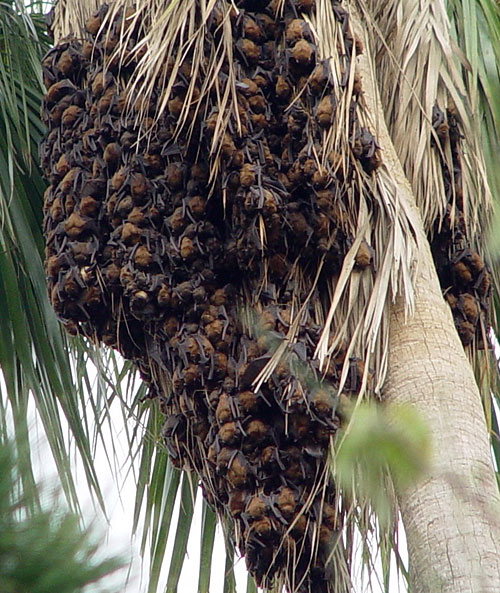
The lesser Asian house bat is the most common of our insectivorous bats, and is not fussy where it comes to choosing a roosting site; large colonies of up to several hundred bats can be found in buildings, hollow trees, and beneath the leaves of palm trees. On more than one occasion, I've seen these bats flying around lamp posts, feasting on the insects drawn to the light.


Large colony of lesser Asian house bats roosting in palm tree;
(Photo by Chen Shiang-Fan)


Lesser Asian house bat, Singapore;

The Malayan flying fox (Pteropus vampyrus) is one of the world's largest bats, with a wingspan of up to 1.5 metres. This species used to be common, but due to widespread hunting and loss of fruit trees, the population has declined greatly. The current status of this species in Singapore is a little confusing. According to A Guide to the Threatened Animals of Singapore, which was published in 1995, populations still exist in the Central Catchment Area, Pulau Ubin, Pulau Tekong and the Singapore Botanic Gardens.


Malayan flying fox, Disney's Animal Kingdom Park;
(Photo by Scottwdw)

However, my copy of Wild Animals of Singapore, which was published last year, doesn't include the Malayan flying fox in the Species Identification Guide, and lists it as a visitor to Singapore in the checklist. This appears to be corroborated by the Ecology Asia website, which states that 'there are no known roosts in Singapore, but visits by small flocks from neighbouring countries occur when there are trees fruiting in the Central Catchment Forest.'


Malayan flying fox, Oakland Zoo;
(Photo by Thomas Hawk)

Not many people seem to be aware of the ecological value of bats. The insectivorous species are significant insect predators, while others play an indispensable role in pollination and seed dispersal. Many people are surprised when I tell them that durians are pollinated chiefly by bats!

Bats can be very challenging to study; after all, many species are small and almost impossible to identify on the wing, and for many of us, the most we will ever get are fleeting glimpses as they flit around at high speed. Good luck trying to identify that nondescript brown blur that just flew past. Many of their calls occur at frequencies beyond our hearing abilities, necessitating the use of special equipment. Not to mention that they are nocturnal, a fact that presents even more challenges to researchers trying to study bat ecology and behaviour.

Using mist nets can provide valuable data, but might still be inadequate in constructing a comprehensive overview of bat numbers and diversity. Different species of bats fly at different heights, and some might go about their nightly activities above the forest canopy, well beyond the range of any net.

There's plenty to discover about Singapore's bats. An article published earlier this year revealed the rediscovery of the bicoloured leaf-nosed bat, a species thought to be extinct locally, as well as the discovery of Hardwicke's woolly bat (Kerivoula hardwickii), a new species record for Singapore.

T. M. Leong & K. K. P. Lim. 2009. Noteworthy microchiropteran records from the Bukit Timah and Central Catchment Nature Reserves, Singapore. Nature in Singapore, 2, 83-90.

Before that, a survey of bats had shown the presence of 3 species not previously recorded in Singapore, the Malayan slit-faced bat (Nycteris tragata), Blyth's horseshoe bat (Rhinolophus lepidus), and lesser tube-nosed bat (Murina suilla), but also suggested that 8 insect-eating species had become locally extinct. 1 of those species thought to be extinct was the bicoloured leaf-nosed bat, which if you recall, was subsequently rediscovered.

Pottie, S. A., Lane, D. J. W., Kingston, T. & Lee, B. P. Y-H. 2005. The microchiropteran bat fauna of Singapore. Acta Chiropterologica, 7(2), 237-247.

Another very interesting study looks at the decline in bat diversity in Singapore. By taking into account bat species found in Peninsular Malaysia, Sumatra and Borneo, but not in Singapore, the researchers suggest that the decline in bat species has been much more calamitous than 19th and 20th century records would suggest. There are also possible implications for species loss elsewhere in tropical Southeast Asia, where the loss and fragmentation of rainforests threaten the survival of numerous bat species.

Lane, D. W. J., Kingston, T. & Lee, B. P. Y-H. 2006. Dramatic decline in bat species richness in Singapore, with implications for Southeast Asia. Biological Conservation, 131(4), 584-593.

Before ending off, I guess it's only fair that I try and come up with some practical solutions for the person with a bat in her kitchen. It might be possible to close the door but leave the windows open, and then try to chase the bat out of the house. It might be better to try doing that in the late afternoon or early evening, when the bat is ready to fly off for a night of foraging anyway.

Under no circumstances should one try to catch the bat with bare hands; in the struggle, the thin bones of the bat might be snapped in two, or its delicate wings might be torn. Besides, bats have sharp teeth, and I won't be surprised if they use them in self-defense once in a while. Unlike in other countries, we don't have to be afraid of catching rabies from being bitten by a bat. Nonetheless, there are a number of other potentially dangerous diseases that may be transmitted between bats and humans, so like all other wild animals, it is best to keep one's distance and to take the necessary precautions when coming into contact with wildlife.

Still, I know of people who have small flocks of common fruit bats roosting in their homes, which I have to admit is rather neat. Can't imagine the noise made by the squabbling bats and the shower of guano though...