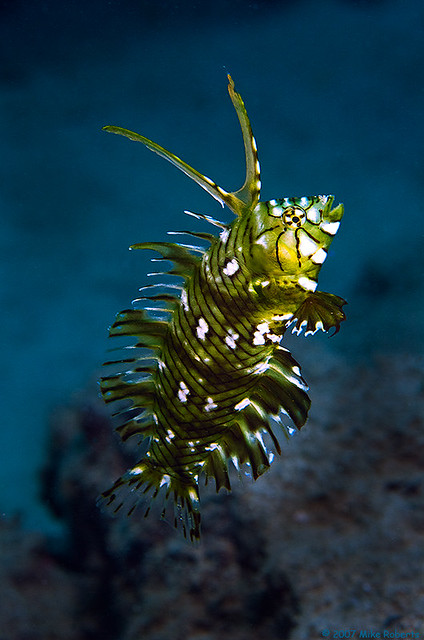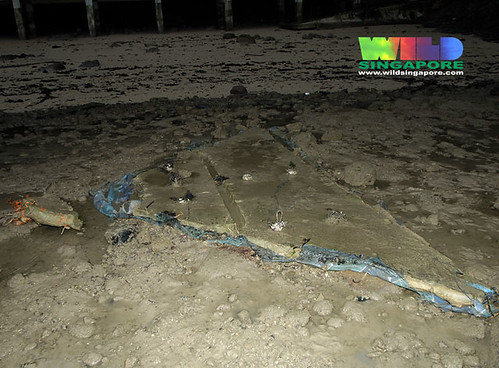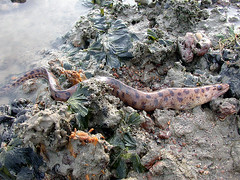
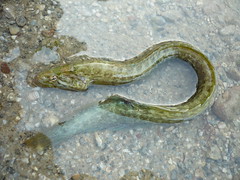
Which one is the eel?
So far, we have looked at a wide variety of eels, from moray eels (F.
Muraenidae), to snake eels (F.
Ophichthidae), from conger eels (F.
Congridae) and pike conger eels (F.
Muraenesocidae), to the freshwater eels (F.
Anguillidae). We've even spent a bit of time on 2 very little-known eel families, the spaghetti eels (F.
Moringuidae) and false moray eels (F.
Chlopsidae)
All the families I've talked about belong to the true eels, or Anguilliformes. In truth, there are numerous other eel-like fishes that are also known as eels, but which are not closely related to the true eels.
On our shore trips, we often encounter a long, eel-like fish. This is the carpet eel blenny (Congrogadus subducens), a predatory species commonly found in reefs, coral rubble and seagrass areas.

Carpet eel blenny, Pulau Sekudu;
(Photo by Ria)
However, the carpet eel blenny is not actually related to eels, and instead belongs to a family known as dottybacks (F. Pseudochromidae).
Other fishes on our shores which might get confused with eels include pipefish (F. Syngnathidae) and eel-tailed catfish (F. Plotosidae). However, it is easy to tell them apart from eels; pipefish have the characteristic long tubular snout, while catfish can be recognised by their barbels.


Left: ?Tidepool pipefish (Micrognathus micronotopterus), Changi;
Right: Black eel-tail catfish (Plotosus canius), Changi;
(Photos by Ria)
More rarely seen are sand-divers (F. Trichonotidae); we have not been able to identify the species encountered on the Sisters Islands.
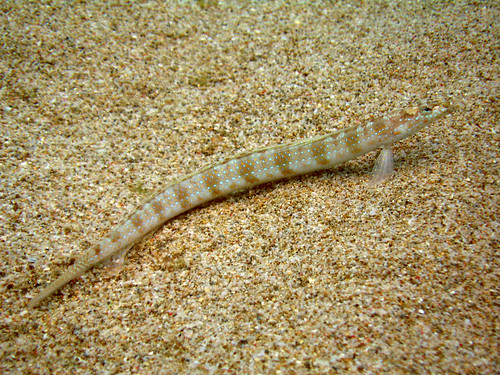
Blue-spotted sand diver (Trichonotus setiger), Kenting;
(Photo by divingintaiwan)
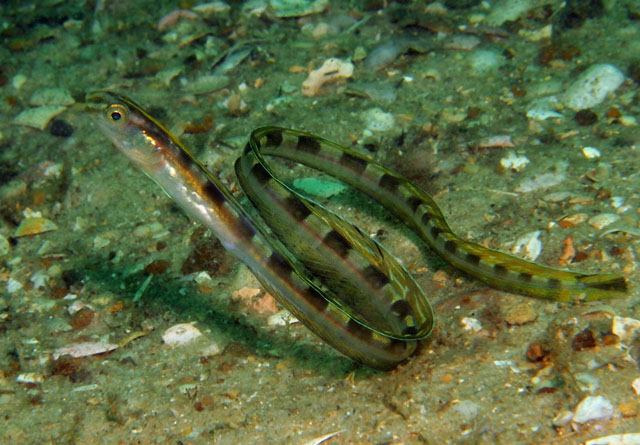
Blennies (F. Blenniidae) often tend to be somewhat elongated, but the snake eel blenny (Xiphasia setifer) is the most eel-like of the family.

Snake eel blenny, Nelson Bay;
(Photo by Dave Harasti)
The cutlassfishes (F. Trichiuridae) are also quite eel-like in appearance, with the largehead hairtail (Trichiurus lepturus) being 1 of the species known to occur in our waters.

Largehead hairtail;
(Photo by Don Flescher)
In temperate waters, more eel-like fish reside. Among them are the gunnels (F. Pholidae), eelpouts (F. Zoarcidae), pricklebacks (F. Stichaeidae), wolf eels (F. Anarhichadidae), and sand lances or sand eels (F. Ammodytidae). Despite the fact that some of their common names have something to do with eels, all these fish are not closely related to eels at all.
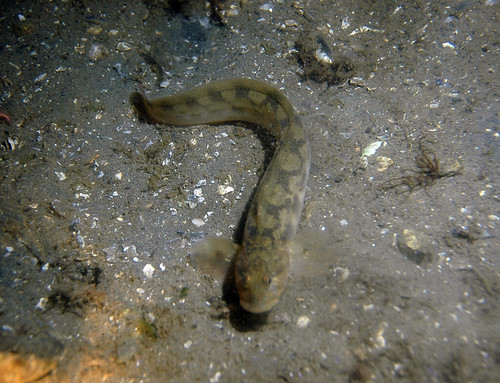


Top: Rock gunnel (Pholis gunnellus), Zeeland;
(Photo by Arne Kuilman)
Centre left: Eelpout (Zoarces viviparus), Ona;
(Photo by andyolsson)
Centre right: Snake blenny (Lumpenus lampretaeformis), Norway;
(Photo by Erling Svensen)
Lower left: Wolf eel (Anarrhichthys ocellatus), Vancouver Island;
(Photo by Dan Hershman)
Lower right: Small sand eel (Ammodytes tobianus), Loch Torridon;
(Photo by Trevor Meyer)
The eelpouts are predominantly fish of the ocean depths, where a wide variety of elongated, serpentine fish can be found. These include the cuskeels (F. Ophidiidae), halosaurs (F. Halosauridae), deep-sea spiny eels (F. Notacanthidae), dragonfishes (F. Stomiidae), grenadiers (F. Macrouridae), bobtail snipe eels (F. Cyematidae), pelican eel (F. Eurypharyngidae), onejaws (F. Monognathidae), gulper eels (F. Saccopharyngidae), ribbonfish (F. Trachipteridae), and oarfish (F. Regalecidae). There is even a deep sea shark that looks like an eel, the frilled shark (Chlamydoselachus anguineus), which is the sole representative of its family (F. Chlamydoselachidae).
As we have seen in previous posts, several species of eel will enter freshwater. To make things more confusing, there is an unrelated family of freshwater fish known as swamp eels (F. Synbranchidae), found in tropical South and Central America, West Africa, Asia and Australia. The most well-known species is the Asian swamp eel (Monopterus albus), found throughout Asia. This species is commonly eaten, and is widespread in aquaculture; in fact, I believe that Singaporeans are generally more familiar with this species than with any of the true eels.
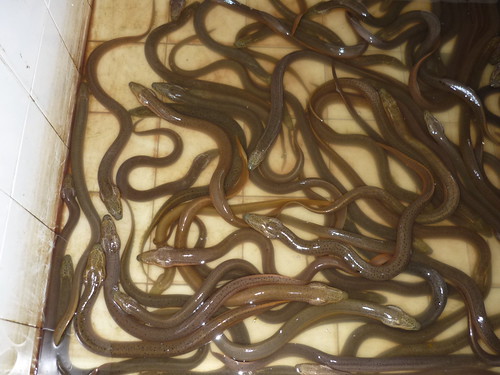
Asian swamp eels at Khai Seng Trading & Fish Farm, Kranji;
The spiny eels (F. Mastacembelidae) are another family of eel-like fish with representatives in South-east Asia. Native to Africa and Asia, many species can be found in the aquarium trade. Spiny eels get their name from the row of short spines on the back, in front of their dorsal fins. However, the most obvious distinguishing feature is the long fleshy appendage on the tip of the snout, which gives the spiny eel a comical appearance.


2 large species of spiny eel commonly seen in the aquarium trade.
Left: Tyre-track eel (Mastacembelus armatus);
Right: Fire eel (Mastacembelus erythrotaenia);
(Photos by cyprinoid)
Among the loaches (F. Cobitidae) of Eurasia, some species are elongated and can also bear some superficial resemblance to eels. The well-developed fins and the short barbels around the mouth should help to distinguish loaches from eels.


Left: Giant kuhli loach (Pangio myersi);
(Photo by cyprinoid)
Right: Eel loach (Pangio anguillaris);
(Photo by nttrbx)
A large fish that is commonly confused with the true eels is the electric eel (Electrophorus electricus) of South America. However, it is not an eel, and instead is a highly specialised South American knifefish.
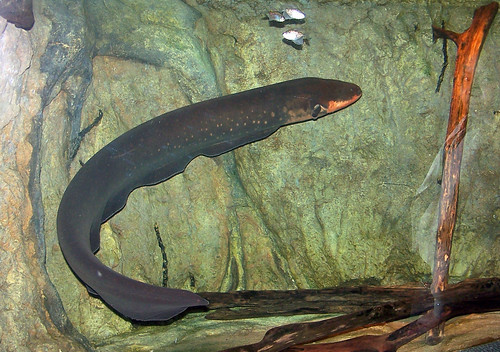
Electric eel at Adventure Aquarium, New Jersey;
(Photo by Floater Ya-Ya)
The South American knifefishes or Gymnotiformes are freshwater species of tropical South and Central America. They generally have elongated bodies, and in fact, are are able to give off a weak electric current to help them navigate in murky waters, as well as to communicate with one another. The electric eel has gone a step further and uses electrical discharges to stun prey and defend itself. Despite their often eel-like appearance, these fish propel themselves by undulations of the long anal fin, and so do not swim like eels. The electric eel belongs to the gymnotids, or naked-back knifefishes (F. Gymnotidae), while another familiar species in aquaria, the black ghost knifefish (Apteronotus albifrons), is a member of the ghost knifefish family (F. Apteronotidae). The remaining South American knifefish families are the bluntnose knifefishes (F. Hypopomidae), sand knifefishes (F. Rhamphichthyidae), and glass knifefishes (F. Sternopygidae).


An assortment of South American knifefish.
Top left: Black ghost knifefish;
(Photo by Neil Hepworth)
Top right: Electric eel;
(Photo by brian.gratwicke)
Centre left: Banded knifefish (Gymnotus carapo);
Centre right: Bluntnose knifefish (Brachyhypopomus occidentalis);
(Photo by Miguel Landines)
Bottom left: Trumpet knifefish (Rhamphichthys rostratus);
(Photo by Ricky Mensch)
Bottom right: Glass knifefish (Eigenmannia virescens);
(Photo by Mauricio Camargo)
The featherbacks or knifefishes (F. Notopteridae) of Africa and tropical Asia are superficially similar to the South American knifefishes, but are unrelated, and lack the ability to generate electricity.


2 species of knifefish found in the aquarium trade.
Left: Clown knifefish (Chitala ornata);
(Photo by Lai Sektong)
Right: African knifefish (Xenomystus nigri);
In a bizarre example of convergent evolution, another large eel-like fish has evolved the ability to generate electricity. This is the aba (Gymnarchus niloticus), also known as the Nile knifefish. The sole member of its family (F. Gymnarchidae), the aba, a fish that is found in many African river systems, is unrelated to the South American knifefishes, but also uses a weak electrical current to navigate. Interestingly enough, in this species, it is the dorsal fin that is the main source for propulsion.

Aba;
Other African fish that can from time to time be mistaken for eels include several species of walking catfish (F. Clariidae), such as the eel catfish (Channallabes apus) and flat-head eel catfish (Gymnallabes typus). Once again, the long barbels give them away.


Left: Eel catfish;
(Photo by Benjamin Lee)
Right: Flat-head eel catfish;
(Photo by Christian Hauzar)
Two families of catfishes (F. Trichomycteridae, F. Heptapteridae) of South America have several species that are eel-like. These include species with bizarre habits, such as the infamous parasitic candiru (Vandellia cirrhosa), and the subterranean cistern catfish (Phreatobius cisternarum).


Left: Candiru;
(Photo by dylanellis30)
Right: Cistern catfish;
(Photo by Janice Muriel-Cunha)
The bichirs (F. Polypteridae) are an exclusively African family of fish that do appear eel-like in terms of appearance and habits. Predatory in nature, with long sinuous bodies, it is difficult not to draw comparisons between bichirs and freshwater eels. The elongation of the body is taken to extremes in the reedfish (Erpetoichthys calabaricus).


Left: Senegal bichir (Polypterus senegalus);
Right: Reedfish;
Befitting their prehistoric appearance, bichirs are actually among the most primitive bony fish alive today. Another family of eel-like African fish also has an ancient heritage; these are the African lungfish (F. Protopteridae). The South American lungfish (Lepidosiren paradoxa), the sole member of its family (F. Lepidosirenidae), also looks like an eel.


Left: West African lungfish (Protopterus annectens);
Right: South American lungfish;
(Photos by SRD)
Even some of the most primitive 'fish' (to use the term very loosely) are eel-like. The parasitic lampreys (F. Petromyzontidae) and scavenging hagfish (F. Myxinidae) lack jaws, and while the lamprey are included among the vertebrates, hagfish are not even considered true vertebrates; they have skulls of cartilage but lack a vertebral column.


Left: Sea lamprey (Petromyzon marinus);
Right: Atlantic hagfish (Myxine glutinosa);
(Photos by Anders Salesjö)
As if having such a great variety of eel-like fishes was not enough, there are amphibians which are also eel-like. Thankfully, there aren't any eel-like frogs; it is the caecilians and salamanders which have evolved eel-like species. The typhlonectines are a subfamily of caecilians (F. Caecilidae) which are fully aquatic, although they still breathe air. To make matters worse, they are commonly mislabeled in the pet trade as 'rubber eels'.
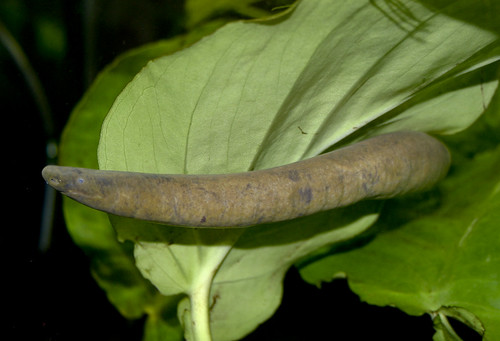
Rio Cauca caecilian (Typhlonectes natans);
(Photo by brian.gratwicke)
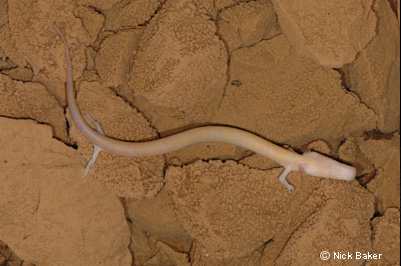
Among the salamanders, the sirens (F. Sirenidae), not to be confused with the mammals known as sea cows or sirenians, are somewhat eel-like, but have external gills and a pair of small forelimbs. The olm (Proteus anguinus) is the most eel-like member of the mudpuppy family (F. Proteidae), but can be obviously differentiated from eels by its lack of pigmentation and eyes, and the presence of bushy external gills and 4 small but well-developed legs. It is the amphiumas (F. Amphiumidae), with their elongated bodies and minuscule legs, that are most easily confused with eels. Amphiumas are sometimes known as Congo eels, although they are not eels, and don't live anywhere near the Congo Basin in Africa.


4 eel-like amphibians.
Upper left: Cayenne caecilian (Typhlonectes compressicauda);
(Photo by Danté Fenolio)
Upper right: Lesser siren (Siren intermedia);
(Photo by Pierson Hill)
Lower left: Olm;
(Photo by Nick Baker)
Lower right: Two-toed amphiuma (Amphiuma means);
(Photo by Pierson Hill)
Finally, it goes without saying that on occasion, a snake swimming in the water might be mistaken for an eel. Many snakes found in the region, such as the file snakes (F. Acrochordidae), mock vipers (F. Natricidae), water snakes (F. Homalopsidae), and sea kraits and sea snakes (F. Elapidae), are closely associated with aquatic and marine environments.
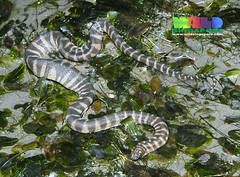


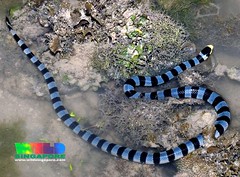

6 local species of snake which are closely associated with water.
Top left: Banded file snake (Acrochordus granulatus), Chek Jawa;
(Photo by Ria)
Top right: Painted mock viper (Psammodynastes pictus), Borneo;
(Photo by dennisikon)
Centre left: Puff-faced water snake (Homalopsis buccata), Nee Soon;
(Photo by Siyang)
Centre left: Dog-faced water snake (Cerberus rynchops), Sungei Buloh;
(Photo by Ria)
Bottom left: Yellow-lipped sea krait (Laticauda colubrina), Pulau Hantu;
(Photo by Ria)
Bottom right: Marbled sea snake (Aipysurus eydouxii), Chek Jawa;
(Photo by Ng Bee Choo)
Oh, and do you remember the 2 fish at the top of this post? Which one is the eel? Well, here's the answer...
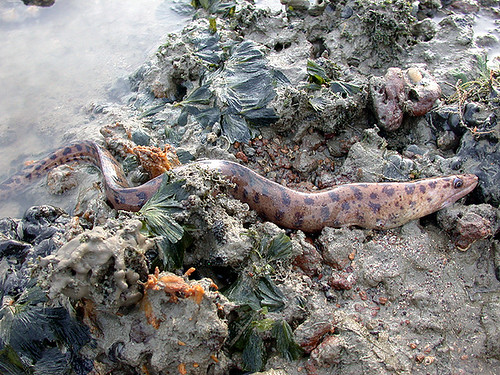
Brown-spotted moray (Gymnothorax reevesii), Beting Bronok;
(Photo by Chee Kong)
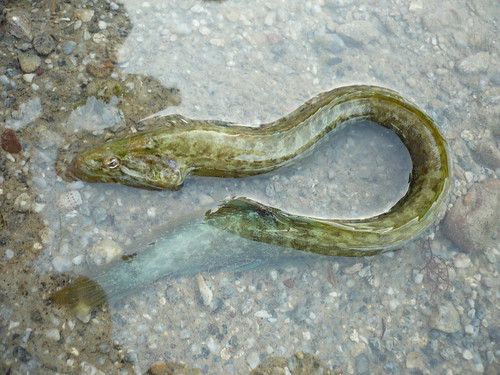
Carpet eel blenny, Sentosa;
And with that, I've come to the end of my eel series.
Part 1: Moray eels (Muraenidae)
Part 2: Snake eels (Ophichthidae)
Part 3: Conger eels (Congridae) and Pike conger eels (Muraenesocidae)
Part 4: Freshwater eels (Anguillidae)
Part 5: Spaghetti eels (Moringuidae) and false moray eels (Chlopsidae)
Part 6: Non-eels (this post)