Showing posts with label sponges. Show all posts

Sunday, May 10, 2009

Seeing Stars on a Siloso Shore on Sunday

P1200084

While others were busy checking out the shores of Pulau Hantu, I headed down to explore a shore I've become very fond of.

Every time I take a closer look at the islets off Siloso Beach, I never fail to be amazed at the vast array of interesting creatures that survive in these waters. But my motive for visiting this shore was also to see if there was any visible impact from the oil spill that recently occurred in the area.

Monday, January 12, 2009

Siloso: Suckers and Stars

P1170801

One thing I love about visiting this shore is that I simply don't quite know what to expect. Since this beach is so heavily impacted by surrounding human activities, it's easy to dismiss the waters here as being relatively lifeless compared to other more pristine shores. But it increasingly appears that the murky waters have plenty of secrets to reveal.

This time around, I made extra preparations. After my previous visit, I'd listed a couple of things that I would need:
The next time I visit this shore, I'm definitely going to need the following:

i) Containers. I'm not a fan of taking photos of marine animals in plastic containers, since I greatly prefer showing them in their natural environment. But given the murky water, and the fact that it's too easy for various creatures to swim away into deeper water and vanish, the use of containers will be a great aid.

ii) Nets. A few small aquarium nets, which would help me spend more time studying fish closely, instead of just seeing them shoot off into the depths before I can even react to their presence. Used in conjunction with a few small plastic containers, I don't have to worry so much about all the sediment in the water when I'm trying to take photos.

I have to admit, catching animals, even if it's just to take a few photographs, seems like a cop-out. It's a bit like trapping a lion or bird simply because you're not able to creep close enough to get a good photograph. And I really dislike subjecting the animals to such stress. But the fact that I'd brought plastic containers and two handheld nets really made it so much easier for me to take a closer look at the marine life living in these waters.

P1170676 P1170868
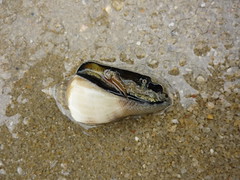
While the black-lipped conch (Canarium urceus) is found in some numbers, especially close to the bridge, I managed to find only a single pearl conch (Laevistrombus canarium).

P1170718
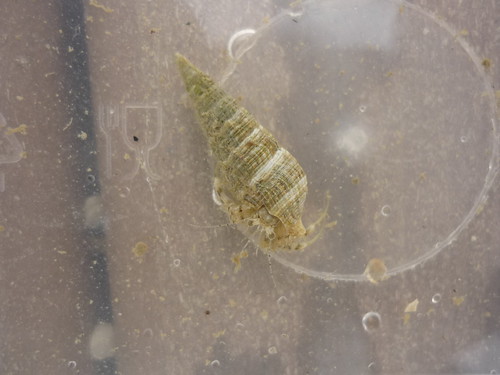
I didn't really bother looking at the creeper snails (F. Cerithiidae and Potamididae), because I wanted to spend more time looking for other less common creatures. Another reason was because every creeper snail I picked up turned out to contain a tidal hermit crab (Diogenes sp.) instead. But based on cursory observation, it would seem that the most common species would be the zoned horn snail (Batillaria zonalis), with smaller numbers of banded creeper snails (?Cerithium sp.) and plain creeper snails (?Cerithium sp.).

P1170748
Here's a tidal hermit crab that's substantially larger than the others, large enough to occupy the shell of a pearl conch.

P1170709
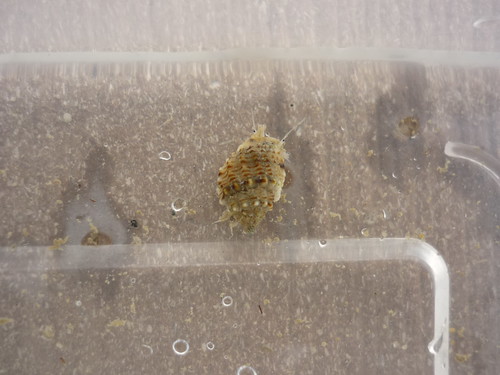
Besides creeper snails, other very common snails on this shore include the whelks. The tiny prickly whelk (Nassarius crenoliratus) is found in large numbers, often half-buried in the sand at the water's edge.

P1170730 P1170767
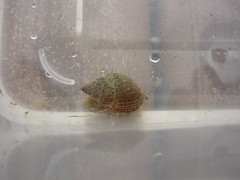
The common whelk (Nassarius livescens) is also well-represented on this shore.

P1180020
I've found a large spiral melongena (Pugilina cochlidium) on this shore before, but today, I found only two rather small specimens, crawling on the submerged parts of the bridge.

P1170754 P1170773
Although I did not see any live nerites today, I did find a couple of empty nerite shells. The one on the left is the waved nerite (Nerita undata). The one on the right though, is very interesting. The lined nerite (Nerita articulata) is most often found in mangroves and monsoon drains, so the presence of such a fresh-looking shell here on Sentosa is intriguing.

P1170743 P1170910
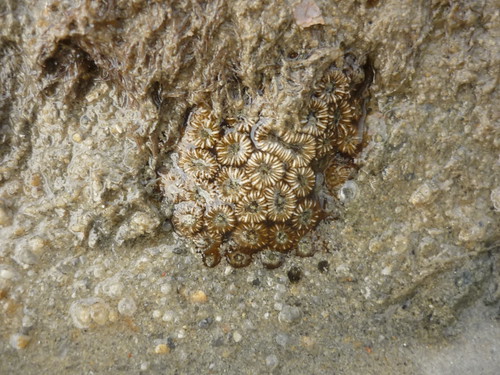
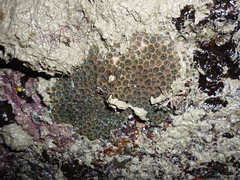
It's nice to see that the small handful of hard corals growing amongst the rocks are still surviving.

P1170865 P1170966
I managed to find two different kinds of zoanthids growing on the rocks, the button zoanthid (Zoanthus sp.) and the broad zoanthid (Palythoa mutuki).

P1170788 P1170785
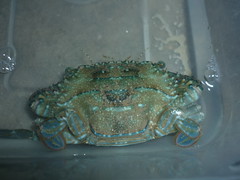
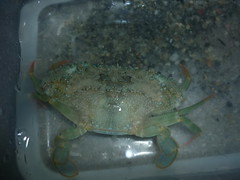
There are numerous tiny swimming crabs (F. Portunidae), and it can be very challenging to spot and capture them. These are possibly very young flower crabs (Portunus pelagicus).

P1180010 P1170967
However, there are much larger swimming crabs out there. I did not manage to find any larger flower crabs, but I did find quite a few blue swimming crabs (Thalamita sp.) and blue-spined swimming crabs (Thalamita prymna).

P1170789
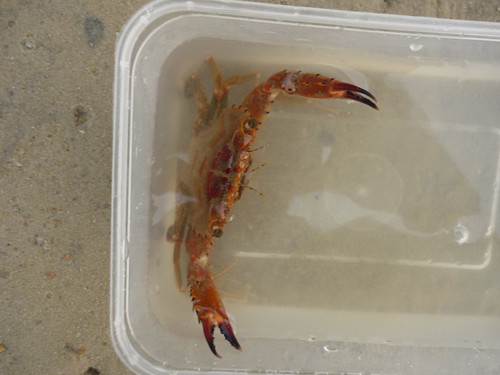
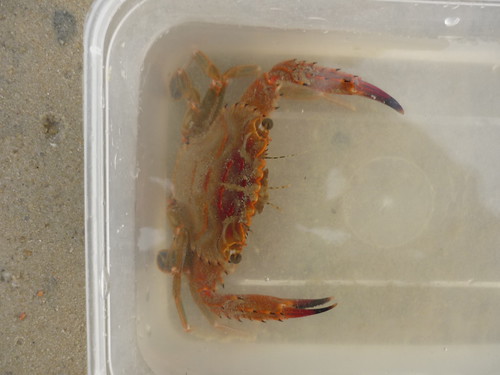
But the most surprising crab find of the day was this red swimming crab (Thalamita spinimana)!

P1170793
This is the first time I've ever seen this species on Sentosa. This extremely aggressive crab is more often found on reefs in the Southern Islands. Luckily I had the nets with me.

There are numerous shoals of fish, among them Kops' glass perchlet (Ambassis kopsii) and young crescent perch (Terapon jarbua).

P1170778 P1180026
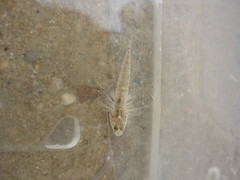
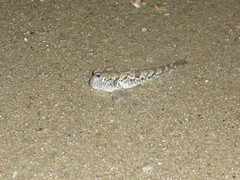
Gobies are also very common here; not only are there small groups of various species resting on the sandy seabed, there are quite a few small mudskippers among the rocks. I think the goby I caught today was a young ornate lagoon goby (Istigobius ornatus), while the mudskipper in my photographs is a gold-spotted mudskipper (Periophthalmus chrysospilos).

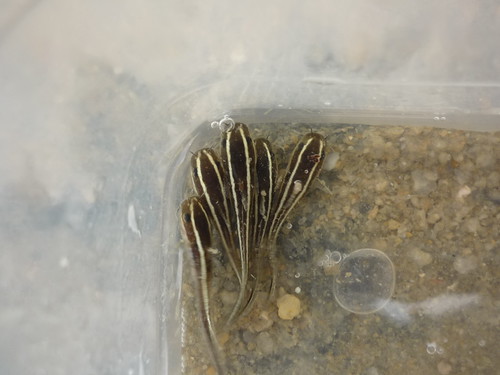
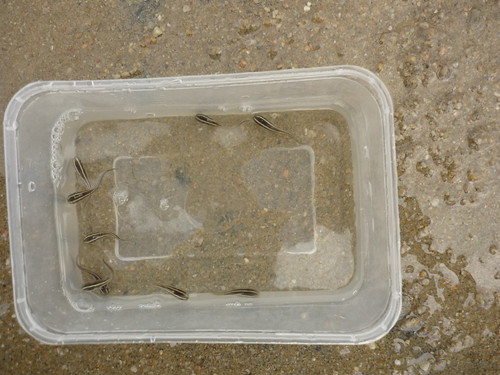
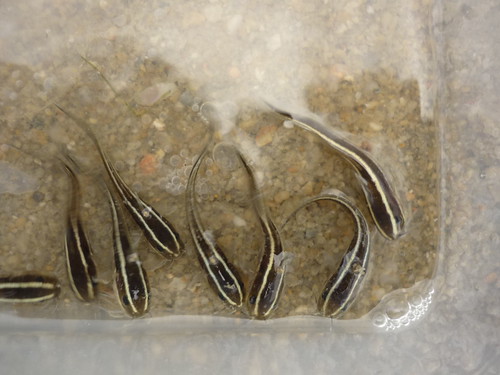
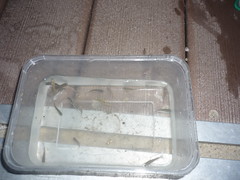
A dark wriggling mass in the deeper water catches my eye. To my great surprise, it's a large shoal of baby striped eeltail catfish (Plotosus lineatus)!

They're very skittish, and the water is too murky to take a decent photo of the entire school. I try to slowly herd them towards the shallows, but they simply scatter and merge back into a shoal behind me.

P1170822
So I sneak up on them, net in hand. More out of sheer luck and the vast numbers of catfish in the shoal, rather than any real skill, I actually manage to net quite a few catfish.

P1170810
They're so tiny.

P1170815
I've seen even larger shoals over at Tanjung Rimau, but this is the first time I've ever seen these catfish in these lagoons.

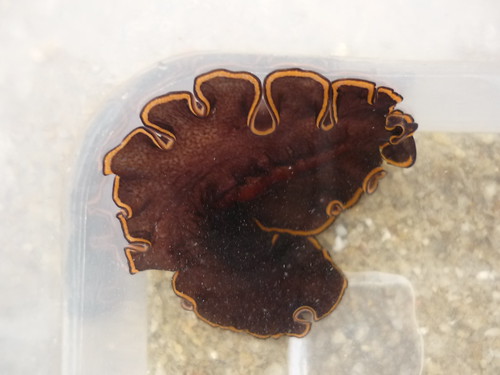
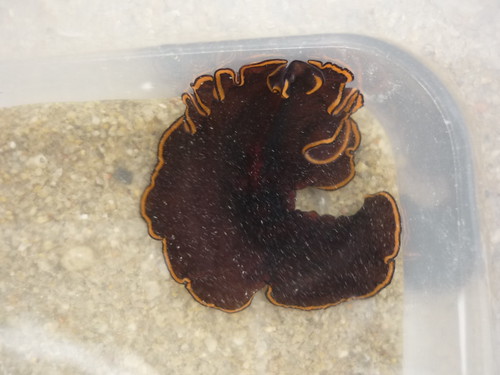
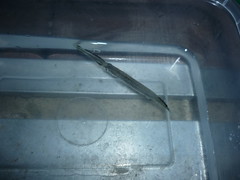
After releasing the catfish, which promptly vanish into the murky depths, presumably to rejoin the shoal further out in the lagoon, I soon come upon another exciting find: a polyclad flatworm (Pseudobiceros sp.), swimming away.


I took a couple of videos. The background music you can hear in the first clip is coming from the nearby Café del Mar.


Is this the same flatworm I'd seen swimming on one of my previous trips?

P1170833
When not swimming, these flatworms crawl about on the seabed in search of food.

P1170826
EDIT: Initially, I thought that this flatworm might be the orange-edged black flatworm (Pseudobiceros uniarborensis), but there are some subtle differences in this particular worm that lead me to believe that it might belong to another species instead. In fact, it appears to be a species that Ria herself has never seen before!

But this find is quickly overshadowed by another even more unexpected encounter.

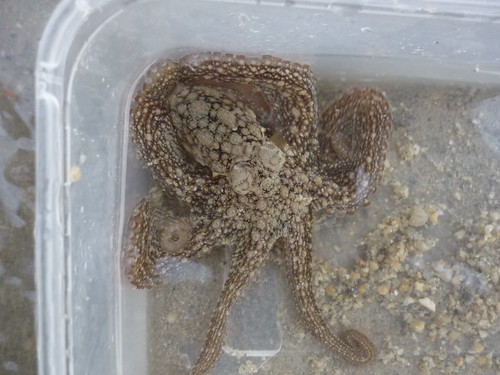
I was just walking along the shore, peering into the water, on the lookout for any signs of movement. A piece of seabed stirred, changed colour for a moment, then all but vanished against the sand. It took me a second for my mind to process what I was seeing.

P1170848
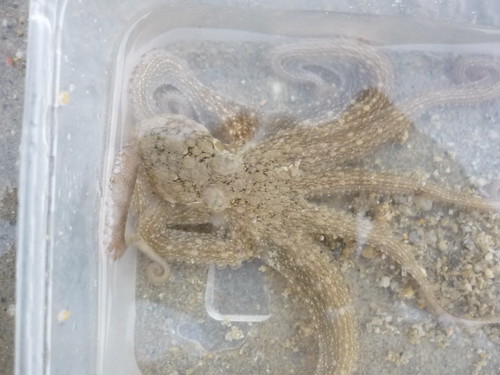
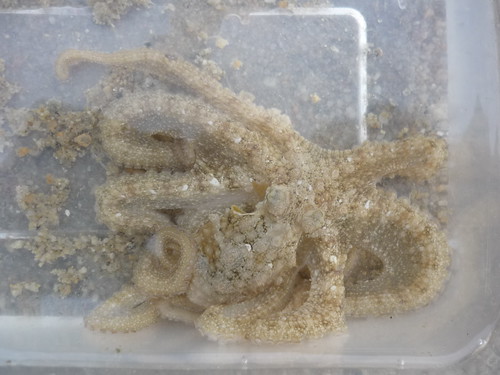
It was an octopus!

Capturing it wasn't easy; the first time I caught it in the net, it released a squirt of ink, and then wriggled its soft body over the edge and fell back into the water. It then held onto a rock and refused to let go. But I finally managed to get it into the net, and got it to remain inside the container for a few minutes while I took as many photos as I could.

P1170852
P1170858


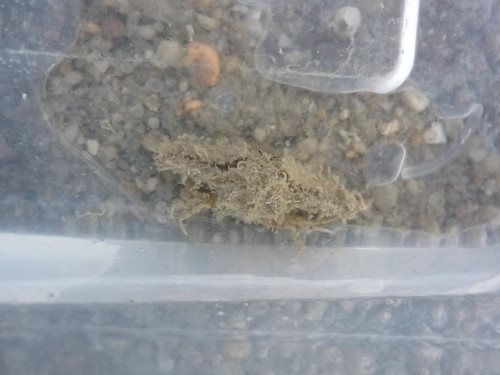
Octopus are supreme masters of camouflage; you can see how this octopus effortlessly changes its colour in an attempt to match the sand. It's likely to be the two-spot reef octopus, which is the species we frequently find at Tanjung Rimau.


Octopus are expert escape artists, as you can see in this video.

P1170880
I was staring at the sargassum (Sargassum sp.) growing on the bridge when a piece of seaweed moved; it turned out to be an extremely well-camouflaged arrow-head spider crab (Menatheius sp.)

P1170895
On the other side of the bridge, amongst the spoon seagrass (Halophila ovalis), I find a small elbow crab (F. Parthenopidae).

P1170975 P1170976
There was a small shoal of fish swimming above the patch of spoon seagrass. Thanks to the tide, taking a closer look at them was simple; all I had to do was place my net in such a way that all of them were swept into it by the waves.

P1170983
Here's a closer look. I realised that it was a mixed shoal consisting largely of baby mullet (F. Mugilidae), as well as a few Kops' glass perchlet (Ambassis kopsii).

P1170989 P1170997
Other fish species in these shallows include tropical silverside (Atherinomorus duodecimalis) and broad-nose halfbeak (F. Hermirhamphidae).

P1170915
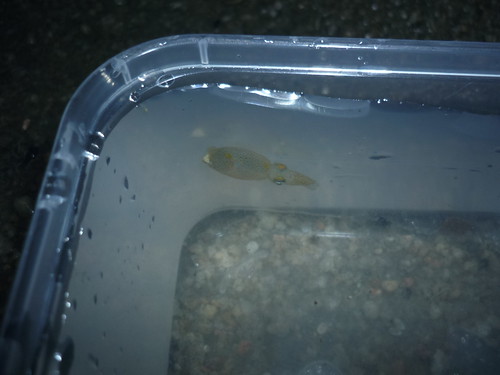
It soon turned out that the octopus was not the only cephalopod inhabiting this lagoon; close to the rocks on one end of the islet, I came upon a pygmy squid (Idiosepius sp.).

P1170920
As well as a small group of much larger pencil squid (F. Loliginidae). After a few frustrating attempts, I finally managed to get one of them to enter my net. I think these might be bigfin reef squid (Sepioteuthis lessoniana).

The colours of both types of squid look a little washed-out in the photographs, but I think it's partly because of the stress of being caught. In real life, they were both constantly changing colours, thanks to the chromatophores in their skin.

P1180008
This is a large cirolanid isopod. Like the sea slaters (Ligia sp.) found in rocky shores and mangroves, these critters are scavengers. Burrowing in the sand, they lie in wait at the water's edge, emerging to feast on carrion. This one was much larger than the ones that bit me on a previous trip.

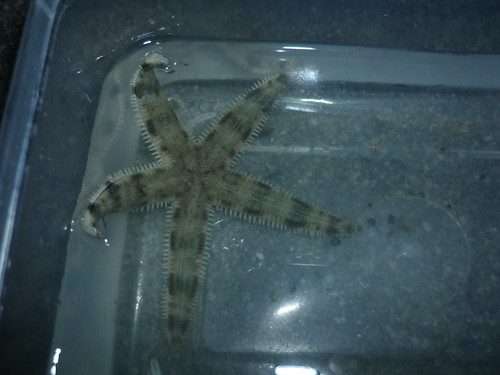
The true highlight of the night came as I was about to head back, contemplating another night without finding the common sea stars (Archaster typicus) that first drew me to this islet 2 years ago. Although I had found a solitary specimen in October, the sea stars were not seen on my most recent visit. So I was a little concerned about their continued presence on this lagoon.

But as I was walking back towards the bridge, something caught my eye. It was the arm of a sea star, poking up from beneath the sand at the water's edge.

P1170945
Finally, I'd found my common sea star!

P1170948 P1170947
Almost immediately, I spotted a second sea star nearby. Alas, this one was completely unresponsive; it did not try to right itself when flipped over, and the tube feet were not moving at all. I think it was only very recently deceased. The body of a sea star rapidly disintegrate once the animal dies, so those dried sea stars you find as tacky souvenirs and ornaments are actually made by collecting and killing live sea stars.

P1170951 P1170957
After some very careful and meticulous inspection of the sand, I manage to dig up two more live sea stars.

It's great to see that there's still a small population of common sea stars surviving here after all!

There was so much to see on this trip, and all on a stretch of reclaimed beach only a couple of hundred metres in length. It's a really great example of how marine life can survive in areas of coastal development; it might not be optimal habitat, but as the past few trips have clearly illustrated, it is far from the sterile, lifeless environment that many of us assume it to be.

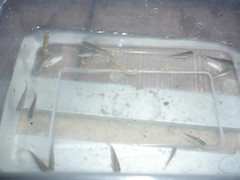
Striking an odd figure with my aquarium nets and headlamp, crouched over the water, I did attract the attention of quite a few other beachgoers, from little children to couples out to enjoy a romantic evening. Whenever I could, I did share a little about the various creatures I'd found on this shore; at one point, the container full of tiny fish definitely helped to drive home the point that despite all the ongoing development, Siloso Beach is definitely inhabited by a wide variety of marine creatures.

I have to admit that even though the nets and containers were a great help in ensuring that I managed to get decent photographs of the many creatures I spotted, I still prefer to have photographs of the animals taken in situ. And although I did try to release all of the animals as quickly as possible, I do feel a little bad for stressing them out a little, especially with the more high-strung and sensitive organisms such as fish and cephalopods. The octopus and squid were definitely not too pleased about their plight.

Even so, given the extremely murky water and the fine sediment, it would appear that there are few alternatives, short of getting a more powerful camera with underwater capabilities, or actually bringing a small fish tank with me to hold the animals temporarily.

I've also just received a very interesting comment on a post about my previous visit. A reader who goes by the nickname of ahkhee said:
I went to Siloso Beach to free dive a couple of weeks ago during low tide.

I spotted a batfish, some butterflyfish, anemone, pufferfish, purple and orangy sea slugs.

What's interesting is that you can still find some lobster and crab cages at the bottom of the sea bed.

However, it disgusts me to swim in water filled with rubbish. Yet, many fish try to thrive in it.

I am planning on a free diving trip soon. And this time, I am bringing an Underwater camera along.

Perhaps, this time, you can bring ur masks and snorkels and join me in this excavation and discovery.

It's very exciting to hear that! I'm certainly very interested in seeing if ahkhee actually makes the trip, and is subsequently able to tell us what he manages to find. If there are any divers out there willing to join him in exploring such a challenging environment, ahkhee left his email address in his comment. I can't dive, and I have no experience in snorkelling, but I eagerly await future updates if ahkhee goes ahead with his idea.

Siloso Beach has been overlooked by most of us, but as far as I'm concerned, this is one shore that I'll be visiting a lot more often in future.

This is part 2 of a 2-part series on a trip to Siloso Beach on 12th January, 2009.

Part 1: Return to Siloso
Part 2: Siloso: Suckers and Stars (this post)

Friday, October 17, 2008

Siloso suntan

P1070015

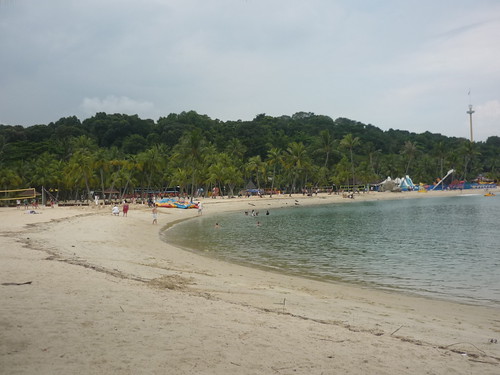
Today, I returned to Siloso Beach, intent on getting properly tanned after the most recent session was ruined due to rain.

It's quite a soothing experience, chilling out by the beach and napping in the afternoon sun, and admiring beautiful girls walking past. But of course, it gets a little dull after a while, so I also spent some time exploring and looking out for marine life.

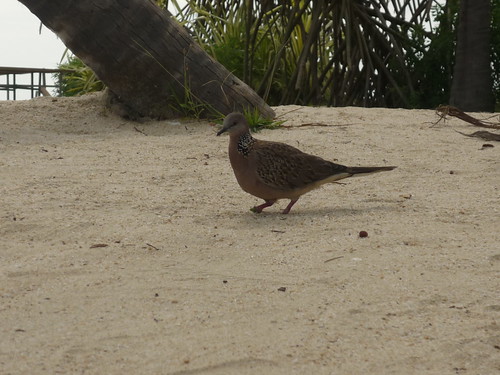
The beach is patrolled by numerous birds, among them common mynahs (Acridotheres tristis), Javan mynahs (Acridotheres javanicus) and spotted doves (Streptopelia chinensis), looking for tasty tidbits on the sand.
P1070023
I noticed something odd about this particular spotted dove. Then I realised that it had no feet! The bird was shuffling around on stumps, but appeared to be in good shape. It didn't have any problems flying. I wonder what sort of unfortunate incident led to it losing its feet.

The sargassum (Sargassum sp.) that choked the beach on the previous visit had largely cleared up, although there were still clumps floating here and there. While I was swimming in the shallows, I came upon a juvenile halfbeak (F. Hemirhamphidae). Naturally, I didn't take any photographs, since I didn't have my camera at hand.
P1070036 P1070050
I found this pretty nerite shell on the beach. I have no idea which species it is; the common nerite species are highly variable, and I still have problems telling the various species apart.
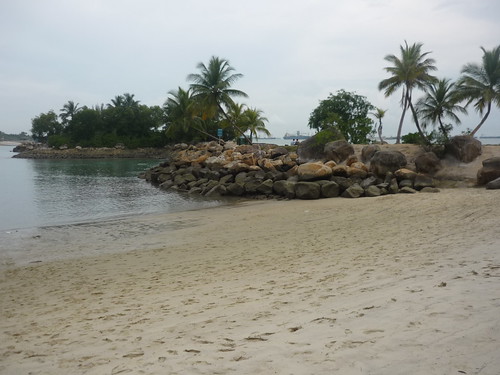
P1070179
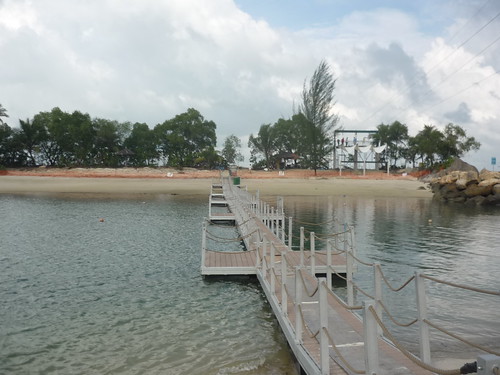
At the end of Siloso Beach, close to where the Naked Hermit Crabs conduct their shore walks, there are these large rocks which form part of a breakwater. These rocks form a hiding place for plenty of marine creatures.
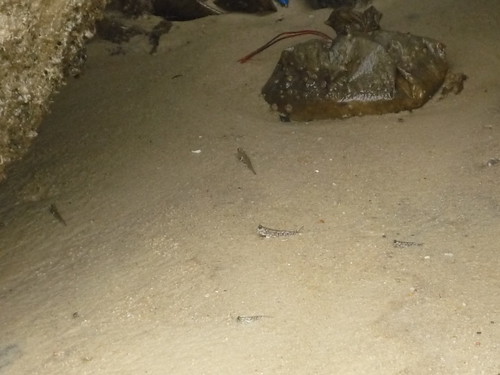
P1070053
Such as small mudskippers. These are probably dusky-gilled mudskippers (Periophthalmus novemradiatus).
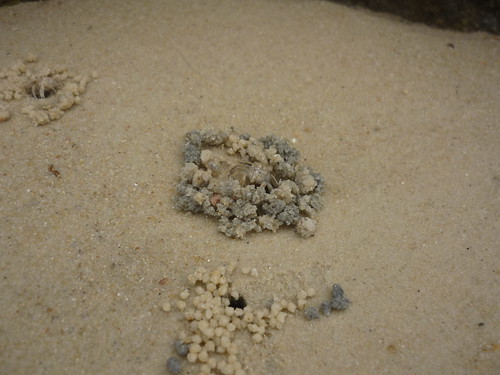
P1070161
The beach here is also inhabited by sand bubbler crabs (Scopimera sp.).
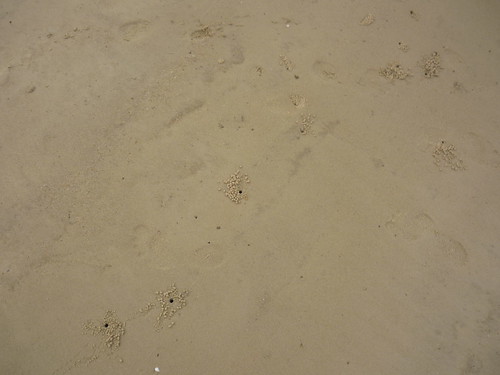
P1070165
They're not present in huge numbers, unlike on the islets across the lagoon, but there's still a pretty sizeaable colony.
P1070076
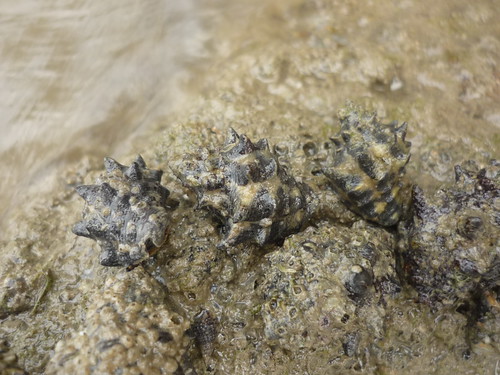
There are plenty of drills on the rocks. This should be Thais bitubercularis, which is distinguished from its relatives by the presence of spines on its shell. Unfortunately, this species is highly variable, and there are individuals which lack the tubercles on their shells. In such a situation, according to A Guide to Common Seashells of Singapore, the species can 'be distinguished by the shape of the penes'. Well thanks a lot, that was certainly very helpful for identification in the field.
P1070081 P1070077
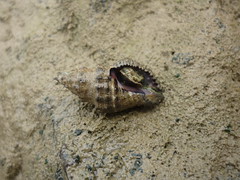
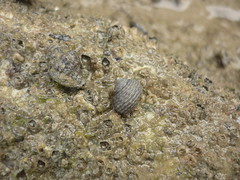
Tidal hermit crabs (Diogenes sp.) can be found here. The one on the left is wearing the shell of a lightning dove snail (Pictocolumbella ocellata), while the two in the other photo are wearing the shells of a drill (F. Muricidae), and an uncommon member of the top shell family called Euchelus atratus.
P1070086
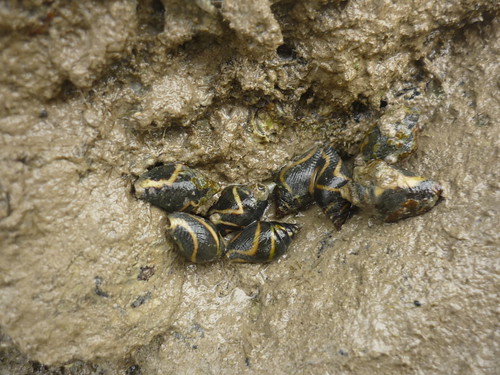
Here's a small group of live lightning dove snails.
P1070088 P1070091
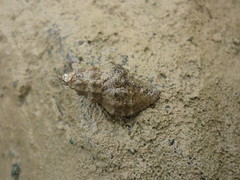
This snail is a perfect match for the photos of Drupella concatenata in A Guide to Common Seashells of Singapore. The book states that it's a specialised predator of coral polyps, and that it's often found on Acropora or staghorn coral. Is this a sign that we've got corals growing amongst these rocks? Or maybe there's coral on the outside of the breakwater...
P1070096
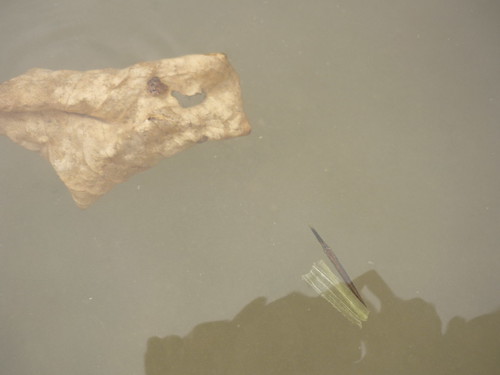
A juvenile halfbeak, the same species as the one I saw while swimming. It's easy to see why they're sometimes mistaken for floating rubbish.
P1070105 P1070107
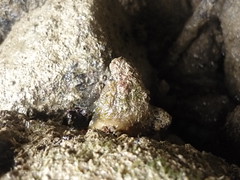
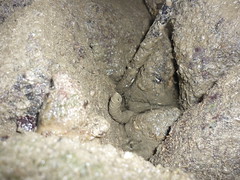
Some sort of sea aquirt on the left, and the tube of some sort of worm on the right. Switching on the flash and taking photos inside these dark crevices reveals a lot of hidden life.
P1070118
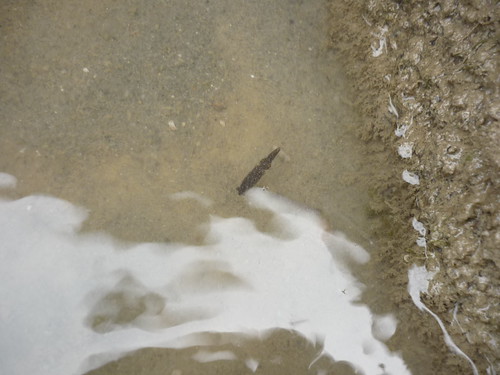
A tiny squid, just like the one I saw on the previous visit, swims into view, but proves too alert and too skittish to pose for decent photos.
P1070113 P1070119
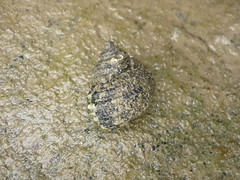
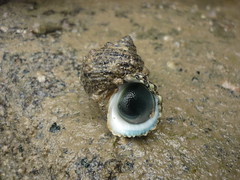
I realise that the turban snails that I've been finding in these murky swimming lagoons are Turbo intercostalis. This species is also present on the rocky shore and coral rubble at Tanjung Rimau, along with its close relative Turbo bruneus.
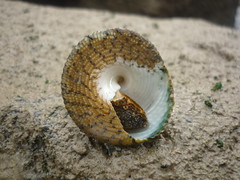
P1070139 P1070141
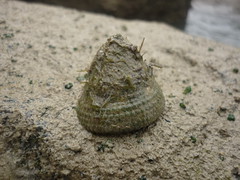
I nearly miss this spotted top shell (Trochus maculatus), with its well-camouflaged shell, but I think my skills at finding these snails have been honed by practice on Tanjung Rimau.
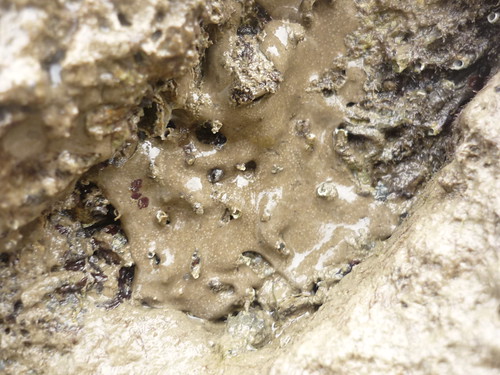
P1070125
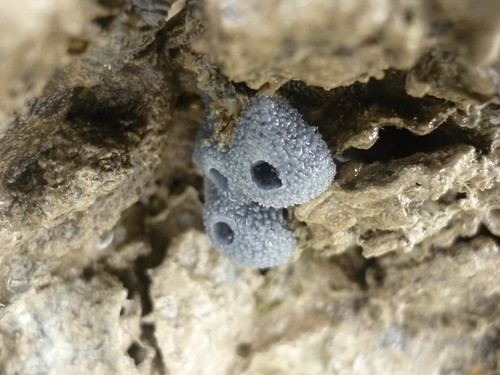
Is this a sponge or a sea squirt?

P1070150
I think this one's a sponge. I need to brush up on my sessile organisms.
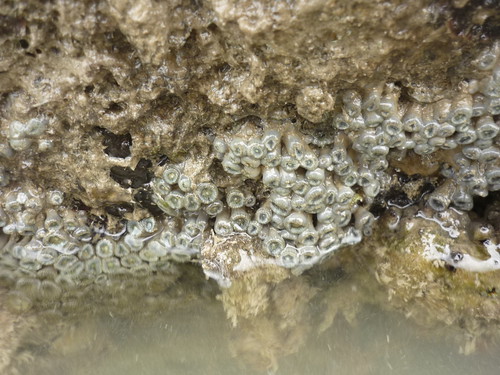
P1070123
Oh look, a small colony of zoanthids.
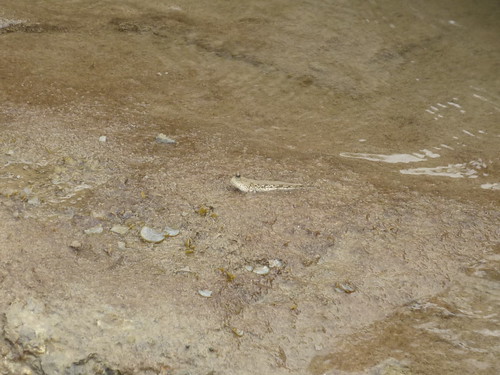
P1070127
I find a mudskipper that's larger than the small ones I saw earlier on. I think it's a gold-spotted mudskipper (Periophthalmus chrysospilos).
P1070177
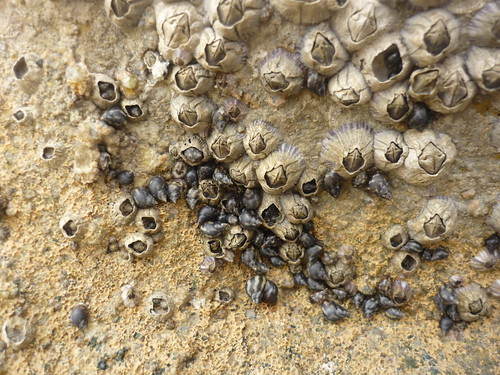
High up on the rocks, clustered amongst the acorn barnacles (Balanus sp.), are countless tiny periwinkles (F. Littorinidae).
I had to go wash up and prepare for my first monitoring session with TeamSeagrass. But I knew that if the tide was still low enough after that, I would be back to check out more of Siloso Beach after dark.

Coming up: I explore one of the islets off Siloso Beach at night. What will I discover?

This is part 2 of a 2-part series on a trip to Siloso Beach on 17th October, 2008.

Part 1: Siloso suntan (this post)
Part 2: Siloso: seagrass and sea stars