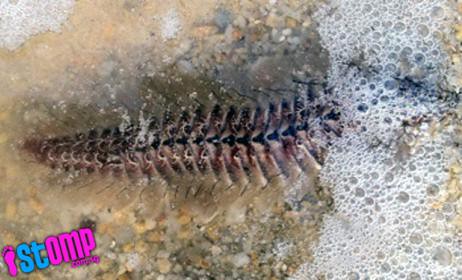
Showing posts with label worms. Show all posts
Showing posts with label worms. Show all posts
Tuesday, September 24, 2013
Tuesday, October 16, 2012
Mega Marine Survey Day 2: Pulau Ubin
I've just returned from my first field session with the Northern Expedition of the Comprehensive Marine Biodiversity Survey; Ria has a post on the preparations that took place before the field trips commenced today.
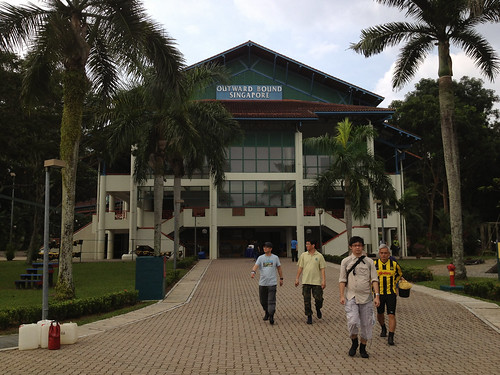
Our base of operations is at Outward Bound Singapore (OBS), on the western side of Pulau Ubin.
Our base of operations is at Outward Bound Singapore (OBS), on the western side of Pulau Ubin.

Saturday, August 18, 2012
Saturday Seringat-Kias
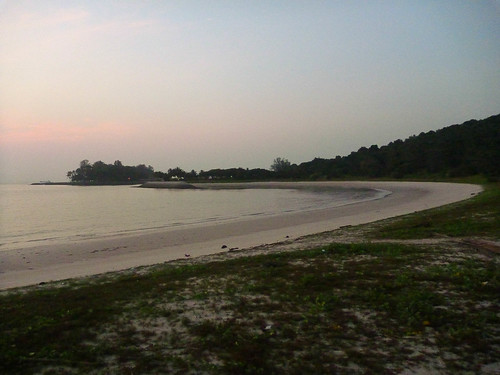
A small group headed out to visit Lazarus Island on one of the last early morning low tides of the year. While the rest headed towards the rocky shores of Lazarus Island, Kok Sheng and I decided to explore a lagoon located in the north of Seringat-Kias; James and I had previously checked out this area in April 2010. On that occasion, we visited that lagoon during the day, and it was raining, so we might have missed out on a lot of the marine life that lived in that lagoon. Hopefully, we would find a more interesting variety of critters this morning.
Saturday, June 9, 2012
World Oceans Day @ Tanah Merah

Yesterday was World Oceans Day, and in recognition of this day in which we are supposed to "celebrate and honour the body of water which links us all, for what it provides humans and what it represents", the International Coastal Cleanup Singapore (ICCS) team conducted cleanups of 2 stretches of coastline. I had signed up for Tanah Merah Site 7, the same place I had volunteered for earlier in April as part of a series of year-round coastal cleanup efforts. I have visited this shore infrequently every year, and it really is gratifying to see how the efforts of small groups of individuals have truly helped make a difference in reducing the amount of trash accumulating here.
Saturday, April 28, 2012
Earth Day Coastal Cleanup @ Tanah Merah
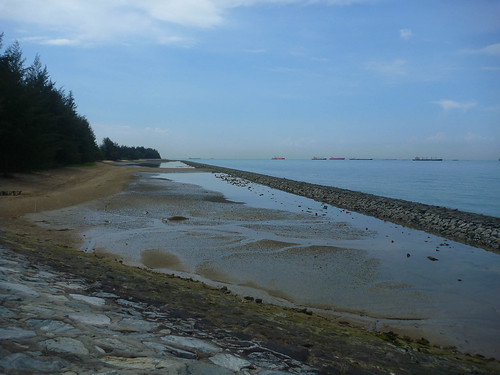
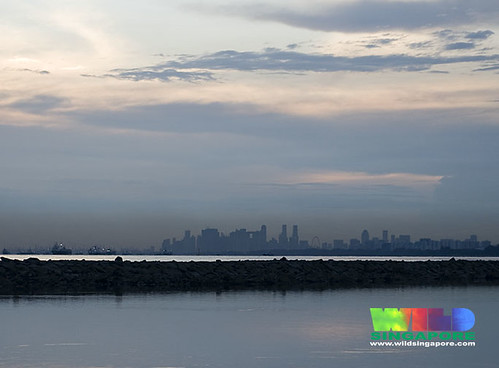
For those of us who visit and explore the shores of Singapore to document the marine life that can be found on our coasts, Tanah Merah stands out as a unique and special place. Although the original shore here is long gone due to land reclamation, a rich community of marine organisms has managed to colonise and reestablish itself. We find habitats as diverse as rocky shores, seagrass beds, sandy beaches, coastal forests, and even a coral reef on the outer edge of the seawall.
(Photo by Ria)
Unfortunately, this shore, despite its beauty and diversity, suffers from pollution. Much of the marine life is slowly recovering from the devastation of the oil spill that struck 2 years ago, although some crude oil still lingers in the environment. Another insidious threat comes from the vast quantities of garbage that wash up and get trapped behind the seawall. Because this area is not under the purview of the armies of cleaners that work tirelessly every morning to remove litter and other trash from our public beaches, the rubbish simply accumulates, forming massive piles of plastic, broken glass, and other debris.

Litter on Tanah Merah shore, July 2011;
(Photo by Ria)
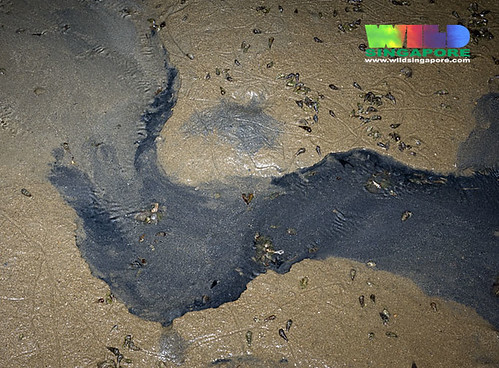
Dig deep enough, and you'll find out where much of the oil has gone, April 2012;
(Photo by Ria)
In response, the International Coastal Cleanup Singapore (ICCS) team has decided to conduct a series of year-round cleanups on this shore.

And so, keen to do my part on a shore that I am personally very fond of, I signed up for the latest session, which was held on the morning of 28th April.
Monday, March 26, 2012
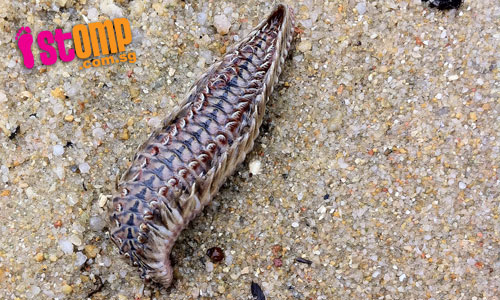
Monday, December 26, 2011
Ribbons: Terrestrial Nemerteans of Singapore
People with a fascination for marine life would probably have heard of nemerteans, commonly known as ribbon worms.
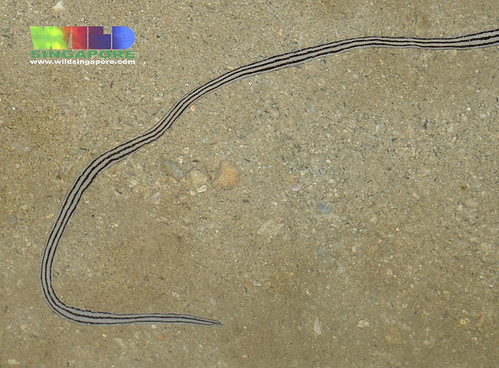
Black and white ribbon worm (Baseodiscus delineatus), Terumbu Pempang Darat;
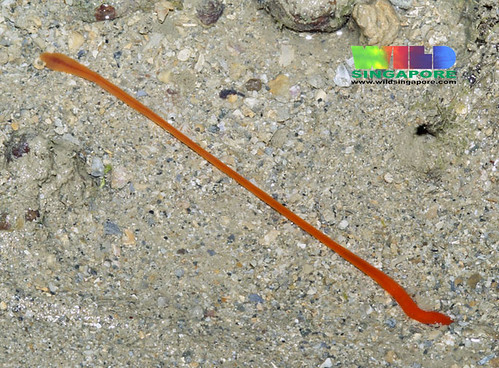
Red ribbon worm, Kusu Island;
(Photos by Ria)
Most ribbon worms live in marine environments, with a small proportion adapted to freshwater habitats. Just earlier today, I learnt that a small handful of nemertean species have actually managed to colonise the land, and that they can be found in Singapore!
Black and white ribbon worm (Baseodiscus delineatus), Terumbu Pempang Darat;
Red ribbon worm, Kusu Island;
(Photos by Ria)
Most ribbon worms live in marine environments, with a small proportion adapted to freshwater habitats. Just earlier today, I learnt that a small handful of nemertean species have actually managed to colonise the land, and that they can be found in Singapore!
Thursday, October 21, 2010
Raffles Museum Treasures: Giant reef worm
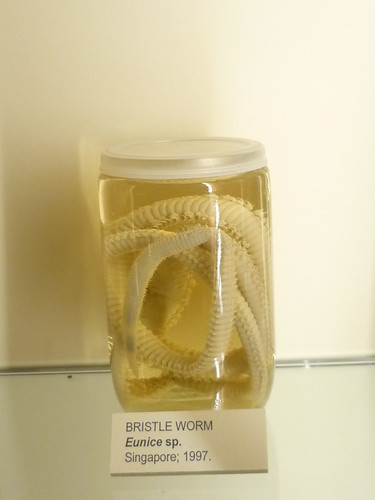
Giant reef worm (Eunice sp.)
Collected from Singapore, 1997
Native to Singapore
Wild Fact Sheets
A Guide to Singapore Polychaetes
The annotated budak: Eunice aphroditois
Life on Australian Seashores
SeaLifeBase
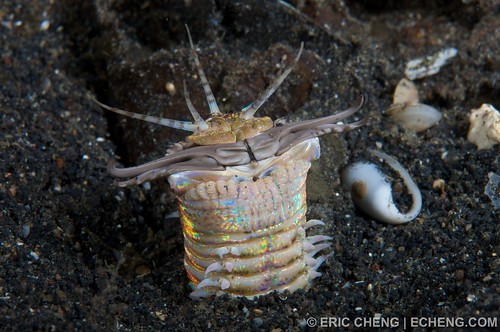
Eunice aphroditois
(Photo by echeng)
Monday, September 13, 2010
Monday Morgue: 13th September 2010
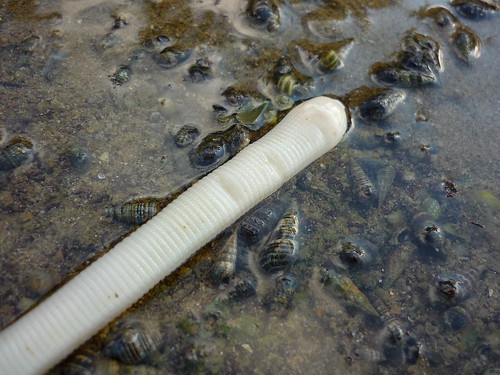
Peanut worm (Sipuncula)
Tanah Merah, 29th May 2010
This was one of many dead and dying peanut worms that I encountered on a shore at Tanah Merah, shortly after an oil spill had occurred off Changi East.
Wild Fact Sheets
A Guide to Seashore Life
UCMP Web Lift to Taxa
Monday, July 12, 2010
Monday Morgue: 12th July 2010
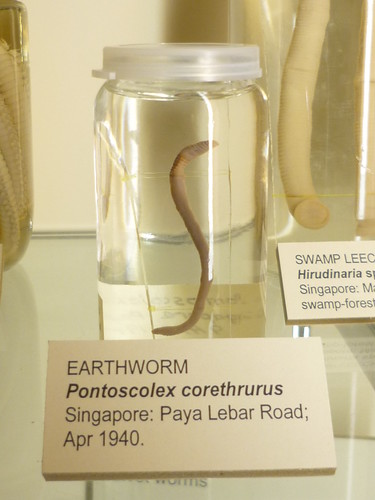
Earthworm (Pontoscolex corethrurus)
Raffles Museum of Biodiversity Research, 17th May 2010
Terrestrial earthworms (Oligochaeta) from Singapore
Occurrence of the Exotic Earthworm Pontoscolex corethrurus (Müller) (Glosscolecidae: Oligochaeta) in Taiwan
Alien earthworms in the Asia/Pacific region with a checklist of species
and the first records of Eukerria saltensis (Oligochaeta : Ocnerodrilidae)
and Eiseniella tetraedra (Lumbricidae) from Japan, and Pontoscolex
corethrurus (Glossoscolecidae) from Okinawa
Invasion of Amazonian landscapes by the earthworm Pontoscolex corethrurus (Glossoscolecidae)
Tuesday, June 22, 2010
Raffles Museum Treasures: Marine flatworm
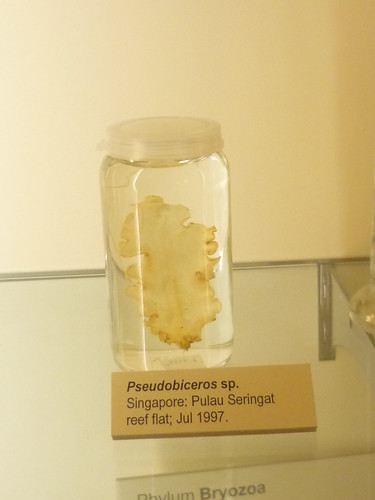
Marine flatworm (Pseudobiceros sp.)
Collected from Pulau Seringat reef flat, July 1997
Native to Singapore
Wild Fact Sheets: Starry flatworm
Wild Fact Sheets: White-orange black flatworm
Wild Fact Sheets: Brown-striped flatworm
Wild Fact Sheets: Damawan flatworm
Wild Fact Sheets: Persian carpet flatworm
Marine Flatworms of the World!
Nine new species of Pseudobiceros (Platyhelminthes: Polycladida) from the Indo-Pacific
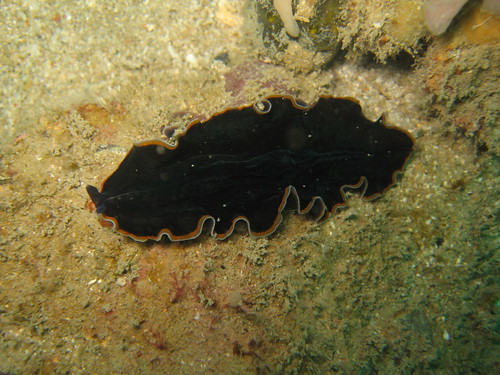
Pseudobiceros uniarborensis
(Photo by Debby)
Saturday, May 29, 2010
A heartbreaking sight on Tanah Merah
Death is not the greatest loss in life. The greatest loss is what dies inside us while we live.
- Norman Cousins
We've created something that will affect your children's children. Can YOU say the same about YOUR life?
- "BP Public Relations" (BPGlobalPR) (NOTE: SPOOF ACCOUNT)
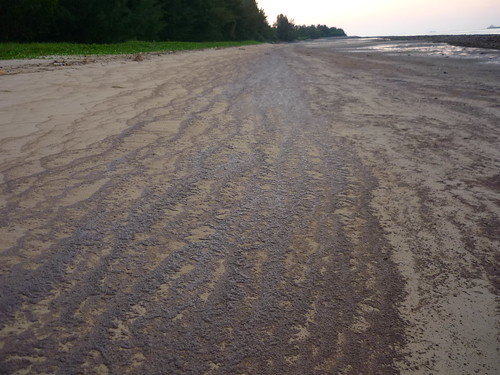
Saturday morning, and I went down to a special stretch of seashore at Tanah Merah to see how the oil spill has affected the marine life. Ria and Chay Hoon had documented the impacts on one end of the shore, so I decided to explore the other end. This is one of the areas where the oil first hit the coast, so it is particularly important to see how the various marine animals are coping with the large amounts of crude oil that have suddenly washed up here.
Before I even set foot on the sand, I could notice 2 things. The first was the overwhelming smell of petroleum. The second was the long stretch of black deposits on the sand, which I correctly guessed was the result of oil being washed up onto the beach.
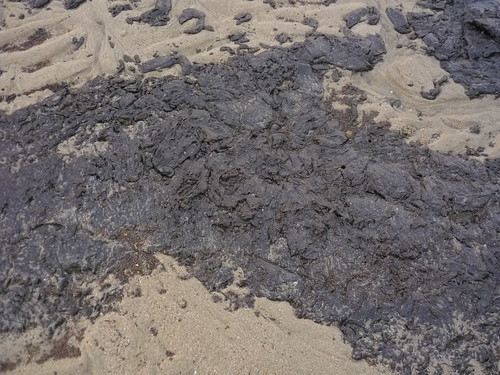
The sand on the high shore is coated with a layer of oil.
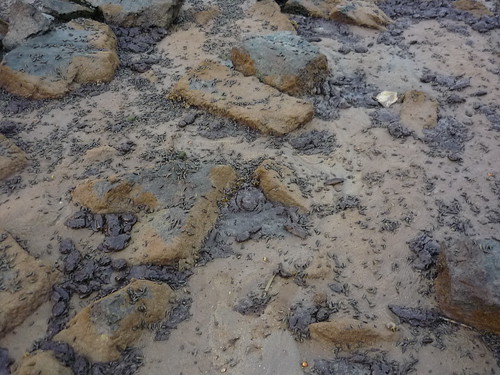

Further down, closer to the seawall, I can see that the swarms of zoned horn snails (Batillaria zonalis) are still present. They all seem to have hunkered down and are not moving at all.
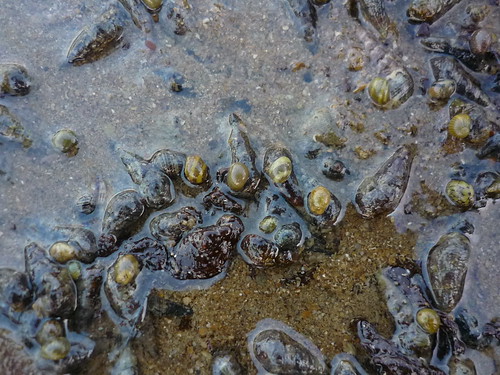
The tiny dubious nerites (Clithon oualaniensis ) are still abundant, but like the zoned horn snails, they're not doing much for now except sit around.
The larger nerites (Nerita spp.) that are normally so common on the rocks seem to have completely vanished.
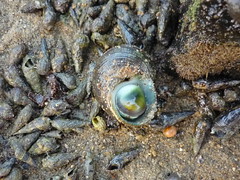
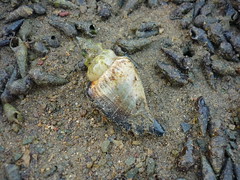
Other snails, such as this dwarf turban snail (Turbo bruneus) and black-lipped conch (Canarium urceus), also appear to be trying to wait out the worst of the spill.
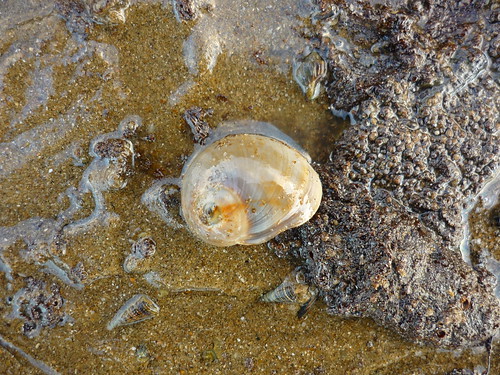
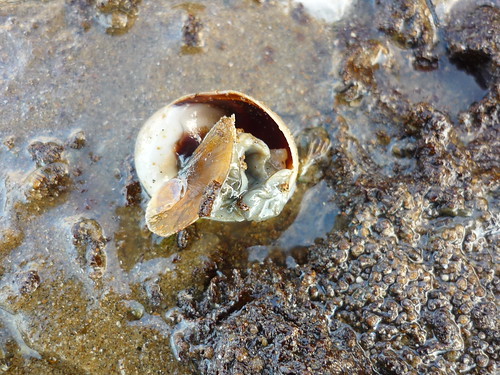
This ball moon snail (Polinices didyma) however was quite dead.
Unlike the snails, the worms (to use the term in general) are in really bad shape.
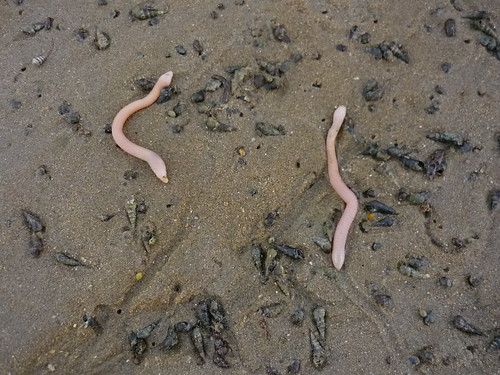
I don't normally encounter peanut worms (Sipuncula) alive on the shore, and definitely not in broad daylight. Normally, these worms live buried in the substrate. However, today, the shore is full of peanut worms.

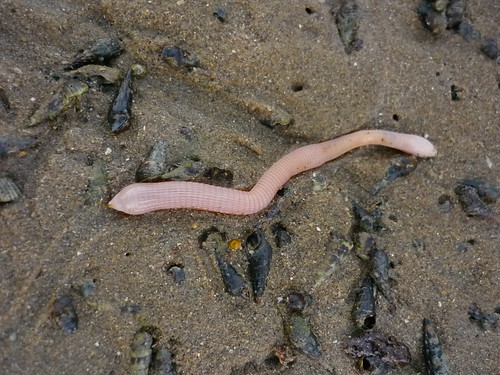

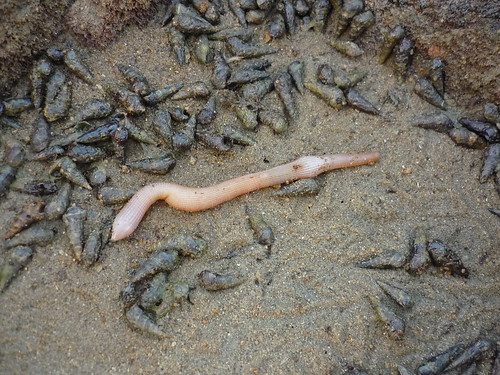

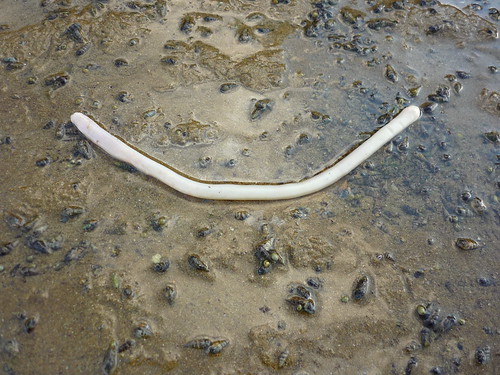
Some of them have turned a pale white, and are still weakly crawling about helplessly. Others are clearly very dead.

You may make fun of me for feeling pity for a worm, but it was quite heartbreaking to see such a huge worm barely clinging on to life, making half-hearted attempts to crawl around in a futile effort to escape the pollution that had suddenly swamped its home.

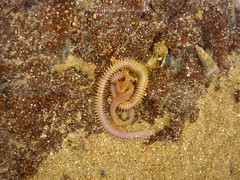
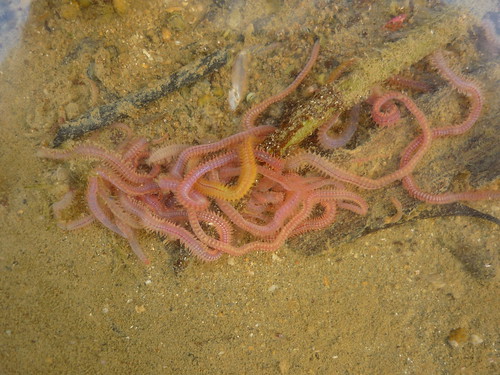
I suppose that these polychaete worms (Polychaeta) are usually buried in the sand and mud. Today, I saw large groups of them wriggling around, twisting and writhing aimlessly, as if in a last-ditch, uncoordinated effort to swim away and flee from danger.

Acorn worms (Enteropneusta) and their casts are scattered here and there, but I have no way of knowing how they're coping. I guess it's a good sign that they're not emerging from the sand and dying en masse like the peanut worms.
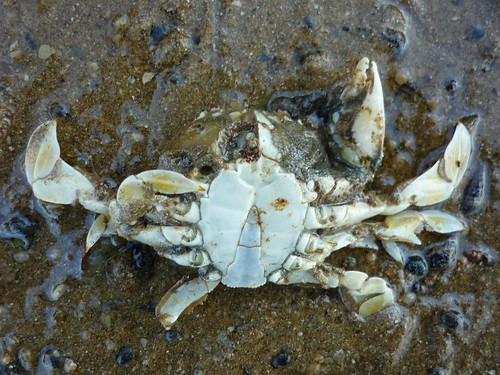
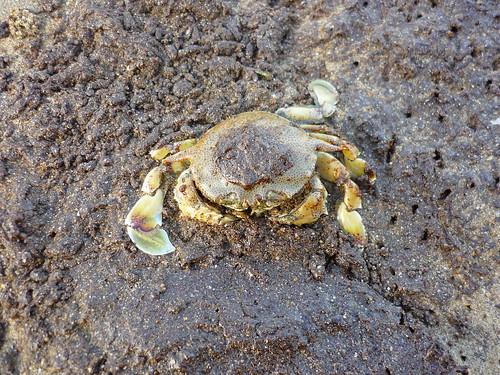

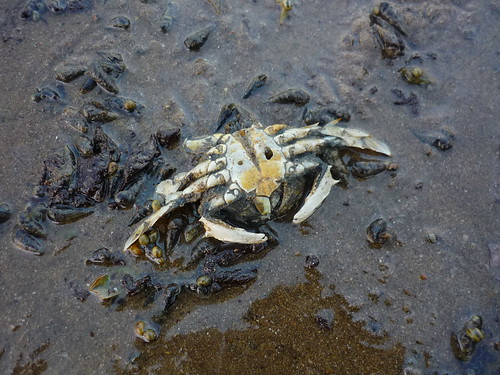
The crabs also seem to coping very poorly. Dead spotted moon crabs (Ashtoret lunaris) were scattered everywhere. I gave up counting after 15.
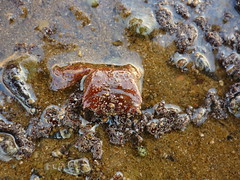
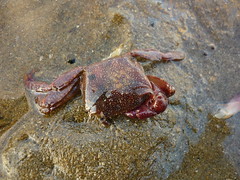
I saw a couple of dead purple climber crabs (Metopograpsus sp.).

A dead soldier crab (Dotilla sp.). I saw 2 live soldier crabs, but they seemed a little disoriented.

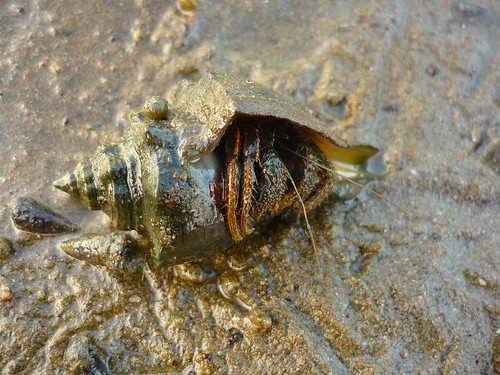
I saw a few live flower crabs (Portunus pelagicus) and orange striped hermit crabs (Clibanarius infraspinatus). They seem much more lethargic than usual.

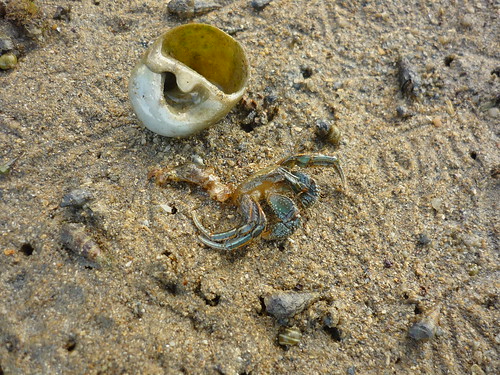
I didn't check if this flower crab and orange striped hermit crab were actual carcasses or discarded moults.
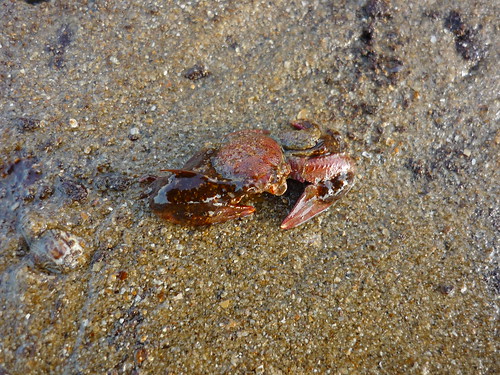
Dead big red porcelain crab (Petrolisthes sp.).
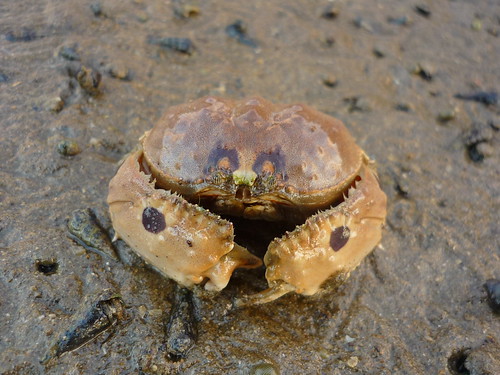
The most exciting find was this crab.
It's a spotted box crab (Calappa philargius). All past sightings of this crab have been at Changi, so it is a first for Tanah Merah. It's also my first time seeing this species. Not to mention that the others have not seen this crab in years; apparently, the last recorded sighting was in May 2006. I seem to be having quite a bit of luck in finding box crabs lately; in April, I found a reef box crab (Calappa hepatica) at Pulau Hantu, which was the first time any one of us had spotted this species on our intertidal trips.
Fortunately, the spotted box crab was still very much alive. I hope it survives the oil spill, and that we'll be able to find more box crabs in future visits.
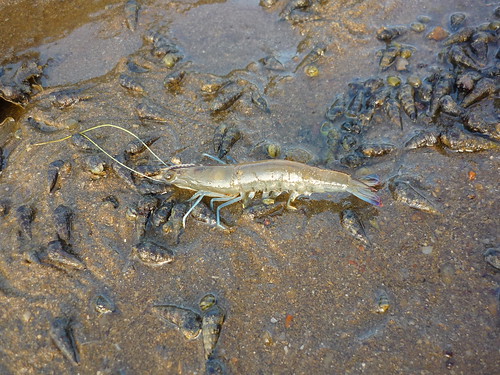
This blue-tailed prawn (Penaeus latisulcatus) was still alive, even though it was out of the water. I flicked it into the nearest pool, and it seemed a little dazed.
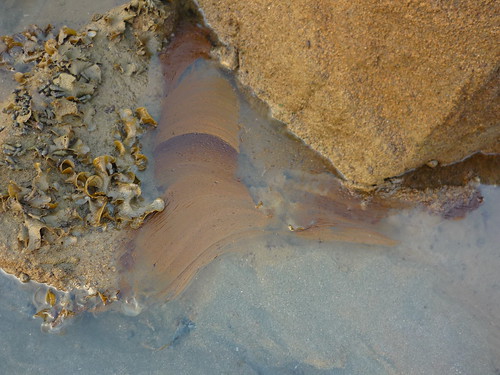
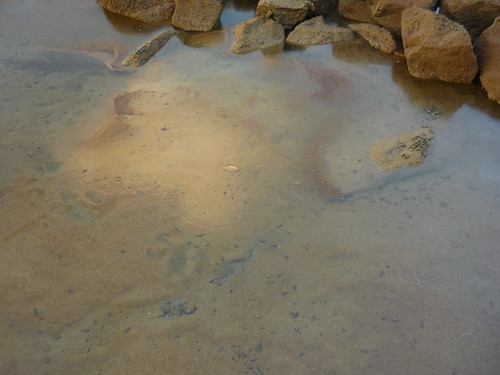
There is a thin oily film on the surface of many of the larger pools. As the tide comes in, this sheen soon covers the entire lagoon.
The fish seem to be doing alright. I saw many schools of tiny fish swimming around in the pools, even those that had a thin film of oil on the surface. Gobies like the shadow goby (Acentrogobius nebulosus) seemed quite unaffected by the oil.
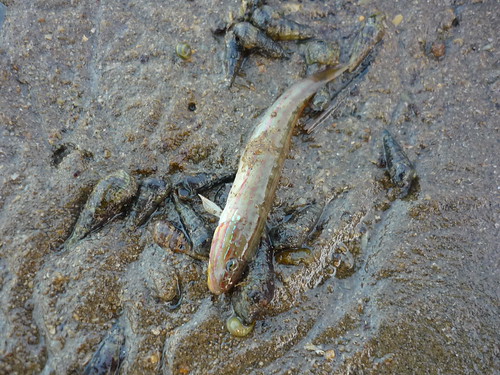
Like the blue-tailed prawn, this head-stripe goby (Amblygobius stethophthalmus) was found out of the water, but it swam off once it was flicked into a pool.
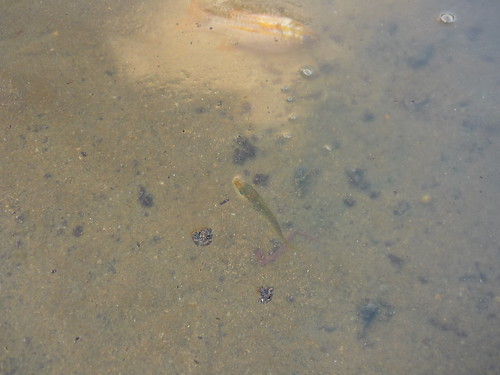
This fish however, was gasping for air at the surface, which is not a good sign at all.
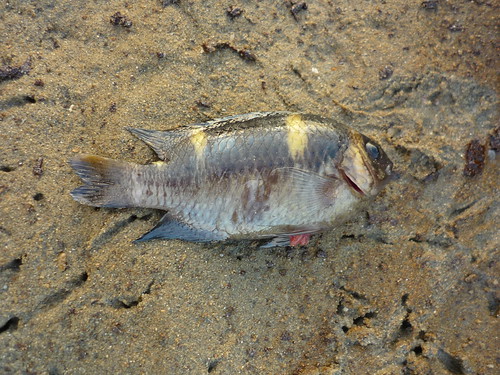

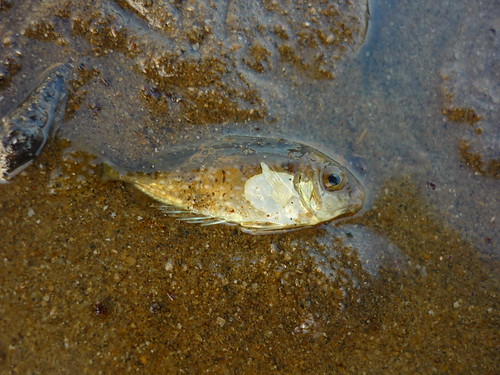
There were some casualties among the fishes, like this yellow-banded damselfish (Dischistodus fasciatus), lined cardinalfish (Cheilodipterus sp.), and juvenile rabbitfish (Siganus sp.).
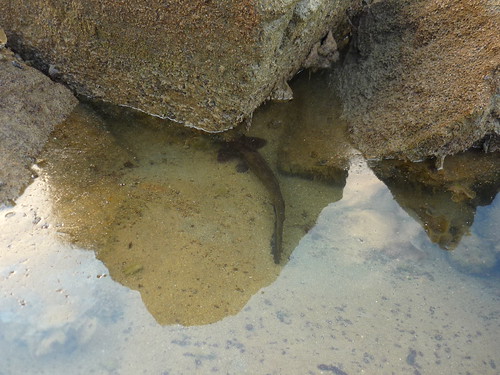
This large eel-tailed catfish (Plotosus sp.) was hanging out beneath a rock during the daytime, which is quite unusual behaviour for a catfish. I wanted to go closer to take a photo, but it wriggled deeper among the rocks.
That was when I saw something else nearby that sent a chill down my spine.

Ah yes, it's been a while since my last brush with an estuarine stonefish (Synanceia horrida). We are always extremely wary on this shore, having had a few close shaves with stonefish on many occasions.

The stonefish does not seem to be too badly affected by the oil spill. But then again, stonefish are usually so lethargic and loathe to move around that you can't tell if it's more sluggish than usual.
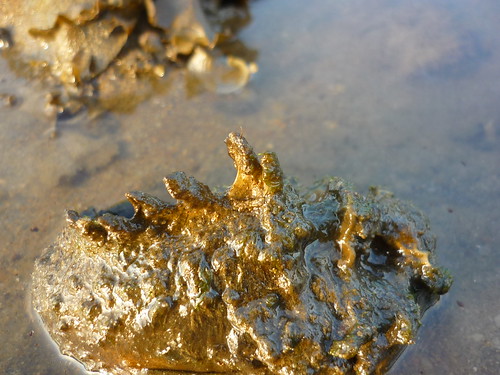
The spines on the dorsal fin are raised when the stonefish feels threatened. These spines act as hypodermic needles, injecting venom when contact is made with the threat. For an unfortunate shore explorer, this is usually on the sole of the foot.
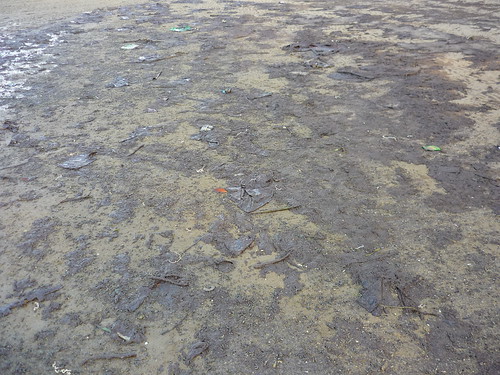
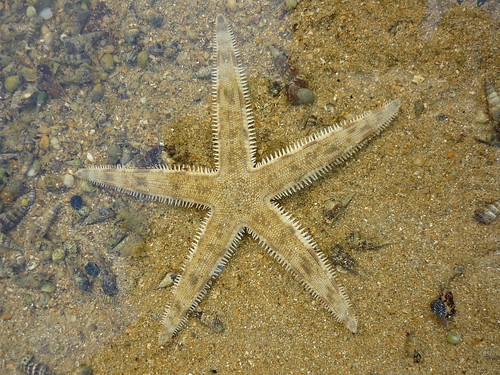
The only echinoderms I saw were a few common sea stars (Archaster typicus). They appeared to be doing fine.

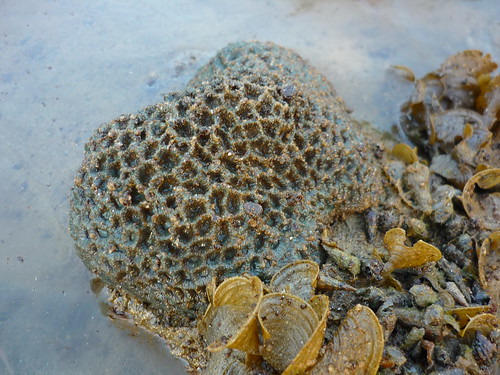
There are some hard corals scattered here and there among the rocks. Some of them show signs of having been covered in oil. I hope they survive this ordeal. In fact, I'm now wondering how the reef on the seaward side of the seawall has fared.
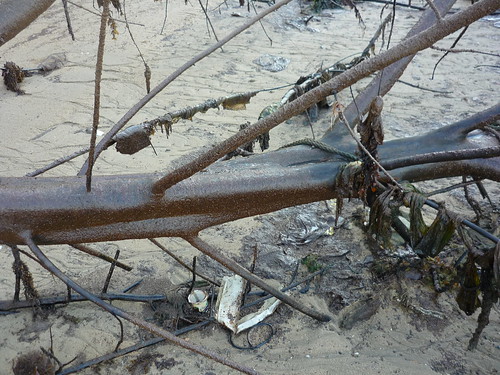
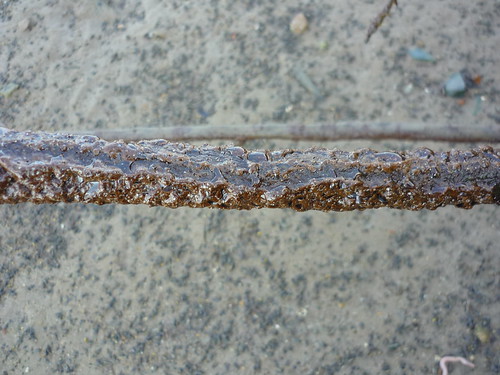
This fallen rhu tree (Casuarina equisetifolia) is covered in a glistening coat of oil.

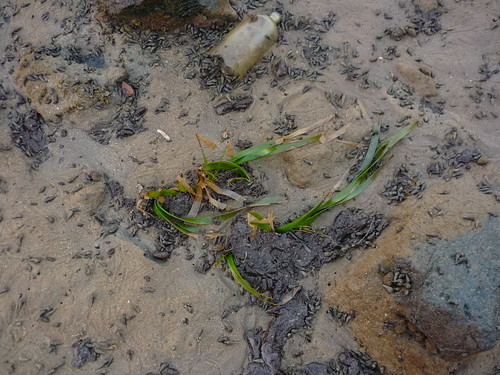
The seagrasses still seem fairly alright; the patches of smooth ribbon seagrass (Cymodocea rotundata) and clumps of tape seagrass (Enhalus acoroides) are still alive, albeit somewhat stained with oil. At least they haven't been smothered and buried.

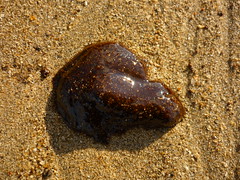
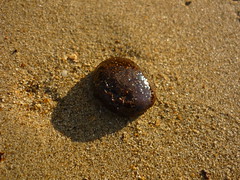
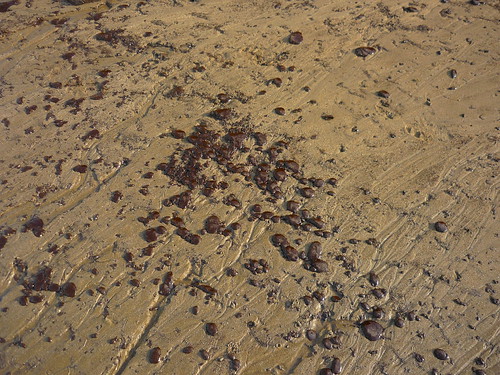
There were globules of oil scattered around on the sand.
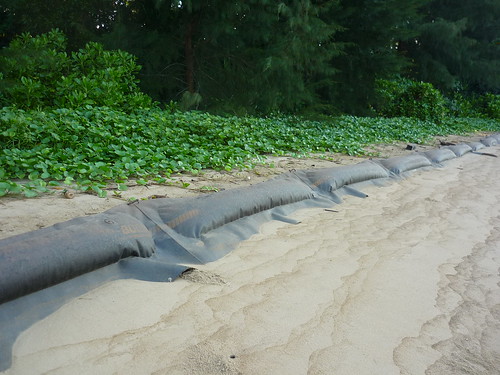
A large boom has been installed on the high shore, probably to prevent the oil from being deposited further inland.
It's difficult not to feel a sense of helplessness and outrage at what has happened here. This is a shore that stands as a living example of the resilience of our marine life, able to recover and in fact recolonise areas that have been reclaimed and altered by human activities. It is a shore that never fails to amaze and surprise us with the dazzling variety of animals that have been found living on such an unassuming shore, and every visit yields new discoveries. And yet, disaster has struck, and a little part of me died inside, seeing how the habitats have been so profoundly affected by the oil spill.
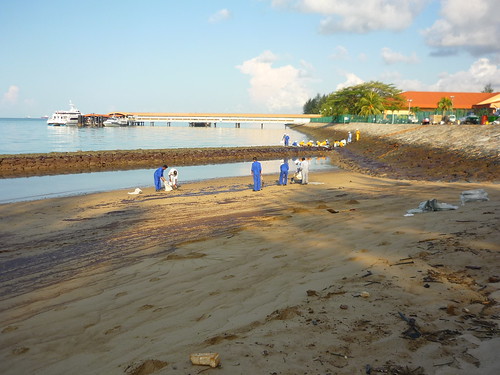
As I was leaving, I spotted several groups of people on the shore.
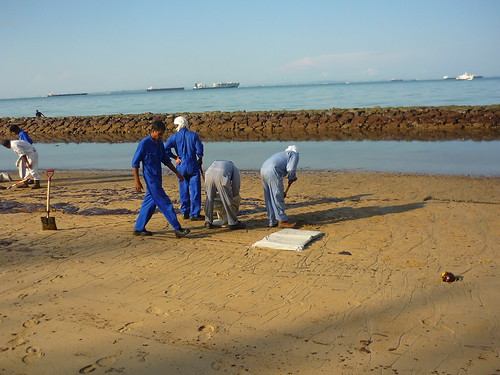

It turned out that these were workers here to clean up the oil. A group was shoveling the layer of sand that was stained with oil into bags, while another group was mopping up the oil on the rocks.
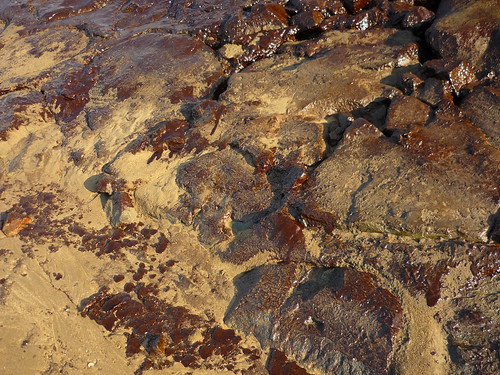
I spoke to one of the men who was overseeing the cleanup operations. Apparently, he is a marine biologist from the International Tanker Owners Pollution Federation (ITOPF), a group that 'provides objective technical advice and information on all aspects of pollution response and the effects of spills on the marine environment. Our technical services include on-site clean-up advice, pollution damage assessment, assistance in spill response planning, and the provision of training and information.' He said that he was based in London, and was here in Singapore specifically to provide guidance and advice on combating the oil spill. He commented that in comparison with oil spills that he had seen elsewhere, this is considered to be quite mild in terms of the impacts on marine life.

In a way, he has a point. Singapore's waters are polluted to some degree, and there is always some amount of oil floating around in the water, especially in areas with high marine traffic. It is not unexpected that the organisms in some areas have adapted to tolerate some amount of oil in the environment. Whether or not they are able to survive this oil spill is another matter altogether; while some groups of animals seem to be decimated, others seem capable of weathering the worst of it.
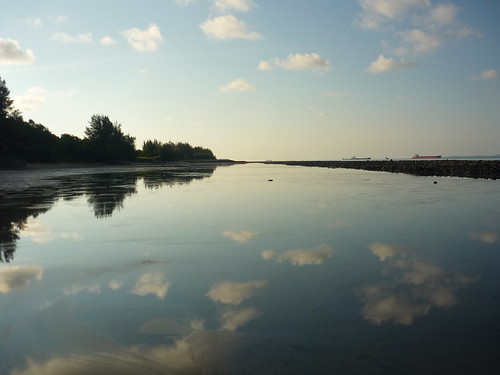
Still, it is depressing to see the heavy toll on the marine life that inhabit this shore. Even those creatures that survive might suffer from long-term effects caused by prolonged exposure to toxic substances in the oil. Or the ecosystem might be greatly altered due to the massive die-off of certain species, with shifts and upheavals in trophic relationships.

Tanah Merah will recover eventually. Given enough time, the animals will repopulate the area, and I am fairly confident that we will one day see the shores of Tanah Merah restored to their former beauty. Life always finds a way. But for now, all we can do is hope that the cleanup efforts succeed in minimising the damage, not just here, but on other shores like Changi and Chek Jawa, which have also been hit by the oil spill.
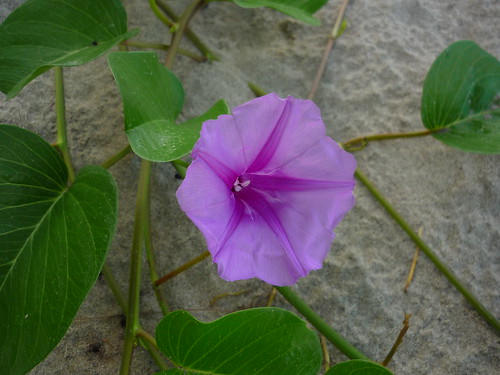
Hope springs eternal.
Subscribe to:
Posts (Atom)