Wednesday, May 21, 2008

Changi's Hidden Wonders

P1040649

Update: Take a look at what some of the others found, at the wildfilms blog, and God's wonderful creation.

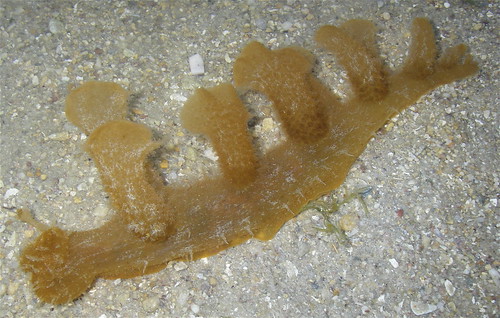
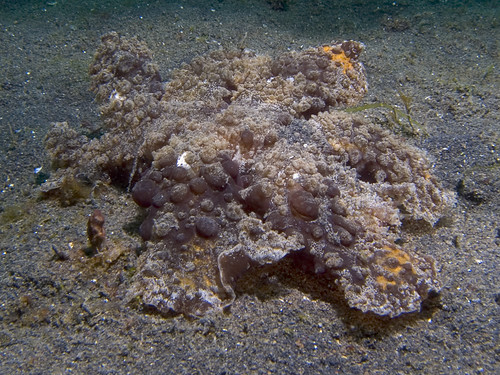
A rocky shore, strewn with pebbles, gravel, and bits of rubble and even man-made debris, might seem barren and lifeless, devoid of the rich biodiversity that can be found on other shores. The waters are murky and loaded with sediment, the rocks are coated with algae and sponges and can be slippery, and the wet sand is mixed with fine silt, so that one sinks a little while walking along the beach. But for an inquisitive and intrepid band of four, this little stretch proved to be a treasure trove of remarkable and beautiful wonders.

This is the first time I'm exploring this area, one of the last natural rocky shores left on Changi, and once again, I found plenty of amazing little creatures that manage to survive despite all the development and pollution that's occurring in Singapore.
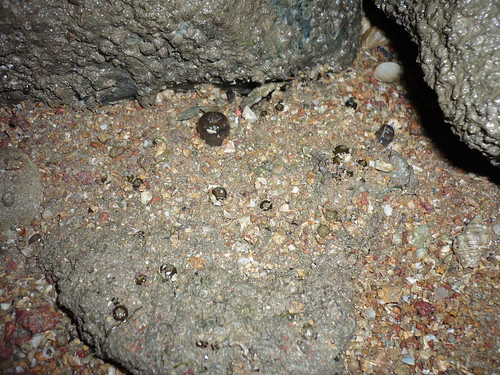
P1040652
The rocks were pockmarked with these little blobs, which are small anemones waiting for the tide to return.
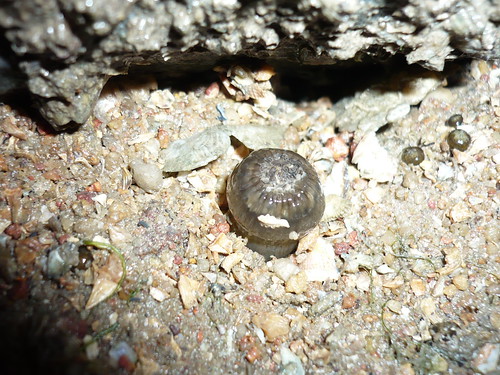
P1040655

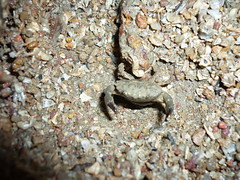
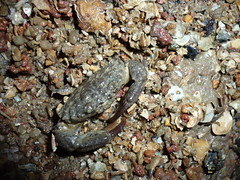
Squatting down and flipping over rocks can yield amazing and marvellous discoveries. Plenty of creatures make their homes beneath the rocks.
P1040661 P1040663
P1040667 P1040685
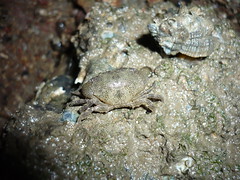
Like these tiny crabs, most of which are barely the size of my thumbnail.

Friday, May 16, 2008

Nudibranchs for the aquarium


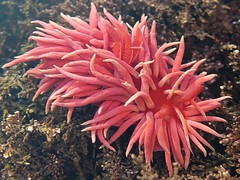
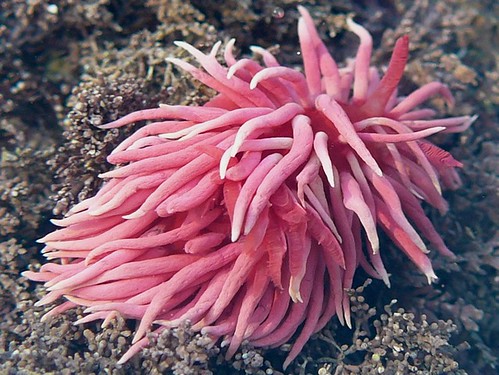
Upper left: Hermissenda crassicornis; Upper right: Okenia rosacea;
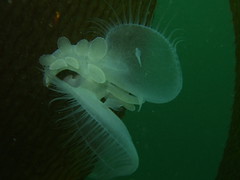
Lower left: Peltodoris nobilis; Lower right: Melibe leonina;
Four nudibranch species exhibited at the Monterey Bay Aquarium

In the previous post, I have gone to great lengths to show why most nudibranchs are simply not meant to be kept in aquariums, mostly due to their highly specialised diets. However, there is a small minority of nudibranch species that can survive in an aquarium, provided their food requirements are met.

NUDIBRANCHS IN PUBLIC AQUARIUMS

A quick search reveals that few if any public aquariums have nudibranchs on display. Perhaps the most notable exception to this rule is the world-famous Monterey Bay Aquarium. It has four species on display, three of them in its Rocky Shore exhibit:


Hermissenda crassicornis, which is an exception among nudibranchs, in that it is quite a generalist where it comes to feeding. More on that later. (Photo by * Alicia)


Okenia rosacea, which is a predator on a particular species of pink bryozoan. (Photo by jalbersmead)


Peltodoris nobilis, a specialist on sponges. This species is actually said to give off a citrus scent when disturbed, and is affectionately known as the 'sea lemon'. (Photo by Bill Bouton)

Note that these are all species that can be found in the waters of Monterey Bay. Presumably, apart from the generalist Hermissenda crassicornis, the aquarium either manages to culture the necessary prey species in captivity, or has a steady supply of prey from the wild to feed their captive nudibranchs.

NUDIBRANCHS AROUND THE WORLD

Many people might be under the impression that nudibranchs are an exclusively tropical group, but the fact is, nudibranchs are a truly global group. They can actually be found in all the world's oceans, living within a wide array of habitats and ecosystems, encompassing lifestyles such as pelagic drifters in the open ocean, and colourful benthic dwellers in the tropical coral reefs of the Indo-Pacific and kelp forests of North America's Pacific coast; from the seas surrounding the British Isles to New Zealand, and even in frigid Antarctic waters!

Instead of having to buy nudibranchs collected from halfway around the world, aquarists might do better to look at the nudibranch diversity closer to home, as it would definitely be much easier to find and obtain the right prey for local species.

Which brings me to another point, that of proximity to the shores. Aquarists interested in trying to keep nudibranchs in aquaria, and with ready access to the shore, can always experiment with those found locally. Not only is it possible to directly observe the behaviour of nudibranchs in the wild and find out their diet, it is possible to collect nudibranchs along with their prey. If attempts to culture the necessary prey species in captivity fail, the aquarist still has the option of collecting more of the prey species from the shore. Of course, all this should be done only when local environmental conditions are able to sustain a limited level of collection.

Hermissenda crassicornis: THE BEST CANDIDATE FOR THE AQUARIUM?

I mentioned earlier on that the opalescent nudibranch (Hermissenda crassicornis) is quite a generalist where it comes to diet, which lends it particularly well to being raised in captivity.

Its primary prey in the wild appears to be various species of hydroids, although observation in the wild have recorded it preying on other nudibranchs and possibly small bivalves, and experiments in marine laboratories have shown that it will also feed on various sea anemones and tunicates, and even pieces of squid and mussel. In the laboratory, this species can even be raised on fish food pellets!

Possibly due in part to the ease of keeping it well-fed in an aquarium, Hermissenda crassicornis has become a laboratory animal model for research on the neurobiology of learning and memory, and can also be readily cultured in captivity, with the newly hatched larvae being raised on planktonic algae. Some examples of studies which focus on this slug can be seen here.

Thus Hermissenda crassicornis would seem to be the perfect nudibranch for a home aquarium. It's colourful and attractive, and it won't slowly starve to death in an aquarium. Unfortunately, its range is limited to the North Pacific, including the Pacific coast of North America from Baja California to Alaska, as well as the seas around Japan and the Korean Peninsula. The waters in these areas are certainly not tropical, and it can hence be inferred that while Hermissenda crassicornis would make a colourful and interesting addition to a coldwater marine aquarium, it probably would not do so well in a tropical reef aquarium.

Another species of nudibranch which has been reported to have somewhat indiscriminate dietary preferences (compared to other nudibranchs) is Austraeolis ornata from the coasts of southern Australia; this species has been observed consuming various anemones, stranded jellyfish, and other nudibranch species, and has even taken carrion under captive conditions. Unfortunately, like the preceding species, it too is an inhabitant of temperate waters, and hence is unsuitable for tropical aquaria.


(Photo by Dave Harasti)

Melibe: A NUDIBRANCH SUITABLE FOR THE AQUARIUM?

The fourth species of nudibranch exhibited at the Monterey Bay Aquarium in the Kelp Forest exhibit is a very different sort of creature:


Melibe leonina, a predator on tiny crustaceans. (Photo by bswift)

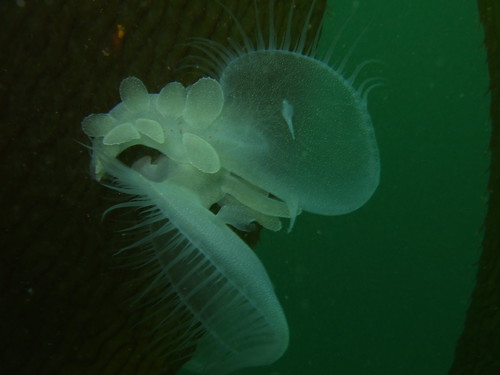
Nudibranchs as a whole are already pretty weird creatures, but those from the genus Melibe are simply downright bizarre.


Melibe sp., Cyrene Reef (Photo by Chay Hoon)

Most nudibranchs, like the vast majority of gastropods, possess a toothed radula, which they use to slowly rasp away at their food. Melibe are unique in that they have actually lost the radula; instead, they possess an expandable oral hood which they use to engulf zooplankton and other tiny marine creatures.


(Photo by Ria)


The oral hood is especially obvious in these Melibe leonina. (Photo by jrixunderwater)

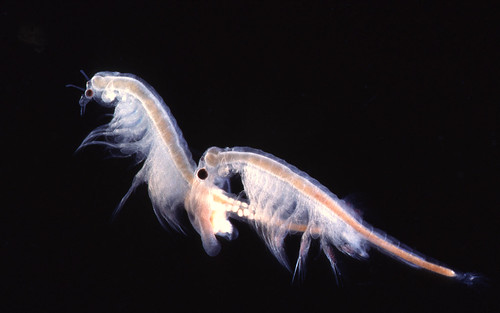
Logically, it would appear that various species of Melibe might be among those nudibranchs that could plausibly survive in an aquarium, provided that there is a regular supply of tiny live prey, such as brine shrimp, mysids, amphipods, or copepods. The technology to culture these crustaceans as live food is already well established.


The brine shrimp Artemia salina, commonly raised as live food for various organisms in the aquarium hobby. Special variants are marketed as novelty pets called 'Sea Monkeys'. (Photo by el viejo)

Like Hermissenda crassicornis, Melibe leonina has been used in laboratories as a model for neurobiology research, with some examples of studies done on this species shown here. Many papers describing work done on captive Melibe, such as this paper, mention that the use of cultured Artemia to feed these nudibranchs. However, this species has yet to be bred in the lab, and so the laboratory animals are made up of adults collected from the sea (this species can be seasonally abundant), with larvae being hatched in the lab from eggs brought in from the wild.

Melibe leonina is another nudibranch that is native to temperate waters off the Pacific coast of North America, from Baja California to Alaska, and so like Hermissenda crassicornis, is not suitable for tropical aquaria. But if the feeding biology of other Melibe species is similar to that of M. leonina, it would be likely that all other species in the genus have the potential to be suitable candidates for aquariums.

However, given that some species of Melibe can grow to quite large sizes, with M. mirifica said to grow more than 30 centimetres in length and M. japonica supposedly reaching 50 centimetres, such huge individuals would require large aquariums, and these might be more than capable of consuming much larger prey than mere brine shrimp.


Melibe ?mirifica (Photo by Ben Naden)

As for suitability for a reef aquarium, presently it appears that no one has deliberately attempted to keep a Melibe within a reef aquarium setup yet, although some aquarists have found Melibe engeli in their aquariums, possibly having stowed away in shipments of live rock.

A captive Melibe will probably need a special tank all to itself, or at least require peaceful tankmates that won't try to eat it, or that it won't try to eat. Another point to consider is whether its tankmates will compete with it for food; the nudibranch might be unable to get its fair share of brine shrimp if all its food is being relentlessly snapped up by fish. In comparison with other nudibranchs, Melibe are not very poisonous, though they do give off noxious secretions that oddly enough, have been reported to smell sweet and fragrant. However, camouflage is their primary means of defence, and if that fails, Melibe will escape predators by actively swimming away (combined with autotomy, or shedding of their cerata). Which might cause some trouble in a reef aquarium, since a swimming Melibe might just blunder right into a large sea anemone or colony of zoanthids and get stung to death, or get sucked up by the filter intake.

At least these nudibranchs do have a decent chance of surviving in an aquarium, even if chances are they have short lifespans anyway. Which is more than can be said about virtually all other nudibranchs sold in the aquarium trade, which are in all respects as good as dead once removed from their natural environments and separated from their prey.

PEST CONTROL NUDIBRANCHS

For some species of nudibranchs, their highly specific diet works to their benefit where it comes to ridding aquariums of unwanted 'pest' species.

It is sometimes very ironic that the desirable corals and sea anemones that one often forks out exorbitant sums of money to purchase can be quite delicate, whereas some species accidentally introduced into the aquarium often do a little too well. Not only can these pests affect the aesthetic value of the aquarium, they can also even affect the health and survival of their tankmates.


(Photo by PhotoByMark)

Glass anemones (Aiptasia spp.) are the bane of the reef aquarist; these unwanted anemones can reproduce so well in aquaria, that they often overwhelm and outcompete other sessile organisms, stinging expensive corals, giant clams, and zoanthids to death. Numerous solutions have been proposed, from physical removal of the anemones to injecting chemicals to kill them, to using predators to control their numbers. All have their advantages and drawbacks; many of the possible predators of glass anemones will also nibble expensive invertebrates in the aquarium.


Once established, Aiptasia can quickly reach plague proportions. (Photo by robertopalmari)


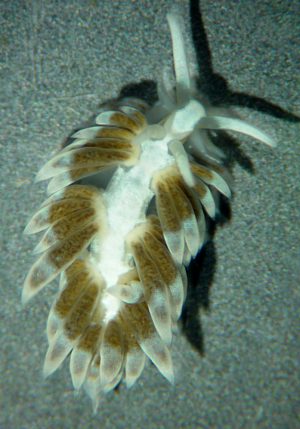
Aeolidiella stephanieae (Photo from Sea Slug Forum)

One tiny species of nudibranch from Florida, Aeolidiella stephanieae is currently being promoted as an effective way to get rid of Aiptasia without threatening other aquarium inhabitants. This is one of those species which is able to retain and use the zooxanthellae from its prey, which is predominantly if not exclusively composed of Aiptasia. However, the zooxanthellae alone cannot sustain the nudibranch indefinitely, so it has to feed often. Because nudibranchs in general are so particular about their food, the claims that this species can be a reef-safe and effective means of Aiptasia control appear to be accurate. Their prey is extremely easy to culture in captivity, and so are the nudibranchs themselves.


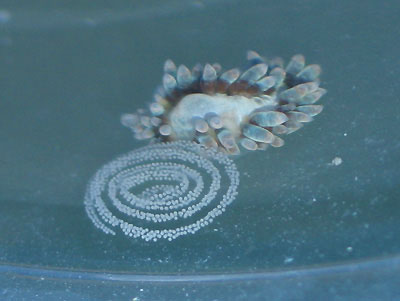
Aeolidiella stephanieae laying eggs (Photo from Reefkeeping)


Swarm of juvenile Aeolidiella stephanieae feeding on Aiptasia. (Photo from Berghia.net)

Many nudibranch species have a planktonic larval stage, where the newly hatched young float about in the plankton, feeding on various other planktonic organisms. Hermissenda crassicornis and Melibe leonina, discussed earlier, are among them. This need to keep the planktonic larvae alive is often the greatest hurdle to successfully breeding many marine animals in captivity. However, Aeolidiella stephanieae has a very short non-feeding planktonic larval stage; these larvae quickly metamorphose into miniatures of the adults, ready to feed on Aiptasia. Once established in an aquarium, a single pair of Aeolidiella stephanieae can quickly form a small breeding colony that continues to propagate itself as long as Aiptasia are present.


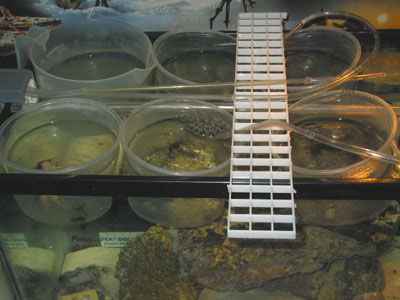
An example of a simple and inexpensive setup to culture Aeolidiella stephanieae. (Photo from Reefkeeping)

The catch though, is because they are so small, stocking them in insufficient numbers in large aquaria may mean that the nudibranchs quickly consume all the Aiptasia in the immediate vicinity, then starve to death before they manage to consume the last remaining Aiptasia elsewhere in the tank, which will then quickly proliferate once again in the absence of their predator. They may also be vulnerable to predatory tankmates such as fish, shrimp and crabs, many of which will not be able to resist such bite-sized morsels.


Pair of Aeolidiella stephanieae attacking Aiptasia (Photo from Conscientious Aquarist)

Many websites discussing the use of these nudibranchs as pest control encourage buyers to culture Aiptasia in a separate container so as to provide a continuous food supply. This way, one can maintain a ready stock of nudibranchs on standby to combat future blooms of Aiptasia in the main aquarium. An alternative is to remove the nudibranchs with a pipette once they've done their job and pass them on to a friend who needs them.

There is some confusion regarding the species used to control Aiptasia in aquarium; the species Aeolidiella stephanieae was described only in 2005. Prior to that, this species was marketed as Berghia verrucicornis, which is a completely different species known from the eastern Atlantic and Mediterranean. Thus many of the articles discussing the captive care and propagation of Berghia verrucicornis, such as seen here, here and here, are actually referring to Aeolidiella stephanieae. And in fact, as this link shows, it is possible that more than one species is actually being sold and researched under the name of Berghia verrucicornis.


Spurilla major (Photo taken by * Alicia)

Another species that has been cultured and marketed as a predator of Aiptasia is the Indo-Pacific species known as Berghia major. However, like Aeolidiella stephanieae, this species apparently does not belong to the genus Berghia, and is now known as Spurilla major.


Spurilla neapolitana (Photo by jordirs123)

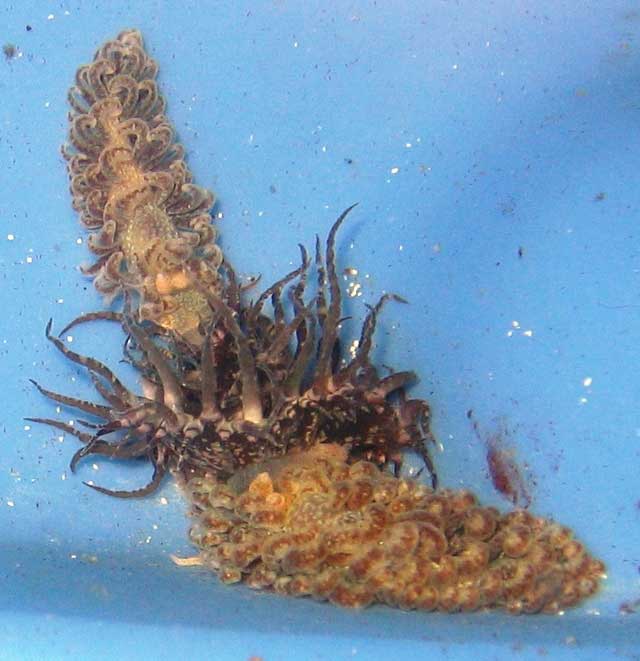
Another species, Spurilla neapolitana from the Mediterranean, western Atlantic, and eastern Pacific, has also been recorded to consume Aiptasia in the aquarium. An article on the care and breeding of this species in the aquarium is available here.


Two Spurilla neapolitana feeding on Aiptasia. (Photo from Reefkeeping)


Spurilla neapolitana also feeds on majano anemones (Anemonia majano), another undesirable anemone species that will sting other invertebrates in the aquarium. (Photo from Reefkeeping)


Chelidonura varians, a predatory cephalaspidean slug. (Photo by Erwin Kodiat)

Another slug that one may find in the aquarium trade being promoted as pest control is Chelidonura varians from the Indo-Pacific. This is a predator that feeds on small acoel flatworms (usually Convolutriloba retrogemma), which can quickly become a harmless but unsightly plague in the aquarium.

However, despite this name, it is not a nudibranch, but instead belongs to a closely related group of gastropods known as the headshield slugs. That has not prevented tragedy from occurring, like this person who ordered Chelidonura varians, but instead ended up receiving the nudibranch Chromodoris annae. Needless to say, these nudibranchs are most likely going to slowly starve in the aquarium. This problem is likely exacerbated by the fact that like all other sea slugs, Chelidonura varians is sometimes marketed as a nudibranch, under the name of 'blue velvet nudibranch', when it is not a nudibranch.

Coming up, nudibranchs can find their way into aquariums, as stowaways and hitchhikers. Is this a good or a bad thing? What can you do as a responsible aquarist?

This is part 4 of a 5-part series on nudibranchs, inspired by a feature article on nudibranchs on the National Geographic website.

Part 1: Nudibranchs are beautiful
Part 2: What is a nudibranch?
Part 3: Are nudibranchs suitable for aquariums?
Part 4: Nudibranchs for the aquarium (this post)
Part 5: Nudibranchs: Stowaways and Hitchhikers

Are nudibranchs suitable for aquariums?


Upper left: Hypselodoris bullocki; Upper right: Phyllidia elegans;
Lower left: Chromodoris fidelis; Lower right: Tambja amakusana;
(Photos taken by Jun at Pulau Hantu)

Because of their bright and attractive colours, many nudibranch species would appear to make popular aquarium subjects. Indeed, from time to time, one might be able to find nudibranchs offered for sale in shops or online. However, there are certain aspects of nudibranch biology which make the group as a whole too challenging even for expert aquarists.

FEEDING TIME... WITH WHAT?

As mentioned in the previous post, most nudibranch species are highly specialised in terms of prey. Unlike many other marine creatures in aquariums, which will soon adapt to living on frozen shrimp or fish, and even flakes and pellets, nudibranchs would rather starve than change their diet.


(Photo by DAYofTheDead)

Let's have a hypothetical scenario, one that is unfortunately a sad reality for many people. You're a responsible aquarist, and a thriving healthy reef aquarium is your pride and joy. One day, you see a nudibranch being sold in your local fish store (LFS). The store assistant tells you that not only is it reef-safe, but it's great at eating algae. Captivated by its appearance, you buy it in a moment of weakness and plop it right into your aquarium. The slug seems to be doing okay, even if it's not chowing down on the algae. But then you open a reference book or check the Internet. Uh oh. Turns out that nudibranchs don't eat algae at all, and have a highly specific diet. What do you do next?

1) What sort of nudibranch do you have?

You could try and figure out exactly what nudibranch species you have in your aquarium. Unfortunately, it isn't always so clearcut, what with new species of nudibranch still being discovered and named.

Perhaps you're lucky, and have purchased a highly distinctive species like say, Jorunna funebris.


(Photo by Marcus)

2) What does your nudibranch feed on?

So you have a Jorunna funebris. The next step would be to find out what exactly your nudibranch feeds on. Is it a sponge? A coral? A hydroid? Or is its diet in the wild completely unknown?

A best-case scenario would have your nudibranch being sold together with its prey. Or perhaps you're in your LFS and you find the nudibranchs on display together with a bunch of rocks encrusted with some sort of sponge. Better still, the nudibranchs are perched on the rock, and seem to be chewing away at the sponge. There is a likelihood that if you purchase both the nudibranch and the sponge together, you'll have found a perfect match.

A somewhat more convoluted method would be to consult the scientific literature, and determine what exactly your nudibranch feeds on.

This website has a list that matches nudibranchs with their prey species. Of course, it's still very incomplete. What if your nudibranch isn't listed in here?

This is the listing for Jorunna funebris:
  • Haliclona sp.
    Johnson & Boucher, 1983:260

  • Xestospongia sp.
    Avila, 1995:520 [Gulavita, Scheuer, & de Silva, 1991; Kubo, Kitahara, & Nakahara, 1989]
    Gulavita, Scheuer, & de Silva, 1991:229
    Karuso, 1987:46
    Kubo, Kitahara, & Nakahara, 1989:1384

  • bluish purple sponge
    Willan & Coleman, 1984:32

'Bluish purple sponge'... well that's very helpful indeed. There must be countless species of sponges out there which could be described as 'bluish purple'.

There are quite a number of photos out there depicting Jorunna funebris feeding on blue sponges, but without a sponge expert to identify the sponges being consumed, we're pretty much getting nowhere.


Photos of Jorunna funebris feeding on blue sponges in various localities. Upper left: Great Barrier Reef; Upper right: Gulf of Thailand;
Lower left: Bali; Lower right: Mariana Islands;
(Photos contributed by observers and posted to the Sea Slug Forum)


This counts as 'blueish purple'... I think. (Photo by Ria)

Bill Rudman of the Sea Slug Forum has identified one of the blue sponges that Jorunna funebris feeds on as Euplacella cf. australis, but searching reveals that the genus has now been synonymised with Callyspongia. So it should probably be Callyspongia cf. australis instead.

Having 3 genera of sponges to work with is somewhat more helpful, but then, finding the right species is really like searching for the proverbial needle in a haystack. After all, according to the World Porifera Database, the number of known species in Callyspongia, Haliclona and Xestospongia is nothing short of staggering. Just how many species in these genera are blue, and are found living in the Indo-Pacific along with Jorunna funebris? And out of all these blue sponges living in the Indo-Pacific, exactly which of these species are the ones that have been observed to be preyed upon by Jorunna funebris?

Of course, you'd better hope that the researchers actually correctly identified the nudibranch and its sponge prey. Or that the particular sponges that would feed your Jorunna funebris have not already been moved out of Callyspongia, Haliclona or Xestospongia due to taxonomic reshuffling.

3) Is the prey species easily obtainable?

Pinpointing the exact species that Jorunna funebris feeds on isn't easy, but there is a big difference between merely knowing what your nudibranch eats, and actually being able to provide the food. Let's take a gamble and say that the latest shipment of blue sponges at your nearest LFS is from the Indo-Pacific, and as a bonus, they happen to be labeled as belonging to the sponge genera that will stop your nudibranch from slowly starving to death.

But what if the sponges were misidentified, and your nudibranch won't touch them? Or what if they were mislabeled along the way, and actually come from the Caribbean? Will these other sponges do just as well for your nudibranch? Or what if the blue sponges are indeed the right sort from the Indo-Pacific, but are prohibitively expensive?

4) Is the prey species easy to rear in captivity?

It will be quite pointless if the expensive blue sponge that you have bought just to feed your expensive nudibranch dies barely an hour after you've placed it in your aquarium. Not many sponge species can be easily kept alive in aquariums. Keeping your sponge alive while your nudibranch slowly devours it will be an added challenge.

5) Is it possible to maintain a long-term supply of the prey species just to feed the nudibranch?

In order to keep your nudibranch well-fed and happy for the rest of its natural lifespan, you will of course need to have a constant supply of its prey. Is the right species of blue sponge regularly stocked at your LFS? Is it possible to grow and culture blue sponges at home? Is there a related species found locally that you can collect and serve up as an alternative? It won't do if your nudibranch finishes up every last bit of sponge before you've had the chance to establish a long-term supply of its food.

Out of desperation, you could place your nudibranch in an aquarium with plenty of mature live rock, and see if it finds anything to eat. Live rock usually refers to rocks that have spent some time in the sea, and have been colonised by all manner of organisms. There is a booming trade in a number of tropical countries, where chunks of coral rubble are harvested and shipped to hobbyists all over the world.

Live rock can be a bit of a gamble, since one can never predict what organisms might be introduced into your aquarium, desirable or otherwise, but this is where it might save your nudibranch's life. An aquarium full of live rock, with some diversity of marine life, might just happen to have the right prey for your hungry nudibranch. Of course, even if you do find your nudibranch's prey in there, it's just a short-term solution; you'll have to find a way to cultivate the prey species in large enough quantities to sustain its predator.


Your nudibranch might find something to eat in there... or not. (Photo by inspired@rogers.com)

What I've illustrated here is just how challenging it can be simply to meet the dietary requirements of a captive nudibranch. I've used a common and widespread species for which the diet is known and well-recorded, but it can be seen how things can go horribly wrong at any step in the process. And this is already quite an optimal situation, where we have an aquarist who is dedicated and responsible enough to research on the nudibranch's needs and is willing to go to great lengths to obtain the required prey. Even so, most nudibranchs in aquaria are doomed to slowly starve.

Feeding nudibranchs successfully often requires a bit of luck, such as this guy, who found blue sponges being sold in the same store as Jorunna funebris. Fortunately for him (and his nudibranch), the sponges he purchased belonged to a species that the nudibranch will eat.

SLUG TIME-BOMBS?

The main problem regarding nudibranchs in aquariums is to do with finding the right prey to keep them alive. However, for some species, there is another aspect of their biology which makes them highly unsuited to life in captivity.


Phyllidiella pustulosa (photo by Ria)

Most nudibranchs are poisonous to some degree, but are still safe around fish and other tankmates. But as mentioned in the previous post, some species, such as the one shown above, will secrete noxious chemicals into the surrounding water. Sometimes they don't even need to be attacked by a predator, just stressed for one reason or another. In the sea, these toxic substances are soon diluted and washed away. But within the confines of an aquarium, such an incident can be disastrous, wiping out all the inhabitants.

FRAGILE BEAUTY

Besides their specific diets and poisonous nature, nudibranchs in general are just not very hardy creatures. Like many invertebrates, they can be extremely sensitive to fluctuations in water temperature and quality. Buildup of waste products like ammonia and nitrates can be lethal, as are copper-based medications (a big no-no around invertebrates). In short, even if they were not so particular about their food, and even if some of them were not so toxic they could practically nuke an entire aquarium, most nudibranchs would be suitable only for advanced and experienced aquarists.

HIGHLY NOT RECOMMENDED

Based on the online aquarium stores and Internet postings, it would appear that the nudibranch species most commonly found in the aquarium trade is Hypselodoris bullocki. Unfortunately, like all its relatives, it specialises only on certain species of sponge which are likely to be not readily available. The exact species of sponges which it feeds on in the wild have yet to be accurately examined and identified by a sponge expert. Hence, as is shown in all these messages by worried owners, these colourful slugs just don't do well in aquariums.


(Photo by Chay Hoon)

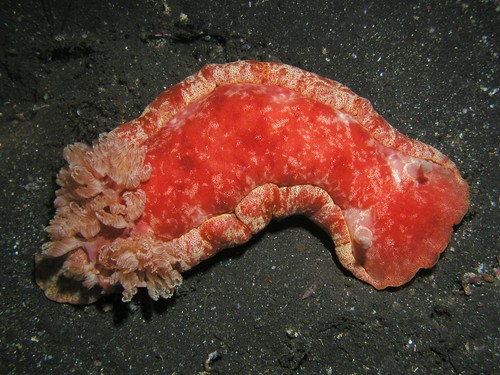
Another species found in the trade from time to time is one of the most well-known nudibranchs of all, the large and extremely attractive Spanish dancer (Hexabranchus sanguineus).


(Photo by Chika)

Like so many other species of nudibranch which are sold for aquariums, this beautiful species is an obligate predator of sponges. Besides, the fact that it can exceed 50 centimetres in length means that a very large tank is needed to provide adequate space.

Other species which might be found offered for sale would include various colourful Chromodoris species; the four species shown below have been encountered in the trade by various individuals. Once again, these pretty slugs will eat only certain species of sponges, and nothing else. Why then am I not surprised that most aquarists fail to keep them alive for any extended period of time?


Upper left: Chromodoris lochi; Upper right: Chromodoris willani;
Lower left: Chromodoris annae; Lower right: Chromodoris magnifica;
(Photos by symbion1, * Alicia, AKIRA2020, and Erwin Kodiat)

FALSE ADVERTISING

There are a number of businesses that market nudibranchs as colourful algae-eaters, even though most species are specialised predators on sessile invertebrates. Unsuspecting buyers end up purchasing these colourful slugs, under the mistaken belief that these will feed on algae while adding colour to their aquariums. Instead, these nudibranchs are condemned to slowly waste away, starving to death in home aquariums or dealers' tanks.
"Add bright color to your tank and take care of algae at the same time! If you have nasty green algae on your rocks and/or glass these clean up guys will move along and help you with your tank in a hurry."
- Aquatic Connection (Hypselodoris bullocki feeds on sponges, not algae).

"These are sea slugs and help to keep your aquarium clean."
- The Saltwater Fish Shop
In the site's catalogue, you can find 'Purple Nudibranch' (Hypselodoris bullocki), 'Spanish Dancer' (Hexabranchus sanguineus), and 'Nudibranch' (with photos of Risbecia imperialis, Hypselodoris bennetti, and Chromodoris willani). All 5 species shown on the website are dedicated predators on various species of sponge, and certainly do not 'help to keep your aquarium clean'.

"A couple weeks ago I bought a nudibranch at Petland. They told me that he would eat algae and he is beautiful so I bought him. After watching him for a couple days I didn't notice him eating. I searched all over the Internet but haven't found what he eats. I'm hoping you could tell me. Here is a picture of him. Thank you for your help."
- The sad and unfortunate fate of most nudibranchs in the aquarium trade.

"After I purchased the slug, I noticed for 3 days that it was not interested in eating up the algae and hence it prompted me to do a massive search for the details of this creature.

The person at the shop was not able to provide me the exact name of the creature but he told that it was a slug. I did a search and saw the same creature on the Forum. Reading through the Forum, I found out that Jorunna funebris actually feeds on blue sponge and nothing was said about feeding on algae. I don't have any form of sponge in my tank, and I am concerned that it might die of starvation some day."
- An all too common story with nudibranchs in aquariums.

"I purchased several sea slugs from my LFS which were supposed to be algae eaters. Two Hypselodoris bullocki, one Chromodoris joshi and one that I can't identify [subsequently identified as possibly Phyllidiella pustulosa]. As I have read in your Forum, they don't eat algae."
- A buyer realises his mistake.

"Firstly aquarium shop owners who are telling their customers that nudibranchs are grazing herbivores are either lying or just don't know. In either case I think they are irresponsible and not exercising their duty of care to their customers, or for that matter to the animals in their care."
- Bill Rudman, in reply to a reader's query about feeding Hypselodoris bullocki in captivity.

Whether it is out of ignorance, erroneous information passed down by collectors and suppliers, or a deliberate attempt to make a quick buck out of selling off nudibranchs before they starve to death, such irresponsible marketing of nudibranchs not only dooms these slugs to a slow lingering death from starvation (while the bewildered owner wonders why they aren't touching the algae!), but also puts entire aquariums and their inhabitants at great risk, especially in the case of those nudibranchs capable of releasing their toxins into the water.

This site sells both Hypselodoris bullocki and Glossodoris atromarginata, and correctly mentions that they both feed on sponges, although simply knowing that they eat some sort of sponge isn't even half the battle.

NUDIBRANCH-NOT

Perhaps some of the confusion and misinformation surrounding nudibranch diets originates from the assumption that snails and slugs in general are herbivores and scavengers - we tend to perceive terrestrial snails and slugs as slow and peaceful vegetarians (though most will consume animal matter, and there are dedicated carnivores among the terrestrial gastropods). Most of the snails found in freshwater aquaria are quite harmless, and indeed help consume algae and detritus (and expensive plants!). Many snails sold for marine aquariums and touted as reef-safe fulfill an important function as algae eaters (such as Turbo and Astraea spp.) or as scavengers and detritivores (such as Cerithium and Nassarius spp.). However, many people don't realise that gastropods are simply extremely diverse in terms of diet, ranging from strict herbivores to specialised predators.

Another source of confusion possibly stems from the annoying tendency of many shops to market ALL sea slugs as nudibranchs. It seems that quite a number of people, even some authors of aquarium guides, think that the term 'nudibranch' is synonymous and interchangeable with 'sea slug', and that any slug found in the marine environment can be called a nudibranch. However, as was shown in the previous post, nudibranchs are but a single lineage of marine slugs. The slugs most often erroneously called nudibranchs in the aquarium trade are the sacoglossan (sap-sucking) slugs, of which Elysia ornata below is one such example.


(Photo by Ria)

The species most commonly sold in the aquarium trade, often under the name of "lettuce nudibranch", is the Caribbean species Elysia crispata, shown below.


(Photo by laszlo-photo)

These slugs are vegetarians, and they are capable of doing an excellent job at keeping undesirable algae at bay in the home aquarium, but they are not nudibranchs. As a result of this misnaming, people in the aquarium trade, from collector to dealer to hobbyist, might come under the wrong impression that nudibranchs are all placid and harmless algae-eating vegetarians, like their sacoglossan relatives.

Quite a few other species of sea slugs, such as some of the sacoglossan slugs mentioned above, and some sea hares, are often kept in aquaria, usually to control algae. However, the various species found in the trade present varying levels of difficulty for the aquarist in terms of living requirements and hardiness, and are not recommended for beginners. But in any case, the task of keeping these slugs alive in captivity is far easier than can be said for nudibranchs.


Aplysia dactylomela is one of several species of sea hare often kept in reef aquariums.

UNSUSTAINABLE TRADE

Nudibranchs are so difficult to keep alive in captivity, let alone breed, and so any nudibranch found offered for sale would have been collected from the wild. There have been records of nudibranchs laying eggs in aquariums, but it is highly unlikely that the resulting larvae would be able to survive and grow into adults. Not only do most species go through a planktonic larval stage, and would be extremely difficult to raise in captivity, the absence of their prey species would tend not to favour the survival of the young. Although there is a growing effort within the hobby to promote captive propagation of marine fish, crustaceans, and even corals, attempting to culture colourful nudibranchs such as Jorunna funebris or Hypselodoris bullocki in captivity is still next to impossible.

Nudibranchs are attractively coloured, which is enough reason for many to purchase them without doing the necessary background research on their needs. They also have naturally short lifespans, and don't live for long in aquariums anyway. A hobbyist who is unaware of the difficulties of keeping a nudibranch might be compelled to replace the stock that are cruelly lost through starvation. And so, any increased demand in nudibranchs will lead to an increase in removal of individuals from the ocean, possibly placing further stress on these wild populations. Many nudibranchs have a restricted range, are dependent on certain habitats, and combined with their specialised diets, may already be vulnerable to extinction. While the conservation status of these little slugs is generally not known, there is always the possibility that collection for the aquarium trade may pose some threat to certain populations.

The possibly unsustainable trade in wild-caught nudibranchs is a cause for concern. That virtually all of these nudibranchs are doomed to die of starvation in home aquariums should be all it takes to stop this cruel business.

Nudibranchs are simply unsuitable for aquariums. When was the last time you ever saw a nudibranch in a public aquarium? If public aquariums, with comparatively so much more resources at their disposal, refrain from keeping nudibranchs, what then are the chances that hobbyists will be able to keep nudibranchs alive in a home aquarium?

Responsible aquarists should always do their research before making impulse purchases, and nudibranchs are no exception. Only the most dedicated hobbyists should ever attempt to keep nudibranchs, and even if one is able to find the right food, the chances of successfully breeding them and raising the young in captivity are at present infinitesimal. Responsible businesses should refrain from selling nudibranchs, or refuse to accept nudibranchs from suppliers. They should certainly never market nudibranchs as algae-eaters.

Coming up, nudibranchs that can survive in an aquarium...

This is part 3 of a 5-part series on nudibranchs, inspired by a feature article on nudibranchs on the National Geographic website.

Part 1: Nudibranchs are beautiful
Part 2: What is a nudibranch?
Part 3: Are nudibranchs suitable for aquariums? (this post)
Part 4: Nudibranchs for the aquarium
Part 5: Nudibranchs: Stowaways and Hitchhikers