Tuesday, December 16, 2008

Siloso Surprises

P1120206

Most people are unaware that the swimming lagoons at Siloso Beach are actually quite rich in marine life. I've been wanting to explore some of these small islets off the main beach at low tide for quite some time, and besides, I also wanted to see if there was any noticeable increase in rubbish after ZoukOut.

I've got a soft spot for this place, even though it is really challenging. The water is extremely murky, and visibility is poor. If anyone tried scuba diving here, it would seriously be considered muck diving. Every step, no matter how gentle, stirs up a huge plume of sediment that instantly renders the water as opaque as a piece of cardboard. Unlike other shores that I've explored, there's no reef flat or otherwise flat areas of ground where marine creatures get trapped. There's only a gently sloping beach that suddenly drops off, and in some places, if you're not careful, you can suddenly plunge from your knees to waist-deep. The ground is mostly composed of a mixture of fine sand and mud that tends to crumble beneath your feet and slide down the slope, sending you into deeper water, whether you like it or not. Because of the profile of this shore, almost every fish, crab, prawn, or other motile organism that you spot will shoot straight for the murky depths before you can even think of switching on your camera.

And yet, with some patience, and a whole lot of luck, there's actually quite a fair bit to discover in such a difficult environment.

P1120208
There are four of these artificial islets along Siloso Beach, and only one has a floating bridge that allows you to walk across. If I ever want to explore the other islets that are not connected to the main beach, I'll have to swim.

P1120211 P1120219
One section of Siloso Beach has been cordoned off for some sort of development works, and wooden barriers have been erected to prevent people from trespassing. These are now draped with Sargassum seaweed (Sargassum sp.).

P1120213
The tide must have been really high in order to hang all this seaweed above me.

P1120218 P1120215
These wooden poles have been here long enough to become encrusted with acorn barnacles (Balanus sp.) and colonised by periwinkles (F. Littorinidae). Purple climber crabs (Metopograpsus sp.) can be found here as well, but they're really skittish and good at hiding amongst the fronds of drying sargassum.

The floating bridge itself provides a good surface for a great deal of marine life to settle down and colonise.

P1120222
Here we have a thumbs-up sea squirt (Polycarpa sp.), and a pink flowery soft coral (F. Nephtheidae).

P1120225
There's something reddish and flat growing on this part of the bridge. Could it be some sort of hard coral?

P1120227
Here's a closer look.

P1120229 P1120241
First time I've seen an onch slug (F. Onchidiidae) on this bridge. And here's a waved nerite (Nerita undata).

P1120253
Common whelks (Nassarius livescens ) live up to their name, being easy to spot even on Siloso Beach itself.

P1120259
I'm seeing this trend where some species that prefer the silty, muddier northern shores of Singapore can be found in the similar conditions of these artificial lagoons. This spotted moon crab (Ashtoret lunaris), which we normally find on Changi, is one such example.

Note to self: Moon crabs are extremely feisty, and if you try to catch them, they will pinch. HARD.

I finally crossed the bridge and ended up on the islet. There was some rustling in the bushes, and several times, I managed to spot rats (Rattus sp.) scampering in the shadows. That could be a reason why I couldn't find any land hermit crabs (Coenobita sp.). Some parts of the beach were covered with tiny balls of sand surrounding small round holes in the ground, telltale signs of sand bubbler crab (Scopimera sp.) activity. Larger burrows at the high shore hinted at the presence of a sizeable population of ghost crabs (Ocypode ceratophthalmus).

P1120265
I've never found any moon snails (F. Naticidae) here before, but sand collars, which are the egg masses of these predatory molluscs, are quite commonly seen.

P1120273
After a few frustrating attempts, I finally found a well-behaved purple climber crab that allowed me to get close and snap a few photos before scurrying off.

P1120279
The blue swimming crab (Thalamita sp.) is commonly seen among the coral rubble on nearby Tanjung Rimau, but it seems to be found in respectable numbers among the large rocks found on both ends of the islet. This was just one out of four that I found within a small area.

P1120292
Flower crabs (Portunus pelagicus) belong to the same family as swimming crabs, and juveniles of this species greatly outnumber the blue swimming crabs here.

P1120281 P1120296
There aren't many shores where I can easily find both pearl conch (Laevistrombus canarium) and black-lipped conch (Canarium urceus).

P1120287 P1120290
There were a few of these blue-tailed prawns (F. Penaeidae) in the shallows, and they were quick to swim for deeper water or bury themselves. And as you can see in the second photo, it doesn't take much movement to stir up all the silt and sediment, ruining your chances of taking a decent photo.

P1120321 P1120305
It's impossible to miss the countless zoned horn snails (Batillaria zonalis), as well as the tiny tidal hermit crabs (Diogenes sp.) which inhabit the empty shells. I really must do a comprehensive survey of all the cerithid and potamidid snails in these lagoons and sort out which species inhabit these reclaimed beaches.

P1120315 P1120325
There are two tiny patches of spoon seagrass (Halophila ovalis) next to the bridge. I still remember how excited I was when I first stumbled upon the seagrass almost 2 months ago.

P1120328
Here's another creature more commonly seen on our muddy northern shores, a spiral melongena (Pugilina cochlidium).

P1120375
I was joined by two Bangladeshi workers who had come to do a bit of fishing. With a few tosses of a simple cast net, they managed to haul in quite a few fish. More on their catch in the next post.

P1120380 P1120414
Besides fish and random pieces of seaweed, driftwood, and assorted marine trash, the net also brought in a small elbow crab (F. Parthenopidae), as well as a blue-spined swimming crab (Thalamita sp.). I took a few photos before returning both of them to the sea.

P1120389 P1120400
To my amazement, there was a solitary tape seagrass (Enhalus acoroides), at one end of the islet. How does it manage to get enough sunlight in these turbid waters?

I tried to find the common sea stars (Archaster typicus) that I'd found on previous visits, but despite my best efforts, I couldn't. The water was too murky to get a good view of the seabed. I hope they're all lurking in the deeper parts of the lagoon.

The tide was rising, so I crossed the bridge back to Siloso Beach.

P1120420
All the flotsam, both natural and manmade, creates a disgusting frothy mess.

P1120423
Can you see the purple climber crab trying to clamber onto the shoe?

There doesn't seem to be more rubbish than usual. Looks like the barriers did their job after all in keeping the bulk of the litter from ZoukOut out of the sea.

P1120425
But here's one piece of rubbish that definitely came from ZoukOut. There was a booth set up by DBS that was giving out these noisemakers at ZoukOut.

I decided to go take a look at the area that was used for ZoukOut.

P1120432
This is the blue netting that I was talking about, which not only prevented people from sneaking in and out during the event, but also provided a barrier for most of the litter.

P1120437
Most of the stages and platforms have been cleared, leaving behind these tents.

P1120453
The beach is all quiet now, but just three days ago, there were thousands of people crammed into this area.

P1120463
Most of the litter has been removed, although there are lots of small cigarette butts half-buried in the sand. And there are some bits of trash lying on the ground. But the situation does seem a lot better than I'd feared it would be.

P1120449
Just outside the barrier, I found this ghost crab, alert and skittish as ever.

Red-eared slider (Trachemys scripta elegans)
I went to the toilet to wash up, and there was a red-eared slider (Trachemys scripta elegans) in the fountain!
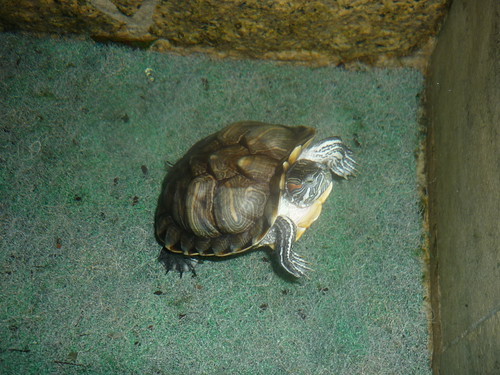
Red-eared slider (Trachemys scripta elegans)
This turtle is a native of North America, and has been widely introduced to ponds, reservoirs, and canals all over Singapore. I wonder how this individual manages to find enough food to survive.

And as I walked to the Beach Station to take the Sentosa Express back to VivoCity, I passed a pond full of various species of frogs and toads, calling for mates.

Common Asian toad (Duttaphrynus melanostictus)
I managed to take a photo of Singapore's most common amphibian, the common Asian toad (Duttaphrynus melanostictus).

Coming up: I came upon a few very interesting fishy finds, which more than made up for the lack of sea stars.

This is part 1 of a 2-part series on a trip to Siloso Beach on 16th December, 2008.

Part 1: Siloso Surprises (this post)
Part 2: Fishy business on Siloso

Sunday, December 14, 2008

Thoughts on ZoukOut 2008


I had a splendid time at this year's ZoukOut, partying all night long until well past 7 a.m. today.

But even in the midst of all the hedonistic debauchery, as I danced along to the music in a state of euphoria, I couldn't avoid thinking about the possible environmental impact of massive events like this.

I wonder if the noise has any long-lasting adverse effects on the animals living nearby in the forest and in the sea. Does the loud music cause them any distress? Underwater World is also situated quite close to where ZoukOut was held, and the animals in the aquaria can't really swim away to escape the noise. Or are all of these creatures already acclimated to such nocturnal disturbances, given that this was only the most recent mega-party to take place on this stretch of beach?

Such impacts on the local wildlife are difficult if not impossible to determine, short of going snorkeling during ZoukOut and seeing if all the fish are fleeing for deeper water. But other impacts are more readily observed.

It was impossible not to notice the vast amount of disposable items used during the event. From the plastic bracelet that was snapped onto everyone's wrist once they'd entered, to the promotional flyers advertising Rip Curl discounts for ZoukOut attendees, I wondered just how much resources went into manufacturing items that would be thrown away by the end of the event. The most obvious example would have been the plastic cups that the drinks were served in. Of course, it makes life much easier for the staff, since they don't have to fight through the crowds to retrieve glasses and jugs, and besides, it does make the party safer for everyone (no worries about stepping on broken glasses with your bare feet), but I wonder if anyone out of the 26,000 partygoers reused their cups.

In the morning, as I was preparing to leave, it was easy to see all the litter that was strewn all over the beach. From flattened plastic cups and empty bottles of water, to plastic bags, lightsticks, half-deflated noisemakers, cigarette butts, pieces of tissue paper and even the odd slipper, I couldn't help thinking about the horrific mess, and the backbreaking work that lay ahead for those tasked to do the cleaning up. While the event organisers did install walls of netting that prevented the trash from falling into the sea (and stopped drunk people from drowning themselves), I hope none of the litter was picked up by the wind and blown over the barriers. Considering that I'd just helped out the day before at a walk organised by the Naked Hermit Crabs on a stretch of shore a very short distance away, it was a little upsetting to think about the possible effects that it would have on the marine environment.

I dare not calculate the carbon footprint for ZoukOut; the amount of fossil fuels that went into powering the lights and sound systems for just that one night must have been quite high. And then one must factor in all the fuel and other resources that went into the production and transportation of items used during the event, from the lanyard that everyone received, which came with a basic survival guide and lightstick attached, to all the bottles of soft drinks that were consumed. Take into account the fact that many of the people there at ZoukOut had flown in from overseas, and the carbon footprint increases even more.

A truly ironic moment came when Above & Beyond was spinning, and everyone had their arms and lightsticks in the air, singing along to Miracle by Oceanlab.

The DJs who make up Above & Beyond purchase carbon offsets to reduce the impact of their international tours and releases, and Miracle is probably the first (and only) tune by a trance act that attempts to inspire active effort to combat climate change. Yet at that point in time, seeing people around me flicking used cigarette butts to the ground, or tossing empty plastic cups to be crushed underfoot, I wondered if the lyrics of the song were lost on many of those in the audience:

Are you hoping for a miracle
As the ice caps melt away
No use hoping for a miracle
There's a price we'll have to pay


If there's any consolation, it appeared that the vast majority of people depended on public transport to enter and leave Sentosa. Part of the reason must have been the increased entrance fees for those entering by car and taxi, as well as the increase in parking fees for the public carparks closest to Siloso Beach. Of course, it made the ride on the Sentosa Express a lot squeezier than usual, but at least it was only for a few minutes.

Clouds had been building up for several hours, and there wasn't any sunrise to admire. When I reached VivoCity, it began to pour. I hope the barriers did their job, and that the rain didn't wash any of the trash into the sea.

Regardless of all these worries and concerns, I did enjoy myself tremendously, and it's highly likely that I'll be attending ZoukOut in subsequent years. But at the same time, I can't help but think about the ethical quandary I find myself in. Most of the time, I try my best to advocate sustainable use of the Earth's limited resources. Yet here I am, willingly taking part in an event that abets the consumption of staggering amounts of fossil fuels, leads to the generation of huge quantities of litter, and possibly causes some disturbance to the terrestrial and marine fauna living in nearby habitats. At best, you can call it cognitive dissonance. At worst, you can call it hypocrisy.

Come December 31st, yet another mega-party will be held on Siloso Beach. It probably won't be as massive as ZoukOut, but the problems will be the same. I do wonder if there's a better way to organise and operate these events, so as to reduce the carbon footprint and the amount of trash produced. It's an area that I think is deserving of further exploration. After all, everyone's free to party like there's no tomorrow (anyone recall that rave scene in The Matrix Reloaded?), but there has to be a way to ensure that the environmental costs are minimised as much as possible.

Friday, October 17, 2008

Siloso: seagrass and sea stars

P1070285

After my first seagrass monitoring session over at Tanjung Rimau, I decided to stay around and explore more of Siloso Beach. The tide was still low enough, and I thought that there more marine life might be out and about after dark. I headed for the bridge that would bring me to one of the islets across the lagoon. And before I had even started to cross the bridge, I found this ghost crab (Ocypode ceratophthalmus). This is the first time I've ever found one on Siloso Beach itself. These crabs are actually quite common on our beaches and sandy shores, but are very shy and come out only at night.

I was hoping that this would be a sign of all the exciting discoveries that lay ahead.

In the shallows, I see shoals of small fish, mostly young Kops' glass perchlet (Ambassis kopsii) and crescent perch (Terapon jarbua). They're too quick for me to even contemplate taking a photograph of them.

P1070292
Here among the rocks, it looks as if the nerites are out in full force; they're crawling all over the place. I think these are Nerita undata.

P1070298
Here's a nerite and a sea slater (Ligia sp.) close together.

P1070302
I've seen reef spiders (Desis sp.) many times on the coral rubble of Tanjung Rimau, but this is the first time I've seen one here in this lagoon. This one seems to have captured some sort of isopod.

P1070303 P1070304
I think this snail is Chicoreus torrefactus, a predator that feeds on bivalves by drilling a small hole into the shell of its prey.

P1070307
There's zoanthids growing beneath this rock.

P1070308 P1070339
Young halfbeaks (F. Hemirhamphidae) can be seen near the surface.

P1070311
It's slightly easier to sneak up on mudskippers at night. This one's probably a dusky-gilled mudskipper (Periophthalmus novemradiatus).

P1070322 P1070318
Whelks (Nassarius livescens) are commonly found patrolling the sand, but I wasn't expecting to find a live pearl conch (Laevistrombus canarium).

P1070353
I've been finding sand collars regularly, but have yet to find any moon snails on this shore. Sand collars are the egg masses of moon snails, and are a mixture of mucus and sand.

P1070327
Close to the floating bridge, I'm shocked to stumble upon a small patch of spoon seagrass (Halophila ovalis)!

This is the most common species of seagrass found in Singapore, but I'm amazed that it manages to eke out a precarious existence in the murky waters of this lagoon.

P1070329 P1070331
The bridge provides plenty of hiding places for young fish. The one on the left should be a young silver moony (Monodactylus argenteus), but I'm not so sure about the one on the right.

P1070333
Every time I explore this bridge, I manage to spot purple climber crabs (Metopograpsus sp.).

P1070341 P1070343
Among the rocks on one end of the islet, I discover not one, but two hard corals!

P1070354
Here's a gang of tidal hermit crabs (Diogenes sp.), inhabiting an assortment of snail shells. I see creeper snails (Batillaria zonalis), three species of whelks (Nassarius livescens, N. crenoliratus and N. pullus), as well as a few drills (F. Muricidae). One way of finding out what snails live in an area is to check out what the hermit crabs are wearing.

P1070349 P1070358
Swimming crabs (Thalamita sp.) and juvenile flower crabs (Portunus pelagicus) are often found in the shallows.

P1070361
Not often seen though, are moon crabs. I'm not sure if this is the spotted moon crab (Ashtoret lunaris).

P1070370
Here's another amazing find. A flatworm, swimming away! My expertise in flatworms is lousy, but I guess this could be a species of Pseudobiceros.


I took a short video. Isn't it graceful? These beautiful worms normally crawl around on the seabed, but as you can see, they're also capable of swimming.

Apologies for the video quality; my skills are nowhere close to those of Andy. Almost immediately after I stopped recording, a tiny squid, possibly the same species as the one I found earlier on in the afternoon, swam past. Damn.

But the most exciting discovery of the night overshadows even the flatworm. Last May, I'd found common sea stars (Archaster typicus) in the shallows of this very same islet. You can see my submission of this discovery over on STOMP.

Today, I was hoping to find them again.

P1070363
The tide is rising, and the water's getting murkier. Just as I'm about to give up, I find one, half-buried in the sand.

Yes!

P1070365
Here's another look. It's good to know that there's still at least one common sea star surviving on this shore. I hope there's many more in the deeper parts of the lagoon.

And so, after having spent an entire afternoon and evening on Sentosa, I head for home, exhausted, but absolutely thrilled at all the amazing discoveries I've made today. Who knew that one could find seagrasses, hard corals, flatworms, and sea stars in these seemingly barren swimming lagoons? I'm really keen on exploring Siloso Beach during a really low tide, and see what other treasures I might find.

This is part 2 of a 2-part series on a trip to Siloso Beach on 17th October, 2008.

Part 1: Siloso suntan
Part 2: Siloso: seagrass and sea stars (this post)