Showing posts with label random musings. Show all posts

Monday, June 24, 2013

Ecological musings


Bukit Timah;


As voting for this year's Singapore Blog Awards draws to a close, I'd like to end with some final thoughts.

When it comes to giving tips and points on doing your part for the environment, one tends to encounter the usual suggestions on the 3Rs, cutting down on the amount of waste generated, saving water and electricity, and reducing our reliance on fossil fuels. These can all be summarised by this overarching concept:

Reduce your level of consumption of the Earth's finite resources.

Friday, June 14, 2013

A quote worth sharing...

Just a quick post, but I saw this in my Facebook news feed, and thought that this was worth sharing.


"If you really think the environment is less important than economy try holding your breath while counting your money."
- Dr. Guy McPherson

Wednesday, May 8, 2013

Happy birthday, Sir David Attenborough


(Comic by Bird and Moon)

Sir David Attenborough turns 87 today (8th May), and I thought it would be fitting to pay tribute to the man who has played an integral role in stoking my fascination for the natural world.

Tuesday, October 18, 2011

Macaques, Conflict and Keyboard Warriors

Sadly, I saw no monkeys
(Photo by John 3000)

About a week ago, someone named Paul Chan wrote in to the Straits Times Forum, in response to reports of several long-tailed macaques attacking visitors to the Forest Walk along the Southern Ridges.

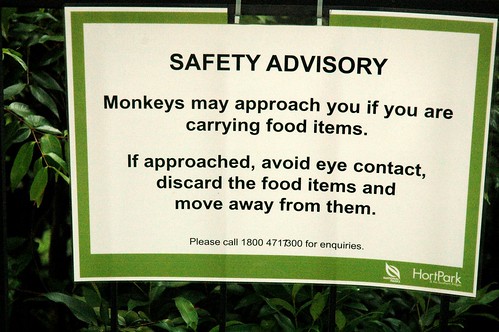
Hort Park (Animal Encounter)
Long-tailed macaque (Macaca fascicularis);
(Photo by gamebit)
(The photos in this post feature several macaques that have been encountered by visitors to various parts of the Southern Ridges over the past few years)

Cull monkeys if over-population is the problem (Mirror)

I WAS shocked to read that a search was on for a monkey believed to have attacked three people over the past three weeks ("Attacks spark hunt for monkey"; last Friday).

I was also disappointed with the response of National Parks Board (NParks) officials that the monkey-feeding problem might have reached a tipping point and that sometimes, animals just go crazy. Did NParks do an extensive survey or study to arrive at such conclusions?

Despite many reports of rogue monkeys attacking people and foraging for food at bus stops and households, NParks prefers to pin the blame on human feeding or provocation.

The attack on Hort Park visitor Tang Mae Lynn was apparently due to the monkey pack invading her personal space at the Forest Walk; she carried no food or drink. The problem could be due to monkey over-population or lack of monitoring by NParks officials.

I disagree with NParks about not going after the monkeys because the creatures belong there as much as humans. Does that mean we should silently accept monkey attacks as normal?

It is the job of NParks to ensure monkeys behave where they co-exist with us. NParks has a duty to patrol and monitor the growth of the animal population within the forest boundaries. The animals should be culled if they encroach on human living space and disturb our peace. They should also be punished if they misbehave.

NParks could install closed-circuit television (CCTV) cameras along the Forest Walk and areas prone to monkey attacks to check on the culprits while initiating programmes to control such disturbances so that both animals and people can share the limited space on our island in peace.

Paul Chan

Monday, July 11, 2011

A new look for Monday Morgue

P1140339
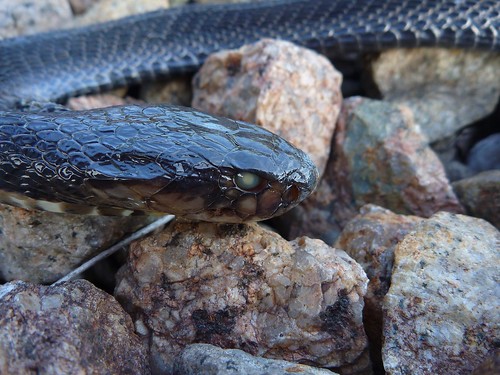
Equatorial spitting cobra (Naja sumatrana)
Woodlands, 27th June 2011

One of the regular features of this blog has been my weekly Monday Morgue updates, featuring photos of a dead animal I encountered somewhere in Singapore, whether it's dead fish on a shore or a crushed snail in my neighbourhood. You may have noticed a lack of new Monday Morgue entries on this blog in recent months. That's because after a suggestion from some friends, I decided to move my Monday Morgue posts over to a blog specially dedicated to sharing photos of animal carcasses.

Saturday, May 1, 2010

Lazy Lizard's Tales Special Feature: Raffles Museum of Biodiversity Research

P1380105

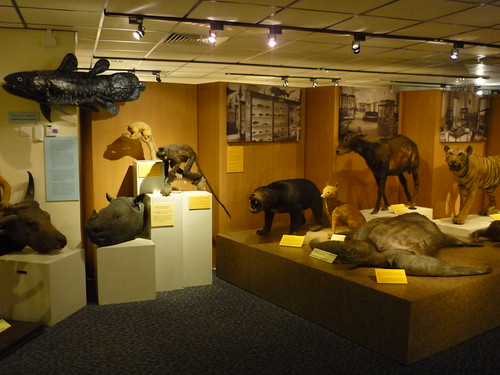
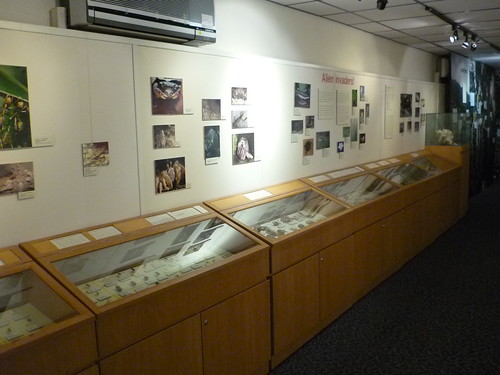
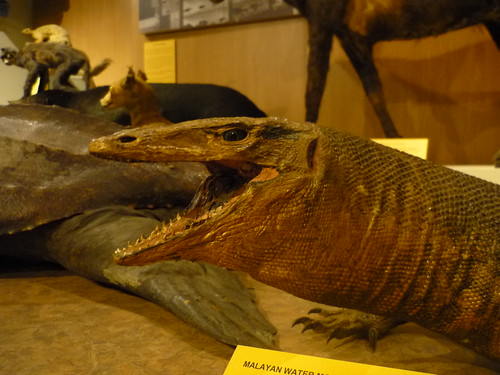
In commemoration of International Museum Day, which is held in May every year, and to help raise awareness of the Raffles Museum of Biodiversity Research, I will be doing a special feature this month on the Raffles Museum and some of the specimens in its Public Gallery.

The Raffles Museum, tucked away in a corner of the Faculty of Science in the National University of Singapore, is a museum that definitely deserves to be more widely known among the Singaporean population. Many people who pay a visit are surprised to learn about the amazing diversity of life that once inhabited Singapore, and are even more amazed to discover that despite our small size and the loss of much of our natural habitats, Singapore does still possess amazing biodiversity.

P1430409

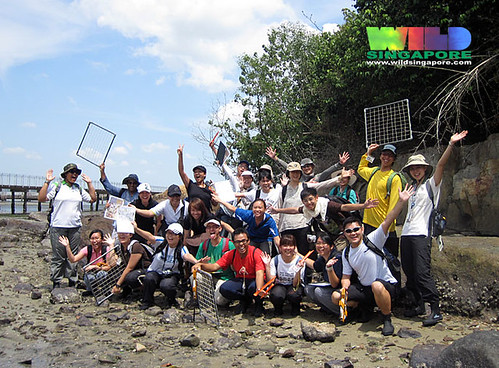
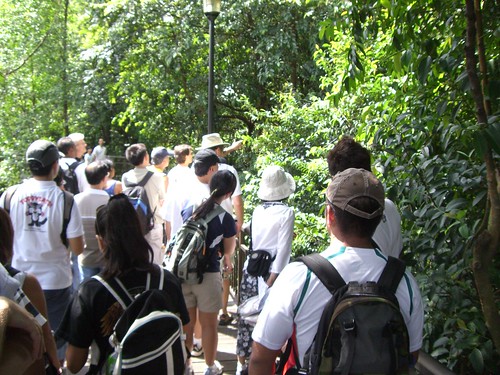
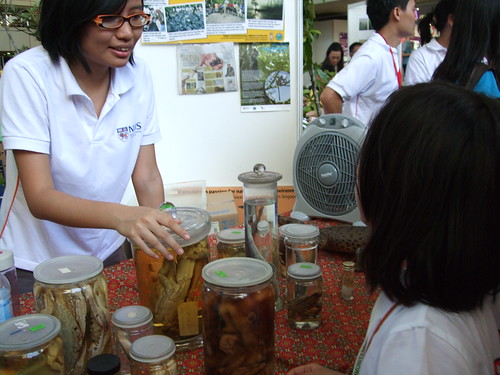
Public outreach is carried out with the help of guided walks and outdoor exhibitions, facilitated by the Raffles Museum Toddycats!, the volunteer arm of the museum.


(Photos by habitatnews)

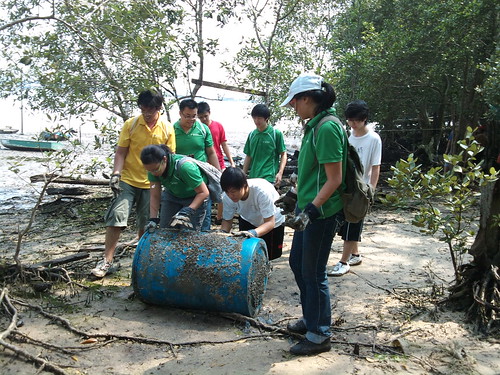
The museum is is the national coordinator for the International Coastal Cleanup Singapore, the oldest and largest environment programme in Singapore. This annual exercise helps gather data on the threat of marine pollution, while at the same time removing significant amounts of trash from our coastal areas.


(Photo by habitatnews)

Behind the scenes, the museum is involved in a wide range of research on biodiversity both local and regional, from recovering carcasses of local wildlife, to mounting expeditions to survey the biodiversity of other parts of Southeast Asia.

It publishes books and pamphlets on local biodiversity for the general public, as well as 2 of its own peer-reviewed journals, the Raffles Bulletin of Zoology, and Nature in Singapore.


Scientists from around the world visit the museum to examine specimens, in an effort to unravel the secrets of the tangled web of life.

What we have at the Public Gallery is but just a tiny fraction of the museum's vast collection of specimens, many dating back to the time of Sir Stamford Raffles and Alfred Wallace. Due to space constraints, less than 1 percent is currently on display, which honestly is a darn shame, because there is a very real need to educate the public about Singapore's natural heritage, and from my point of view, the current facilities are woefully inadequate. Considering that natural history museums can be considered cultural and national icons, and essential places for invaluable research and education, it is a great disservice that the Raffles Museum should be so overlooked and underappreciated.

A donation drive is currently going on, to raise funds so that the museum may expand into a proper national museum devoted to showcasing the region's biodiversity and natural history. At least 2,000 sq m, or 10 times the current museum's size, will be devoted to exhibition space. Imagine Singapore's very own version of the Natural History Museum in London, recently the focus of a 6-part BBC documentary.

NUS has set aside land for the museum, provided it is able to raise an additional $24 million by June. It is now truly a race against time, and the museum has put up a page where the public can help contribute to the cause.

In my own bid to help raise awareness, for the month of May, I will post a photo of a specimen in the Public Gallery every day. Some of these specimens are quite unique and special in their own way, and where possible, I will try to provide some information on these specimens.

For those of you who are familiar with the museum, which is your favourite specimen, and why? Leave a comment, and maybe you'll get to see a photo of it.

P1380126

Friday, March 12, 2010

Of moths and social media


(Taken by jinnslim)

Much has been said about online social networks; tools such as blogs, instant messaging, Facebook, Twitter, and many other platforms have made it possible for people to establish channels for communication and share information very easily.

Recently, I saw firsthand the relevance of social media where it comes to natural history.

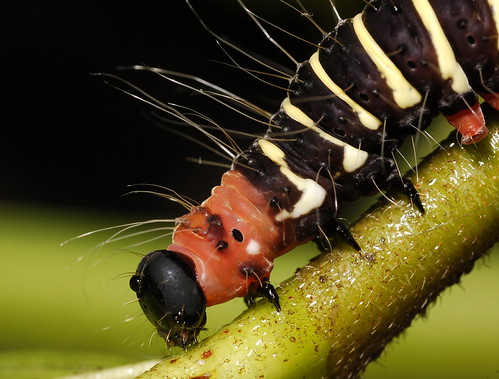
It all started more than 2 weeks ago, with a Twitter update by my girlfriend Christel, who saw several caterpillars in an area of the National University of Singapore (NUS).

caterpillar-twitter

Saturday, November 14, 2009

Missing

P1320079

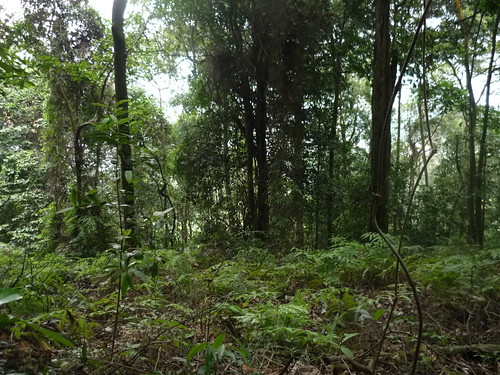
Singapore's last remnants of rainforest harbour few remaining hazards for careless hikers; having lost virtually all of our large mammals, wannabe explorers, blind and deaf to everything around them, have no fear of being ambushed and eaten by jungle denizens. By our hand, the forests have been tamed, sanitised, and made almost entirely safe for everyone to explore and enjoy. What remains is but a shadow of a forest primeval, a shell that at first glance still seems wild and untamed, but which actually disguises a biome thrown off kilter.

P1310841

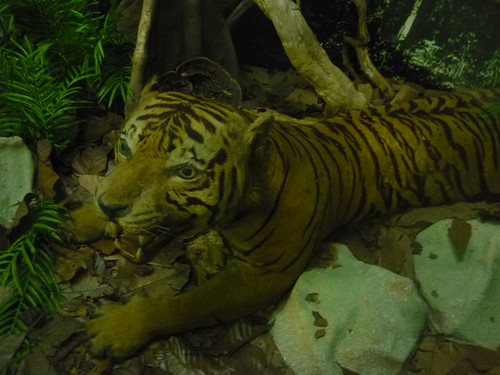
If only the forest could share the stories from its past, of the rumbling growls of tigers, of the clash of antlers as stags fought, of the thundering of hooves as wild boar charged through the undergrowth. In a forest devoid of its megafauna, and subsequently thrown into a state of disarray, do the trees clamour for the return of the tiger?

P1320181

The tiger is long gone, and will never return. And yet, if you just close your eyes, allow your mind to wander, and listen, you may just catch the slightest ghost of a roar of a long-dead big cat. And for a moment, you forget everything else, and you feel the rush of adrenaline coursing through your veins, as dulled senses are heightened once again, awakening memories once thought lost and buried.

Saturday, May 16, 2009

Happy 100 episodes, I and the Bird!


I and the Bird, currently the longest-running nature-related blog carnival, has just celebrated its 100th edition with a mega post over at the Nature Blog Network.

As mentioned on the I and the Bird homepage:
I and the Bird is a carnival celebrating the interaction of human and avian, an ongoing exploration of the endless fascination with birdlife all around the world. It is also a biweekly showcase of the best bird writing on the web published on alternating Thursdays.

There's a submission by yours truly in this latest edition, which is written in the form of an awards show; Call of the Koel wins the Sympathy for the Devil Award.

By the way, I forgot to mention that my post on the native parrots of Singapore appeared in I and the Bird #99, which was hosted over at Migrations.

Blog carnivals are an excellent way to link up with like-minded individuals, writing about a common interest. Being a truly cosmopolitan group, birds can be found virtually everywhere on the planet, and a typical edition of I and the Bird features blog posts by people based in all sorts of places, from the frigid Alaskan tundra to the tropical forests of Sri Lanka. The Bird Ecology Study Group has participated in numerous editions of I and the Bird, and has done much to share information about the behaviour of many Southeast Asian birds. After having followed the blog carnival for years, I decided to join in and do my part in raising the profile of Singapore's avifauna.

There are quite a few other nature-related blog carnivals that one can participate in; these include Scientia Pro Publica, Carnival of the blue, Circus of the Spineless, and Festival of the Trees. Others, like The Boneyard, Linnaeus' Legacy, Oekologie, and Tangled Bank, lasted for a while, but appear to be currently defunct.

Running a blog carnival and maintaining it requires a fair bit of effort and commitment, and 100 editions is a very impressive milestone for I and the Bird. So head down to Nature Blog Network and check out the amazing list of participants in this centenary edition, all of whom have much to share about the unique relationships we have with wild birds.

Monday, April 6, 2009

Any moray eel experts out there?

P26-03-09_19.14[01]

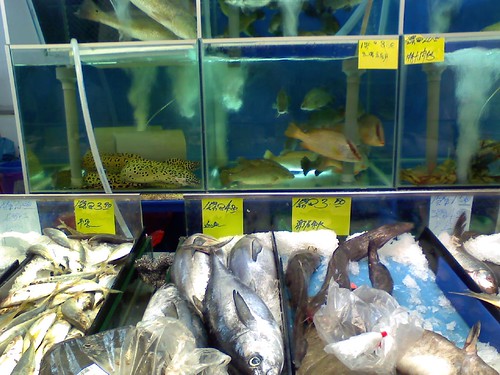
Is there anyone with some proficiency in identifying moray eels? I've got a few low-quality photos of moray eels in a fish tank that need identification. I've been looking through FishBase, but haven't been able to find a picture of a moray eel with a colour pattern that is a perfect match for the species in my photos.

P26-03-09_19.15

The moray eels were actually being offered for sale at the Bedok North outlet of Sheng Siong Supermarket. Yes, after writing about this post that was submitted to STOMP, I was curious enough to go and see if Sheng Siong was indeed selling moray eels for consumption.

Apologies for the lousy picture quality and resolution, but I only had my handphone camera with me at that time.

Does anybody want to try to help in determining the species of moray eel being sold? My hunch is that these are juveniles belonging to a species of Gymnothorax, but like I said, this is just a hunch.

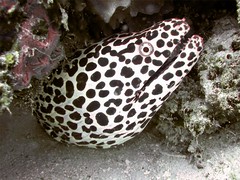
So far, the most similar species I've managed to find are the honeycomb moray (Gymnothorax favagineus) and black-spotted moray (Gymnothorax isingteena).


Left: Honeycomb moray, Lombok;
(Photo by linda.sonia)
Right: Black-spotted moray, Maldives;
(Photo by le congre)

But as you can see from the examples above and elsewhere on the Internet, these two species are covered in small black spots, not the larger rosettes seen on the eels at Sheng Siong. Of course, we cannot rule out the possibility that the juveniles might have a different colour pattern from the adults.

I did manage to find this photo, which bears a much closer resemblance to the ones in my photos:


"IMG_3685_Black-spotted moray (Gymnothorax melanospilus)", Pulau Dayang;
(Photo by Tiomanese)

Gymnothorax melanospilus is an outdated name used for both the honeycomb moray and black-spotted moray, which does strengthen my suspicion that the moray eels being sold at Sheng Siong could belong to either one or even both of these species. But just to make sure, I hope someone with greater expertise can confirm my suspicions, or even purchase a specimen for closer study.

According to FishBase, the honeycomb moray has a very high vulnerability to overfishing, while the black-spotted moray has been assessed to have high to very high vulnerability. Given that it is likely that the moray eels at Sheng Siong were wild-caught, and are juveniles to boot, one worries about the sustainability of the moray eel fishery that is the source of these eels.

Being apex predators, moray eels have small population sizes and tend to breed slowly. While fears are growing about overexploitation of other apex predators of the reef such as sharks, groupers and humphead wrasse, moray eels have not been receiving much attention.

As far as I know, there is no significant market for moray eel flesh in Singapore, although if this post over at Fishingnewsroom.com is to be believed, moray eels are consumed in Hong Kong. This next video shows moray eels being slaughtered at a Taiwanese restaurant:


So there is a commercial market for moray eels in the region after all.

I guess there's nothing wrong with eating moray eels; right now, my interest is more to do with whether there is any need to import and sell live moray eels for food here in Singapore. Just how much demand is there for moray eels? How many moray eels does Sheng Siong import and sell every week? Where do these moray eels come from? Which demographic purchases and consumes moray eels? There are so many questions left unanswered.

On the flipside, I wouldn't be surprised if the moray eels are being bought by opportunistic aquarists. One man's meat may be another man's pet...

Sunday, December 14, 2008

Thoughts on ZoukOut 2008


I had a splendid time at this year's ZoukOut, partying all night long until well past 7 a.m. today.

But even in the midst of all the hedonistic debauchery, as I danced along to the music in a state of euphoria, I couldn't avoid thinking about the possible environmental impact of massive events like this.

I wonder if the noise has any long-lasting adverse effects on the animals living nearby in the forest and in the sea. Does the loud music cause them any distress? Underwater World is also situated quite close to where ZoukOut was held, and the animals in the aquaria can't really swim away to escape the noise. Or are all of these creatures already acclimated to such nocturnal disturbances, given that this was only the most recent mega-party to take place on this stretch of beach?

Such impacts on the local wildlife are difficult if not impossible to determine, short of going snorkeling during ZoukOut and seeing if all the fish are fleeing for deeper water. But other impacts are more readily observed.

It was impossible not to notice the vast amount of disposable items used during the event. From the plastic bracelet that was snapped onto everyone's wrist once they'd entered, to the promotional flyers advertising Rip Curl discounts for ZoukOut attendees, I wondered just how much resources went into manufacturing items that would be thrown away by the end of the event. The most obvious example would have been the plastic cups that the drinks were served in. Of course, it makes life much easier for the staff, since they don't have to fight through the crowds to retrieve glasses and jugs, and besides, it does make the party safer for everyone (no worries about stepping on broken glasses with your bare feet), but I wonder if anyone out of the 26,000 partygoers reused their cups.

In the morning, as I was preparing to leave, it was easy to see all the litter that was strewn all over the beach. From flattened plastic cups and empty bottles of water, to plastic bags, lightsticks, half-deflated noisemakers, cigarette butts, pieces of tissue paper and even the odd slipper, I couldn't help thinking about the horrific mess, and the backbreaking work that lay ahead for those tasked to do the cleaning up. While the event organisers did install walls of netting that prevented the trash from falling into the sea (and stopped drunk people from drowning themselves), I hope none of the litter was picked up by the wind and blown over the barriers. Considering that I'd just helped out the day before at a walk organised by the Naked Hermit Crabs on a stretch of shore a very short distance away, it was a little upsetting to think about the possible effects that it would have on the marine environment.

I dare not calculate the carbon footprint for ZoukOut; the amount of fossil fuels that went into powering the lights and sound systems for just that one night must have been quite high. And then one must factor in all the fuel and other resources that went into the production and transportation of items used during the event, from the lanyard that everyone received, which came with a basic survival guide and lightstick attached, to all the bottles of soft drinks that were consumed. Take into account the fact that many of the people there at ZoukOut had flown in from overseas, and the carbon footprint increases even more.

A truly ironic moment came when Above & Beyond was spinning, and everyone had their arms and lightsticks in the air, singing along to Miracle by Oceanlab.

The DJs who make up Above & Beyond purchase carbon offsets to reduce the impact of their international tours and releases, and Miracle is probably the first (and only) tune by a trance act that attempts to inspire active effort to combat climate change. Yet at that point in time, seeing people around me flicking used cigarette butts to the ground, or tossing empty plastic cups to be crushed underfoot, I wondered if the lyrics of the song were lost on many of those in the audience:

Are you hoping for a miracle
As the ice caps melt away
No use hoping for a miracle
There's a price we'll have to pay


If there's any consolation, it appeared that the vast majority of people depended on public transport to enter and leave Sentosa. Part of the reason must have been the increased entrance fees for those entering by car and taxi, as well as the increase in parking fees for the public carparks closest to Siloso Beach. Of course, it made the ride on the Sentosa Express a lot squeezier than usual, but at least it was only for a few minutes.

Clouds had been building up for several hours, and there wasn't any sunrise to admire. When I reached VivoCity, it began to pour. I hope the barriers did their job, and that the rain didn't wash any of the trash into the sea.

Regardless of all these worries and concerns, I did enjoy myself tremendously, and it's highly likely that I'll be attending ZoukOut in subsequent years. But at the same time, I can't help but think about the ethical quandary I find myself in. Most of the time, I try my best to advocate sustainable use of the Earth's limited resources. Yet here I am, willingly taking part in an event that abets the consumption of staggering amounts of fossil fuels, leads to the generation of huge quantities of litter, and possibly causes some disturbance to the terrestrial and marine fauna living in nearby habitats. At best, you can call it cognitive dissonance. At worst, you can call it hypocrisy.

Come December 31st, yet another mega-party will be held on Siloso Beach. It probably won't be as massive as ZoukOut, but the problems will be the same. I do wonder if there's a better way to organise and operate these events, so as to reduce the carbon footprint and the amount of trash produced. It's an area that I think is deserving of further exploration. After all, everyone's free to party like there's no tomorrow (anyone recall that rave scene in The Matrix Reloaded?), but there has to be a way to ensure that the environmental costs are minimised as much as possible.

Wednesday, October 15, 2008

Blog Action Day 08: Poverty


poverty, n.

1. The state of being extremely poor.
2. The state of being insufficient in amount.


Today is Blog Action Day, and the topic of discussion this year is poverty.

As someone who is very concerned about environmental problems and conservation of biodiversity, the relevance of poverty to the issues closest to my heart might not be readily apparent. However, poverty and the state of the environment are actually inextricably linked together; to fully explain the complex and multi-faceted relationships between poverty and the environment would require a long series of posts, which I might have considered doing if I had more time, and greater expertise in critically analysing these issues. But suffice to say that all over the world, people trying to manage environmental degradation or conservation also have to grapple with issues of poverty. Whether it is combating desertification and staving off famine in the Sahel by introducing better agricultural practices, compensating farmers and livestock herders in India for losses resulting from wildlife depredations, or developing ecotourism in Venezuela so that villagers will see more value in keeping a rainforest rather than having it razed for timber, the conservationists and environmentalists involved in such projects and initiatives are all too aware that tackling environmental problems usually goes hand in hand with solving the problems of the people first.

Here in Singapore, where the vast majority of us do not have to worry about starving to death, bathing in rivers filled with raw sewage, or drinking water laden with toxic industrial waste, the lives of the millions for whom such scenarios are part and parcel of daily life can be difficult to identify with. Those horrific scenes of slums and famines, of fly-infested refugee camps and garbage-choked rivers, might seem distant, unfamiliar, even alien. But let's not forget that today, poverty still exists in Singapore, even though most of us choose to ignore it. There is still much that can be done to tackle this problem, both on a local and global basis.

When November and I made a television appearance on Rouge in April earlier this year as members of the Naked Hermit Crabs, we met two very passionate members of ONE (SINGAPORE), President Vernetta Lopez and co-founder Michael Switow. They spoke up about poverty, and the global movements that are calling for much more to be done. One of the biggest campaigns is Stand Up, which serves as a reminder to the rest of the world about the Millennium Development Goals, which leaders of 189 countries had agreed upon and signed in 2000.

Singapore will be taking part in this global mobilisation, with various events being held all across the country. This is the opportunity for all of us to stand up and speak out against poverty, and let our voices be heard.

For if we choose to continue to ignore poverty and the implications that it has on the environment, then perhaps it points to a very different sort of poverty within us.