Wednesday, May 21, 2008

Do not touch!

While exploring this stretch of Changi, I became acutely aware of why there is a need to avoid handling some of the marine life with bare hands.

Lots of people don't realise it, but there is quite a wide variety of marine life that can really make a shore trip thoroughly unpleasant, or worse, land you in hospital or even kill you.

When I first started out on the shores, I did everything with my bare hands, whether it was flipping over rocks, or picking up molluscs and crabs. Then I got smarter and wore gloves, the sort worn by durian sellers. I finally got myself a pair of cheap gloves made from rubber and polyester, similar to the sort worn by scuba divers. They've certainly protected me from the stings of anemones and the spines of sea urchins, and allowed me to handle dead fish without direct contact with my skin, but today, I realised that these gloves aren't always enough to protect my hands from potentially dangerous marine animals.
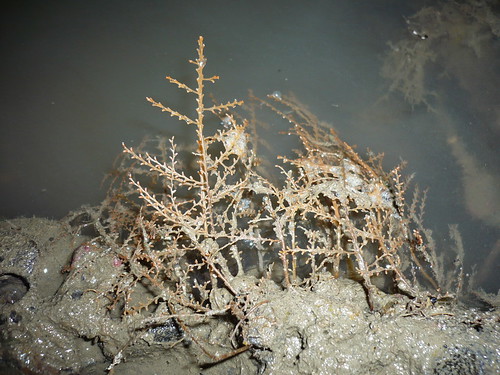
P1040858
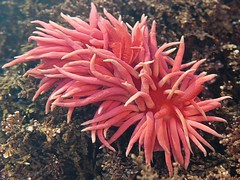
Hydroids, with their featherlike appearance, may look fragile, but they pack a punch. I haven't been stung by hydroids before, and I don't really want to know how it feels like to brush against them on a day when I'm not wearing my gloves.
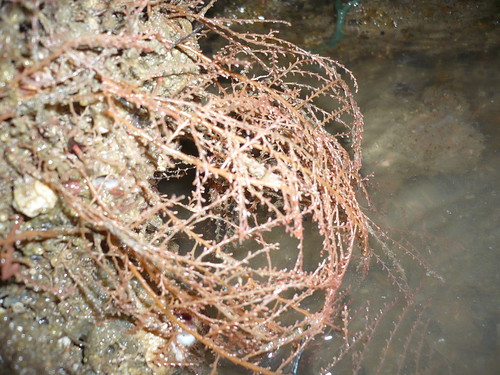
P1040982
Still, aren't they pretty to look at?

Near the end of our explorations, after the sun had risen, I first noticed a familiar pink shape squirming in the wet sand. "Bristleworm!"
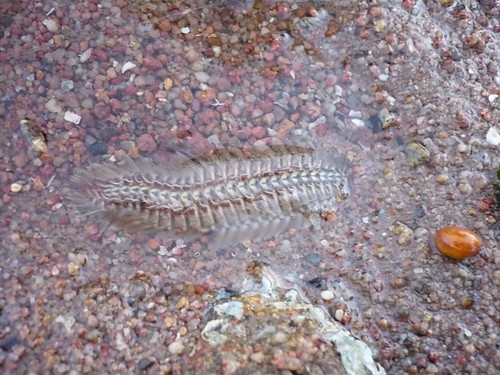
P1050027
It's Chloeia, a species of amphinomid polychaete that is quite often seen on these northern shores.

These worms are often nicknamed 'fireworms', because of the fine setae ('hairs') that they possess. These break off easily and can become embedded in the skin, causing itchiness, inflammation and rashes. Certainly an effective defense against predators. You can think of them as the marine equivalent of hairy caterpillars, many of which are covered in urticating hairs and should NEVER be picked up with bare hands. If there's any consolation, according to this paper, there are no toxin-producing glands associated with the setae.

As we gathered round, I noticed that the worm was not alone. "Hey, another one!" "One more!" "And another one!"

In all, there were at least seven of these worms on a small patch of beach!
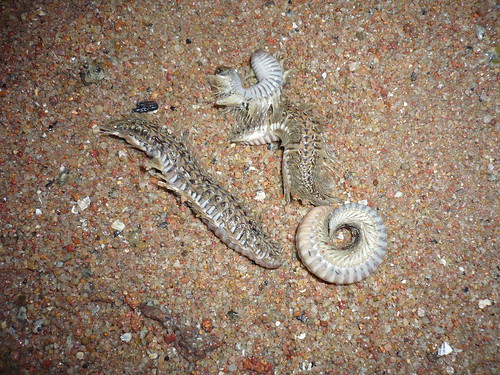
P1050016
Seeing them writhe about makes my hair stand.


These worms were being mobbed by springtails (Pseudanurida billitonensis ), which are tiny 6-legged arthropods closely related to insects. The springtails commonly found on our shores are carnivores, scavenging and feeding upon dead and dying marine animals washed up on the shore.


Here's a heavily zoomed-in photo of some springtails, taken by Marcus.

Anyway, I digress.

Since I was wearing a glove on my left hand, I was pretty confident in handling these worms without harm.
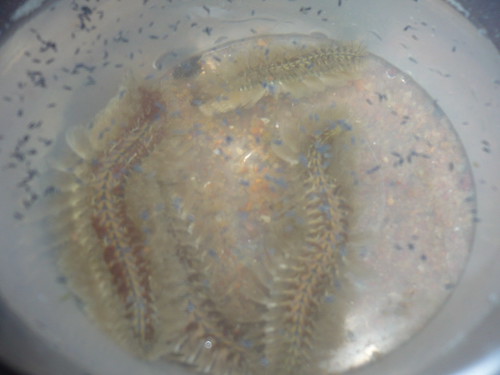
P1050015
I put some of these worms together in a container. The black dots are the springtails.
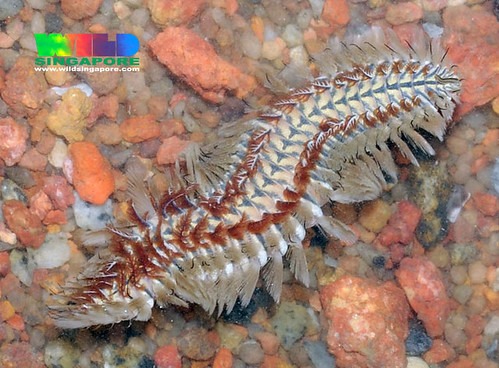

(Photo by Ria)
These worms can swim, using wavelike movements of their parapodia and setae to paddle themselves along. We were keen on documenting this swimming behaviour, so I picked one up, and placed it in a small sheltered pool among the rocks.

That was when things didn't quite go exactly as I expected. A few seconds after placing the worm in the water, my fingertips inside the glove started to itch. It was a mild burning sensation, which to me felt like a mixture of pinpricks and being bitten by several ants.

I quickly took off my glove and dipped my hand in the sea (NOT the same pool the worm was swimming in). Thankfully, the itchiness quickly subsided. Maybe only a few of the setae managed to penetrate my glove and reach my fingertips, which would mean that I didn't get a full dosage of the worm's potential firepower.

From now on, I'm never handling Chloeia ever again. What's up with these worms named after women? Eunice has sharp jaws that can deliver a painful bite, and Chloeia is covered with tiny stinging 'hairs'. Ugh.


(Photo by Kok Sheng)
We returned the worms to the beach, by tipping the container over. Some of them headed out to sea, but one was almost immediately attacked by a small swimming crab! I guess the hard exoskeleton of the crab provides some protection from the worm's setae.

So these worms do have their enemies, despite their urticating setae.

To end off, the setae of fireworms really do cause a burning, itchy sensation, and they do cause numbness. I was wearing gloves, so I was protected from the worst of it, but I still got affected. So don't go around picking up these worms with your bare hands, or you'll definitely regret it.

Well, it could have been a lot worse for me, based on what I've been reading. I'm glad that my cheap gloves worked pretty well in protecting me, even if it was only up to a certain extent. Thorough washing under running water should have removed any setae left on my glove, and my fingers are fine, though I must admit, while I'm typing this entry, there is a slight numbness in the index and middle fingers of my left hand, which were the most severely affected by the setae.

Hmm... maybe I should get someone adventurous (or downright silly) enough to see which is worse: having a handful of hydroids, or a fistful of fireworms? We could do something like the marine equivalent of the Schmidt Sting Pain Index (with descriptions of various ant, bee and wasp stings from "a tiny spark has singed a single hair on your arm", to "like fire-walking over flaming charcoal with a 3-inch rusty nail in your heel"), comparing the severity of the stings of a variety of marine organisms. Of course, with creatures like stonefish, stingray, and cone snails, there is a very real element of risk involved. But hey, it's worth making such a sacrifice for science!

Coming up: Death on the shores. Is the release of captive animals kindness or cruelty?

This is part 3 of a 4-part series on a trip to Changi on 21st May, 2008.

Part 1: Changi's Hidden Wonders
Part 2: Echinoderm Hangout
Part 3: Do not touch! (this post)
Part 4: Death on the shores


DISCLAIMER: The writer will not be held liable for any pain, agony, trips to the hospital, medical fees, or deaths resulting from attempts to fool around with venomous, biting, stinging, or otherwise potentially harmful marine organisms.

Echinoderm hangout

P1040974

This is my first-ever trip to this stretch of Changi, but taking into consideration the echinoderms I encountered on my previous trip to a different part of Changi, I think this whole area is really proving to be a great place for echinoderm diversity.

P1040785
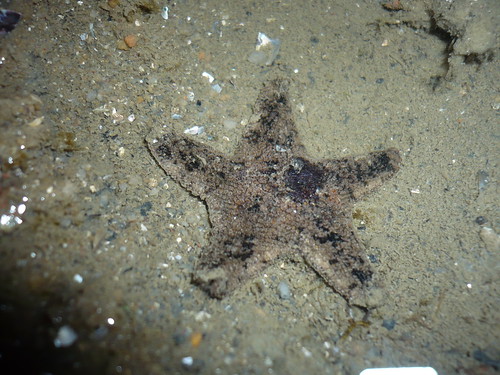
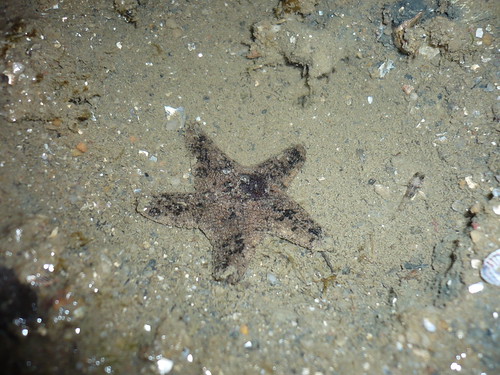
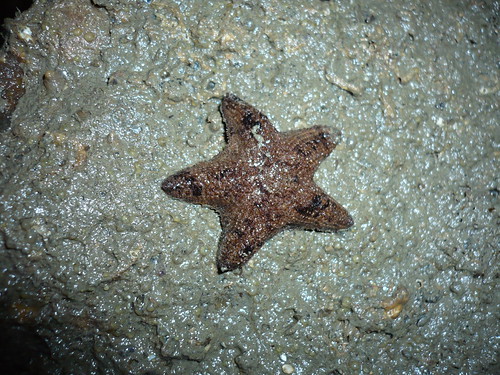
Kok Sheng was supposed to be looking for the spiny sand star (Astropecten indicus), but instead we found plenty of Asterina coronata. It doesn't seem to have a common name, so we affectionately nickname it the rock star.

P1040779
Do you see the cute baby goby next to the sea star? It's barely 2 centimetres in length!

P1040843
This rock star is more orange in colour.

P1040841
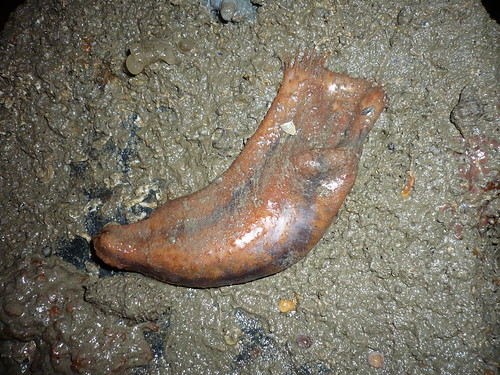
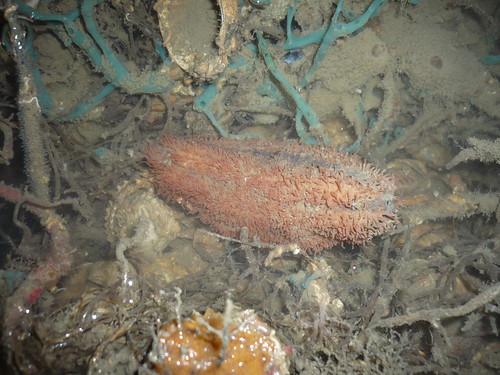
This is a semi-deflated cucumarid sea cucumber, seeking out the dampness beneath a rock while waiting for the tide to rise. It's listed in A Guide to the Sea Stars and Other Echinoderms of Singapore as 'cucumarid sp. 1' on page 156.

P1040869
I placed it in the water, where it looks a lot happier.

P1040962
P1040990
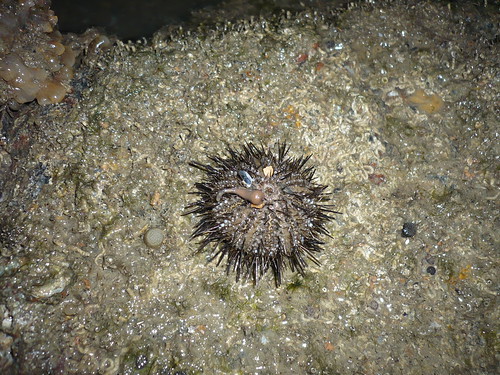
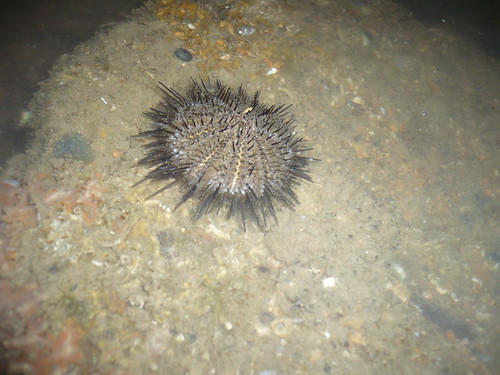
Sea urchins with short black spines (Temnopleurus toreumaticus?) can be found clinging to the rocks.

P1040973
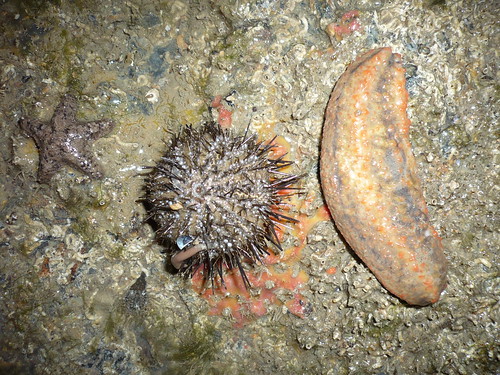
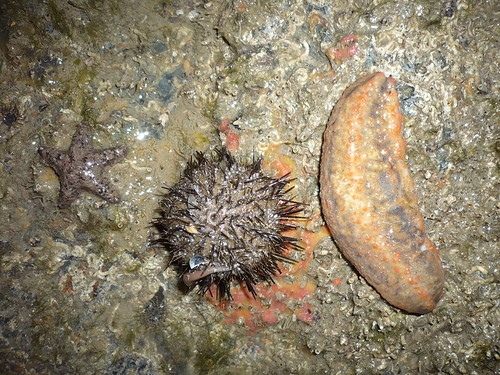
An echinoderm gallery! Asteroidea (sea stars), Echinoidea (urchins and sand dollars), and Holothuroidea (sea cucumbers) are represented here. Now I just need to repeat this feat with the addition of a brittle star (Ophiuroidea) and a featherstar (Crinoidea), and I'll have a complete set.

I've never found echinoderms very fascinating, being more into molluscs and crustaceans in general. But I have to admit, there is a certain excitement in finding echinoderms. Before I started getting more involved this year, I'd only seen a tiny handful of Singapore's echinoderm diversity. But after having gone on more shore trips, I'm really beginning to realise just how wonderfully diverse they are, in terms of morphology and ecology.

Coming up: things you should not touch, and death on the shore. Stay tuned.

This is part 2 of a 4-part series on a trip to Changi on 21st May, 2008.

Part 1: Changi's Hidden Wonders
Part 2: Echinoderm Hangout (this post)
Part 3: Do not touch!
Part 4: Death on the shores

Changi's Hidden Wonders

P1040649

Update: Take a look at what some of the others found, at the wildfilms blog, and God's wonderful creation.

A rocky shore, strewn with pebbles, gravel, and bits of rubble and even man-made debris, might seem barren and lifeless, devoid of the rich biodiversity that can be found on other shores. The waters are murky and loaded with sediment, the rocks are coated with algae and sponges and can be slippery, and the wet sand is mixed with fine silt, so that one sinks a little while walking along the beach. But for an inquisitive and intrepid band of four, this little stretch proved to be a treasure trove of remarkable and beautiful wonders.

This is the first time I'm exploring this area, one of the last natural rocky shores left on Changi, and once again, I found plenty of amazing little creatures that manage to survive despite all the development and pollution that's occurring in Singapore.

P1040652
The rocks were pockmarked with these little blobs, which are small anemones waiting for the tide to return.

P1040655

Squatting down and flipping over rocks can yield amazing and marvellous discoveries. Plenty of creatures make their homes beneath the rocks.

P1040661 P1040663
P1040667 P1040685
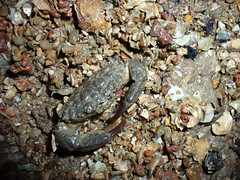
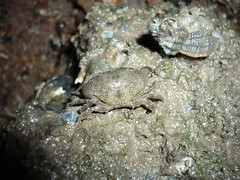
Like these tiny crabs, most of which are barely the size of my thumbnail.

Friday, May 16, 2008

Nudibranchs for the aquarium


Upper left: Hermissenda crassicornis; Upper right: Okenia rosacea;
Lower left: Peltodoris nobilis; Lower right: Melibe leonina;
Four nudibranch species exhibited at the Monterey Bay Aquarium

In the previous post, I have gone to great lengths to show why most nudibranchs are simply not meant to be kept in aquariums, mostly due to their highly specialised diets. However, there is a small minority of nudibranch species that can survive in an aquarium, provided their food requirements are met.

NUDIBRANCHS IN PUBLIC AQUARIUMS

A quick search reveals that few if any public aquariums have nudibranchs on display. Perhaps the most notable exception to this rule is the world-famous Monterey Bay Aquarium. It has four species on display, three of them in its Rocky Shore exhibit:


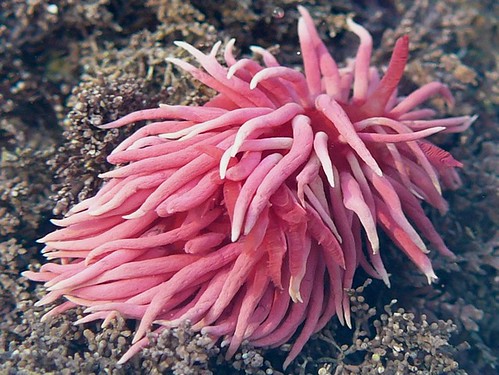
Hermissenda crassicornis, which is an exception among nudibranchs, in that it is quite a generalist where it comes to feeding. More on that later. (Photo by * Alicia)


Okenia rosacea, which is a predator on a particular species of pink bryozoan. (Photo by jalbersmead)


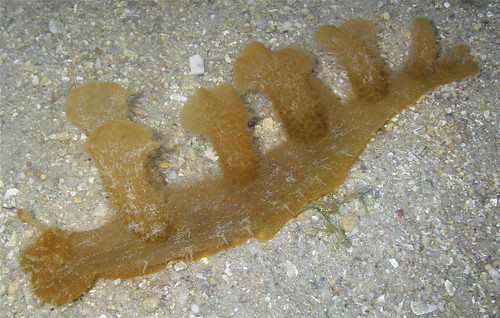
Peltodoris nobilis, a specialist on sponges. This species is actually said to give off a citrus scent when disturbed, and is affectionately known as the 'sea lemon'. (Photo by Bill Bouton)

Note that these are all species that can be found in the waters of Monterey Bay. Presumably, apart from the generalist Hermissenda crassicornis, the aquarium either manages to culture the necessary prey species in captivity, or has a steady supply of prey from the wild to feed their captive nudibranchs.

NUDIBRANCHS AROUND THE WORLD

Many people might be under the impression that nudibranchs are an exclusively tropical group, but the fact is, nudibranchs are a truly global group. They can actually be found in all the world's oceans, living within a wide array of habitats and ecosystems, encompassing lifestyles such as pelagic drifters in the open ocean, and colourful benthic dwellers in the tropical coral reefs of the Indo-Pacific and kelp forests of North America's Pacific coast; from the seas surrounding the British Isles to New Zealand, and even in frigid Antarctic waters!

Instead of having to buy nudibranchs collected from halfway around the world, aquarists might do better to look at the nudibranch diversity closer to home, as it would definitely be much easier to find and obtain the right prey for local species.

Which brings me to another point, that of proximity to the shores. Aquarists interested in trying to keep nudibranchs in aquaria, and with ready access to the shore, can always experiment with those found locally. Not only is it possible to directly observe the behaviour of nudibranchs in the wild and find out their diet, it is possible to collect nudibranchs along with their prey. If attempts to culture the necessary prey species in captivity fail, the aquarist still has the option of collecting more of the prey species from the shore. Of course, all this should be done only when local environmental conditions are able to sustain a limited level of collection.

Hermissenda crassicornis: THE BEST CANDIDATE FOR THE AQUARIUM?

I mentioned earlier on that the opalescent nudibranch (Hermissenda crassicornis) is quite a generalist where it comes to diet, which lends it particularly well to being raised in captivity.

Its primary prey in the wild appears to be various species of hydroids, although observation in the wild have recorded it preying on other nudibranchs and possibly small bivalves, and experiments in marine laboratories have shown that it will also feed on various sea anemones and tunicates, and even pieces of squid and mussel. In the laboratory, this species can even be raised on fish food pellets!

Possibly due in part to the ease of keeping it well-fed in an aquarium, Hermissenda crassicornis has become a laboratory animal model for research on the neurobiology of learning and memory, and can also be readily cultured in captivity, with the newly hatched larvae being raised on planktonic algae. Some examples of studies which focus on this slug can be seen here.

Thus Hermissenda crassicornis would seem to be the perfect nudibranch for a home aquarium. It's colourful and attractive, and it won't slowly starve to death in an aquarium. Unfortunately, its range is limited to the North Pacific, including the Pacific coast of North America from Baja California to Alaska, as well as the seas around Japan and the Korean Peninsula. The waters in these areas are certainly not tropical, and it can hence be inferred that while Hermissenda crassicornis would make a colourful and interesting addition to a coldwater marine aquarium, it probably would not do so well in a tropical reef aquarium.

Another species of nudibranch which has been reported to have somewhat indiscriminate dietary preferences (compared to other nudibranchs) is Austraeolis ornata from the coasts of southern Australia; this species has been observed consuming various anemones, stranded jellyfish, and other nudibranch species, and has even taken carrion under captive conditions. Unfortunately, like the preceding species, it too is an inhabitant of temperate waters, and hence is unsuitable for tropical aquaria.


(Photo by Dave Harasti)

Melibe: A NUDIBRANCH SUITABLE FOR THE AQUARIUM?

The fourth species of nudibranch exhibited at the Monterey Bay Aquarium in the Kelp Forest exhibit is a very different sort of creature:


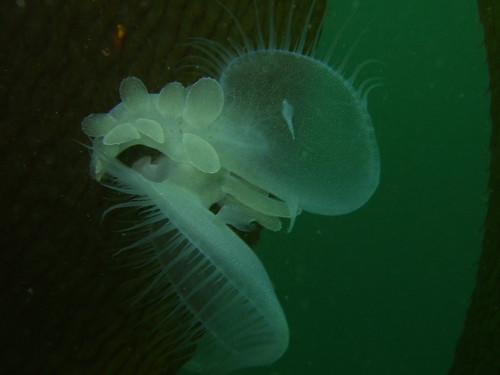
Melibe leonina, a predator on tiny crustaceans. (Photo by bswift)

Nudibranchs as a whole are already pretty weird creatures, but those from the genus Melibe are simply downright bizarre.


Melibe sp., Cyrene Reef (Photo by Chay Hoon)

Most nudibranchs, like the vast majority of gastropods, possess a toothed radula, which they use to slowly rasp away at their food. Melibe are unique in that they have actually lost the radula; instead, they possess an expandable oral hood which they use to engulf zooplankton and other tiny marine creatures.


(Photo by Ria)


The oral hood is especially obvious in these Melibe leonina. (Photo by jrixunderwater)

Logically, it would appear that various species of Melibe might be among those nudibranchs that could plausibly survive in an aquarium, provided that there is a regular supply of tiny live prey, such as brine shrimp, mysids, amphipods, or copepods. The technology to culture these crustaceans as live food is already well established.


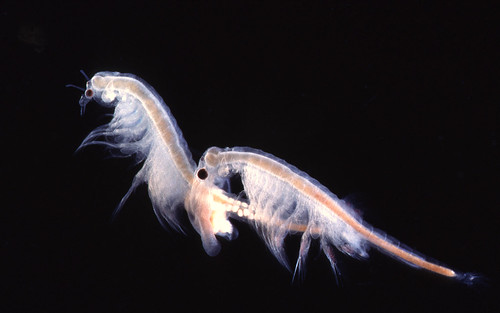
The brine shrimp Artemia salina, commonly raised as live food for various organisms in the aquarium hobby. Special variants are marketed as novelty pets called 'Sea Monkeys'. (Photo by el viejo)

Like Hermissenda crassicornis, Melibe leonina has been used in laboratories as a model for neurobiology research, with some examples of studies done on this species shown here. Many papers describing work done on captive Melibe, such as this paper, mention that the use of cultured Artemia to feed these nudibranchs. However, this species has yet to be bred in the lab, and so the laboratory animals are made up of adults collected from the sea (this species can be seasonally abundant), with larvae being hatched in the lab from eggs brought in from the wild.

Melibe leonina is another nudibranch that is native to temperate waters off the Pacific coast of North America, from Baja California to Alaska, and so like Hermissenda crassicornis, is not suitable for tropical aquaria. But if the feeding biology of other Melibe species is similar to that of M. leonina, it would be likely that all other species in the genus have the potential to be suitable candidates for aquariums.

However, given that some species of Melibe can grow to quite large sizes, with M. mirifica said to grow more than 30 centimetres in length and M. japonica supposedly reaching 50 centimetres, such huge individuals would require large aquariums, and these might be more than capable of consuming much larger prey than mere brine shrimp.


Melibe ?mirifica (Photo by Ben Naden)

As for suitability for a reef aquarium, presently it appears that no one has deliberately attempted to keep a Melibe within a reef aquarium setup yet, although some aquarists have found Melibe engeli in their aquariums, possibly having stowed away in shipments of live rock.

A captive Melibe will probably need a special tank all to itself, or at least require peaceful tankmates that won't try to eat it, or that it won't try to eat. Another point to consider is whether its tankmates will compete with it for food; the nudibranch might be unable to get its fair share of brine shrimp if all its food is being relentlessly snapped up by fish. In comparison with other nudibranchs, Melibe are not very poisonous, though they do give off noxious secretions that oddly enough, have been reported to smell sweet and fragrant. However, camouflage is their primary means of defence, and if that fails, Melibe will escape predators by actively swimming away (combined with autotomy, or shedding of their cerata). Which might cause some trouble in a reef aquarium, since a swimming Melibe might just blunder right into a large sea anemone or colony of zoanthids and get stung to death, or get sucked up by the filter intake.

At least these nudibranchs do have a decent chance of surviving in an aquarium, even if chances are they have short lifespans anyway. Which is more than can be said about virtually all other nudibranchs sold in the aquarium trade, which are in all respects as good as dead once removed from their natural environments and separated from their prey.

PEST CONTROL NUDIBRANCHS

For some species of nudibranchs, their highly specific diet works to their benefit where it comes to ridding aquariums of unwanted 'pest' species.

It is sometimes very ironic that the desirable corals and sea anemones that one often forks out exorbitant sums of money to purchase can be quite delicate, whereas some species accidentally introduced into the aquarium often do a little too well. Not only can these pests affect the aesthetic value of the aquarium, they can also even affect the health and survival of their tankmates.


(Photo by PhotoByMark)

Glass anemones (Aiptasia spp.) are the bane of the reef aquarist; these unwanted anemones can reproduce so well in aquaria, that they often overwhelm and outcompete other sessile organisms, stinging expensive corals, giant clams, and zoanthids to death. Numerous solutions have been proposed, from physical removal of the anemones to injecting chemicals to kill them, to using predators to control their numbers. All have their advantages and drawbacks; many of the possible predators of glass anemones will also nibble expensive invertebrates in the aquarium.


Once established, Aiptasia can quickly reach plague proportions. (Photo by robertopalmari)


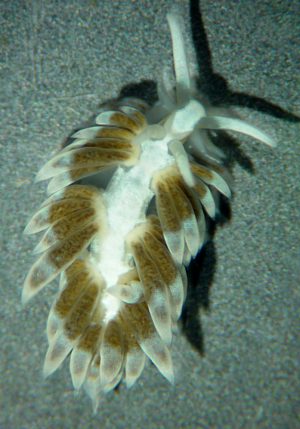
Aeolidiella stephanieae (Photo from Sea Slug Forum)

One tiny species of nudibranch from Florida, Aeolidiella stephanieae is currently being promoted as an effective way to get rid of Aiptasia without threatening other aquarium inhabitants. This is one of those species which is able to retain and use the zooxanthellae from its prey, which is predominantly if not exclusively composed of Aiptasia. However, the zooxanthellae alone cannot sustain the nudibranch indefinitely, so it has to feed often. Because nudibranchs in general are so particular about their food, the claims that this species can be a reef-safe and effective means of Aiptasia control appear to be accurate. Their prey is extremely easy to culture in captivity, and so are the nudibranchs themselves.


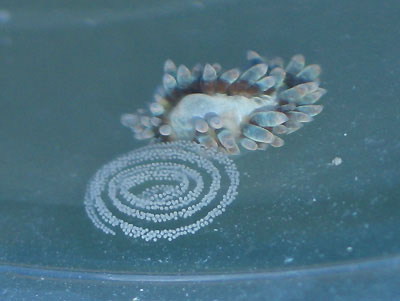
Aeolidiella stephanieae laying eggs (Photo from Reefkeeping)


Swarm of juvenile Aeolidiella stephanieae feeding on Aiptasia. (Photo from Berghia.net)

Many nudibranch species have a planktonic larval stage, where the newly hatched young float about in the plankton, feeding on various other planktonic organisms. Hermissenda crassicornis and Melibe leonina, discussed earlier, are among them. This need to keep the planktonic larvae alive is often the greatest hurdle to successfully breeding many marine animals in captivity. However, Aeolidiella stephanieae has a very short non-feeding planktonic larval stage; these larvae quickly metamorphose into miniatures of the adults, ready to feed on Aiptasia. Once established in an aquarium, a single pair of Aeolidiella stephanieae can quickly form a small breeding colony that continues to propagate itself as long as Aiptasia are present.


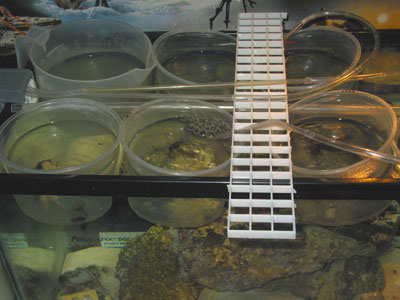
An example of a simple and inexpensive setup to culture Aeolidiella stephanieae. (Photo from Reefkeeping)

The catch though, is because they are so small, stocking them in insufficient numbers in large aquaria may mean that the nudibranchs quickly consume all the Aiptasia in the immediate vicinity, then starve to death before they manage to consume the last remaining Aiptasia elsewhere in the tank, which will then quickly proliferate once again in the absence of their predator. They may also be vulnerable to predatory tankmates such as fish, shrimp and crabs, many of which will not be able to resist such bite-sized morsels.


Pair of Aeolidiella stephanieae attacking Aiptasia (Photo from Conscientious Aquarist)

Many websites discussing the use of these nudibranchs as pest control encourage buyers to culture Aiptasia in a separate container so as to provide a continuous food supply. This way, one can maintain a ready stock of nudibranchs on standby to combat future blooms of Aiptasia in the main aquarium. An alternative is to remove the nudibranchs with a pipette once they've done their job and pass them on to a friend who needs them.

There is some confusion regarding the species used to control Aiptasia in aquarium; the species Aeolidiella stephanieae was described only in 2005. Prior to that, this species was marketed as Berghia verrucicornis, which is a completely different species known from the eastern Atlantic and Mediterranean. Thus many of the articles discussing the captive care and propagation of Berghia verrucicornis, such as seen here, here and here, are actually referring to Aeolidiella stephanieae. And in fact, as this link shows, it is possible that more than one species is actually being sold and researched under the name of Berghia verrucicornis.


Spurilla major (Photo taken by * Alicia)

Another species that has been cultured and marketed as a predator of Aiptasia is the Indo-Pacific species known as Berghia major. However, like Aeolidiella stephanieae, this species apparently does not belong to the genus Berghia, and is now known as Spurilla major.


Spurilla neapolitana (Photo by jordirs123)

Another species, Spurilla neapolitana from the Mediterranean, western Atlantic, and eastern Pacific, has also been recorded to consume Aiptasia in the aquarium. An article on the care and breeding of this species in the aquarium is available here.


Two Spurilla neapolitana feeding on Aiptasia. (Photo from Reefkeeping)


Spurilla neapolitana also feeds on majano anemones (Anemonia majano), another undesirable anemone species that will sting other invertebrates in the aquarium. (Photo from Reefkeeping)


Chelidonura varians, a predatory cephalaspidean slug. (Photo by Erwin Kodiat)

Another slug that one may find in the aquarium trade being promoted as pest control is Chelidonura varians from the Indo-Pacific. This is a predator that feeds on small acoel flatworms (usually Convolutriloba retrogemma), which can quickly become a harmless but unsightly plague in the aquarium.

However, despite this name, it is not a nudibranch, but instead belongs to a closely related group of gastropods known as the headshield slugs. That has not prevented tragedy from occurring, like this person who ordered Chelidonura varians, but instead ended up receiving the nudibranch Chromodoris annae. Needless to say, these nudibranchs are most likely going to slowly starve in the aquarium. This problem is likely exacerbated by the fact that like all other sea slugs, Chelidonura varians is sometimes marketed as a nudibranch, under the name of 'blue velvet nudibranch', when it is not a nudibranch.

Coming up, nudibranchs can find their way into aquariums, as stowaways and hitchhikers. Is this a good or a bad thing? What can you do as a responsible aquarist?

This is part 4 of a 5-part series on nudibranchs, inspired by a feature article on nudibranchs on the National Geographic website.

Part 1: Nudibranchs are beautiful
Part 2: What is a nudibranch?
Part 3: Are nudibranchs suitable for aquariums?
Part 4: Nudibranchs for the aquarium (this post)
Part 5: Nudibranchs: Stowaways and Hitchhikers