Ever since I obtained some gear from Timberland that I will be using for my upcoming trip to Inner Mongolia and Jiuzhaigou, I've been wanting to try bringing my jacket and boots out on a hike somewhere in Singapore. Not only was it a good way for me to get used to wearing them, I decided to take the opportunity to show off the items I received in the best possible way: with a little photoshoot.
Showing posts with label Tampines. Show all posts
Saturday, August 13, 2011
Timberland Earthkeepers: Breaking in the Gear
Ever since I obtained some gear from Timberland that I will be using for my upcoming trip to Inner Mongolia and Jiuzhaigou, I've been wanting to try bringing my jacket and boots out on a hike somewhere in Singapore. Not only was it a good way for me to get used to wearing them, I decided to take the opportunity to show off the items I received in the best possible way: with a little photoshoot.
Monday, July 26, 2010
Monday Morgue: 26th July 2010
Javan myna (Acridotheres javanicus)
Tampines, 13th June 2010
Oriental Bird Images
Internet Bird Collection
Sunday, April 18, 2010
Please tell me if you see Rambo
STOMPer ramram is desperately looking for his pet lory, Rambo. It flew away on Sunday (18 April) at about 10am.
The STOMPer said in an email:
"Rambo, my lory flew away on Sunday (18 April), at around 10am in the area of Tampines Street 83.
"If you see him, please call me at [censored].
"I'm desperately looking for him."
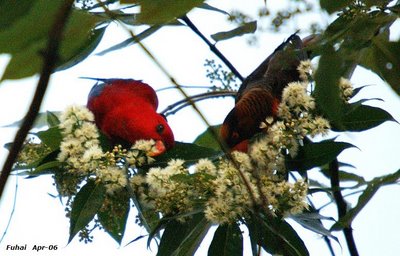
Rambo is probably a black-capped lory (Lorius lory), a species native to New Guinea and surrounding islands.
(Photo by jormungund)
If this particular bird is not retrieved, and manages to survive in the wild, it will add to the growing list of exotic parrots recorded in Singapore. So far, there is only 1 record of black-capped lory in Singapore, an individual seen at the Singapore Botanic Gardens in 2000.
(Photo by kampang)
While only a small handful of non-native parrots have established breeding populations here in Singapore, there is always the chance that for other species, enough individuals may escape to eventually form a breeding pair. Parrots are highly popular as pets, and combined with the number of captive wildlife facilities we have here, escapes are more or less inevitable. What matters is whether enough birds escape to reach critical mass, such that the birds are able to breed and form a self-sustaining population.
This has happened with the rainbow lorikeet (Trichoglossus haematodus), which has been recorded breeding in Singapore.
Originally native to a large area of Australia, Maluku islands, New Guinea, New Caledonia, Solomon Islands and Vanuatu, the rainbow lorikeet is now considered a fairly common introduced resident.The Bird Ecology Study Group dedicated a short series of posts on the rainbow lorikeet, its status as a pest in Western Australia (where it is not native), and the possibility of it becoming a pest in Singapore.
(Photo by air17)
Lories and lorikeets are characterised by the unique brush-tipped tongue, which they use for feeding on nectar and soft fruits. The group as a whole is native to Wallacea, New Guinea, Polynesia and Australia.
Besides the black-capped lory and rainbow lorikeet, the chattering lory (Lorius garrulus) from the northern Maluku islands has also been recorded in Singapore, with an adult female seen at the grounds of Singapore General Hospital in 1951.
(Photo by gwashley)
The red lory (Eos bornea), which hails from the southern Maluku islands, is present in sufficient numbers to be considered a common escapee throughout Singapore. Sightings are concentrated around the Botanic Gardens and the vicinity of Bukit Timah Road, Central Catchment Nature Reserve and Sentosa; sightings elsewhere have been one-off and are likely to be fresh escapees. The first record is of a pair seen at Woodleigh Park in 1987. Breeding is suspected.
(Photo by ♥ Airey)
One of the photos in this post not only shows a record of a red lory in Singapore, but also indicates the presence of the dusky lory (Pseudeos fuscata) from New Guinea in Singapore.
(Photo by sypix)
One of the comments also reveals that mixed flocks of lories have been seen in Singapore, comprising a mixture of species such as red lory, dusky lory, blue-eared lory (Eos semilarvata), blue-streaked lory (Eos reticulata) and violet-necked lory (Eos squamata).
Blue-eared lory, endemic to the island of Seram in the southern Maluku islands;
(Photo by Carlos Urdiales)
Blue-streaked lory, a species native to the Tanimbar islands;
(Photo by allereb)
Violet-necked lory, native to northern Maluku and Raja Ampat islands;
(Photo by Saad1995)
These exotic birds are colourful and endearing, but it remains to be seen if they pose any threat to native birds, especially where it comes to competition for food and nest-holes.
Labels:
birds,
introduced species,
pets,
STOMP,
Tampines
Sunday, March 28, 2010
Photos from Tampines bushfires: Part 2
This is a continuation of my previous post on the bushfires that took place along a particular stretch of Tampines Avenue 9. Jeremy Chin, who submitted his photos to STOMP, has kindly shared his photos with me.
Here are his photos of the bushfire that took place on 3rd March 2010, some of which were posted on this submission to STOMP.
Thanks so much to Jeremy for sharing his photos and for allowing me to post them on my own blog. Credit also goes to STOMP for having posted his submissions in the first place. While I do not care for much of the content that goes up on STOMP, there are quite a few relevant or interesting posts that deserve to be shared and publicised. Whether it is about wildlife sightings, explorations of our parks and nature areas, human misbehaviour or ignorance, many of the posts on STOMP do serve as a platform for education and awareness with regards to local issues to do with nature and the environment.
Part 1: Bushfire at Tampines, 30th January 2009
Part 2: Bushfire at Tampines, 3rd March 2010 (this post)
Photos from Tampines bushfires: Part 1
Several weeks ago, I blogged about a submission to STOMP about a large bushfire along Tampines Avenue 9 on 3rd March 2010. There was another post on STOMP about the same fire.
This same area had caught fire at the end of January last year.
It turns out that the same person, Jeremy Chin, had sent his photos to STOMP last year, and also did so this year. Here are the original posts he had submitted to STOMP:
Tampines bush fire so huge, it can be seen from Eunos (31st January 2009)
More pictures from massive Tampines bushfire (4th March 2010)
He left a comment on my repost of his submission:
Hi Ivan,
I'm the original contributor of the above article to STOMP.
Happened to chance across your blog on the search engine.
Pls do contact me at destinee.sg@gmail.com if you need some high resolution photos of the above incident and the aftermath of it that's not available to STOMP or for anyone else.
I got in touch with him and he sent me his photographs, and kindly gave me the permission to post them up here.
Here are his photos from the bushfire that took place last year:
Coming up, Jeremy's photos from the March 2010 bushfire.
Part 1: Bushfire at Tampines, 30th January 2009 (this post)
Part 2: Bushfire at Tampines, 3rd March 2010
Thursday, March 11, 2010
Haze from Tampines-Buangkok forest fire seen near Serangoon Secondary
STOMPer Carrick shot these pictures of the black smoke and haze coming from the bush fire which broke out on Mar 9 at the Tampines- Buangkok area.
The STOMPer snapped these pictures near Serangoon Seconday school and said:
"The area near Serangoon Secondary and Punggol Park was seen with a serious haze."
The STOMPer snapped these pictures at around 11:30am.
Related posts: Yet another raging bushfire at Tampines (7th March 2010)
More pictures from massive Tampines bushfire (4th March 2010)
Bushfire the size of a football field rages at Tampines (3rd March 2010)
Scorching sun turns Singapore from 'green' city into gold (3rd March 2010)
The haze is back at Pasir Ris (2nd March 2010)
Bush fire rages at Expo area (19th February 2010)
Related articles:
Bush fires worsen air quality in Singapore (10th March 2010) (Mirror)
Air quality slips into moderate range (10th March 2010) (Mirror)
Forest goes up in smoke (10th March 2010) (Mirror)
Vegetation fire at Tampines took at least 4 hours to put out (4th March 2010) (Mirror)
Large fire at open field in Tampines (4th March 2010) (Mirror)
Sorry kid, it's going to stay hot and dry for a while (2nd March 2010) (Mirror)
Last month the driest Feb in 140 years (1st March 2010) (Mirror)
February 2010 is driest month for Singapore since records began in 1869 (2010) (Mirror)
Driest February ever recorded to date in Singapore (25th February 2010) (Mirror)
February's a dry, hot season in Singapore (19th February 2010) (Mirror)
Smoke in the air due to bush fires (18th February 2010) (Mirror)
71 bush fires in two weeks (18th February 2010) (Mirror)
Sunday, March 7, 2010
Yet another raging bushfire at Tampines
Two STOMPers witnessed the bushfire at the open field at Tampines St 45 today (Mar 7), and says the smoke engulfed the surrounding blocks, making breathing difficult.
Says STOMPer Putri:
"This open field near Tampines St 45 caught fire today (Mar 7), probably because it is so hot and dry.
"The picture was taken across the TPE."
Another STOMPer, Desmond, comments:
"This happened at about 1.45pm today, at the field next to my home.
"The sweltering hot weather must have dried up the vegetation and this resulted in a fire.
"The burning smoke engulfed the surrounding residential buildings, affecting resident's visibility. The smoke made breathing difficult as there was a bad smell and it was very dusty.
"Firefighters came in within a few minutes and started bringing out the hoses from the nearby blocks (which were at least a good 400m away from the fire).
"Policemen were everywhere, trying to get the public to stand back for their own safety.
"The fire was spreading quickly across the dried grass, and yellow smoke soon emerged from the thick haze as the fire grew.
"Fortunately, firefighters managed to slowly put out the blaze after their continuous effort in spraying water all over the blaze.
"I think it took about 30 minutes to extinguish the fire."
STOMP is trying to contact SCDF for more details, so do check back later.
Do check out the video posted on STOMP.
Related posts: More pictures from massive Tampines bushfire (4th March 2010)
Bushfire the size of a football field rages at Tampines (3rd March 2010)
Scorching sun turns Singapore from 'green' city into gold (3rd March 2010)
The haze is back at Pasir Ris (2nd March 2010)
Bush fire rages at Expo area (19th February 2010)
Related articles: Vegetation fire at Tampines took at least 4 hours to put out (4th March 2010) (Mirror)
Large fire at open field in Tampines (4th March 2010) (Mirror)
Sorry kid, it's going to stay hot and dry for a while (2nd March 2010) (Mirror)
Last month the driest Feb in 140 years (1st March 2010) (Mirror)
February 2010 is driest month for Singapore since records began in 1869 (2010) (Mirror)
Driest February ever recorded to date in Singapore (25th February 2010) (Mirror)
February's a dry, hot season in Singapore (19th February 2010) (Mirror)
Smoke in the air due to bush fires (18th February 2010) (Mirror)
71 bush fires in two weeks (18th February 2010) (Mirror)
I used to live in that neighbourhood! I do have fond memories of exploring that area of open land during my upper primary and secondary school days. Afternoons lost in my own little world, chasing after changeable lizards (Calotes versicolor), common Asian toads (Duttaphrynus melanostictus) and banded bullfrogs (Kaloula pulchra), trying not to get snagged in the thickets of giant mimosa (Mimosa pigra). Where I squatted in front of marshy ponds for hours, watching tadpoles and water snails. It was where I saw scaly-breasted munia (Lonchura punctulata), little heron (Butorides striatus) and white-breasted waterhen (Amaurornis phoenicurus). On many occasions, I saw people flying kites or playing around with remote-controlled helicopters.
If there's any consolation, this patch is just part of a large area of scrub and grassland found in many parts of Tampines and Pasir Ris. While the fauna and flora in this area are interesting in their own right, I don't think any species inhabiting this habitat is under any great risk of extinction. The vegetation will grow back eventually, what matters now is whether or not the original species will be able to recolonise the field from the surrounding patches of scrub, separated by barriers such as apartment buildings, roads and concretised drains and canals. I also hope that such fires don't become a regular occurrence, which would eventually lead to the growth of fire-climax vegetation, in which probably only a small proportion of common and hardy species would be able to survive in the long term.
Subscribe to:
Posts (Atom)