Showing posts with label Central Business District. Show all posts
Showing posts with label Central Business District. Show all posts
Thursday, June 9, 2011
Wednesday, June 9, 2010
This python crawled up a car at a traffic junction when light was red
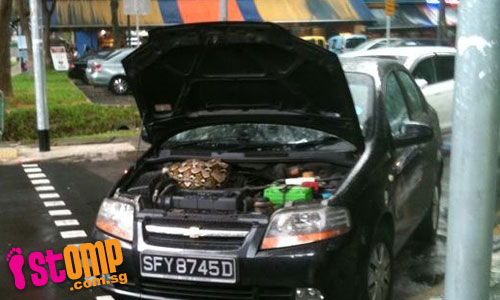
STOMPer Scorpgal and her husband spotted a python curled up under the hood of a car on their way to lunch in Cantonment.
In her email, the STOMPer wrote:
"My husband was on his way to Southpoint for lunch when he saw policemen and a car parked in the middle of Cantonment Road.
"A car had stopped at the traffic light when a passer-by saw a python crawl under the car and up into the bonnet!
"The passer-by then immediately stopped the driver to inform him of the snake.
"I wonder where did the python emerge from?"
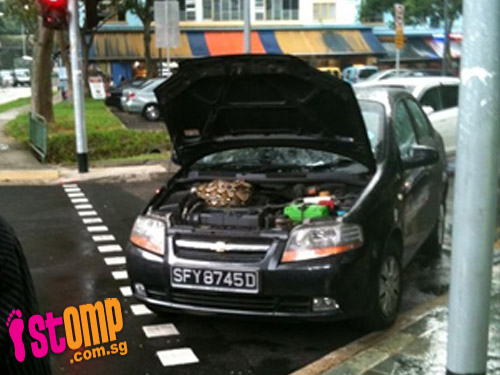
This certainly goes to show that wildlife can be found even in downtown Singapore.
This isn't the first time reticulated pythons (Broghammerus reticulatus) have been recorded entering cars; it is possible that they are seeking warmth, or simply foraging for food. Here's an earlier report about a python that crawled into a car.
At least the python in this case didn't end up like the one in this report.

Wednesday, May 26, 2010
Water discoloration at Marina Bay worsens as pollution increases
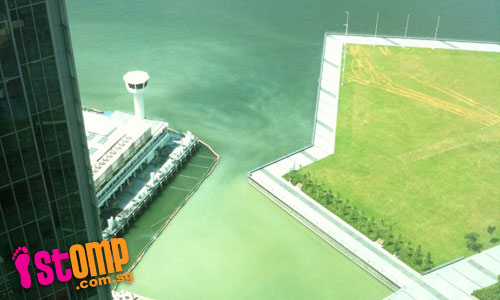
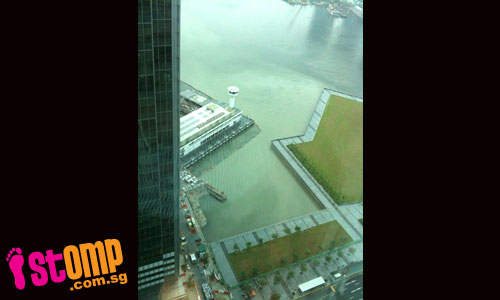
The water discoloration caused by pollution at Marina Bay has worsened since it was first noticed by STOMPer Aki a few weeks ago.
On May 17, Aki posted a picture which show slight discoloration of the waters near his office in Raffles Quay.
In a separate picture taken today (May 26), the discoloration is visibly more serious.
Suspecting that waste from one of the buildings is being released into the waters, the STOMPer hopes that NEA will investigate the cause before things get out of control.
Aki says in a message:
"I took this photo from our office.
"I feel bad that this building in Raffles Quay is disposing waste in Marina Bay.
"You can see the discoloration in the water.
"NEA should look into this".
Picture of discoloration taken on May 17:
Related post: Waste from Raffles Quay building pollutes water at Marina Bay (17th May 2010)
Monday, May 17, 2010
Waste from Raffles Quay building pollutes water at Marina Bay
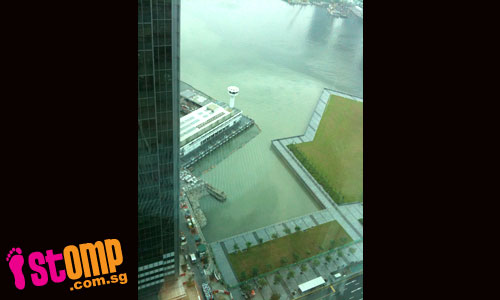
A commercial building in Raffles Quay is polluting the waters at Marina Bay, says STOMPer aki.
The worried STOMPer says:
"I took this photo from our office.
"This building in Raffles Quay is disposing waste into the waters at Marina Bay.
"You can see the discolouration in the water.
"NEA should look into this."
Based on the map, it appears that the building in question is One Marina Boulevard.
Friday, May 14, 2010
Singapore, the haze is back!
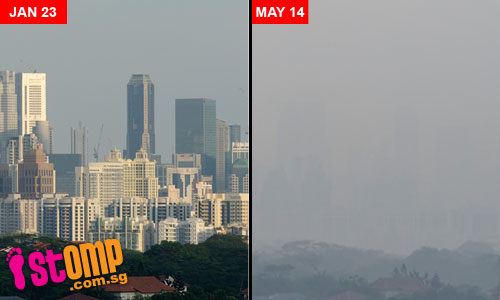
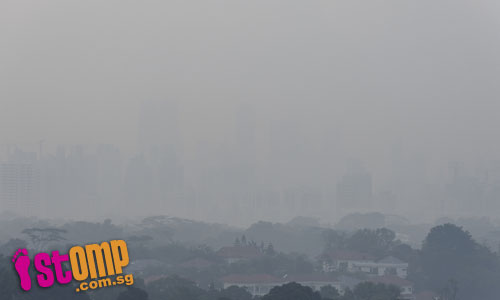
These two pictures of the Singapore skyline, taken from the same place on two different dates, were submitted by STOMPer Andrew West, who was intrigued by the difference in clarity between them.
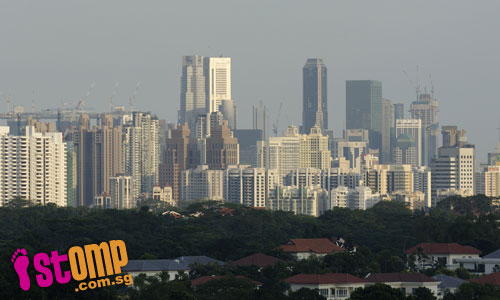
While the picture taken on January 23 this year shows a clear view of the Singapore commercial district, the picture taken this morning shows only a hazy blur, with hardly a building in sight.
Data provided by NEA on its website shows that air quality has dipped since the start of the year.
The Pollutant Standards Index (PSI) for January 23 registered at 31, or 'good' on the air quality scale.
On May 13, recorded PSI levels rose to 58, a 'moderate' on the air quality scale.
STOMPer Andrew West says:
"Here are two photos, one from this morning (May 14) and one from January, when it was clear.
"What a contrast between the two photos!
"This may make an interesting Story.
"Both taken from a high level at Holland Close (Holland Village)".
Based on the Regional Haze Map over the last few days, there have not been any major hotspots near Singapore. It appears that there have been isolated fires in parts of Sumatra, and some burning is going on in Indochina and Myanmar, but I don't think it is likely that these are major causes behind the haze.
I do wonder if there have been any outbreaks of bushfires locally though, given how warm it has been lately. However, it has also been raining quite a fair bit, so this might reduce the likelihood of bushfires.
Thursday, December 10, 2009
Monkey goes to CBD, monkey climbs building...then monkey gets stuck
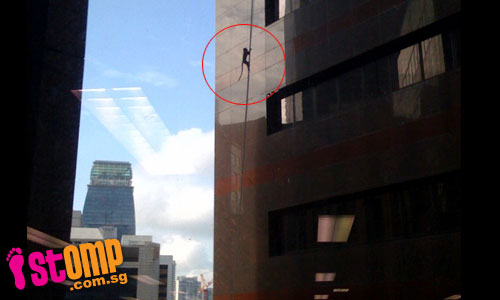
We have seen monkeys roaming residential areas, but this monkey is a little more adventurous -- it was seen in the CBD, climbing up Equity Plaza.
A STOMPer saw the monkey when she came into her office on the 15th floor of the adjacent Republic Plaza at about 9.15am today (Dec 10).
She said:
"I came in and saw the monkey climbing up the cable used by the gondola lift for cleaning the building windows.
"Then my colleagues started screaming 'Monkey! Monkey'.
"At first we thought it was going to fall off the cable, but it rested on the ledge of the 26th floor of Equity Plaza."
When STOMP contacted the STOMPer at 10.15am, she said the monkey was still 'stuck' on the ledge.
She said she called the AVA, and they said that they were sending their officers down to rescue the monkey.
She also informed the building management, but was asked if the monkey was the 'animal' type, and whether it was a baboon.

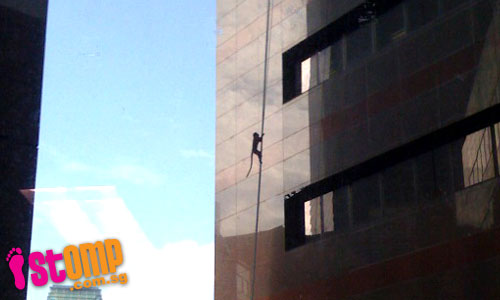
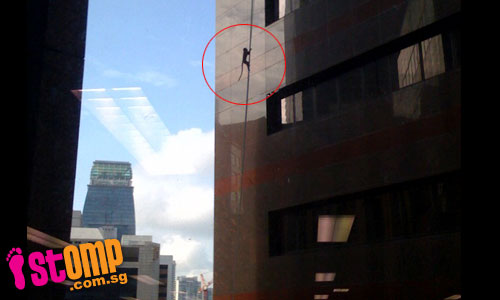
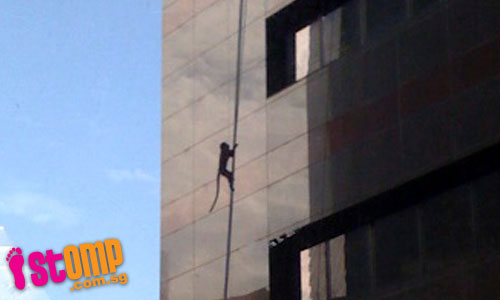

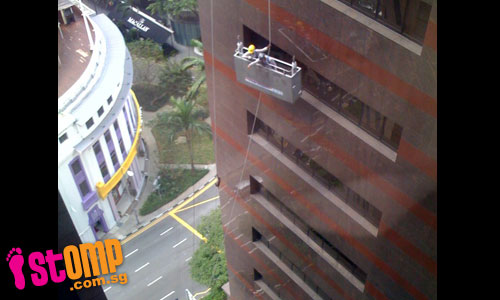
It certainly is a very interesting place to encounter a long-tailed macaque (Macaca fascicularis). I wonder where it came from, since the nearest extensive patch of vegetation that conceivably contains a macaque population would be Mount Faber Park.
There seem to be a lot of reports of macaques popping up in places all over Singapore. I wonder if monkeys are using our networks of parks and roadside trees as green corridors, and dispersing out of their strongholds in the larger forested areas. True, many of the sightings are of lone individuals or small bands, but I wonder if it is possible that some of these wandering monkeys may eventually establish resident populations in our neighbourhoods and town centres. Which will raise a lot of issues regarding coexistence with wildlife, and hopefully, when the time comes, we will be able to take an enlightened stance towards sharing our living and recreational spaces with other species, one that avoids knee-jerk reactions and unnecessary culling.
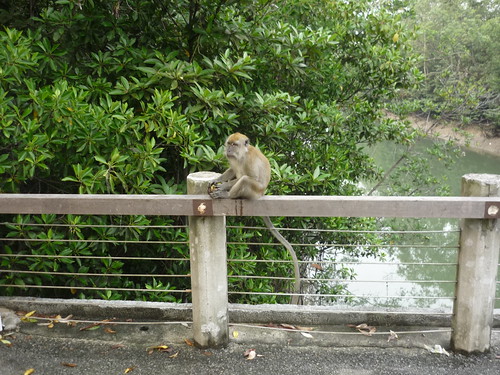
Pasir Ris Park;

Changi Village;
For most people living in Singapore, the long-tailed macaque is the species that comes to mind when monkeys are mentioned. However, there is another species of monkey that inhabits our forests, the banded leaf monkey (Presbytis femoralis).

Central Catchment Area;
(Photo by hiker1974)
Unlike the long-tailed macaque, which spends a lot of time foraging on the ground, the banded leaf monkey is wholly arboreal. Also, while the long-tailed macaque is an opportunistic omnivore, the banded leaf monkey is predominantly vegetarian, and feeds mostly on young leaves and fruit.

(Photo by hiker1974)
Another difference between the 2 species is with regards to the ability of these primates to adapt to living in urban Singapore. While the long-tailed macaque seems to be doing quite well, and can be commonly encountered in many of our nature areas, the banded leaf monkey has not been so fortunate. While it was once found across large areas of the island, it has experienced a calamitous decline; only a small troop of around 20 survives in the Central Catchment Area. Sightings are sporadic, and even though they live in a protected area, it is always possible that the banded leaf monkey has already passed the point of no return, and that inbreeding will eventually doom this species to local extinction.

(Photo by hiker1974)
A troop used to be present in the Bukit Timah Nature Reserve, but eventually dwindled away. The last survivor from this group, an elderly female, climbed down a tree in October 1987 and was killed by a pack of dogs. She now resides in the public gallery of the Raffles Museum of Biodiversity Research (RMBR), bearing silent testimony to the threats that imperil our wildlife.
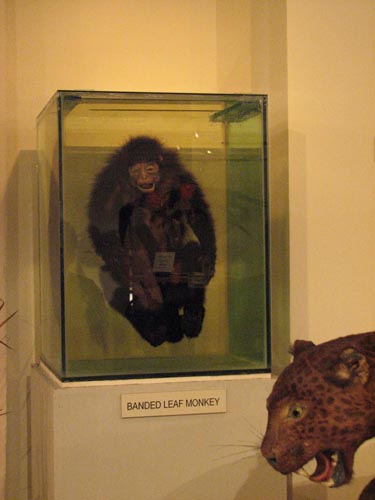
(Photo by access_2359)
A third species of monkey used to be found in Singapore, the southern pig-tailed macaque (Macaca nemestrina). However, it is now considered to be extinct locally, probably a victim of deforestation and the persecution that must have occurred when these monkeys began raiding crops.

Sepilok, Sabah;
(Photo by ccferg)

Sepilok, Sabah;
(Photo by robstephaustralia)
Unlike the long-tailed macaque, the southern pig-tailed macaque has a short tail.
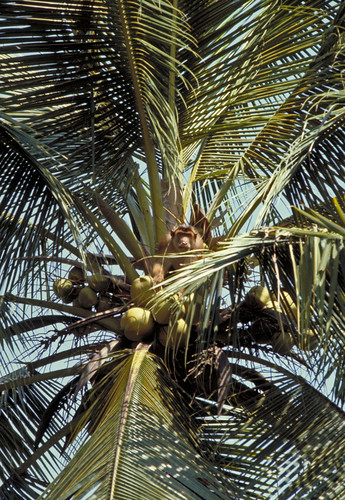
(Photo by Giacomo-Giggio)
Southern pig-tailed macaques are tamed in many parts of Southeast Asia, and used to pluck coconuts.
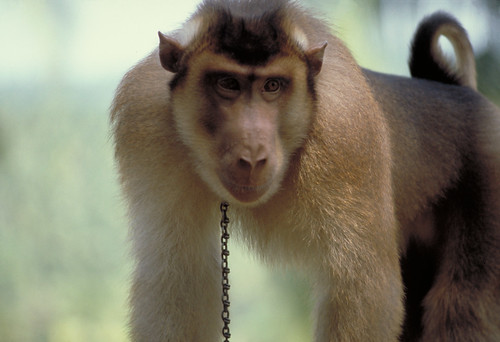
(Photo by Giacomo-Giggio)
Southern pig-tailed macaques are featured at the Sentosa Animal & Bird Encounters, where you can also have your photo taken with a monkey.
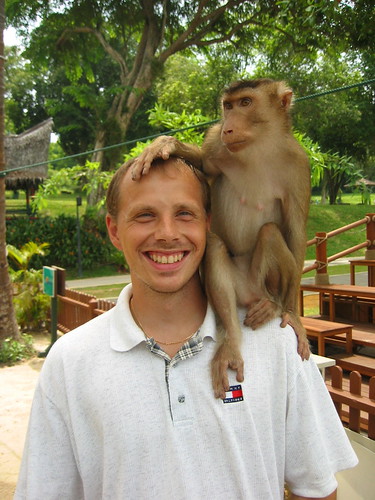
(Photo by Robert Nyman)
I definitely would not recommend trying to replicate this photo with a wild long-tailed macaque.
It certainly is quite puzzling that this species died out while the long-tailed macaque survived; it seems that both species are quite adaptable and capable of living in agricultural areas.
Having said that, I wonder what happened to this particular monkey that had gotten itself stranded in the middle of the Central Business District. Was it eventually caught by Agri-Food & Veterinary Authority of Singapore (AVA) officers, or did it escape and run off elsewhere? And if caught, what happened to it in the end? As far as I know, nuisance monkeys caught by the AVA are subsequently euthanised, as relocation is typically not a viable option.
Perhaps, with more and more of these macaques moving into our residential, commercial, and recreational areas, it is time we looked at how we can learn to live alongside them, and minimise conflict. I won't be surprised if these urban monkeys learn to exploit litter and rubbish bins as a food resource, and for all you know, there will most likely be well-meaning but misguided people out there deliberately feeding them. There will be others calling for the monkeys to be removed, when they start raiding homes or threatening the safety of people. But I believe that there are ways to overcome such mentalities, and I try to be optimistic in hoping that more people will learn to share their neighbourhoods with monkeys, and keep a respectful distance. Hopefully, more can be done to encourage a peaceful coexistence between the 2 species of primate, one that would pave the way for a greater sensitivity towards wildlife and greater ecological awareness.
Subscribe to:
Posts (Atom)