Showing posts with label urban wildlife. Show all posts
Showing posts with label urban wildlife. Show all posts
Wednesday, December 18, 2013
Wednesday, November 20, 2013
Saturday, September 14, 2013
Sunday, June 23, 2013
Singapore got wildlife, meh?
It's a question that anyone involved in nature outreach in Singapore is bound to encounter someday. Yes, despite this country being a small island that has undergone lots of development, lots of wildlife still survives or even thrives in Singapore! If you've ever pondered this question yourself, here's a video that was first screened at last year's Festival of Biodiversity.

Saturday, March 9, 2013
Sunday, February 10, 2013
Happy Year of the Snake!

Schneider's dog-faced water snake (Cerberus schneiderii), Pasir Ris;
According to Chinese astrology, this year is associated with the Element of Water, so it's supposed to be the Year of the Water Snake.
Saturday, June 30, 2012
Thoughts on Roadkill, Part 2: Invasives & Non-natives
On Monday, the Animal Concerns Research & Education Society (ACRES) posted the following image on their Facebook page:
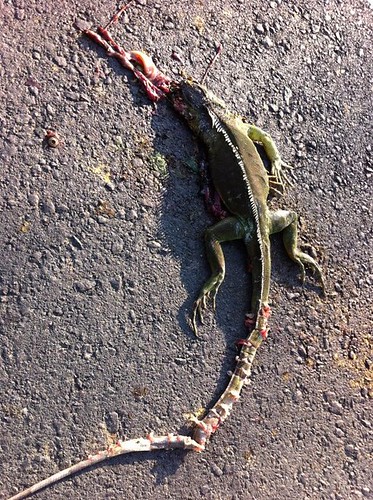
Green iguanas are native to Central and South America. It is saddening and shocking to sight such exotic wildlife here in Singapore, smuggled in to meet the demand for reptiles as illegal pets. This poor adult male Iguana was found run over and dead on the roads on Sungei Tengah road, right in our neighbourhood - Another victim of the illegal wildlife trade being abandoned to fend for himself.
Sunday, June 17, 2012
Wednesday, June 13, 2012
Thursday, April 12, 2012
Tuesday, April 10, 2012

Monday, April 9, 2012
Tuesday, January 24, 2012
Year of the Dragon: Singaporean Dragons
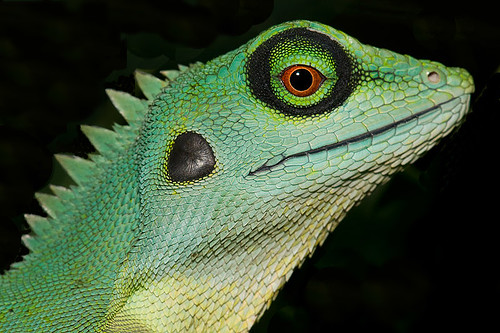
(Photo by sayhitoant)
As mentioned in yesterday's post, Singapore is home to a number of agamid lizards (F. Agamidae). This post will discuss the several species of agamids that are found here.
Thursday, January 19, 2012
Flight of Dragons
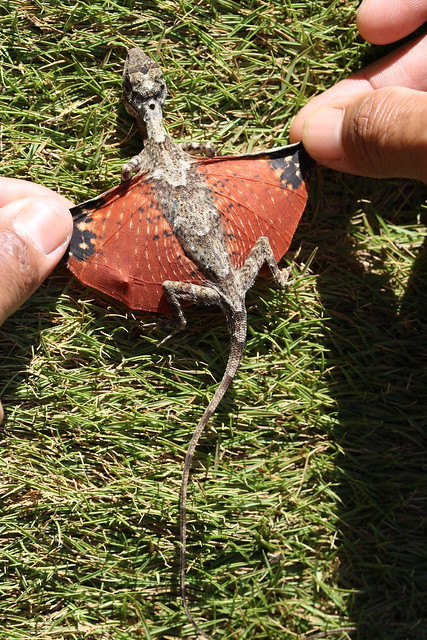
(Photo by Javier_M.)
Over the last couple of years, I've seen a particular image make its way around the Internet, popping up every now and then creating somewhat of a stir every time it resurfaces.
Saturday, January 14, 2012

Sunday, January 8, 2012
Tuesday, October 18, 2011
Macaques, Conflict and Keyboard Warriors
(Photo by John 3000)
About a week ago, someone named Paul Chan wrote in to the Straits Times Forum, in response to reports of several long-tailed macaques attacking visitors to the Forest Walk along the Southern Ridges.

Long-tailed macaque (Macaca fascicularis);
(Photo by gamebit)
(The photos in this post feature several macaques that have been encountered by visitors to various parts of the Southern Ridges over the past few years)
Cull monkeys if over-population is the problem (Mirror)
I WAS shocked to read that a search was on for a monkey believed to have attacked three people over the past three weeks ("Attacks spark hunt for monkey"; last Friday).
I was also disappointed with the response of National Parks Board (NParks) officials that the monkey-feeding problem might have reached a tipping point and that sometimes, animals just go crazy. Did NParks do an extensive survey or study to arrive at such conclusions?
Despite many reports of rogue monkeys attacking people and foraging for food at bus stops and households, NParks prefers to pin the blame on human feeding or provocation.
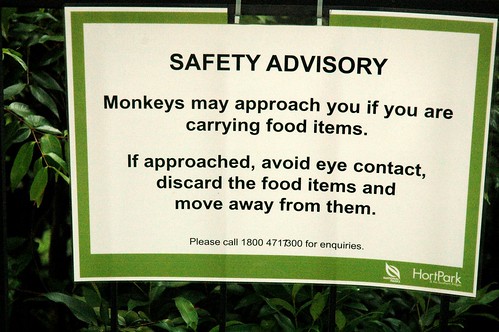
The attack on Hort Park visitor Tang Mae Lynn was apparently due to the monkey pack invading her personal space at the Forest Walk; she carried no food or drink. The problem could be due to monkey over-population or lack of monitoring by NParks officials.
I disagree with NParks about not going after the monkeys because the creatures belong there as much as humans. Does that mean we should silently accept monkey attacks as normal?
It is the job of NParks to ensure monkeys behave where they co-exist with us. NParks has a duty to patrol and monitor the growth of the animal population within the forest boundaries. The animals should be culled if they encroach on human living space and disturb our peace. They should also be punished if they misbehave.
NParks could install closed-circuit television (CCTV) cameras along the Forest Walk and areas prone to monkey attacks to check on the culprits while initiating programmes to control such disturbances so that both animals and people can share the limited space on our island in peace.
Paul Chan
Saturday, August 6, 2011

Monday, August 1, 2011
Monday, July 11, 2011
Subscribe to:
Posts (Atom)