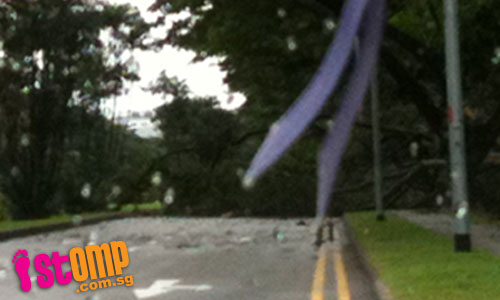
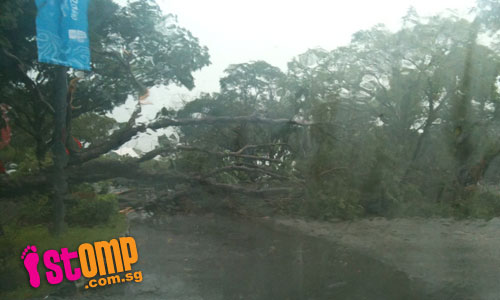
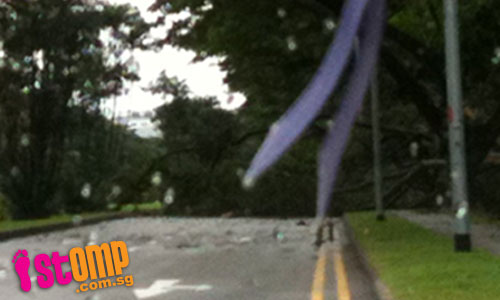
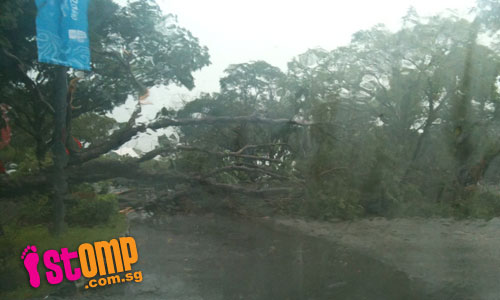
A large tree branch had fallen on an SBS Transit double decker, resulting in a massive traffic jam along the AYE towards the city. STOMPer Hisyam sent in a video of the accident scene and said: "It is shocking to see the fallen branch on the bus like that."
The fallen branch is reportedly blocking up all the lanes on the expressway, except for the extreme right lane, and causing a tailback all the way to the Jurong Town Hall Road.
"It took me an hour just to get past the bus and the branch, because everyone was stuck in grid lock traffic.
"This was near the South Buona Vista flyover and it was a massive jam for a major expressway like the AYE.
"I just hope the authorities have cleared up the mess already so that traffic can flow smoothly."

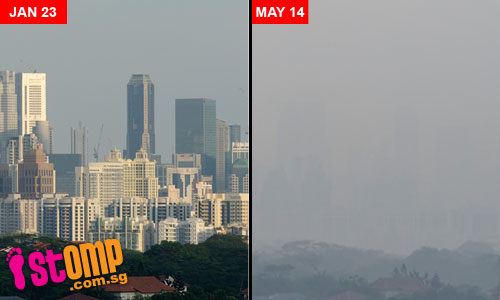
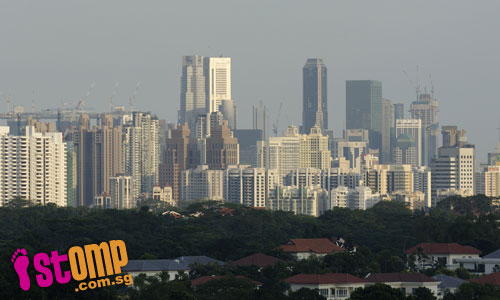
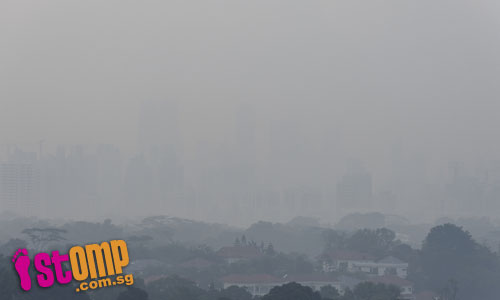
These two pictures of the Singapore skyline, taken from the same place on two different dates, were submitted by STOMPer Andrew West, who was intrigued by the difference in clarity between them.
While the picture taken on January 23 this year shows a clear view of the Singapore commercial district, the picture taken this morning shows only a hazy blur, with hardly a building in sight.
Data provided by NEA on its website shows that air quality has dipped since the start of the year.
The Pollutant Standards Index (PSI) for January 23 registered at 31, or 'good' on the air quality scale.
On May 13, recorded PSI levels rose to 58, a 'moderate' on the air quality scale.
STOMPer Andrew West says:
"Here are two photos, one from this morning (May 14) and one from January, when it was clear.
"What a contrast between the two photos!
"This may make an interesting Story.
"Both taken from a high level at Holland Close (Holland Village)".
Based on the Regional Haze Map over the last few days, there have not been any major hotspots near Singapore. It appears that there have been isolated fires in parts of Sumatra, and some burning is going on in Indochina and Myanmar, but I don't think it is likely that these are major causes behind the haze.
I do wonder if there have been any outbreaks of bushfires locally though, given how warm it has been lately. However, it has also been raining quite a fair bit, so this might reduce the likelihood of bushfires.

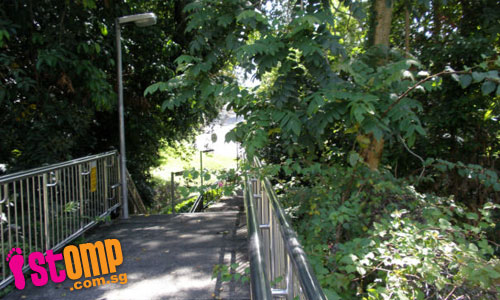
STOMPer Weak heart claims that he prays for divine protection every time he crosses this bridge as the plants are so overgrown that he fears that snakes or spiders might slither out and attack him.
In his email to STOMP, the STOMPer wrote:
"These pictures were taken at the overhead pedestrian bridge that links the Ghim Moh HDB estate to East Sussex Lane.
"This bridge spans the KTM land and I have to pray for divine protection each time I cross this bridge.
"The branches from the trees hang down until they almost reach your head and the bougainvillea plants grow until part of the bridge is blocked.
"I always have this morbid fear of snakes and spiders slithering down the branches to attack my head and body.
"My fear is compounded when the sun sets and the street lamps are turned on.
"I hope the branches can be trimmed off to allay my fear of creepy slimy creatures that lurk in the branches especially at night."
Seriously, I have no idea why this particular idiot submits such nonsense time and time again, and why STOMP always willingly posts such dreck.
My sympathies if you are genuinely so afflicted by all these phobias, but really, I'm not buying your nonsense anymore. I call bullshit on you and all your fictitious phobias.
I mean, would you look at all that he has posted to date?
"As one who is achluophobic, I fear the eclipse of the sun, a moonless night and a car park enshrouded in darkness. I hope these creepers can be removed soon."
"Whenever I wait here for the bus to arrive, I have a sense of trepidation that there might be hornets and snakes lurking in the bushes. I hope the creepers could be removed for public safety."
"Since young I was diagnosed as ophidiophobic and arachnophobic and these creepy creatures make my blood run cold. I hope these creepers could be removed so that I have peace of mind whenever I cross this overhead bridge."
"Whenever I cross this bridge, I have an ominous feeling that some spiders, worms, caterpillars or snakes might be lurking in the branches. The branches of this mango tree have grown until they touch the railings and this compounds my fear of creepy crawling insects. From young I have been arachnophobic, scoleciphobic and ophidiophobic and I hope LTA will send its workers to cut off these protruding branches."
"This palm tree near the bus stop bears flowers twice a year and during the flowering season, swarms of bees are attracted to the flowers. I hope the Town Council will not plant such trees in housing estates as they attract bees."

I know I sound very callous and insensitive, but please do us all a favour and just stay at home. This way there won't be any trees, bushes, or creepers with imaginary horrors threatening your apparently fragile constitution.
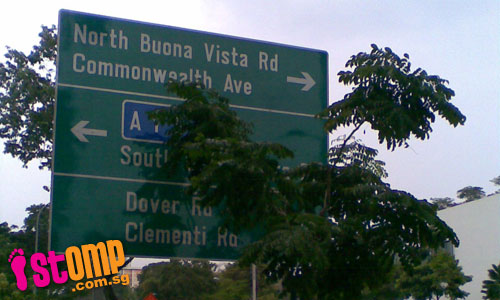
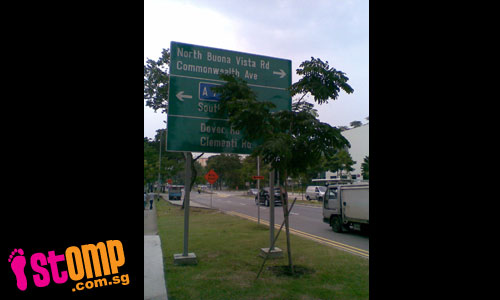
A STOMPer came across this tree that was blocking part of the street signboard and wonders if it will be completely camouflaged behind the tree in 5 years time.
Angela told STOMP via email today (Sep 4):
"Will I still get to see this signboard in 5 years time after the tree has grown taller and bigger?
"I was thinking, which was the first one to be there.
"The tree or the signboard?"
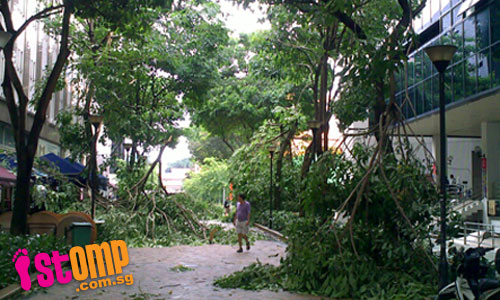
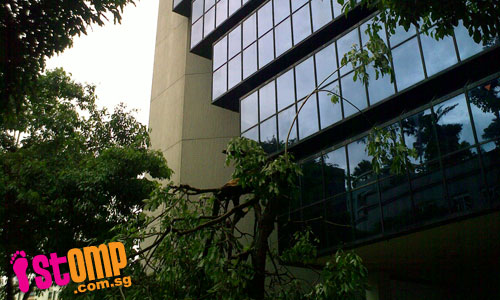
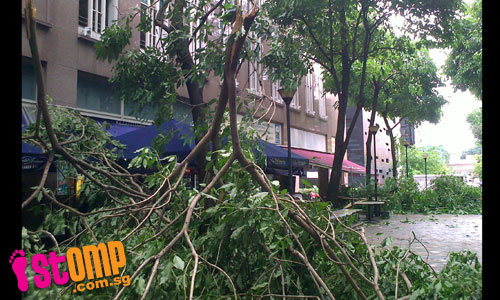
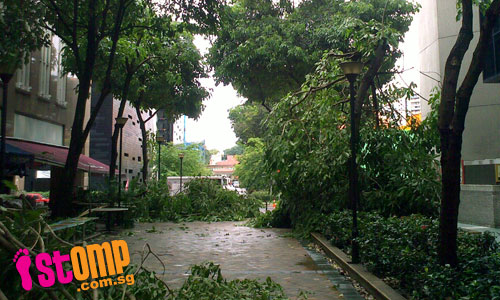
Singaporeans woke up this morning in the wake of a violent storm that started late last night and lasted till the wee hours of this morning (Apr 23).
STOMPers from all over Singapore sent in pictures of the damage wrought by the huge winds.
Munish, a longtime resident of Dover Road had this to say of the storm winds:
"I stay at Block 31 Dover Road.
"Last night's wind uprooted these trees. I've been staying here over 30 yrs and this is the very first time this thing has happened."
STOMPer Astonished also reported winds strong enough to fell trees:
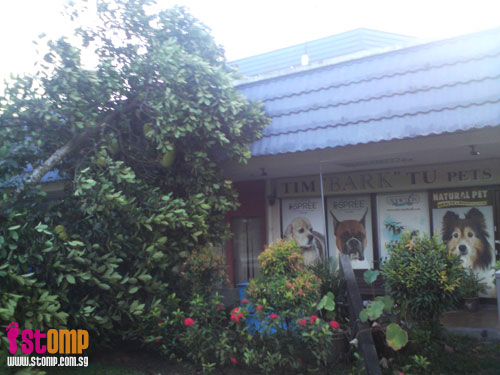
"Lightning and strong winds hit the trees at Hong Leong Gardens Shopping Centre, causing a tree to be uprooted.
"The tree hit the roof of the shop houses there."
He added:
"I think it should be a precaution for Nparks and area management to beware of how you plant the trees in areas near shops, buildings and houses."
Awed by the force of the winds that felled trees in Ang Mo Kio, another STOMPer wrote:
"These felled trees are the after effects of a 'mini-typhoon' at Ang Mo Kio Street 21.
"There are many more along Yio Chu Kang Road."
Elsewhere, STOMPer Cam reported damage to the blinds at her home caused by the storm:
"I can't believe the wind was that strong! We had to go cut it down in case it fell and hurt someone. The whole balcony is a big mess."
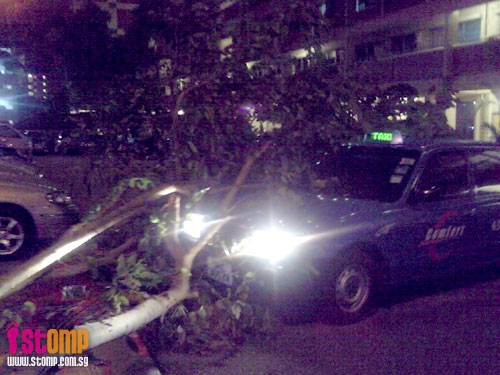
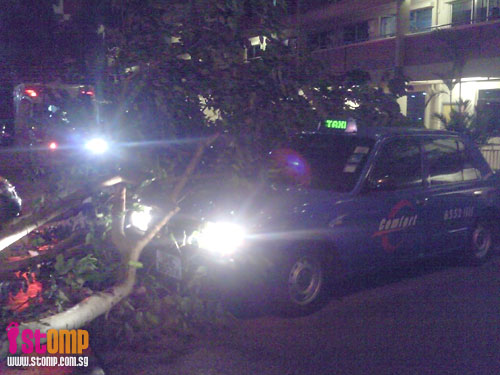
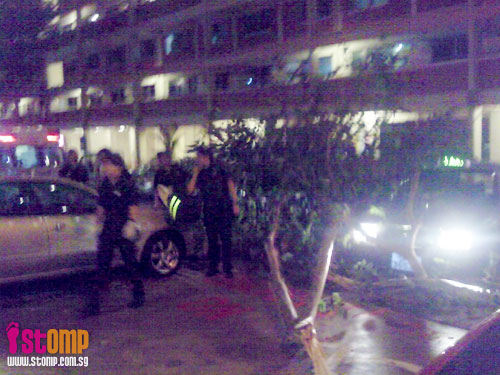
Further north in Bishan, winds tore down branches from a tree that landed on a taxi, damaging the bonnet of the vehicle.
Said the STOMPer of damage:
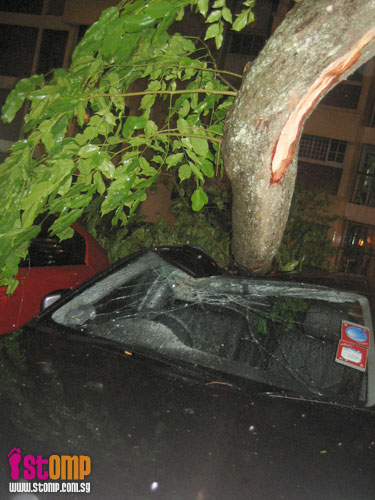
"On April 22 at about 11.30 pm, part of this tree broke and fell onto a taxi which had just dropped a passenger at the carpark of Bishan Street 22, at Block 229."
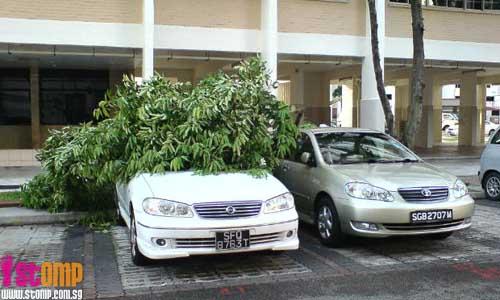
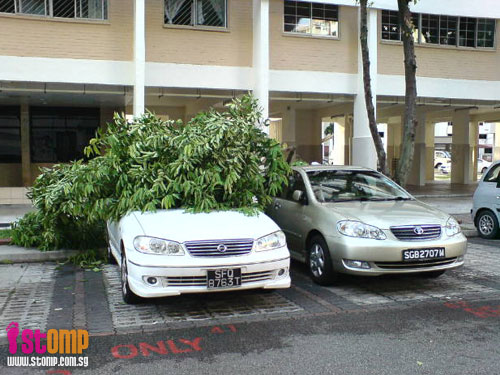
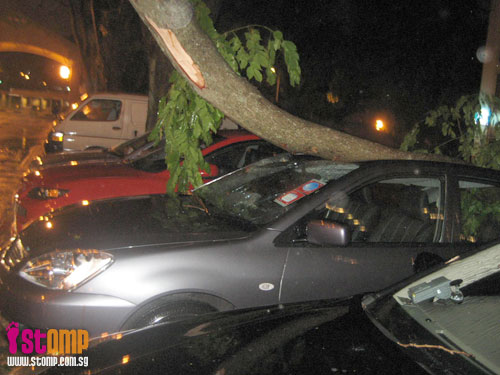
At St George road in the Serangoon area, branches also fell on these two cars at a carpark.
In her MMS, STOMPer Fen said:
"At about 11:00 pm last night, I heard branches cracking.
"In the morning I saw that some branches had broken off completely and landed on these two cars parked at a nearby carpark.
"Both rear windshields had shattered and the car directly under the branch had a badly dented roof.
"One of the car owners had posted a note on his windscreen requesting the other owner contact him, so they could work together to clear the branches."
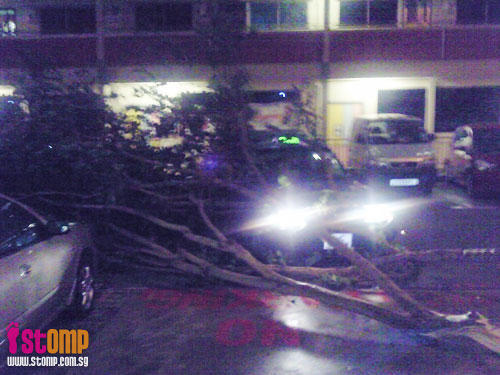
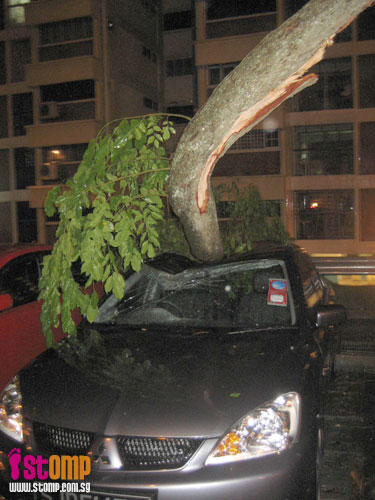
Another unfortunate car owner suffered at the hands of the storm, as STOMPer Faith reports:
"This happened at the carpark of Block 140, Jalan Bukit Merah, right in front of the famous Thai temple.
"A series of strong winds swept central Singapore at about 11.10pm resulting in a huge branch landing on a Mitsubishi Lancer.
"Loud crashing noises from fallen households ornaments were heard throughout the whole block. It must have been one of the strongest winds Singapore had experienced so far.
"No car siren was heard and owner was still unaware at time of my sending this email."
According to another STOMPer, winds in Singapore were strong enough to move heavy objects:
"The wind blew soo hard hard it moved road blocks and distrupted traffic."
STOMP has contacted the NEA for more details on the storm.







UPDATE:A spokesperson for the NEA had the following comments:
"A 'Sumatra' squall is a line of eastward moving intense thunderstorms accompanied by gusty winds that usually occurs between April and September.
"An average of 2-3 'Sumatra' squalls occur in a month during this period. It normally develops overnight in Sumatra and the Straits of Malacca, and affects Singapore between midnight and 9am.
"Maximum wind gusts of up to 90 km per hour from a 'Sumatra' squall have been recorded in the past.
"The strong winds that affected Singapore last night between 11 pm (22 Apr 09) and 12:30 am (23 Apr 09) were caused by an intense fast-moving 'Sumatra' squall.
"Mean wind speeds ranging from 33 to 54 km per hour were recorded across the island. The highest recorded wind gust was 83 km per hour in the western areas.
"A wind gust is a sudden brief increase in the speed of the wind.
"Short duration showers fell over most parts of the island but were heavy in only a few areas. The highest rainfall of 7.0 mm was recorded around Sembawang.
"A wind gust of similar strength was last recorded on Jun 20 2000.
"For the rest of the month, we can expect another one or two 'Sumatra' squalls but they are unlikely to be as severe as the one last night."
Related articles:
Tropical storm behind strongest winds to hit Singapore in 9 years (24th April 2009) (mirror)
Wild wind wreaks havoc (24th April 2009) (mirror)
Gusty winds and rain wreak havoc (24th April 2009) (mirror)
Gusty winds wreak havoc (24th April 2009)
Freak storm wreaks havoc (23rd April 2009)
Related post: Tree uprooted and crashes into construction site during storm in Changi Village (23rd April 2009)

A Sumatra Squall approaching eastern Singapore on 4 July 2005
(All images in this section taken from the NEA's WEATHERWise Singapore)
From the NEA's Meteorological Service FAQs:
What are Sumatras?
Sumatras are lines of thunderstorms which usually occur between March and November each year. These squalls (lines of thunderstorms) develop at night over Sumatra or the Malacca Straits and move east towards Singapore and Peninsular Malaysia usually during the pre-dawn and early morning. They are often characterised by sudden onset of strong gusty surface winds and heavy rain lasting from 1 to 2 hours as they move across the island. Maximum gusts of up to 50 knots have been recorded during the passage of a Sumatra squall (Gusts are temporary rise in wind speed).

A satellite image showing a Sumatra Squall affecting Singapore and southern Peninsular Malaysia
And from WEATHERWise Singapore:
An isolated thunderstorm cell has a short lifespan, usually less than an hour. Sometimes, a number of units or cells of thunderstorms may be organized by wind pattern or by terrain into a line. A thunderstorm line, also known as a squall line (or squall) moves and behaves collectively and can have a longer lifespan.
A Sumatra Squall is such an organised thunderstorm line that develops over Sumatra Island in Indonesia or the Straits of Malacca, often overnight, and then moves eastward to affect Peninsular Malaysia and Singapore. In a typical case, the squall line can bring about one to two hours of thundery showers. Often this happens in the predawn hours or morning. Some Sumatra Squalls are also accompanied by wind gusts of 40 to 80 km/h. Gusts are short-duration bursts of wind. Occasionally, such gusts are strong enough to uproot trees.
Sumatra Squalls can develop at any time of the year, but are uncommon during the Northeast Monsoon Season. Convergence of air streams at low levels (height of less than 1 km) over a large area is a pre-requisite for the development of a Sumatra Squall. Additionally, a general westerly wind above (between 2 to 4 km) blowing from Sumatra Island towards Singapore is needed to steer the squall line forward.


Radar images showing the passage of a Sumatra Squall.
As Kok Sheng mentioned, how apt that this spectacular show of nature's power should take place on Earth Day. It would do us well to remember that although we have the capability to drastically change the environment to suit our needs, to tame mighty rivers and level towering mountains, and even possess the ability to alter the climate, at the end of the day, we are just like any other species, at the complete mercy of the forces of nature.