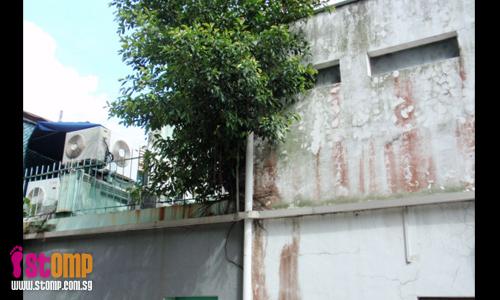
STOMPer Scorpgal and her husband spotted a python curled up under the hood of a car on their way to lunch in Cantonment.
In her email, the STOMPer wrote:
"My husband was on his way to Southpoint for lunch when he saw policemen and a car parked in the middle of Cantonment Road.
"A car had stopped at the traffic light when a passer-by saw a python crawl under the car and up into the bonnet!
"The passer-by then immediately stopped the driver to inform him of the snake.
"I wonder where did the python emerge from?"

This certainly goes to show that wildlife can be found even in downtown Singapore.
This isn't the first time reticulated pythons (Broghammerus reticulatus) have been recorded entering cars; it is possible that they are seeking warmth, or simply foraging for food. Here's an earlier report about a python that crawled into a car.
At least the python in this case didn't end up like the one in this report.
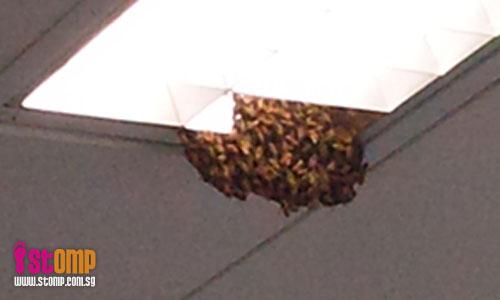
There are several beehives at the overhead bridge ceiling leading to SGH and STOMPer DMummy was shocked when she saw the number of the bees flying in the vicinity.
In her email to STOMP today (Feb 16), the STOMPer wrote:
"Yesterday I went to SGH to visit my relative. I used the overhead bridge at Outram MRT, which leads to SGH.
"When I went up the escalator, I got a shock, as there are bees flying everywhere!
"I looked up and was shocked to see numerous beehives on the lights.
"There was at least six or seven of bee hives on the ceiling lights.
"With the giant hives, directly above the escalator going up, those who have to use the overhead bridge, will definitely have to pass under the hives. This is so dangerous."


These aggregations of honeybees are not hives, but swarms.
This entry on Wikipedia is an excellent place to learn about swarming behaviour in honeybees. A couple of other sites that talk about bee swarms and how to cope with them can be accessed here and here.
Basically, swarming involves the colony splitting up, with a portion of the workers leaving the hive to follow one of the queens in establishing a new colony. In most cases, the original queen leaves, and a newly mated queen takes her place. This first swarm may soon be followed by other young queens setting out to start colonies of their own. While some scouts set out to explore new potential sites for hives, the swarm remains in one place, living off the reserves of nectar and honey which they consumed before they left the hive. It is said that swarming bees tend to be less aggressive since they do not have a hive to defend, although it definitely does not mean that one can disturb the swarm with impunity.
Singapore is home to 3 species of honeybee; the smallest and least aggressive species is the black dwarf honeybee (Apis andreniformis). The Asiatic honeybee (Apis cerana) is a close relative of the western honeybee (Apis mellifera) that forms the bulk of the global beekeeping industry. The third species, the giant honeybee (Apis dorsata), is the largest and most aggressive of our local honeybees. Without close-up photos of individual bees, it is impossible to tell which species is involved in this particular swarming episode.


The 3 honeybee species found in Singapore.
Left: Black dwarf honeybee (Apis andreniformis);
Middle: Asiatic honeybee(Apis cerana);
Right: Giant honeybee (Apis dorsata);
(Photo of Asiatic honeybee by budak, all other photos in this post are taken from vespa-bicolor.net)
Honeybees are part of the Hymenoptera, the group that encompasses the insects we colloquially know as wasps, bees and ants. Apart from the honeybees, Singapore has a great diversity of other bee and wasp species. These include a couple of carpenter bees (Xylocopa spp.), which can be very common and conspicuous in our gardens and parks, as well as various other solitary and social bee species.


Two species of carpenter bee commonly encountered in Singapore.
Left: Xylocopa confusa;
Right: Xylocopa latipes;
As for the social wasps, the most prominent are the hornets, of which at least 4 species are known to occur in Singapore, the lesser banded hornet (Vespa affinis), yellow-vented hornet (Vespa analis), greater banded hornet (Vespa tropica), and the rarely encountered Asian hornet (Vespa velutina), along with many other smaller wasp species, such as those of the genus Polistes.


Four hornet species known to occur in Singapore.
Upper left: Lesser banded hornet (Vespa affinis);
Upper right: Yellow-vented hornet (Vespa analis);
Lower left: Greater banded hornet (Vespa tropica);
Lower right: Asian hornet (Vespa velutina);


Three Polistes wasps that have been recorded in Singapore.
Left: Polistes sagittarius;
Middle: Polistes stigma;
Right: Polistes tenebricosus;
I have to admit, it's not easy living alongside insects that can give painful stings, or worse, sting en masse. I can understand why most people flinch the moment a bee or wasp gets too close for comfort. On two separate occasions, I've had my classes disrupted when a solitary hornet flew into the classroom, sending a whole bunch of students ducking for cover. When these insects build their colonies too close to where we live, work and play, posing a risk to our health, it is necessary to take action. Yet at the same time, the indispensable roles that bees and wasps play in our ecosystem cannot be overlooked. Many plants depend heavily on bees and wasps to pollinate their flowers, whereas various wasps are significant predators or parasites of other insects. Perhaps it is necessary for people to look beyond the stingers, and learn how to best coexist with these social insects.
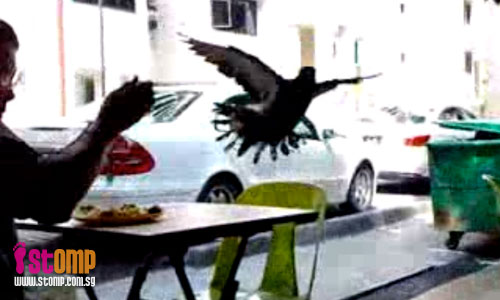
STOMPer Nicholas said that a 'crazy' pigeon was harassing patrons at the Everton coffeeshop for days and sent in a video of a man who had enough and picked it up and placed it several metres away from the eating place.
In an email to STOMP, the STOMPer wrote:
"At Everton coffeeshop, this sickly-looking (and likely to be starving) pigeon has been harassing the patrons of the eatery for days.
"It would fly up unto tables and proceed to peck away at people's food. People were either be pushing it away, or would get up and leave their tables.
"Some ladies would even scream and run off, leaving their food and drinks uneaten.
"Short of injuring the bird, the staff of the coffeeshop have tried shoo-ing the bird away, but to no avail.
"In this video, a man who has had enough of the pigeon's annoying antics picks it up and walks about 30 metres from the coffeeshop before setting it down among the bushes.
"Needless to say, our feathered pest had hopped back to wreck more havoc less than one minute later."



Related post: Neighbour always leaves food for birds! (21st January 2009)
Uncle feeds pigeons despite 'No Feeding' sign at Bencoolen Street (22nd January 2009)
Bird droppings everywhere because of too many pigeons (29th January 2009)
I've seen how bold Javan mynahs (Acridotheres javanicus), common mynahs (Acridotheres tristis), house crows (Corvus splendens) and Eurasian tree sparrows (Passer montanus) can get when food is nearby, but this is the first time I've seen such a fearless feral pigeon (Columba livia).
I have no idea why the pigeon behaved in such a manner; without a biopsy, we will never know the answer. But if I had to make an educated guess, there are a few possible scenarios:
i) This pigeon has experienced very close contact with people; either it was someone's pet, or it's become used to being deliberately fed by people.
ii) It was just really hungry and couldn't find any scraps on the ground.
Of course, it could just be plain crazy, like the original poster said.
Do check out the video posted on STOMP.
One thing I find amusing was that "some ladies would even scream and run off, leaving their food and drinks uneaten". Maybe they watched too much Alfred Hitchcock.