Showing posts with label Cyrene. Show all posts

Tuesday, June 11, 2013

Seagrasses of Singapore (Part 3)

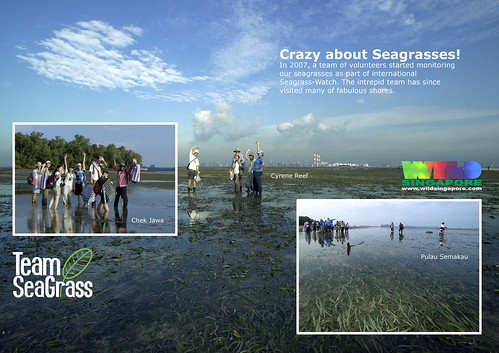
A4 Poster: TeamSeagrass--crazy about seagrasses!
(Click to enlarge)

In my previous post on seagrasses, we explored some of the reasons why seagrass meadows are important habitats, and also looked at some of the threats that seagrasses face. In this final part of the series, I'll show you some local efforts to better understand seagrasses so that we can protect them.

Seagrasses of Singapore (Part 2)

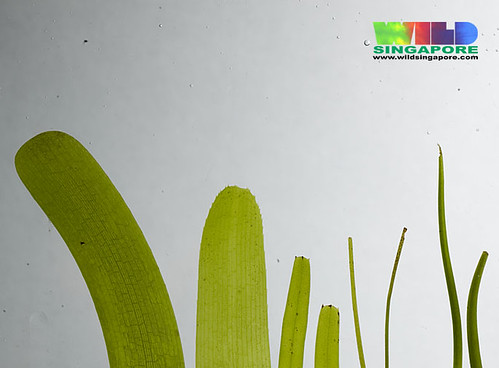
Various seagrasses
The leaves of various seagrass species found in Singapore;
(Photo by Ria Tan)

In the previous post, we took a look at seagrasses, some of the places in Singapore where you can find them, and also went through the ten species of seagrass recorded in Singapore in recent surveys. In this post, we'll find out why seagrass habitats are so important, and some of the threats they face.

Seagrasses of Singapore (Part 1)

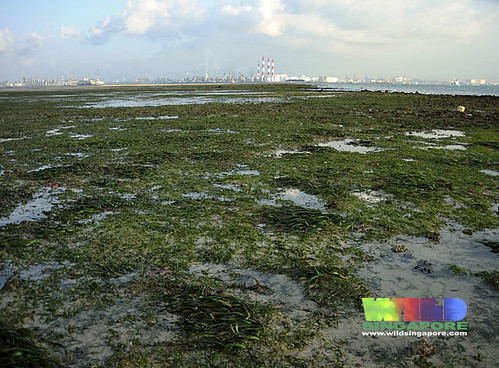
Seagrass meadows of Cyrene overlooking Jurong Island
Lush seagrass meadows of Cyrene Reef;

In my earlier post on World Oceans Day, I mentioned seagrass meadows as one of several marine habitats that can still be found in coastal areas of Singapore. But what are seagrasses? Why are they important? And what can we do to protect them?

Monday, April 15, 2013

Mantis Shrimps of Singapore (ONETWOTHREE DEATH!)


Many people are finally clued in to the awesomeness of mantis shrimps, thanks to a hilarious comic by The Oatmeal.


This has been cited as an excellent example of science communication, and is also a great opportunity to highlight that Singapore has mantis shrimps too!

Monday, October 4, 2010

Monday, September 6, 2010

Saturday, April 11, 2009

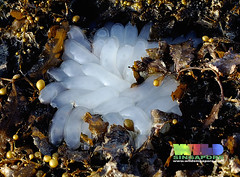
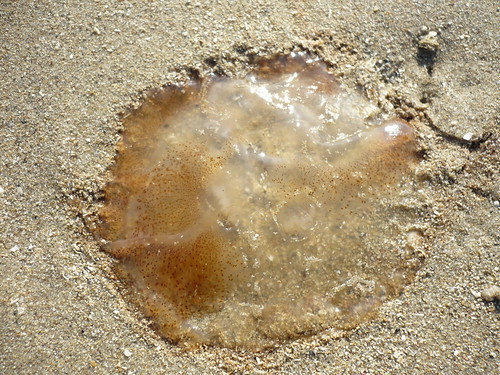
Who's the Eggs-pert?


Egg masses of various marine creatures.
(Photos taken by Ria)

How well do you know your eggs?

In celebration of Easter, Rick MacPherson of Malaria, Bedbugs, Sea Lice and Sunsets has a fun little contest for everyone to try out.

The Second, Maybe Annual Malaria, Bedbugs, Sea Lice and Sunsets Ocean Egg Hunt

Correctly identify the 15 species that laid the eggs in his photo, and you might stand a chance to win a copy of Reef. So if you're up for this egg-citing challenge, head over to Malaria, Bedbugs, Sea Lice and Sunsets and test your eggs-pertise. Okay, I'll stop with the lousy puns.

You can also check out The First, Maybe Annual, Malaria, Bedbugs, Sea Lice and Sunsets Ocean Egg Hunt.

Sunday, March 22, 2009

Snake eels (Ophichthidae)


Longfin snake eel (Pisodonophis cancrivorus), Cyrene Reef;
(Photo by Ria)

In the previous post, I talked about moray eels (F. Muraenidae), a group that is widespread in coral reefs and rocky shores throughout the tropics and warm temperate seas. It is a little puzzling that we don't encounter moray eels more often on our shore exploration trips, and I cannot recall if any of those who dive in our waters have ever encountered moray eels. However, there is a family of eels that we do encounter quite often on our shores, the snake eels (F. Ophichthidae).

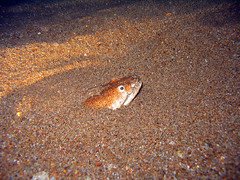
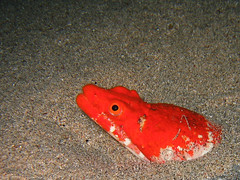
Here in Singapore, the longfin snake eel and worm eel (Muraenichthys sp.) are spotted quite often on our trips, especially at night.


Left: Longfin snake eel, Sisters Islands;
(Photo by Ria)
Right: Worm eel, Sisters Islands;
(Photo by Marcus)

The sgbeachbum blog has 2 excellent videos of a longfin snake eel and worm eel.

We're not too sure about the exact identity of the worm eel which we spot quite often on our shores. The Wild Fact Sheet on snake eels lists the slender snake eel (Scolecenchelys macroptera) as being present in Singapore, under the old name of Muraenichthys macropterus. I suspect that this is the species we know as the worm eel, but I can't tell for sure. If only an ichthyologist could help us out.


Here's a picture of a preserved slender snake eel for comparison, taken from the excellent Fishes of Bitung site.

Snake eels are a large family of about 250 known species, found throughout the world in coastal tropical to warm temperate seas. Some species are known to enter freshwater, whereas for other species, the adults live in seawater but spawn in freshwater, like salmon; the longfin snake eel is 1 such species. Others live exclusively in freshwater environments.

While the maximum size for many snake eel species is unknown, several species are known to reach 1 metre in length. The giant of the family however is the serpent eel (Ophisurus serpens), which has been recorded attaining a length of 2.5 metres.


Serpent eel, Catalonia;
(Photo by ToniTofa)

Snake eels are very similar to moray eels, in that they are nocturnal predators, preying upon fish, cephalopods and crustaceans. Unlike moray eels however, which appear to prefer reefs and rocky shores, snake eels in general seem to have a preference for sandy and muddy habitats.

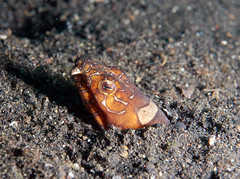
During the day, most species hide in burrows or bury themselves in the sand, leaving only the head exposed.


4 species of snake eel, in their characteristic daytime pose.
Upper left: Crocodile snake eel (Brachysomophis crocodilinus), Dumaguete;
(Photo by Arne Kuilman)
Upper right: Reptilian snake eel (Brachysomophis henshawi), Manado;
(Photo by Daniel, Daniel Kwok)
Lower left: Black-finned snake eel (Ophichthus altipennis), Sulawesi;
(Photo by rlpurkey)
Lower right: Napoleon snake eel (Ophichthus bonaparti), Lembeh;
(Photo by Arne Kuilman)

However, under the cover of darkness, they emerge and actively forage for prey.


Longfin snake eel with octopus prey, Sisters Islands;
(Photo by Ria)

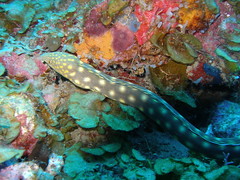
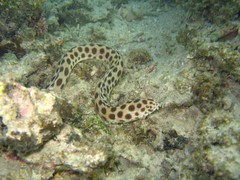
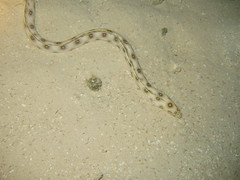
Snake eels aren't as charismatic as their cousins the moray eels; most divers will only see their heads poking up from the seabed, and besides, most species are a dull grey or brown. However, there are some species which are very attractively patterned.


4 colourful species of snake eel.
Upper left: Sharptail snake eel (Myrichthys breviceps), Dominica;
(Photo by juliediver)
Upper right: Harlequin snake eel (Myrichthys colubrinus), Ningaloo Reef;
(Photo by Moon Fish)
Lower left: Spotted snake eel (Myrichthys maculosus), Mauritius;
(Photo by coolpix2006)
Lower right: Goldspotted snake eel (Myrichthys ocellatus), Honduras;
(Photo by adrianne323)

I'm wondering if the harlequin snake eel's appearance is a case of Batesian mimicry, and is an attempt to mimic the characteristic black bands found in the venomous sea kraits (Laticauda spp.). That the harlequin snake eel, like the sea kraits, is distributed over the Indo-Pacific is another interesting clue that suggests that what we are seeing here is an eel imitating a venomous snake in order to keep potential predators away.

Snake eels are consumed in many countries, although they do not appear to support major commercial fisheries. They are also used as bait for other species, and some species, especially attractively patterned species like the harlequin snake eel, are collected for the aquarium trade. In terms of requirements, snake eels are similar to moray eels in that they require plenty of space, will try to eat smaller tankmates, and care must be taken to ensure that they do not escape, with the additional requirement of plenty of fine gravel or sand that will allow the snake eel to bury itself.

There are a couple of other eel families which are utilised for food in the region, the conger eels (F. Congridae) and pike conger eels (F. Muraenesocidae), which I'll be discussing in my next post.

Part 1: Moray eels (Muraenidae)
Part 2: Snake eels (Ophichthidae) (this post)
Part 3: Conger eels (Congridae) and Pike conger eels (Muraenesocidae)
Part 4: Freshwater eels (Anguillidae)
Part 5: Spaghetti eels (Moringuidae) and false moray eels (Chlopsidae)
Part 6: Non-eels

Moray eels (Muraenidae)


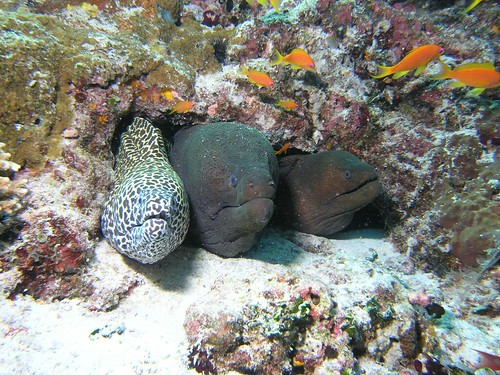
Giant moray (Gymnothorax javanicus) and Black-spotted moray (Gymnothorax isingteena), Maldives;
(Photo by le congre)

Inspired by this post on moray eels being sold for food in a local supermarket, I planned to do a short writeup on moray eel biology. It soon expanded to include discussions on why unagi should be avoided, and mention of other lesser-known eel families like the snake eels and pike conger eels, so much so that there was too much interesting information for a single post. And so, I've decided to do a series of posts instead, devoted to the Anguilliformes, or eels.

First up, the marvellous moray eels...

Saturday, February 14, 2009

Happy Valentine's Day

P1030724
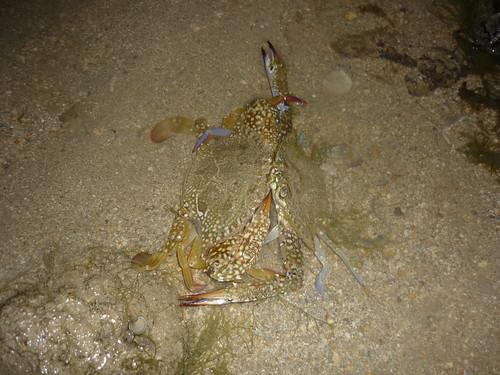
Flower crabs (Portunus pelagicus)
Pulau Subar Darat (Little Sister Island), 31st August 2008

Don't these two crabs look as if they're doing the waltz?

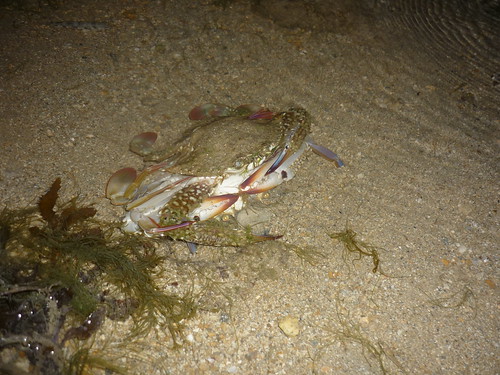
And if all goes well, here's what happens next:

P1030711
Hot crab-on-crab action!

Here's a few other photos I've taken of various critters literally doing it 'like they do on the Discovery Channel'.

American bullfrog (Lithobates catesbeianus) P1010994
Left:American bullfrogs (Lithobates catesbeianus)
Khai Seng Trading & Fish Farm, 20th December 2008;
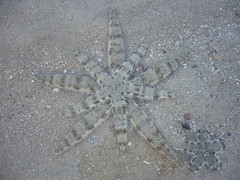
Right:Common sea star (Archaster typicus)
Cyrene Reef, 9th May 2008;

P1090847 P1070405
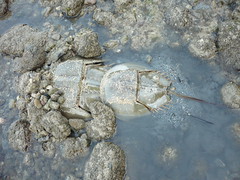
Left:Coastal horseshoe crabs (Tachypleus gigas)
Tanjung Rimau, 6th June 2008;
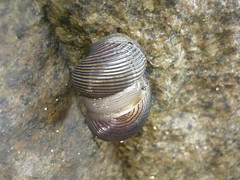
Right:Lined nerite (Nerita articulata)
Changi, 18th October 2008;

Before I continue, I have to apologise for conflating romance with sex, but as you're probably aware, the rest of the animal kingdom does not really share our notions of love and romance. For a great number of species, the act of courtship culminates in what is best summarised as 'Wham, bam, thank you ma'am'.

Though us prudish humans might not openly talk about sex, it cannot be denied that sexual reproduction has had an invaluable part to play in the evolution of life on this planet. If you think about it, almost everything about life on Earth has to do with sex. The staggering variety of life, both past and present, has come about partly due to species evolving their own adaptations to survive and reproduce. Many physical features, from the peacock's dazzling train of feathers, to the antlers of a stag, exist only for a sole purpose: to attract mates. The struggle between predator and prey essentially boils down to who gets to live long enough to reproduce and ensure the survival of one's genes. If a species fails to reproduce quickly enough to replace the individuals that die, it eventually becomes extinct. A great variety of animal behaviour is motivated by sex. Hell, much of the course of human history has been all about people moving into new lands and having sex with the locals. In fact, the common thread that unites a great deal of lifeforms is that they are all seeking to improve their chances of successfully reproducing. Asexual or parthenogenetic organisms are unique and interesting to us, precisely because they don't have sex. Even plants do it, just that their form of reproduction tends to be more subtle and often requires the intervention of other species.


(Image from The Perry Bible Fellowship)


In 1999, the BBC produced a 6-episode documentary series and accompanying book focusing on sexual reproduction in animals, entitled Battle of the Sexes in the Animal World. Snippets from the series have been uploaded to YouTube. The original narration has been dubbed over in Russian, although I think much of the footage speaks for itself. Here's one clip that really brings the point across: a great deal of intra-specific fighting occurs because of male competition to gain access to females.


Another book that discusses reproduction in animals is the witty and humorous Dr. Tatiana's Sex Advice to All Creation: The Definitive Guide to the Evolutionary Biology of Sex by Olivia Judson.


Gideon Defoe's How Animals Have Sex: A Guide to the Reproductive Habits of Creatures Great and Small is a decidedly tongue-in-cheek look from the perspective of a layman at some of the strange and often downright bizarre reproductive habits of other species.


Here's a few other books about animal reproduction which I haven't managed to get my hands on yet. These are A Natural History of Sex: The Ecology and Evolution of Mating Behavior by Adrian Forsyth, Promiscuity: An Evolutionary History of Sperm Competition by Tim Birkhead, and Sexual Selections: What We Can and Can't Learn About Sex from Animals by Marlene Zuk.


A very interesting book that deals with sexual behaviour of a rather different sort is Biological Exuberance: Animal Homosexuality and Natural Diversity by Bruce Bagemihl, which extensively discusses the prevalence of homosexual behaviour in a wide variety of animals.


Four books that explore reproduction from a more human perspective are Why Is Sex Fun?: The Evolution Of Human Sexuality by Jared Diamond, The Red Queen: Sex and the Evolution of Human Nature by Matt Ridley, Sperm Wars: Infidelity, Sexual Conflict, and Other Bedroom Battles by Robin Baker, and Bonk: The Curious Coupling of Science and Sex by Mary Roach.

I thought it would be appropriate to show the reproductive behaviour of some reptile species that can be found in Singapore. Many people are familiar with the mating displays of mammals and birds, but not many are aware of the fascinating displays of many reptiles.


Malayan water monitor (Varanus salvator)


Estuarine crocodile (Crocodylus porosus)


King cobra (Ophiophagus hannah)

I couldn't find any clips of reproductive behaviour in Singapore's native species of turtle, but to make up for it, here's a clip of tortoises mating:


Aldabra giant tortoise (Dipsochelys dussumieri) in Singapore Zoo

Tetrapod Zoology: Terrifying sex organs of male turtles

To conclude, it does get quite hilarious when animals get it wrong.

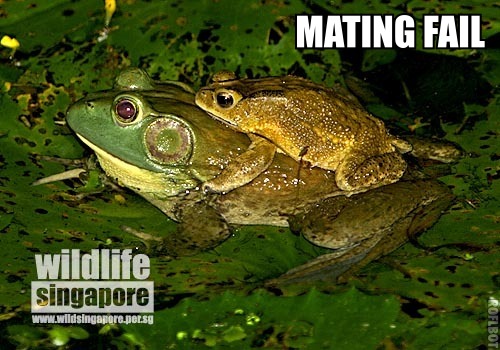
Mating Fail
A male Asian toad (Duttaphrynus melanostictus) tries to get it on with a male American bullfrog (Lithobates catesbeianus).
(Original image from Wildlife Singapore)

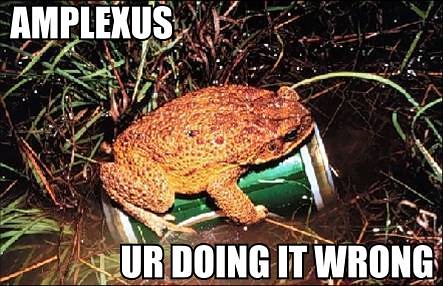
Amplexus - You're Doing It Wrong
Cane toad (Rhinella marinus) and... beer can?
(Original image from Terrapin Procrastination)

Tetrapod Zoology: Shocking inter-racial sex scenes

Now if you'll excuse me, I need to go read up more about the birds and the bees...