Showing posts with label Singapore Botanic Gardens. Show all posts

Sunday, June 23, 2013

Flashback: wildlife news in 1960s Singapore

WhaleSharkClifford
A 6 metre long whale shark (Rhincodon typus), shot by police after it was trapped at a kelong near Pulau Sebarok in 1964. This is the only record of this species in our waters;
The Straits Times, 7 June 1964

This year's theme for the Singapore Blog Awards is "60s Fever", and I thought it would be nice to take a look back at what it was like for Singapore's biodiversity in the 1960s.


Singapore's Master Plan from 1958. Some of the Southern Islands are not included in this map.


Singapore, according to the Urban Redevelopment Authority's (URA) Master Plan 2008. You can see how much our coastline has changed since 1958.

Monday, December 6, 2010

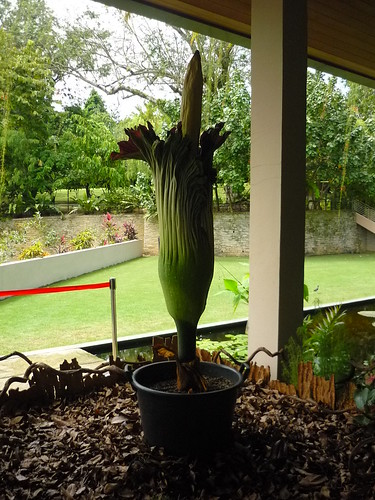
The Saga of Singapore's Titan Arum

P1490279

For a brief period, visitors to the Singapore Botanic Gardens will bear witness to what is probably a once in a lifetime event: the blooming of the titan arum (Amorphophallus titanum).

Monday, July 6, 2009

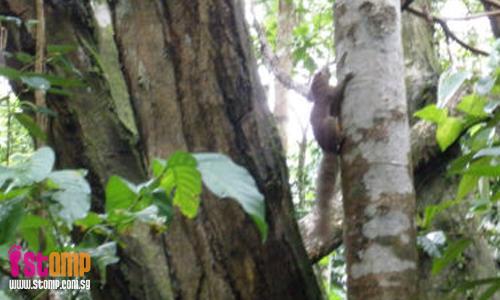
Squirrels jump from tree to tree at Bukit Timah Nature Reserve

Squirrels jump from tree to tree at Bukit Timah Nature Reserve
STOMPer Jungle Man would like to share these pictures he took of the interesting wildlife at Bukit Timah Nature Reserve with fellow STOMPers.

In an email to STOMP today (Jul 6), the STOMPer says:

"These pictures were taken at the Rifle Range Trail of the Bukit Timah Nature Reserve.

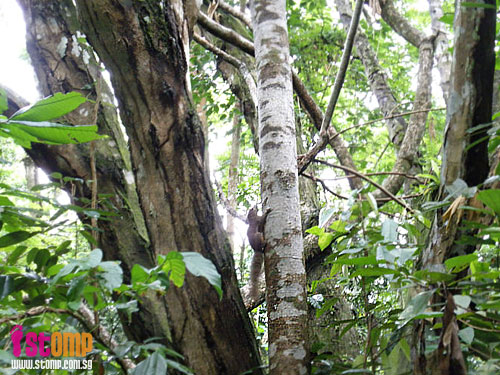
"The squirrel is a small furry animal that jumps from tree to tree. Last Sunday I saw this squirrel clambering up a rambutan tree and a durian tree.

"It plucked a rambutan and then sat down on a branch with its hind paws grappling the branch.

"With the front paws holding the fruit, it bites into the skin and eats the juicy pulp effortlessly.

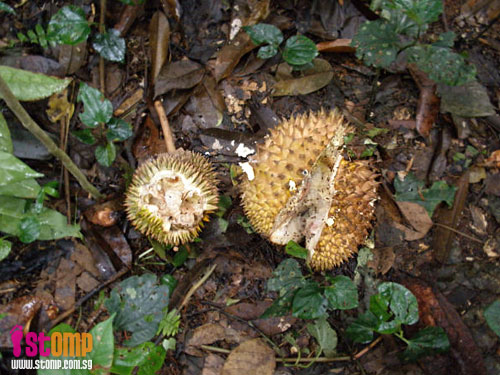
"In another picture, you’ll see a half-eaten durian lying on the forest floor. This provided a good meal for the ants.

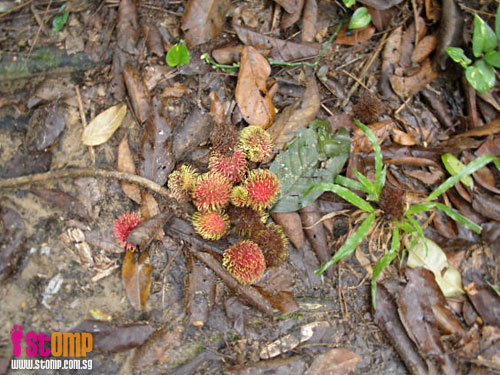
"Some ripened rambutans dropped onto the forest floor after a shower of rain.

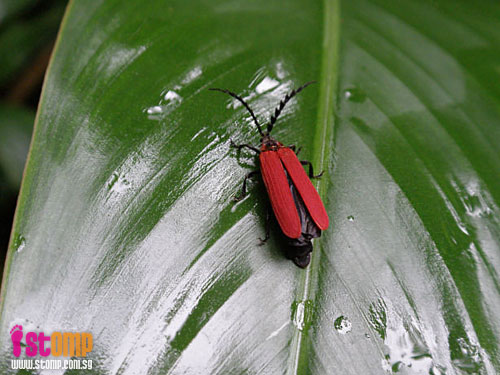
"In another picture is an insect with a black body. Its crimson wings have two saw-tooth antennae.

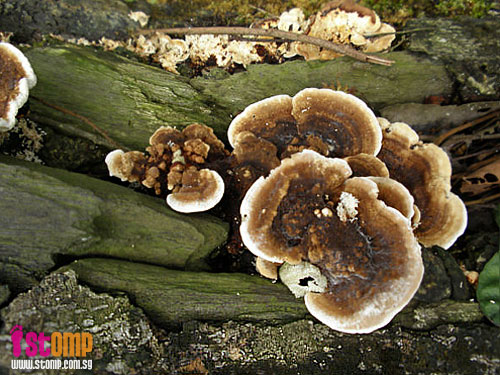
"The last picture shows a white and brown bracket fungus growing well on dead tree trunks."

Squirrels jump from tree to tree at Bukit Timah Nature Reserve

The squirrel in the photo is the plantain squirrel (Callosciurus notatus), which is the species most likely to be encountered here in Singapore. It's widespread and common, even in urban housing estates. The stripes on the flanks and the reddish belly distinguish it from all the other squirrel species in Singapore.


Plantain squirrel, Singapore Botanic Gardens;
(Photo by mjmyap)

Another squirrel species that is quite commonly encountered is the little slender squirrel (Sundasciurus tenuis), around half the size of the plantain squirrel. This species is restricted in its distribution, being found largely in the forested areas of the Central Nature Reserves and Singapore Botanic Gardens.


Slender squirrel, Upper Peirce;
(Photo by hiker1974)

A relative of the plantain squirrel, the variable squirrel (Callosciurus finlaysoni) is not a native of Singapore, being found in south Vietnam, Cambodia, Laos, Thailand and eastern Myanmar. True to its common name, there is a great deal of geographic variation within this single species; depending on the subspecies and the location, the colours can range from entirely black to reddish-brown to grey to white. Since the early 1990s, a population belonging to the subspecies bocourti from central Thailand has become established in Singapore, largely in the Woodleigh area. It's not known what possible ecological impacts might occur as a result, especially if the squirrel manages to spread to more parts of Singapore.


Variable squirrel, Bidadari Cemetery;
(Photo by hiker1974)

Singapore's other squirrel species are much more elusive, and rarely if ever spotted. The shrew-faced ground squirrel (Rhinosciurus laticaudatus) is restricted to the forests of the Central Nature Reserves, as are the red-cheeked flying squirrel (Hylopetes spadiceus) and Horsfield's flying squirrel (Iomys horsfieldii). The red-cheeked flying squirrel, known only from Bukit Timah Nature Reserve, was first recorded locally only in 1996.

Unfortunately, the three-striped ground squirrel (Lariscus insignis) is thought to be extinct in Singapore, while the fate of our 2 giants of the squirrel world looks bleak.

The story of the cream-coloured giant squirrel (Ratufa affinis) is especially tragic, considering that the species was first described by Sir Stamford Raffles, and was once quite common throughout Singapore. In fact, it was often caught as a pet or for food up to the late 1960s. Deforestation seems to have been the main cause of the squirrel's decline; it appears that it was eventually restricted to the forests of Bukit Timah and the Central Catchment Area. With a frightfully small population (estimates of the total population in Singapore range from a mere 2 to 10 individuals), it's clear that even if the squirrel hasn't already gone extinct in Singapore (it was last sighted in 1995), it's just about nearly so.

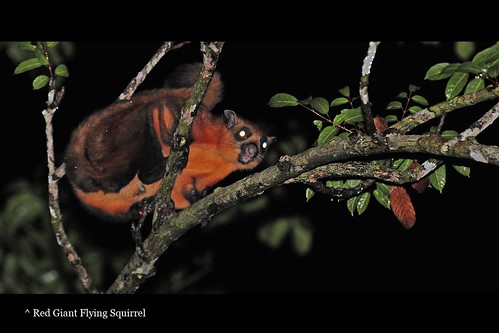
Less is known about the red giant flying squirrel (Petaurista petaurista) in Singapore. This species was last recorded in 1986, so it's possibly already extinct. However, its nocturnal nature and shy habits mean that there is a chance that it still survives in our forests.


Red giant flying squirrel, Langkawi;
(Photo by kwokwai76)

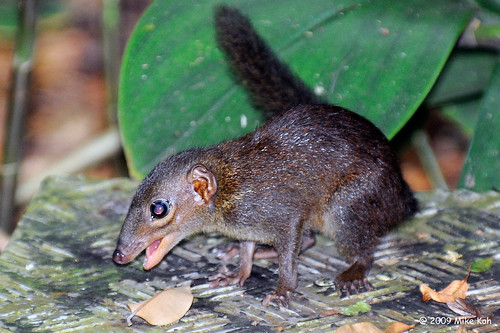
Not to be mistaken for a squirrel is the common treeshrew (Tupaia glis), a mammal that's actually much more closely related to primates than rodents.


Common treeshrew, Singapore Botanic Gardens;
(Photo by astro08)

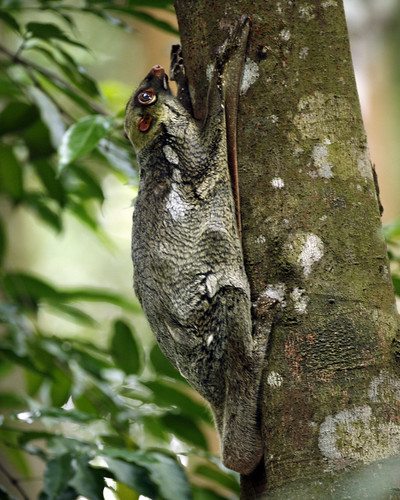
Similarly, the Malayan colugo (Galeopterus variegatus), another distant primate relative, is not to be mistaken for a flying squirrel.


Malayan colugo, Central Catchment Area;
(Photo by Lip Kee)

In a completely unrelated vein, the insect pictured above is a net-winged beetle. Net-winged beetles belong to the family Lycidae, and many species feed on nectar as adults. Most species are brightly coloured in hues of red or orange, signaling that they are toxic and distasteful. They're related to fireflies, among many other beetle families.

Here's a picture of the long-nosed lycid beetle (Porrostoma rhipidius), an Australian species, for comparison.


Long-nosed lycid beetle, Victoria;
(Photo by Wimm/WL)

Sunday, April 19, 2009

Native parrots of Singapore


Long-tailed parakeets, Singapore Botanic Gardens;
(Photo by Lip Kee)

Parrots are commonly thought of as iconic birds of the tropics. Southeast Asia does have a very high number and diversity of parrot species, although most of its diversity is heavily concentrated in the myriad Indonesian islands that lie between the Greater Sundas and New Guinea. 12 parakeet species belonging to the genus Psittacula and 2 species of hanging parrot (Loriculus) are found in the general area covering the Indian subcontinent, Indochina, and nearby islands such as the Andaman and Nicobar Islands. In comparison, the Sundaland region itself, encompassing the Malay Peninsula, Sumatra, Borneo and Java, seems a little poor in parrot species, with a total of 5 species; 2 Psittacula parakeets, the endemic monotypic Psittinus, and 2 hanging parrots.

This post will give a brief introduction to the 3 native species of parrot in Singapore.

Long-tailed Parakeet (Psittacula longicauda)


Male long-tailed parakeet, Singapore Botanic Gardens;
(Photo by hiker1974)

The long-tailed parakeet is the most common native parrot, and can be found in many parts of Singapore, from forests to parks and secondary scrub, wherever there are sufficient tall trees to serve as nesting and roosting sites. This species has a relatively wide distribution, from the Andaman and Nicobar Islands in the Indian Ocean to the Malay Peninsula, Sumatra and Borneo. Populations also exist on many of the surrounding smaller islands. The female lacks the long tail feathers of the male, and the reddish coloration on the head is limited to the cheeks.


Female long-tailed parakeet, Singapore Botanic Gardens;
(Photo by Lip Kee)

Flocks can be spotted in the Changi Village area, where they now have to jostle for nest sites with 2 introduced parrot species, the red-breasted parakeet (Psittacula alexandri) and Tanimbar corella (Cacatua goffiniana). Similarly, the flock at the Botanic Gardens has to compete with red-breasted parakeets and rainbow lorikeets (Trichoglossus haematodus). In fact, it is likely that competition for resources with its introduced relative is leading to the native species being displaced; my personal observation is that the red-breasted parakeet appears to be more common than the long-tailed parakeet in the Changi and Pasir Ris area.

Blue-rumped Parrot (Psittinus cyanurus)


Male blue-rumped parrot, Taman Negara;
(Photo by John Wright)

This is a rare species restricted to the forests of the Central Nature Reserves. Elsewhere in its range, which includes the Malay Peninsula, Sumatra, and Borneo, this species is known to inhabit cultivated areas such as oil palm plantations. The most obvious difference between the sexes is that the male has a blue head while that of the female is brown.


Female blue-rumped parrot, Tawau;
(Photo by Wong Tsu Shi)

Blue-crowned Hanging Parrot (Loriculus galgulus)


Male blue-crowned hanging parrot, location unknown;
(Photo by Jonathan Cheah)

Like the blue-rumped parrot, this species has its stronghold in the Central Nature Reserves, although it can also be encountered in the Singapore Botanic Gardens, and occasionally elsewhere in suburban and urban Singapore, especially when there are trees flowering or fruiting.

The blue-crowned hanging parrot, like all other members of its genus, is often seen hanging from branches while feeding and roosting, hence the name. The easiest way to tell females apart from the males is that the females lack the dark blue feathers on the crown and the red throat patch.
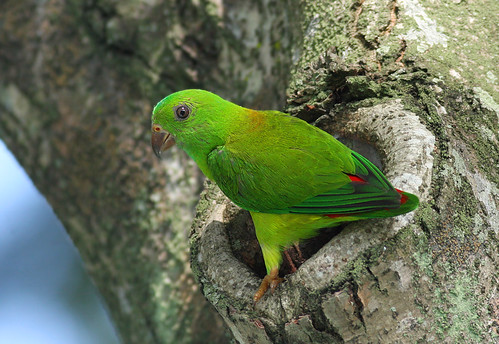

Female blue-crowned hanging parrot, Bukit Panjang;
(Photo by kampang)

Its distribution is similar to that of the blue-rumped parrot, being found on the Malay Peninsula, Sumatra and Borneo, and it has also been introduced to the Jakarta area on Java. This is a species that has been heavily exploited for the pet trade.

These 3 native species of parrot have been joined in recent decades by a wide variety of newcomers. Having escaped or been released from captivity, many of these other parrot species have begun to establish themselves in Singapore, and are now breeding. Others have been known to occur locally for several years, but breeding has yet to be recorded; these populations are being sustained by fresh escapees or releases. Many more have been sighted as lone individuals, and in the absence of breeding partners, are unlikely to become a long-term component of Singapore's avifauna. But further discussion on these non-native parrots is best left for another time.

Tuesday, April 14, 2009

Strange insect spotted at Botanic Gardens

Strange insect spotted at Botanic Gardens
This strange brown insect was spotted emerging from a cocoon at the Singapore Botanic Gardens. The STOMPer, who spotted it, wonders what it is.

In an e-mail, he says:

"While trekking through the trails of the tropical rainforest at Botanic Gardens I came upon this white-coloured cocoon on the bottom of a large leaf.

"On looking closer, I found a black insect with brown eyes on the top of the leaf which could possibly had emerged a short while earlier from the cocoon."

Strange insect spotted at Botanic Gardens

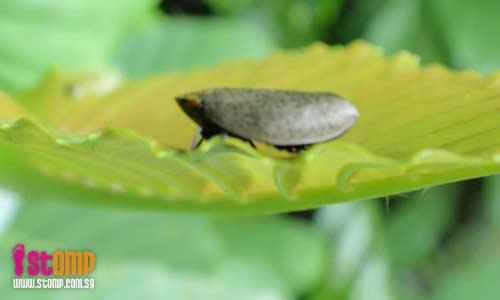
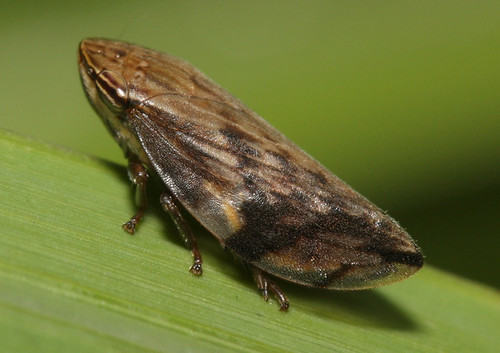
The insect looks like it's a froghopper (Cercopoidea). Like their close relatives the leafhoppers (F. Cicadellidae) and treehoppers (F. Membracidae), froghoppers are herbivorous bugs with piercing mouthparts, which they use to suck the sap of plants.


Unidentified froghopper, Pulau Ubin;
(Photo by Marcus)

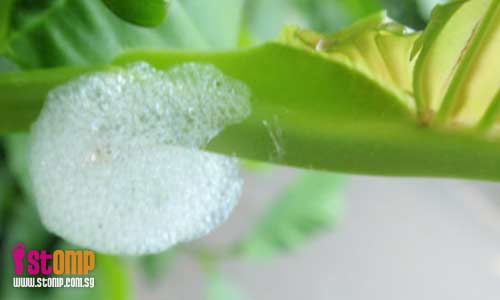
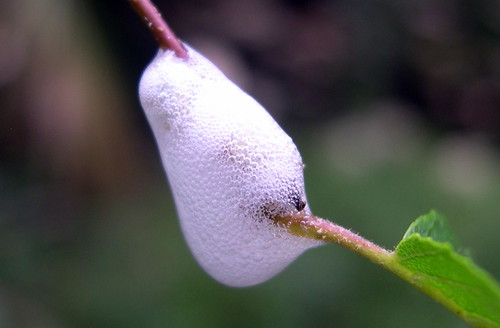
Froghoppers are famous for a trait seen in the nymphs of most species; the nymphs create a thick and white foam out of plant sap (the 'white-coloured cocoon' in the original post). They hide in this protective froth, not only for protection from predators, but also to seek refuge from extreme temperatures and to conserve water. Hence another common name for these bugs is spittlebug.


Nest of 'spittlebug', Florida;
(Photo by rc6750)

Durian Loop better than Botanic Gardens

Durian Loop better than Botanic Gardens
A STOMPer prefers the rich fauna that he encounters on the Durian Loop off Bukit Timah Road, to the manicured lawns of the Botanic Gardens.

In his email:

"The Botanic Gardens with its manicured lawns and artificial gardens, though beautiful, do not impress me.

"I find it more fascinating to walk through the Durian Loop near the Murnane Service Reservoir at Jalan Kampong Chantek.

"Here I come across a rare spider, a rare butterfly or a rare snake occasionally."

Durian Loop better than Botanic Gardens
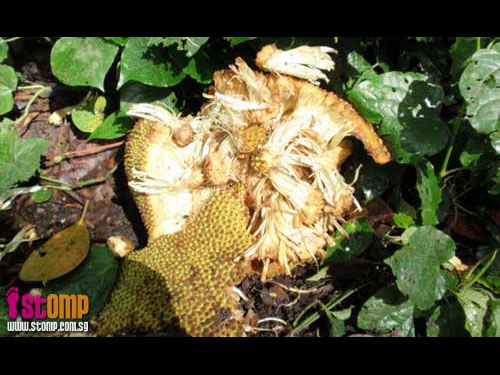
I found this jackfruit on the forest floor. It's half-eaten by birds and monkeys. They have devoured the yellow pulp, leaving behind the seeds. Soon the rotting smell will attract flies.

Durian Loop better than Botanic Gardens
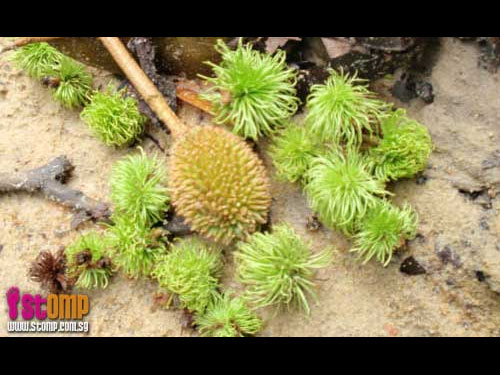
After a heavy shower, some young rambutan fruits have fallen to the ground. The monkeys avoid them because they are unripe.
Durian Loop better than Botanic Gardens
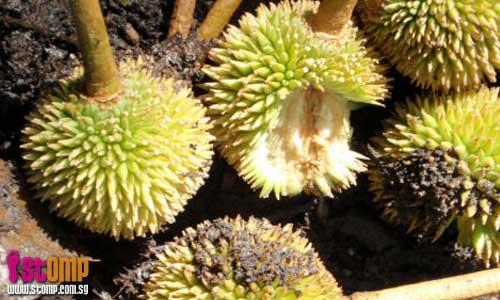
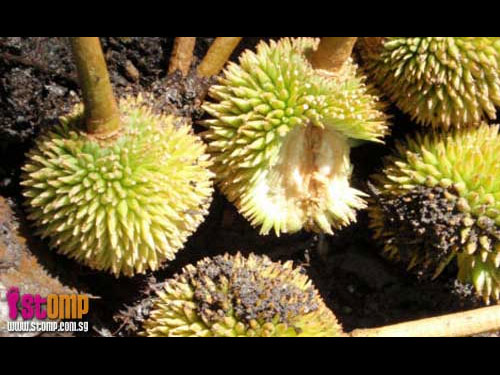
Some durians have fallen before maturity due to the downpour. A young monkey bit into the thorny fruit and promptly abandoned it when it found no juicy flesh. The best connoisseurs of durians are the fast-moving squirrels who have an uncanny nose for the best-tasting durians. If you find a durian with holes and jagged edges, it's probably the work of a squirrel that has taken the first bite. The durian is also probably the best-tasting of the lot.
Durian Loop better than Botanic Gardens
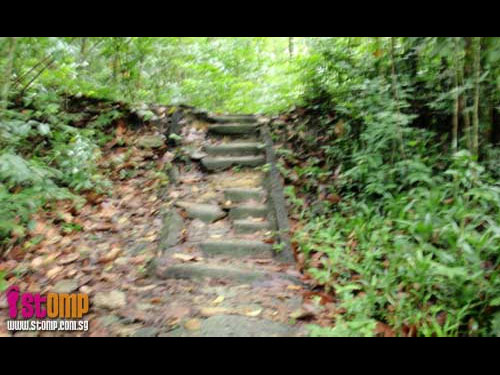
A forest path with its steps damaged by the constant pounding of tropical rainstorms.

Beautiful swans at the Botanic Gardens

Beautiful swans at the Botanic Gardens
A STOMPer sent in pictures of different types of swans he saw at the Botanic Gardens.

In an email to STOMP today (April 14), the STOMPer says:

"These pictures were taken at the Singapore Botanic Gardens.

"A male swan is called a cob, a female swan is called a pen and a baby swan is called a cygnet.

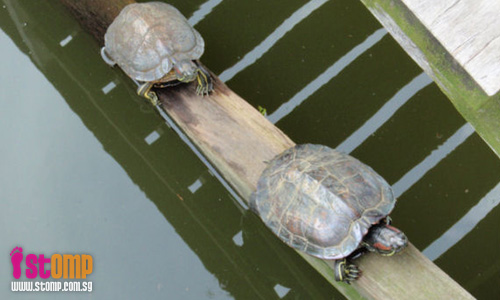
"The swan is the largest aquatic bird and it moves gracefully in water. It is long-necked and web-footed. In the picture, you can see a tortoise and two black swans.

"The swan has a red beak and black swans are only found in the Eco Lake in our Botanic Gardens.

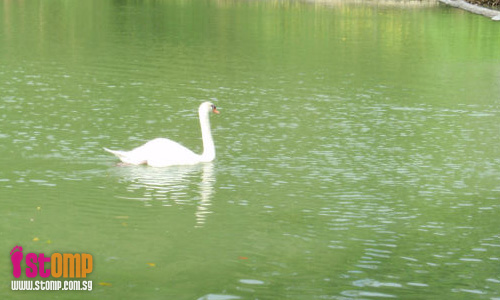
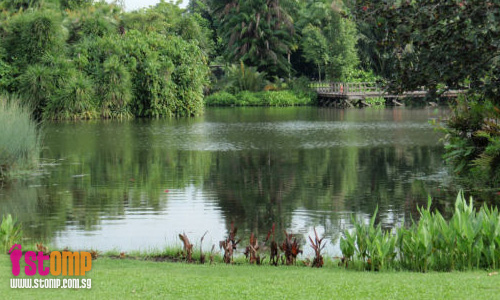
"The white swan (as seen in the picture) is found in the Swan Lake nearer to Napier Road. You can see its reflection in the water.

"In one of the pictures, you can also see two tortoises. After swimming in the water, they decided to dry themselves on the wooden plank beside the wooden bridge.

"The Swan Lake is very peaceful in the early morning. Sometimes you can see newlyweds coming here with their photographers to take some photos of their most memorable day."

Beautiful swans at the Botanic Gardens

When will this particular person learn that the red-eared slider (Trachemys scripta elegans) is a turtle, not a tortoise?

The mute swan (Cygnus olor) is the species that most commonly comes to mind when we think of swans. A native of much of Europe and Central Asia, it has been introduced to other parts of the world, most notably in North America, where it has stirred up a fair bit of controversy; to some, it is a non-native species whose numbers should be controlled by culling, a view that faces much opposition from animals rights organisations and many individuals.

The black swan (Cygnus atratus), on the other hand, hails from Australia, and has recently established itself in New Zealand due to deliberate introduction as an ornamental bird, and also via natural dispersal from Australia. However, a prehistoric subspecies of black swan once existed on New Zealand and the Chatham Islands, but disappeared possibly due to hunting by human settlers. The black swan is also commonly reared in Europe.

There are 4 other species of swan, but they are much more rarely seen in captivity. They are the black-necked swan (Cygnus melancoryphus) of southern South America, the whooper swan (Cygnus cygnus) of northern Eurasia, the trumpeter swan (Cygnus buccinator) of North America, and the tundra swan (Cygnus columbianus) of both North America and northern Eurasia.

As mentioned by the person who submitted the post to STOMP, the 2 species of swan of the Singapore Botanic Gardens actually reside in different areas; the mute swans live at the Swan Lake, while the black swans are found over at the Eco-Lake.

Tuesday, April 7, 2009

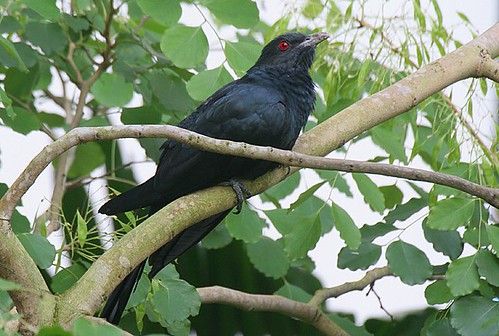
Call of the Koel


Male Asian koel (Eudynamys scolopaceus), Bukit Panjang;
(Photo by kampang)

The Asian koel is a bird that has adapted very well to urban Singapore. Not everyone knows its name, nor is it often spotted, but I'm sure that everyone in Singapore would be familiar with the male's unmistakable call.

Friday, March 27, 2009

Check out why Kusu Island is so popular with tourists

Check out why Kusu Island is so popular with tourists
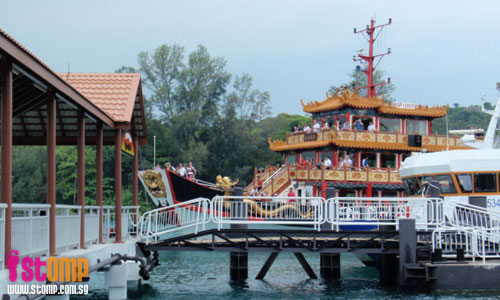
A STOMPer took a day trip to Kusu Island and was impressed with its beauty. Here are some pictures he took, which includes the famous temple known for its turtle pond. Says the STOMPer:

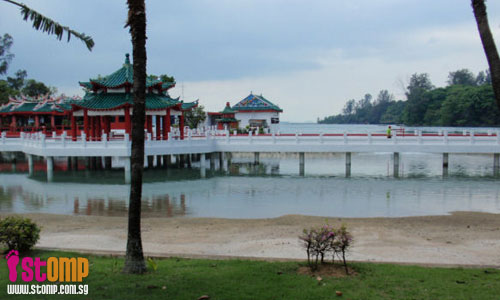
"This upgraded pier at Kusu Island was opened recently and every day shiploads of tourists come here to visit the turtle pond which Kusu is famous for.

"There is a pagoda and a cemented boardwalk for tourists who want to visit the temple.

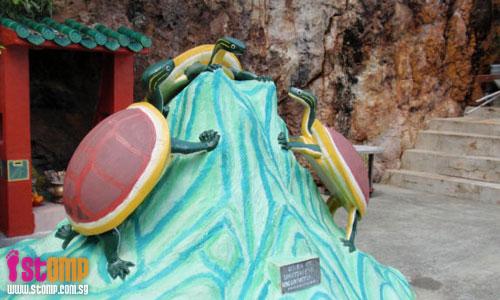
"You can see three stone turtles in the temple and legend has it that in the early days when the sailors were shipwrecked, the giant turtle came to save these poor sailors.

"The live turtle pond there is kept by the temple caretaker. He feeds the turtles with kangkong everyday.

"There is also a sluice gate to the turtle pond. During the hot weather, the water dries up very fast and sea water is then let in through the sluice gate."

Check out why Kusu Island is so popular with tourists

Kusu Island has a rich and fascinating history, and is one of our more well-visited offshore islands. Every year, during the ninth month of the lunar calendar, it is thronged with thousands of people making a pilgrimage to its temple. However, outside of this particular window of time, it is a peaceful, idyllic place, where time seems to slow down. Kusu Island then becomes an excellent location for quiet reflection and contemplation, where one can try to emulate the shelled reptiles that are so closely associated with the island.

Among its various attractions is the Tortoise Sanctuary, with its resident population of turtles released there by devotees in an attempt to gain merit. So far, I have not personally visited the Tortoise Sanctuary, but have instead explored some of the reefs fringing this island.

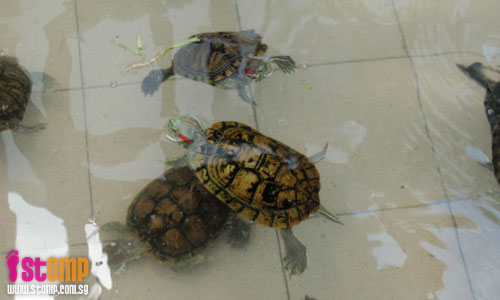
Based on some photographs I've seen of the island's reptilian inhabitants, most of the turtles released are red-eared sliders (Trachemys scripta elegans), a North American species that has now established itself all over Singapore and is now our most common freshwater turtle species. However, there are also smaller numbers of Malayan box turtles (Cuora amboinensis) and giant Asian pond turtles (Heosemys grandis). One wonders if the turtles are able to find sufficient food; as a whole, their slow metabolisms mean that turtles can survive on significantly less food than a similarly-sized bird or mammal, but starvation of captive turtles would be unnecessarily cruel.

Turtles have a long history that dates back to the Triassic, and while it is inaccurate to claim that they have not changed at all over the past 220 or so million years, it is apparent that they hit upon a winning formula very early on. The evolution of the chelonian shell is still a complicated mystery, with Chinlechelys and Odontochelys, 2 new fossil finds last year from the Late Triassic, presenting very contradictory views on how the shell evolved; in fact, scientists are still divided over where turtles belong in the reptile family tree in the first place.

The Testudines are a very wide-ranging group of reptiles, with members inhabiting virtually every tropical and temperate wetland environment. Many terrestrial species are well-adapted to surviving in arid savanna and scrub, or even true desert, while others have colonised offshore islands and evolved into lumbering giants.

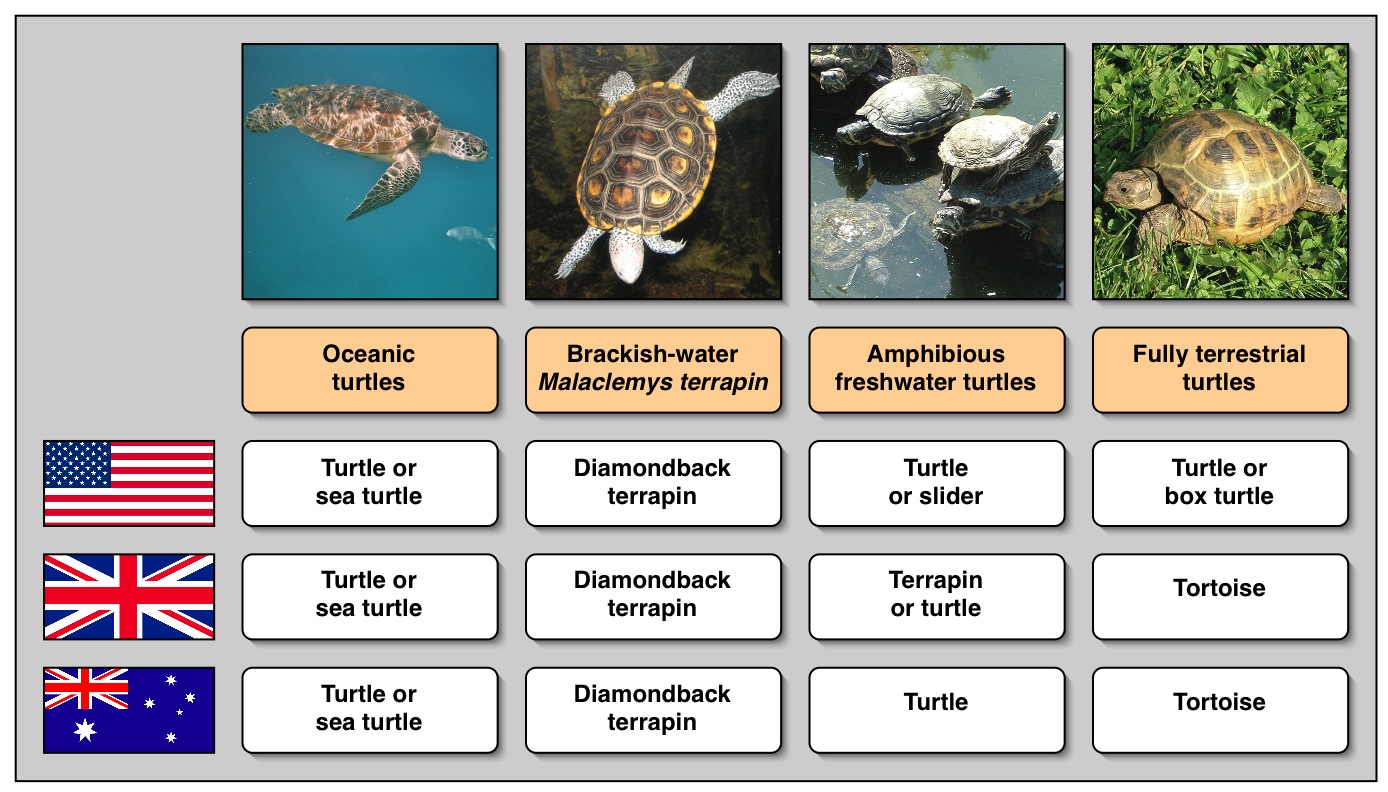
Some confusion exists over the usage of the terms 'turtle', 'terrapin', and 'tortoise'. Locally, 'terrapin' is used for any semi-aquatic species, although I prefer to reserve the term for the diamondback terrapin (Malaclemys terrapin), an inhabitant of coastal brackish swamps on the eastern coast of North America. Here's an excellent graphic from Wikipedia that shows how the names are defined ecologically in some English-speaking countries.


Southeast Asia is particularly rich in turtle species, and Singapore itself has six native species belonging to two families, the Geoemydidae and Trionychidae.

The geoemydids are a family of terrestrial and semi-aquatic species, and range from placid vegetarians to omnivores. Four native species of geoemydid are known to occur in Singapore, the Malayan box turtle, Asian leaf turtle (Cyclemys dentata), spiny turtle (Heosemys spinosa) and Malayan flat-shelled turtle (Notochelys platynota). The local status of the painted terrapin (Batagur borneoensis), not to be confused with the unrelated painted turtle (Chrysemys picta), is indeterminate; it might or might not exist in Singapore, and we need good eyewitness accounts or at least an identifiable specimen to verify its presence. The same goes for the Malaysian giant turtle (Orlitia borneensis), although to be honest, I won't be surprised if these species, as well as several others not mentioned, do in fact exist in some of our more inaccessible waterways.

Unlike the largely peaceable semi-aquatic geoemydids, the trionychids, or softshell turtles, are almost wholly aquatic, and have a reputation for being aggressive predators. Softshell turtles lack the hard bony scutes that cover the carapace of other turtles, and instead have a layer of leathery skin. The snout is elongated to form a snorkel-like structure, enabling the turtle to breathe while the rest of its body remains submerged. Singapore has two species, the Malayan softshell turtle (Amyda cartilaginea) and forest softshell turtle (Dogania subplana), while the existence of a third species, the Asian giant softshell turtle (Pelochelys cantorii), remains unverified.

The international trade in turtles, both for food and as pets, has also resulted in several other species colonising our waters. As mentioned before, the red-eared slider is now ubiquitous in freshwater environments everywhere, from koi ponds in parks to reservoirs, and even in nature reserves.

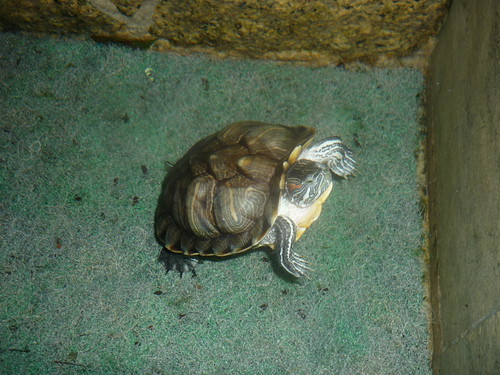
Red-eared slider (Trachemys scripta elegans)
Here is a red-eared slider that I found living in the fountain at one of the washrooms along Siloso Beach.

Recently however, it appears to have been joined by a close relative, the North Antillean slider (Trachemys decussata) of Cuba; I have seen this species in the Singapore Botanic Gardens, while Marcus has a photo of an individual that he spotted at the Sungei Buloh Wetland Reserve.

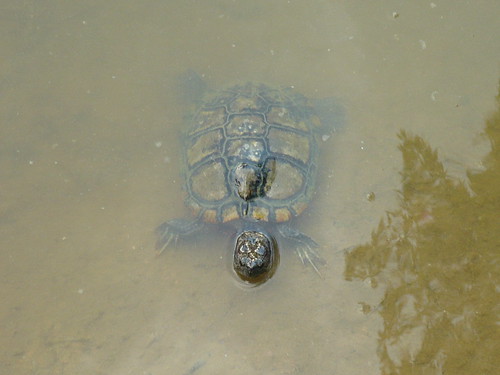
North Antillean slider (Trachemys decussata)
This is the North Antillean slider I saw in the Symphony Lake at the Singapore Botanic Gardens.

These two species belong to the Emydidae, which like the Geoemydidae, are a family of largely semi-aquatic omnivorous turtles, with a few terrestrial species. While the Geoemydidae are predominantly Eurasian, with a single genus found in tropical Central and South America, the Emydidae are found throughout the Americas, with a single species inhabiting Europe, North Africa, and western Asia.

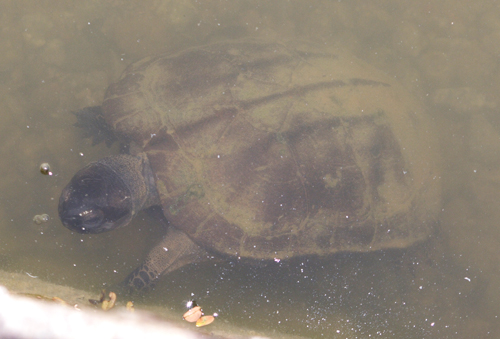
The most common softshell turtle in Singapore is the Chinese softshell turtle (Pelodiscus sinensis), which is commonly bred and imported for food. This is the species most commonly used in turtle soup. Escapees from farms and releases by pet owners and religious devotees have no doubt enabled this species to establish itself in some urban and rural waterways, possibly at the expense of our native softshell turtles.


Chinese softshell turtle at Swan Lake, Singapore Botanic Gardens;
(Photo by Marcus)

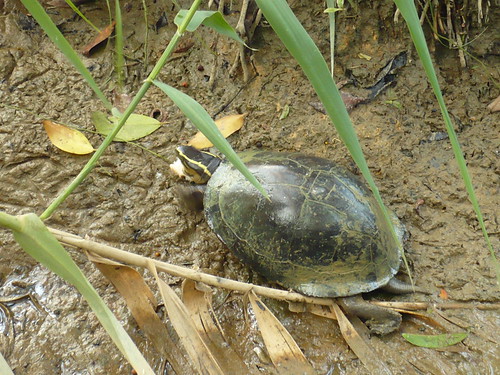
Among the geoemydids, the black marsh turtle (Siebenrockiella crassicollis) is possibly a non-native species. It is now common in many parts of Singapore, and its widespread distribution is probably partly due to the fact that this species is often released by those who believe in gaining karma through releasing captive animals. Similarly, it is likely that many Malayan box turtles encountered in the wild were former captives.


Black marsh turtle at Swan Lake, Singapore Botanic Gardens;
(Photo by Marcus)

Malayan box turtle (Cuora amboinensis)
Here's a Malayan box turtle I spotted at the Symphony Lake, Singapore Botanic Gardens.


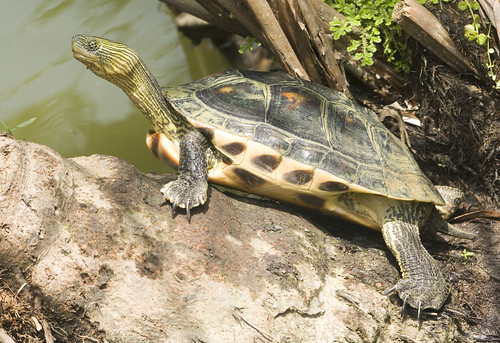
Marcus has photographic evidence of yet another non-native species, the Chinese stripe-necked turtle (Ocadia sinensis). This photo was taken at the Singapore Botanic Gardens.

The pig-nosed softshell turtle (Carettochelys insculpta) is occasionally encountered in local pet shops, although trade in this species is illegal. I was very surprised at the beginning of this year when I saw one swimming in the pond in front of the Visitor Centre at Sungei Buloh!

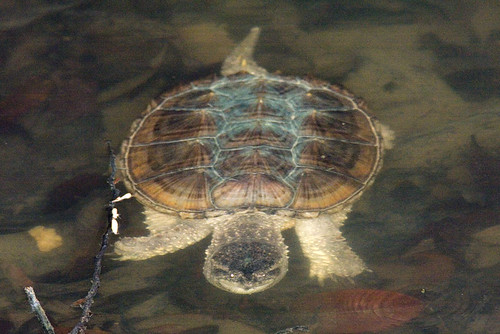
Most worrying though, is the presence of snapping turtles in Singapore's reservoirs. Not only is there a threat to native aquatic wildlife, but these North American species also pose a significant safety hazard. Marcus has photographed a common snapping turtle (Chelydra serpentina) in MacRitchie Reservoir, while someone was foolish enough to blog about releasing a pet alligator snapping turtle (Macroclemys temminckii) into Lower Seletar Reservoir, and was subsequently visited by the AVA. God forbid that enough of these non-native turtles are abandoned and released into our waters to establish breeding populations.


Common snapping turtle, MacRitchie Reservoir;
(Photo by Marcus)


Alligator snapping turtle being released into Lower Seletar Reservoir.
(Photo by Sukianto)

The deliberate release of animals, whether it is abandonment of unwanted pets, or a misguided attempt to gain merit for doing a supposed good deed, continues to piss me off to no end. Our native aquatic fauna is already at risk from a wide variety of threats, from loss of habitats to poaching. The last thing they need is the introduction of non-native species that will upset the ecological balance, whether it is by actively predating upon other species, competing with similar native species for food and other resources, or by spreading diseases and parasites.

Not to mention that there are ignorant individuals who release animals into the wrong habitat, unaware that their act of kindness only condemns the animal to a premature end. Andy has a post on Chinese softshell turtles being released into the sea at Labrador Park.

Needless to say, I have nothing but utter scorn and contempt for people who abandon their pets. I still have a little patience for those who release captive animals for religious reasons (i.e. fang sheng), but after several years of publicity efforts and recommendations from religious groups, I believe almost everyone should have gotten the message by now. Marcus has an excellent write-up on the harmful impacts that may result from releasing captive animals into the wild.

Releasing of Animals - Good or Bad? (pg. 1)
Releasing of Animals - Good or Bad? (pg. 2)
Releasing of Animals - Good or Bad? by the Nature Society (Singapore)

According to the Agri-Food and Veterinary Authority of Singapore (AVA), only two species of turtle can be sold in pet shops - the red-eared slider and Malayan box turtle. However, the presence of several other non-native species indicates that a significant amount of illegal trade still occurs in Singapore. In the past, when I used to visit several pet shops in Tampines and Bedok on a regular basis, I encountered various other species of turtle from time to time, from baby Chinese softshell turtles and pig-nosed softshell turtles (which used to be seen quite regularly in the past), to more exotic species like mata mata (Chelus fimbriatus) and even Indian star tortoise (Geochelone elegans). The Animal Concerns Research and Education Society (ACRES) documents their efforts in cracking down on the illegal trade in turtles as pets, while a recent paper records the availability of a wide variety of turtle species in the local pet trade.

Goh, T. Y. & O'Riordan, R. M. 2007. Are tortoises and freshwater turtles still traded illegally as pets in Singapore? Oryx, 41(1): 97-100.

Unfortunately, the problem is rampant throughout Asia; the trade in live turtles takes on horrifying proportions when one visits the animal markets of Asia, especially those in China. It is feared that the insatiable demand for turtle flesh has seriously depleted wild populations of Asian turtles and tortoises; quotas and other regulations to reduce overexploitation are routinely ignored. Rampant illegal trade at 10 to even 100 times that of the illegal trade is threatening to wipe out the Malayan box turtle in Malaysia and Indonesia. So relentless is this greed that it is now feared that the markets, having all but exhausted stocks of the Asian turtle species, are now turning their attention to North America. States like Iowa and Florida are worried about the growing threat to their turtle populations; even the more common species take time to mature and reproduce, and cannot sustain such a high level of exploitation.

The exotic pet trade also takes its toll on turtles, with tortoises from Madagascar being among the species at risk. The Roti Island snake-necked turtle (Chelodina mccordi), endemic to a single tiny Indonesian island, is critically endangered due to overcollection for the pet trade.

So lucrative is the trade in turtles and tortoises that even the Live Turtle & Tortoise Museum has been besieged time and time again by thieves, with the latest incident involving the theft of seven Indian star tortoises and three radiated tortoises (Astrochelys radiata).

It is worrying that the illegal trade in live turtles not only depletes wild populations, but also means that the risk of non-native species being introduced into vulnerable ecosystems is greatly increased. It is worth noting that trade in species like the Chinese stripe-necked turtle, pig-nosed softshell turtle, and common snapping turtle is illegal in Singapore, yet they have been recorded as being present in the wild. Hopefully, numbers of these non-native turtles are low enough to prevent breeding, but turtles can be long-lived, and it is possible that a lone individual might live for years or even decades, only to finally encounter a newly released member of the opposite sex.

Most people are aware about the threats faced by sea turtles, ranging from pollution, marine litter and nets, to poaching of adults and eggs, to loss of nesting beaches. These are threats that are also faced by a great proportion of terrestrial and aquatic turtle species, yet their plight is often overlooked in comparison with their iconic marine cousins.

Although there have been a number of recent cases where illegal trade in turtles was exposed, and the perpetrators brought to justice, clamping down on the trade requires further international collaboration, and cooperation between government agencies and NGOs. Stricter quotas need to be set and even more closely monitored, laws need to be overhauled to give endangered species the necessary level of protection, while much more needs to be done in training officials to take wildlife protection more seriously, and to detect illegally traded species.

Turtles have survived a great number of extinction events, but can they survive us?