
Showing posts with label Woodleigh. Show all posts
Showing posts with label Woodleigh. Show all posts
Sunday, July 24, 2011
Saturday, October 31, 2009
Eagle-like bird spotted at Serangoon North Ave 2
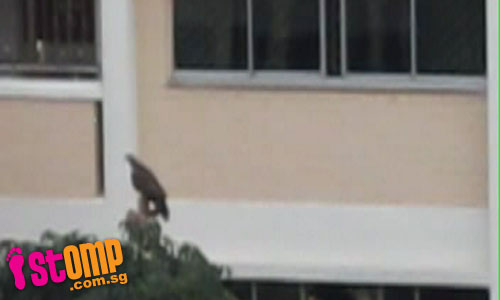
STOMPer John Patrick's wife and son spotted this huge eagle-like bird perched on a tree top at Serangoon North Ave 2.
In email sent to STOMP today (Oct 31), the 49-year-old civil servant wrote:
"My wife and son spotted this bird which looks like the eagles we see in Jurong Bird Park from our eighth floor flat at Serangoon North Ave 2.
"This was in the afternoon of Oct 29 and it appeared to be a very large bird."
Do check out the video posted on STOMP.
The video quality is horribly poor, but if I had to make an educated guess, I wouldn't be surprised if it was an Oriental honey buzzard (Pernis ptilorhynchus).
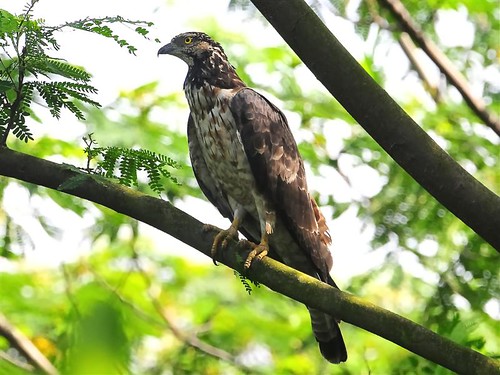
Bidadari Cemetery;
(Photo by NatureInYourBackyard)
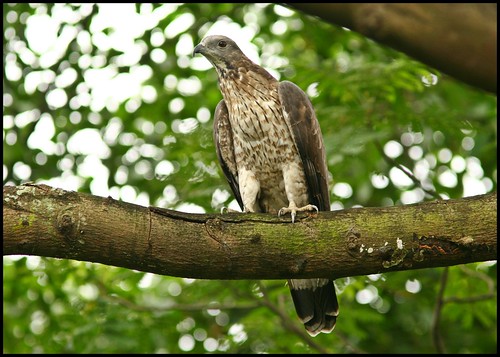
(Photo by hiker1974)
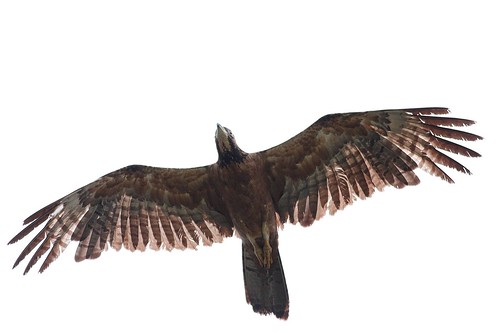
Bukit Panjang;
(Photo by kampang)
As the name suggests, the Oriental honey buzzard actually has quite a unique diet; it specialises on raiding the nests of wasps and bees for their larvae, although it also feeds on other insects, and will take small vertebrates.
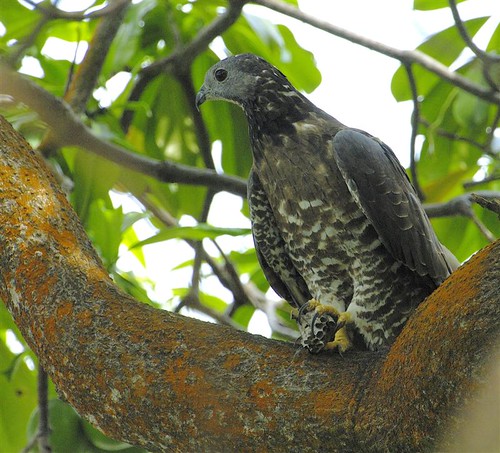
Oriental honey buzzard feeding on wasp nest, Japanese Garden;
(Photo by NatureInYourBackyard)
Compared to other raptors, the Oriental honey buzzard appears to have a long neck with a small head. Its nostrils are slits, and it has special scale-like feathers around its face, nostrils and forehead. These are adaptations to protect the bird from the stings of wasps and bees.
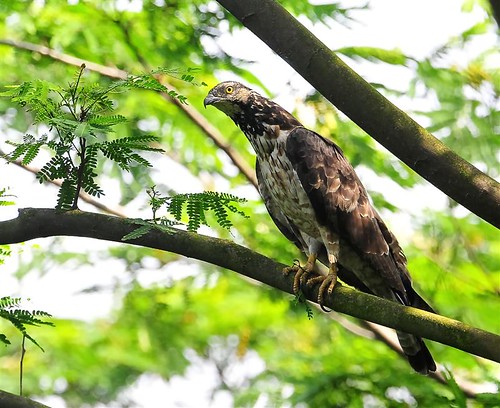
(Photo by NatureInYourBackyard)
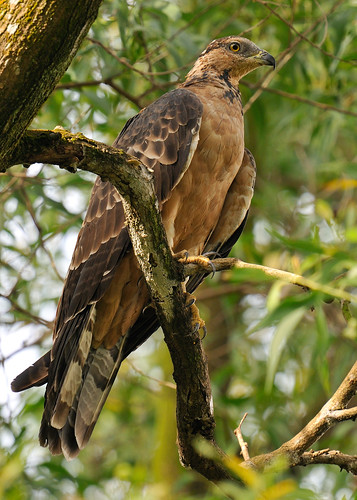
(Photo by cedphotos)
This is a species that is more commonly seen in forested and wooded habitats, although it is becoming quite frequently encountered in urban areas in recent years. Even your jaded Singaporeans, more used to mynas (Acridotheres spp.), feral pigeons (Columba livia), tree sparrows (Passer montanus) and house crows (Corvus splendens), would find it very hard to miss the large raptor perched right outside their homes.
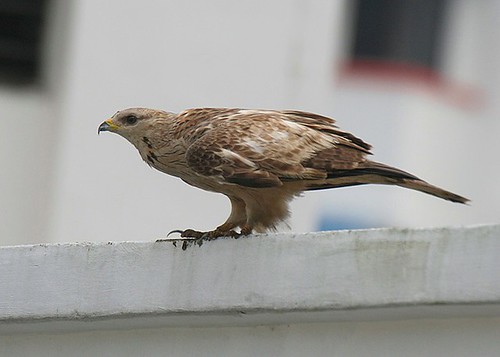
Bukit Panjang;
(Photo by kampang)
The Oriental honey buzzard is not known to breed in Singapore; instead, most sightings are believed to be of migrants from further north. There are 2 main populations; the northern population, belonging to the subspecies orientalis, breeds from Siberia east to China and Japan, and migrates to India and Southeast Asia during the winter. The bulk of sightings of Oriental honey buzzards in Singapore are of birds belonging to this population, and it is considered to be a common winter visitor and passage migrant. Birds belonging to this subspecies have little or no crest.
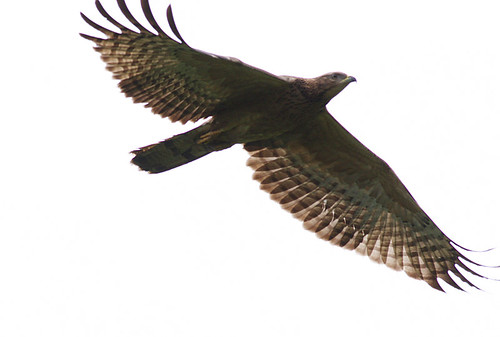
Khatib Bongsu;
(Photo by kampang)
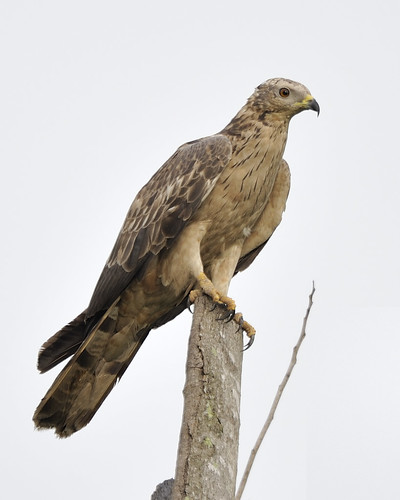
(Photo by cedphotos)
The southern population consists of 5 subspecies resident in the Indian subcontinent and Southeast Asia; the most distinctive feature that sets these subspecies apart from the northern population is the presence of a crest.
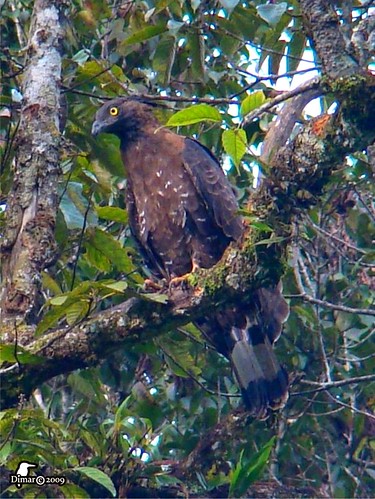
The nominate subspecies (ptilorhyncus) is endemic to Java;
(Photo by dimar_bioui05)
The subspecies torquatus is an uncommon resident breeder in Peninsular Malaysia. It is likely that the occasional records of this subspecies in Singapore are of newly fledged birds dispersing after the breeding season, in search of new territory. Such birds account for most records of Oriental honey buzzards here in the summer months.

(Photo by Laurence Poh)
The torquatus subspecies is considered to be an uncommon non-breeding visitor in Singapore; however, there is always the possibility that eventually, some of these might establish themselves and start breeding locally.

Here is a very interesting photo taken in Malaysia; the bird on the left is a male Oriental honey buzzard belonging to the resident race torquatus, while the bird on the right is a male of the same species, except that it belongs to the migratory race orientalis. You can see how different they are in terms of coloration of plumage, and by the presence of a crest in the resident form.
One very interesting fact about the Oriental honey buzzard is that it apparently mimics other raptor species. In terms of plumage, the Oriental honey buzzard is said to bear a close resemblance to several species of hawk-eagle (Nisaetus spp.) of Southeast Asia.
For example, the subspecies torquatus, resident in Peninsular Malaysia, Sumatra and Borneo, closely resembles Wallace's hawk-eagle (Nisaetus nanus).

This is an Oriental honey buzzard belonging to the race torquatus, photographed somewhere in Malaysia;
(Photo by Laurence Poh)

This is a Wallace's hawk-eagle, Kinabatangan;
(Photo by Leif Gabrielsen)
There is also a much less common morph of torquatus, known as the 'Tweeddale morph', that bears great similarity to Blyth's hawk-eagle (Nisaetus alboniger).

Here is an example of the 'Tweeddale morph' of the Oriental honey buzzard, taken at the Mandai Orchid Garden;
(Photo by Micky Lim)
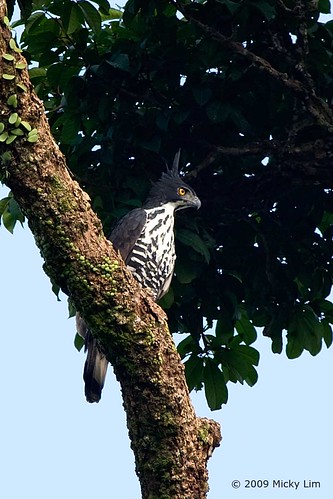
And here is Blyth's hawk-eagle, Panti Forest;
(Photo by Micky Lim)
The 'Tweeddale morph' bird spotted at the Mandai Orchid Garden proved to be the source of some confusion earlier this year.
What makes the Oriental honey buzzard so interesting is that here in tropical South and Southeast Asia, all the different variations in colour and pattern of plumage seen in this species correspond to those of various species and age-classes of hawk-eagle. Besides Wallace's hawk-eagle and Blyth's hawk-eagle mentioned above, other candidates for mimicry include the changeable hawk-eagle (Nisaetus cirrhatus) (itself a highly variable species), Javan hawk-eagle (Nisaetus bartelsi), mountain hawk-eagle (Nisaetus nipalensis) and Philippine hawk-eagle (Nisaetus philippensis).
What is the purpose of this mimicry? It is not often known that larger raptors and owls can be significant predators of other species of raptor and owl; in what is called intraguild predation, smaller predatory species often fall prey to larger predators. However, a large raptor or owl would probably think twice about attacking a well-armed hawk-eagle, especially since it would increase the risk of injury. By mimicking the heavier, more powerful hawk-eagles, the relatively weak and defenceless Oriental honey buzzard probably gains some immunity against predation by other raptors.
The Oriental honey buzzard is just 1 of several raptor species that visit Singapore during the winter months, although it is among the most common. In spring, when it is time for these migrants to head back north to their breeding grounds, these birds may form large flocks, creating an amazing natural spectacle. Tanjung Tuan in Port Dickson is highly popular with birdwatchers each spring, as large numbers of Oriental honey buzzards and other raptors reach the Malay Peninsula, after crossing the Straits of Malacca from Sumatra.

Monday, July 6, 2009
Squirrels jump from tree to tree at Bukit Timah Nature Reserve
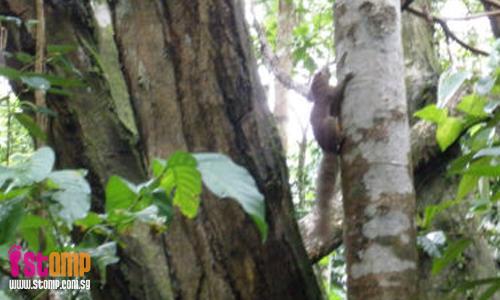
STOMPer Jungle Man would like to share these pictures he took of the interesting wildlife at Bukit Timah Nature Reserve with fellow STOMPers.
In an email to STOMP today (Jul 6), the STOMPer says:
"These pictures were taken at the Rifle Range Trail of the Bukit Timah Nature Reserve.
"The squirrel is a small furry animal that jumps from tree to tree. Last Sunday I saw this squirrel clambering up a rambutan tree and a durian tree.
"It plucked a rambutan and then sat down on a branch with its hind paws grappling the branch.
"With the front paws holding the fruit, it bites into the skin and eats the juicy pulp effortlessly.
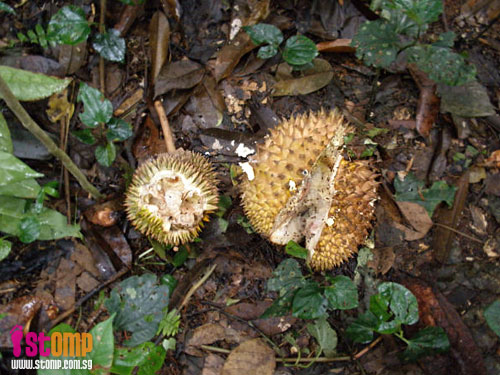
"In another picture, you’ll see a half-eaten durian lying on the forest floor. This provided a good meal for the ants.
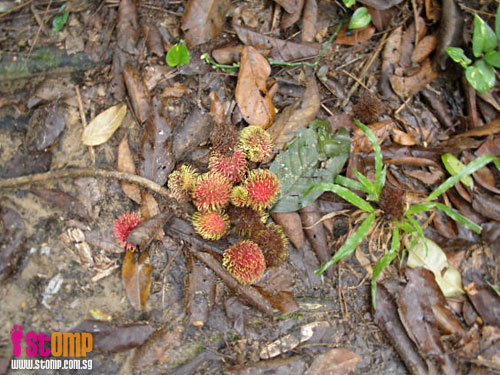
"Some ripened rambutans dropped onto the forest floor after a shower of rain.
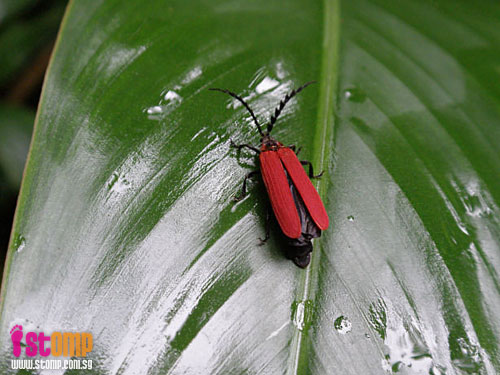
"In another picture is an insect with a black body. Its crimson wings have two saw-tooth antennae.
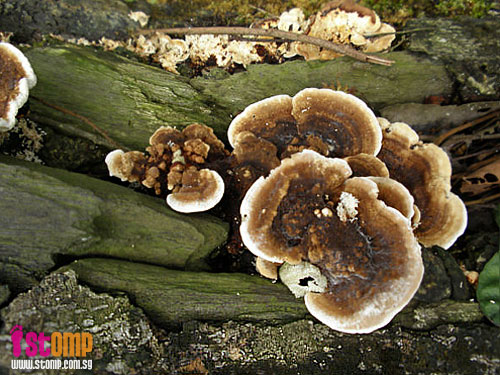
"The last picture shows a white and brown bracket fungus growing well on dead tree trunks."
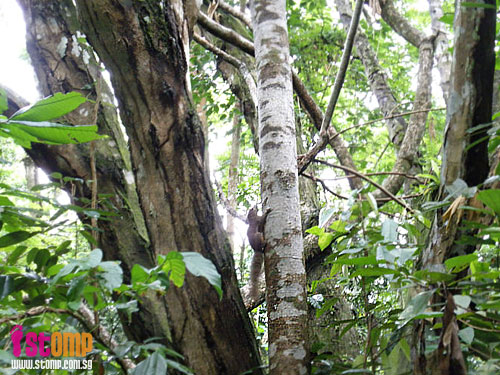
The squirrel in the photo is the plantain squirrel (Callosciurus notatus), which is the species most likely to be encountered here in Singapore. It's widespread and common, even in urban housing estates. The stripes on the flanks and the reddish belly distinguish it from all the other squirrel species in Singapore.

Plantain squirrel, Singapore Botanic Gardens;
(Photo by mjmyap)
Another squirrel species that is quite commonly encountered is the little slender squirrel (Sundasciurus tenuis), around half the size of the plantain squirrel. This species is restricted in its distribution, being found largely in the forested areas of the Central Nature Reserves and Singapore Botanic Gardens.

Slender squirrel, Upper Peirce;
(Photo by hiker1974)
A relative of the plantain squirrel, the variable squirrel (Callosciurus finlaysoni) is not a native of Singapore, being found in south Vietnam, Cambodia, Laos, Thailand and eastern Myanmar. True to its common name, there is a great deal of geographic variation within this single species; depending on the subspecies and the location, the colours can range from entirely black to reddish-brown to grey to white. Since the early 1990s, a population belonging to the subspecies bocourti from central Thailand has become established in Singapore, largely in the Woodleigh area. It's not known what possible ecological impacts might occur as a result, especially if the squirrel manages to spread to more parts of Singapore.

Variable squirrel, Bidadari Cemetery;
(Photo by hiker1974)
Singapore's other squirrel species are much more elusive, and rarely if ever spotted. The shrew-faced ground squirrel (Rhinosciurus laticaudatus) is restricted to the forests of the Central Nature Reserves, as are the red-cheeked flying squirrel (Hylopetes spadiceus) and Horsfield's flying squirrel (Iomys horsfieldii). The red-cheeked flying squirrel, known only from Bukit Timah Nature Reserve, was first recorded locally only in 1996.
Unfortunately, the three-striped ground squirrel (Lariscus insignis) is thought to be extinct in Singapore, while the fate of our 2 giants of the squirrel world looks bleak.
The story of the cream-coloured giant squirrel (Ratufa affinis) is especially tragic, considering that the species was first described by Sir Stamford Raffles, and was once quite common throughout Singapore. In fact, it was often caught as a pet or for food up to the late 1960s. Deforestation seems to have been the main cause of the squirrel's decline; it appears that it was eventually restricted to the forests of Bukit Timah and the Central Catchment Area. With a frightfully small population (estimates of the total population in Singapore range from a mere 2 to 10 individuals), it's clear that even if the squirrel hasn't already gone extinct in Singapore (it was last sighted in 1995), it's just about nearly so.
Less is known about the red giant flying squirrel (Petaurista petaurista) in Singapore. This species was last recorded in 1986, so it's possibly already extinct. However, its nocturnal nature and shy habits mean that there is a chance that it still survives in our forests.
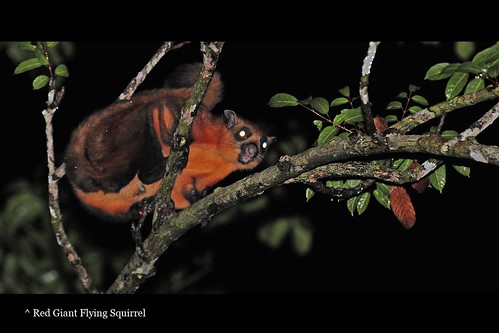
Red giant flying squirrel, Langkawi;
(Photo by kwokwai76)
Not to be mistaken for a squirrel is the common treeshrew (Tupaia glis), a mammal that's actually much more closely related to primates than rodents.
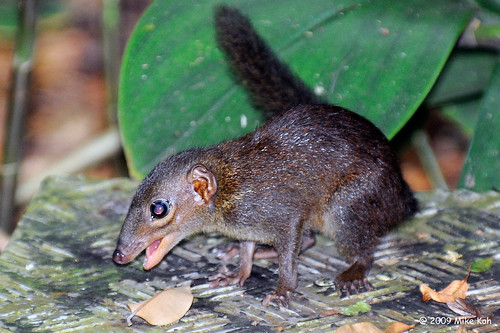
Common treeshrew, Singapore Botanic Gardens;
(Photo by astro08)
Similarly, the Malayan colugo (Galeopterus variegatus), another distant primate relative, is not to be mistaken for a flying squirrel.
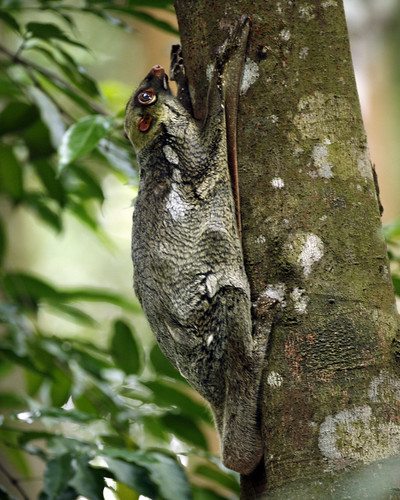
Malayan colugo, Central Catchment Area;
(Photo by Lip Kee)
In a completely unrelated vein, the insect pictured above is a net-winged beetle. Net-winged beetles belong to the family Lycidae, and many species feed on nectar as adults. Most species are brightly coloured in hues of red or orange, signaling that they are toxic and distasteful. They're related to fireflies, among many other beetle families.
Here's a picture of the long-nosed lycid beetle (Porrostoma rhipidius), an Australian species, for comparison.

Long-nosed lycid beetle, Victoria;
(Photo by Wimm/WL)
Subscribe to:
Posts (Atom)