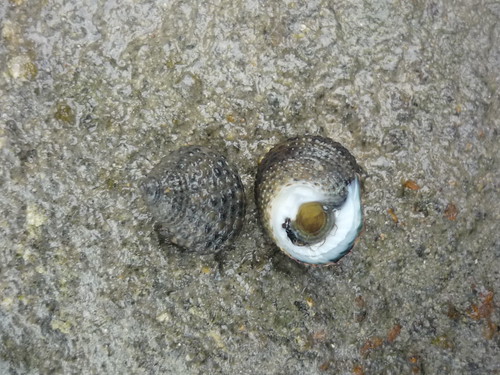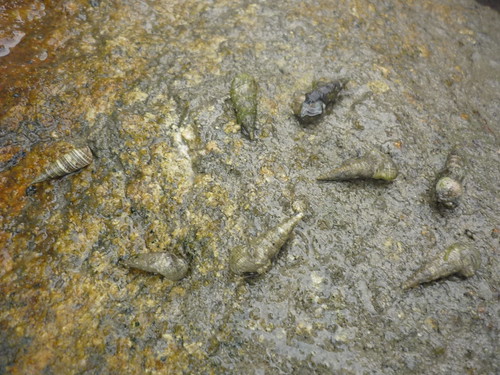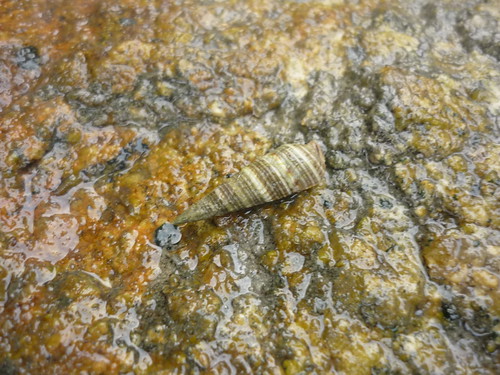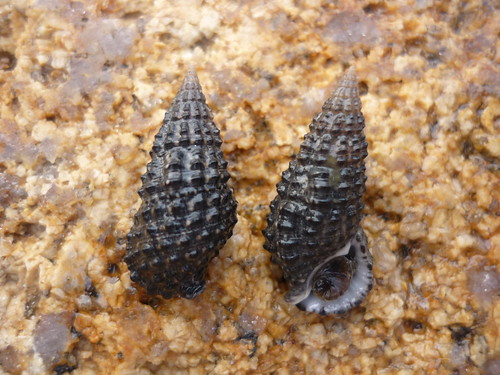
Friday, October 17, 2008

Siloso suntan

P1070015

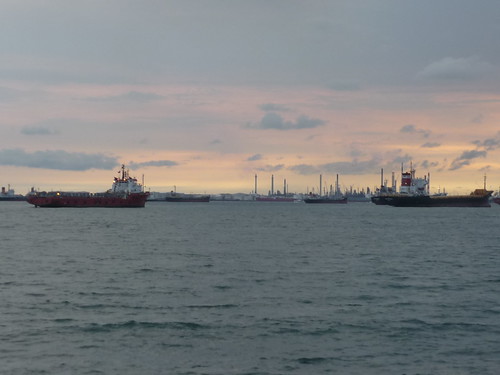
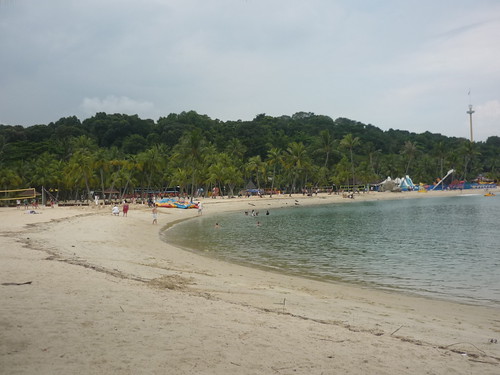
Today, I returned to Siloso Beach, intent on getting properly tanned after the most recent session was ruined due to rain.

It's quite a soothing experience, chilling out by the beach and napping in the afternoon sun, and admiring beautiful girls walking past. But of course, it gets a little dull after a while, so I also spent some time exploring and looking out for marine life.

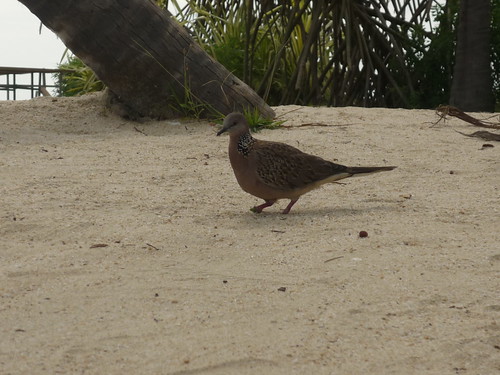
The beach is patrolled by numerous birds, among them common mynahs (Acridotheres tristis), Javan mynahs (Acridotheres javanicus) and spotted doves (Streptopelia chinensis), looking for tasty tidbits on the sand.
P1070023
I noticed something odd about this particular spotted dove. Then I realised that it had no feet! The bird was shuffling around on stumps, but appeared to be in good shape. It didn't have any problems flying. I wonder what sort of unfortunate incident led to it losing its feet.

The sargassum (Sargassum sp.) that choked the beach on the previous visit had largely cleared up, although there were still clumps floating here and there. While I was swimming in the shallows, I came upon a juvenile halfbeak (F. Hemirhamphidae). Naturally, I didn't take any photographs, since I didn't have my camera at hand.
P1070036 P1070050
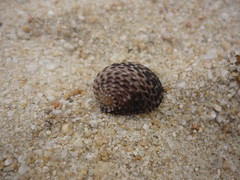
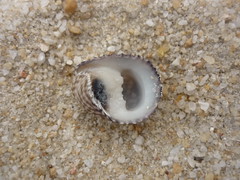
I found this pretty nerite shell on the beach. I have no idea which species it is; the common nerite species are highly variable, and I still have problems telling the various species apart.
P1070179
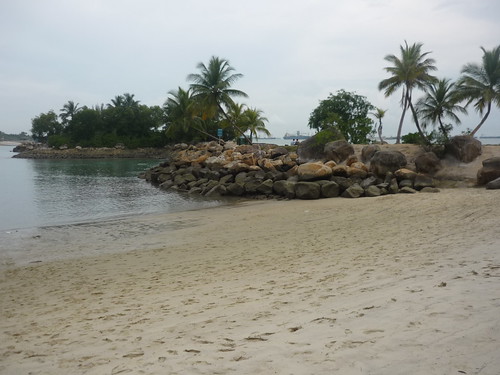
At the end of Siloso Beach, close to where the Naked Hermit Crabs conduct their shore walks, there are these large rocks which form part of a breakwater. These rocks form a hiding place for plenty of marine creatures.
P1070053
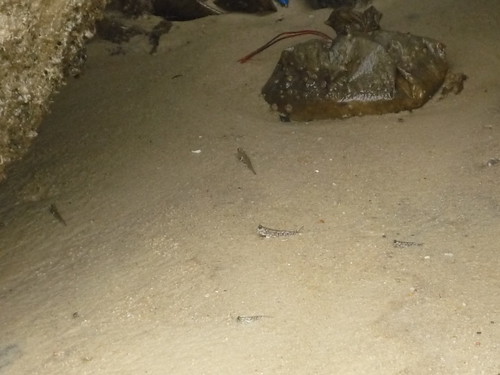
Such as small mudskippers. These are probably dusky-gilled mudskippers (Periophthalmus novemradiatus).
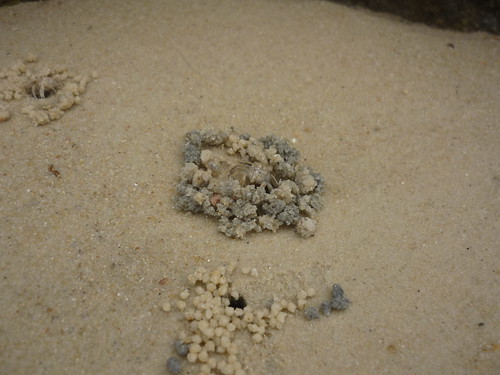
P1070161
The beach here is also inhabited by sand bubbler crabs (Scopimera sp.).
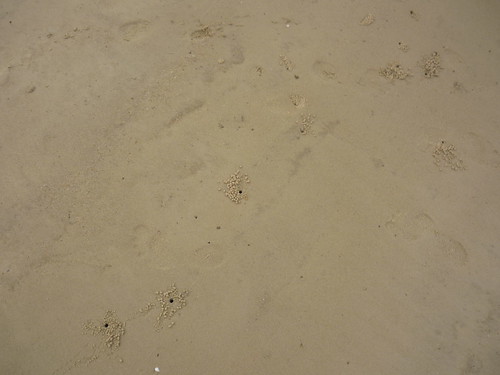
P1070165
They're not present in huge numbers, unlike on the islets across the lagoon, but there's still a pretty sizeaable colony.
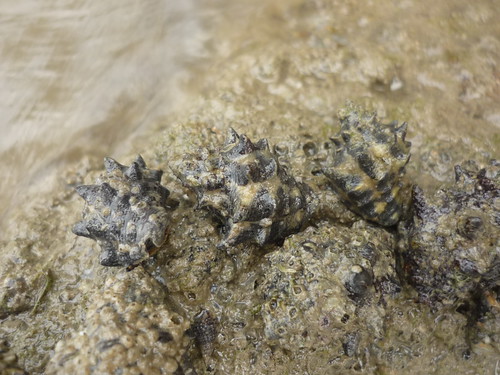
P1070076
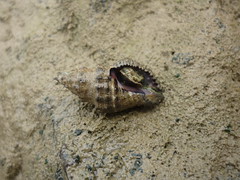
There are plenty of drills on the rocks. This should be Thais bitubercularis, which is distinguished from its relatives by the presence of spines on its shell. Unfortunately, this species is highly variable, and there are individuals which lack the tubercles on their shells. In such a situation, according to A Guide to Common Seashells of Singapore, the species can 'be distinguished by the shape of the penes'. Well thanks a lot, that was certainly very helpful for identification in the field.
P1070081 P1070077
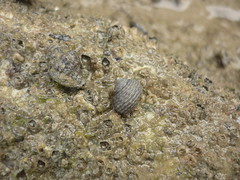
Tidal hermit crabs (Diogenes sp.) can be found here. The one on the left is wearing the shell of a lightning dove snail (Pictocolumbella ocellata), while the two in the other photo are wearing the shells of a drill (F. Muricidae), and an uncommon member of the top shell family called Euchelus atratus.
P1070086
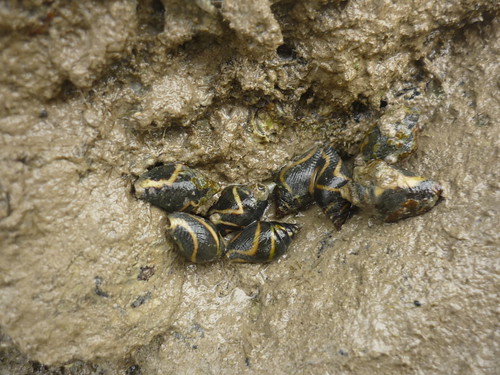
Here's a small group of live lightning dove snails.
P1070088 P1070091
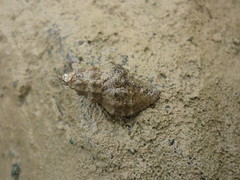
This snail is a perfect match for the photos of Drupella concatenata in A Guide to Common Seashells of Singapore. The book states that it's a specialised predator of coral polyps, and that it's often found on Acropora or staghorn coral. Is this a sign that we've got corals growing amongst these rocks? Or maybe there's coral on the outside of the breakwater...
P1070096
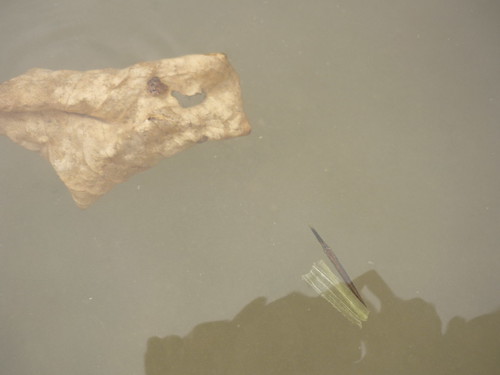
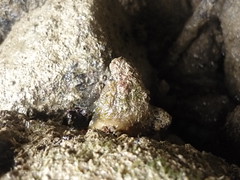
A juvenile halfbeak, the same species as the one I saw while swimming. It's easy to see why they're sometimes mistaken for floating rubbish.
P1070105 P1070107
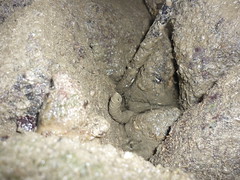
Some sort of sea aquirt on the left, and the tube of some sort of worm on the right. Switching on the flash and taking photos inside these dark crevices reveals a lot of hidden life.
P1070118
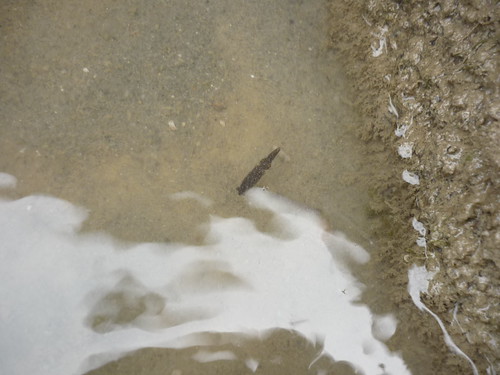
A tiny squid, just like the one I saw on the previous visit, swims into view, but proves too alert and too skittish to pose for decent photos.
P1070113 P1070119
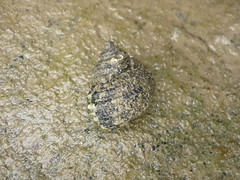
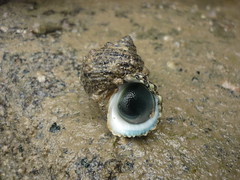
I realise that the turban snails that I've been finding in these murky swimming lagoons are Turbo intercostalis. This species is also present on the rocky shore and coral rubble at Tanjung Rimau, along with its close relative Turbo bruneus.
P1070139 P1070141
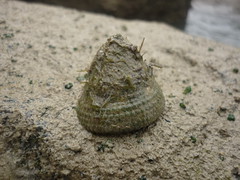
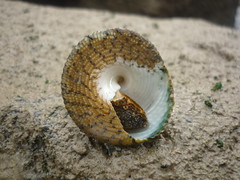
I nearly miss this spotted top shell (Trochus maculatus), with its well-camouflaged shell, but I think my skills at finding these snails have been honed by practice on Tanjung Rimau.
P1070125
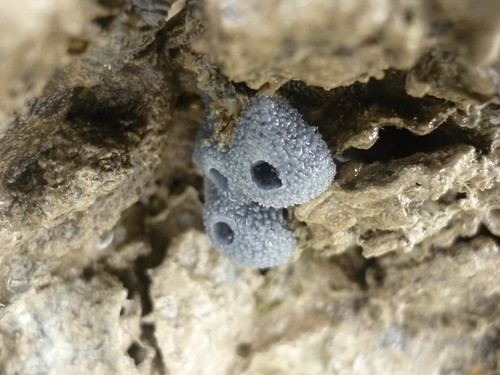
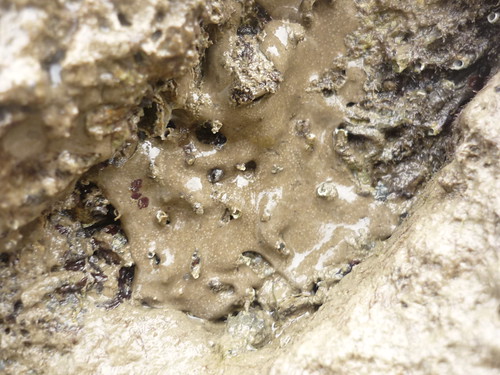
Is this a sponge or a sea squirt?

P1070150
I think this one's a sponge. I need to brush up on my sessile organisms.
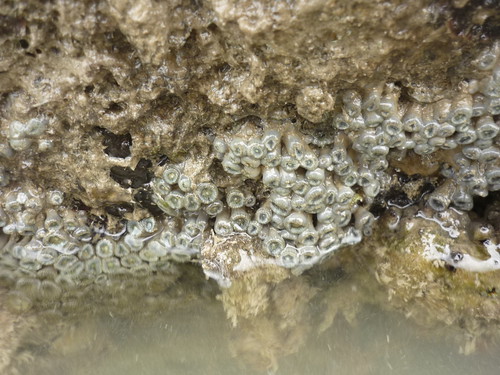
P1070123
Oh look, a small colony of zoanthids.
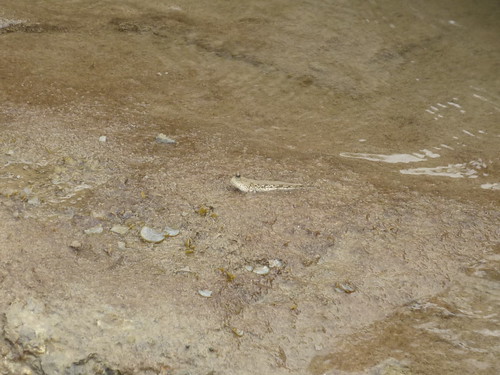
P1070127
I find a mudskipper that's larger than the small ones I saw earlier on. I think it's a gold-spotted mudskipper (Periophthalmus chrysospilos).
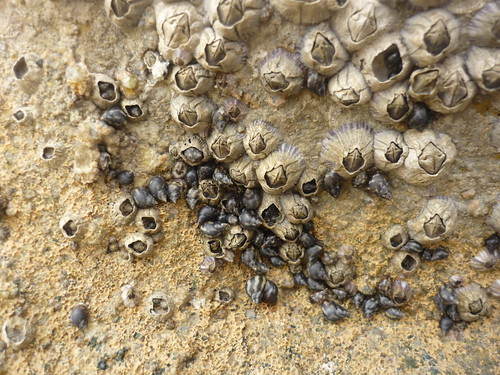
P1070177
High up on the rocks, clustered amongst the acorn barnacles (Balanus sp.), are countless tiny periwinkles (F. Littorinidae).

I had to go wash up and prepare for my first monitoring session with TeamSeagrass. But I knew that if the tide was still low enough after that, I would be back to check out more of Siloso Beach after dark.

Coming up: I explore one of the islets off Siloso Beach at night. What will I discover?

This is part 2 of a 2-part series on a trip to Siloso Beach on 17th October, 2008.

Part 1: Siloso suntan (this post)
Part 2: Siloso: seagrass and sea stars

Wednesday, October 15, 2008

Blog Action Day 08: Poverty


poverty, n.

1. The state of being extremely poor.
2. The state of being insufficient in amount.


Today is Blog Action Day, and the topic of discussion this year is poverty.

As someone who is very concerned about environmental problems and conservation of biodiversity, the relevance of poverty to the issues closest to my heart might not be readily apparent. However, poverty and the state of the environment are actually inextricably linked together; to fully explain the complex and multi-faceted relationships between poverty and the environment would require a long series of posts, which I might have considered doing if I had more time, and greater expertise in critically analysing these issues. But suffice to say that all over the world, people trying to manage environmental degradation or conservation also have to grapple with issues of poverty. Whether it is combating desertification and staving off famine in the Sahel by introducing better agricultural practices, compensating farmers and livestock herders in India for losses resulting from wildlife depredations, or developing ecotourism in Venezuela so that villagers will see more value in keeping a rainforest rather than having it razed for timber, the conservationists and environmentalists involved in such projects and initiatives are all too aware that tackling environmental problems usually goes hand in hand with solving the problems of the people first.
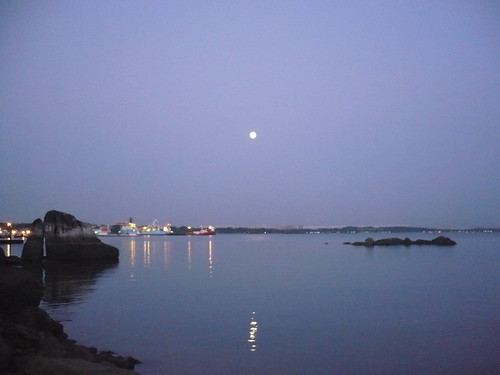
Here in Singapore, where the vast majority of us do not have to worry about starving to death, bathing in rivers filled with raw sewage, or drinking water laden with toxic industrial waste, the lives of the millions for whom such scenarios are part and parcel of daily life can be difficult to identify with. Those horrific scenes of slums and famines, of fly-infested refugee camps and garbage-choked rivers, might seem distant, unfamiliar, even alien. But let's not forget that today, poverty still exists in Singapore, even though most of us choose to ignore it. There is still much that can be done to tackle this problem, both on a local and global basis.

When November and I made a television appearance on Rouge in April earlier this year as members of the Naked Hermit Crabs, we met two very passionate members of ONE (SINGAPORE), President Vernetta Lopez and co-founder Michael Switow. They spoke up about poverty, and the global movements that are calling for much more to be done. One of the biggest campaigns is Stand Up, which serves as a reminder to the rest of the world about the Millennium Development Goals, which leaders of 189 countries had agreed upon and signed in 2000.

Singapore will be taking part in this global mobilisation, with various events being held all across the country. This is the opportunity for all of us to stand up and speak out against poverty, and let our voices be heard.

For if we choose to continue to ignore poverty and the implications that it has on the environment, then perhaps it points to a very different sort of poverty within us.

Tuesday, October 7, 2008

Siloso suntan

P1060248
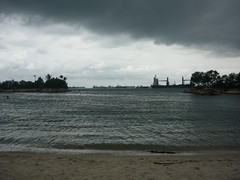
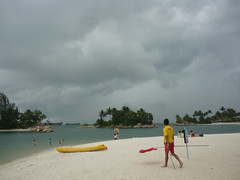
Today's a free day, so I decided to head down to catch some sunshine on Siloso Beach. The weather didn't look too good though.

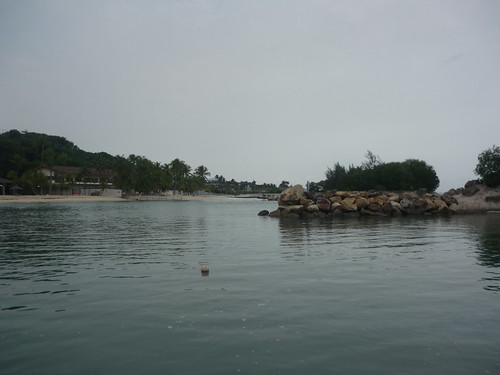
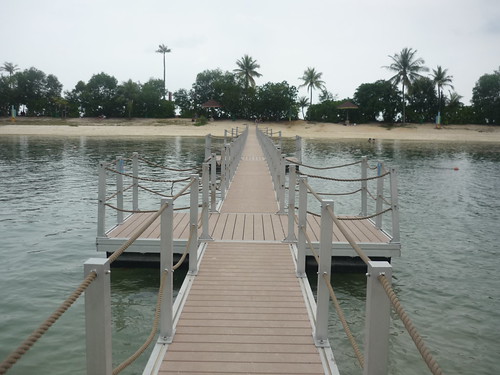
There are several small artificial islets just off the beach. One of them is connected to Sentosa by a floating bridge.

P1060291
One day, I'll have to explore these islets at low tide. Previous cursory visits during my suntanning sessions have revealed quite a lot of marine diversity; among the many creatures I've found have included a wide variety of fish, snails, crabs, and even a common sea star (Archaster typicus). Not to mention that hair-raising encounter with a small estuarine stonefish (Synanceia horrida)!

P1060264 P1060271
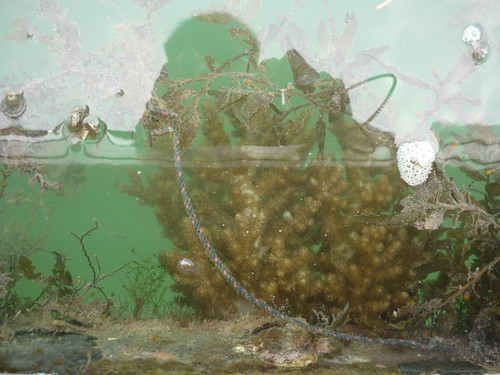
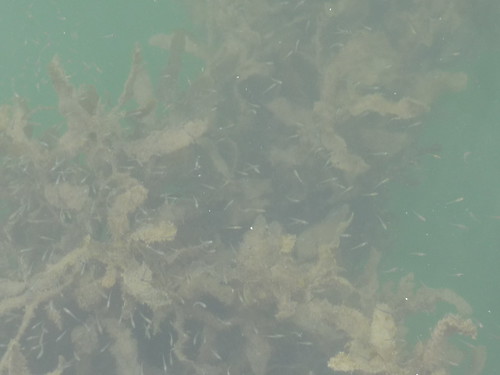
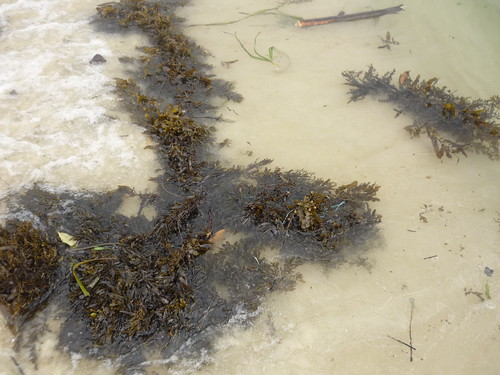
There's plenty of sargassum (Sargassum sp.) growing around the bridge. It looks like this beach is in the midst of an algae bloom.

P1060258
Among the seaweed, I come upon a surprising find: a soft coral!

P1060272
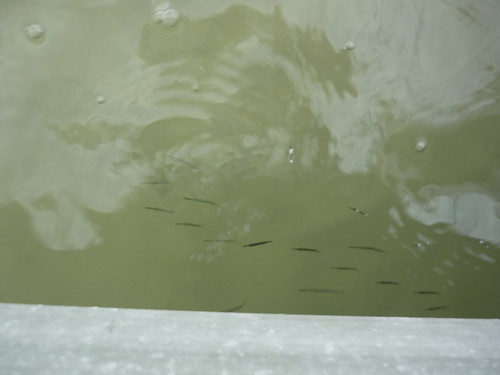
I manage to spot a few shoals of fish swimming.

P1060278
While groups of tiny fish hide amongst the seaweed.

P1060265
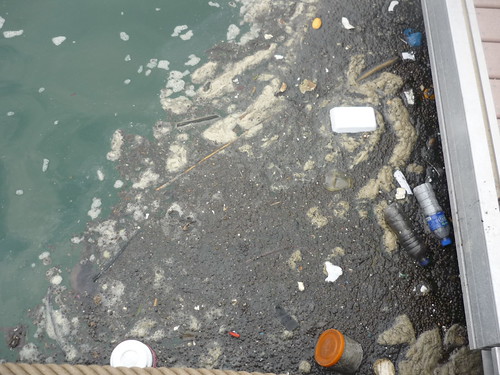
Unfortunately, the bridge also traps a lot of floating debris. What a disgusting filthy mess.

I swim across to one of the small islets across the lagoon, and relax on the beach for a while, soaking up the sunshine. I soon discover why cirolanids are to be feared.

Cirolanids are a family of isopods, and belong to the same group as your more familiar woodlice and sea slaters (Ligia sp.). These tiny critters are most commonly encountered feeding on fish carcasses washed up on our shores. Watching them pour out of a dead fish like so many tiny cockroaches sends shivers down my spine every time I see it happen.

P1060227
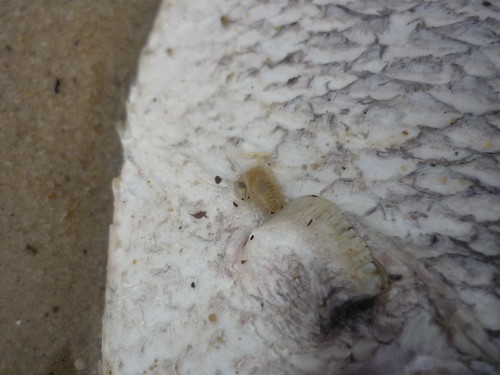
Here's a photo of one that emerged from a dead fish that I found on Changi earlier this month.

I've learned that when there's a dead fish on the beach, it doesn't take long for the cirolanids hiding in the sand to catch a whiff of decaying flesh, and they quickly home in on the source, where they burrow into the carcass and start feasting on it from the inside. Like many other marine creatures, these little scavengers carry out an essential role in consuming carcasses and recycling nutrients.

And as I find out, despite their size, they pack a painful bite.

I'm just lying down on the beach, at the water's edge, when I suddenly feel a sharp pain behind my ear, as if an ant had bitten me. I reach behind, pluck off the offending object, and am startled to see that it's a cirolanid. I quickly fling it away and scramble to my feet, but not before another cirolanid has crawled up my shorts, decided that I taste like dead fish, and taken a tiny bite out of my waist. To think that I had a cirolanid in my shorts still makes me shudder. At least it didn't seek out other places to explore...

P1060301 P1060306
P1060312 P1060316
Crossing back to Siloso Beach, I find a nice spot on the beach, one that should be free of cirolanids, and settle down for a nap. But it looks like my afternoon is about to be ruined. I pray that the clouds will pass, and that the sun will reappear, and give me a nice even tan, but to no avail. It soon begins to pour, and I'm forced to abandon my plans and flee for the nearest shelter. Sigh.

Later on, when the rain finally passes, I re-emerge, and try to make the most out of the weak sunshine.

P1060354
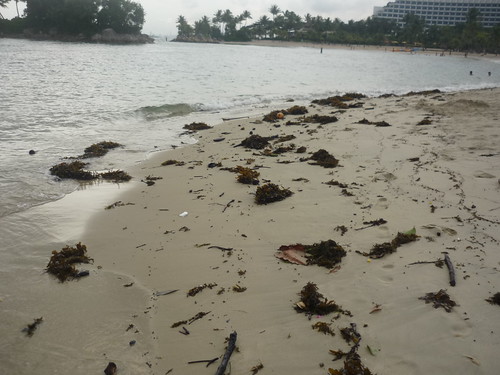
The strong waves have brought even more sargassum washing up on the shore.

P1060372

P1060368 P1060363
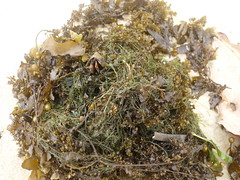
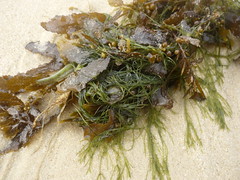
Mixed in with the sargassum are long filaments of green seaweed, possibly Chaetomorpha.

P1060332
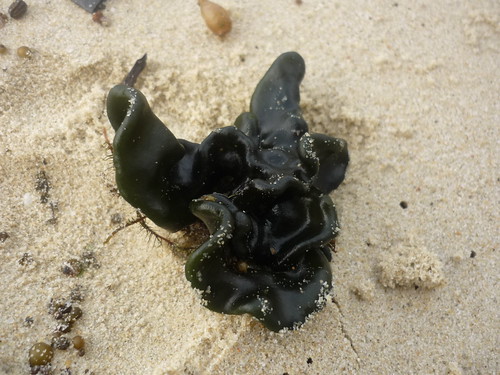
I'm sure this is a kind of algae, I just don't know what it is.

P1060335
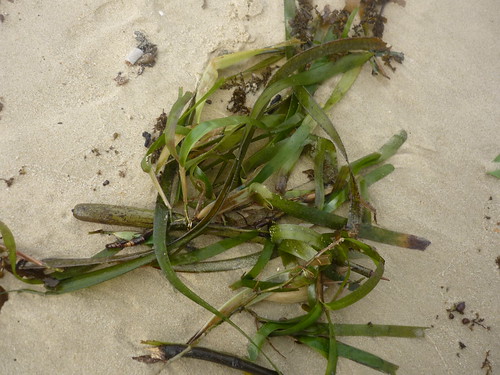
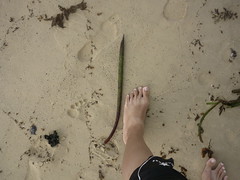
To my surprise, there's also quite a few bits of seagrass among the flotsam. I forgot to check closely and see if these pieces are tape seagrass (Enhalus acoroides). I wonder where all this seagrass is coming from. Did the stormy weather dislodge all this seagrass at nearby Tanjung Rimau or one of our other southern shores, or is there development in the area that's ripping up seagrass beds?

P1060329 P1060365
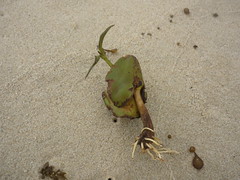
Besides seaweeds and seagrass, I also manage to find a few mangrove seedlings.

While I'm inspecting the sargassum, I get a little surprise. Something is moving inside a clump of seaweed.

P1060317
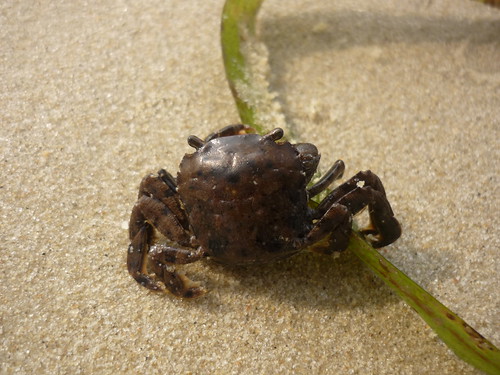
There's a little crab hiding in there!

In all my visits to the shores, I've certainly never seen this species before. It might be a paddler crab (Varuna yui). An entry in A Guide to Seashore Life (where it's listed as Varuna litterata) states that this crab is 'often seen on flotsam or floating seaweed, drifting with the currents'.

After a while, it decides that it's had enough, and scrambles into the sea, where it furiously swims towards the nearest clump of floating sargassum and promptly vanishes.

I finally give up on trying to get a tan. The sun is too weak today, and it looks like I'll have to come back another day if I'm ever going to get any darker.

P1060441
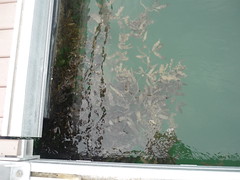
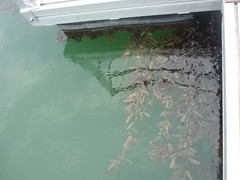
I decide to explore the islet before heading home. While crossing the bridge, I find a shoal of young halfbeaks (F. Hemirhamphidae). It looks like there's more than one species in this school. I also saw a relatively large fish that appeared to be grazing on the sargassum. I didn't manage to take any good photos of it, but I suspect it might be a juvenile rabbitfish (Siganus sp.)

P1060448
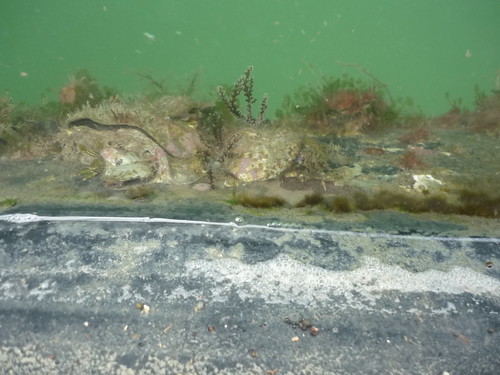
The bridge is really well encrusted with a whole variety of marine life.

P1060450
I find the cast-off exoskeleton of a flower crab (Portunus pelagicus).

P1060509
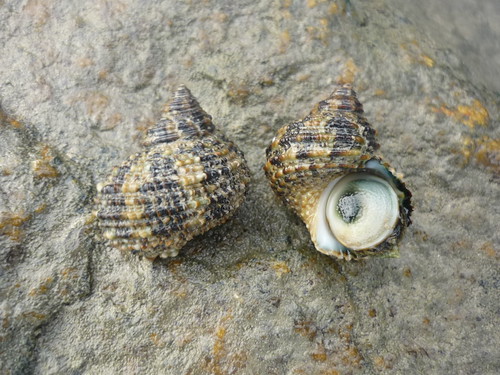
Among the rocks, there are quite a few turban snails (Turbo intercostalis).

P1060519
As well as Monodonta labio, a member of the top shell family.

The seabed is also home to various species of creeper snails.

P1060489
Most common are dense aggregations of Batillaria zonalis.

P1060490
Scattered among them are these snails with bands on their shells. I'm not sure what they are.

P1060528
These snails are found individually on the muddy seabed, close to the rocks. They bear a close resemblance to the photo of Cerithium trailli in A Guide to Common Seashells of Singapore.

P1060475
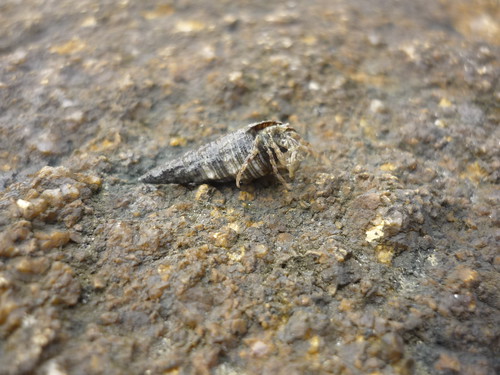
All these creeper snails support a large population of tidal hermit crabs (Diogenes sp.). There's an idiot-proof way to find hermit crabs among all the snails - if you see a shell on the seabed scuttling away from you, it's definitely a hermit crab.

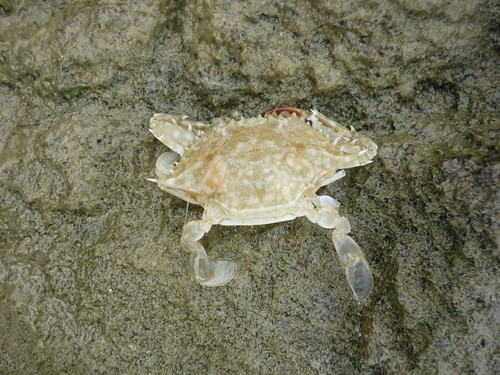
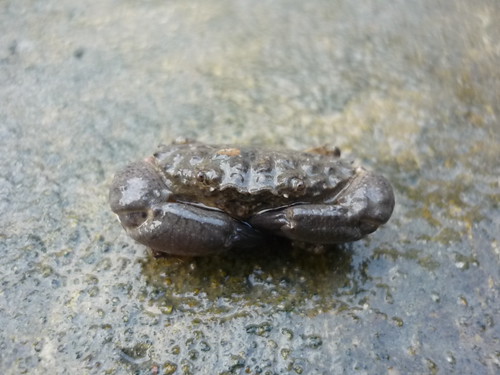
I also managed to find a small crab.

P1060541

I'm not sure of its exact identity; it could be a common rock crab (Leptodius sp.). The crab responded to my intrusion by playing dead.

P1060536
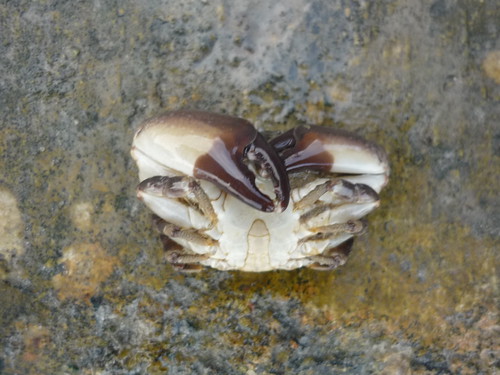
And here's the underside. Damn, I forgot to take a closer look at the pincers. Leptodius has the tips of its pincers shaped like spoons, enabling it to scrape algae from rocks. After taking enough photos, I released it back into the water, where it quickly disappeared beneath a rock.

P1060485
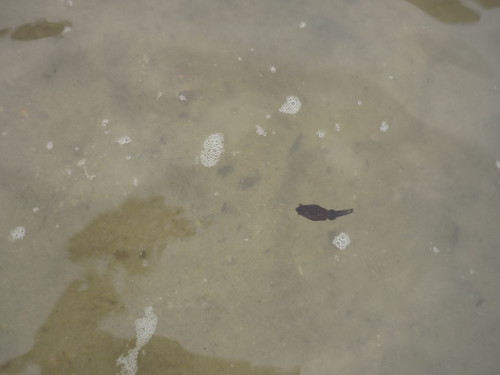
The best find of the day has to be this tiny squid, only about 2cm long! I wonder if it's a baby squid.

P1060483
It's extremely alert, and jets away the moment I get too close. While swimming, it's constantly changing colour. It's certainly very easy to miss this little cephalopod; it looks a lot like a little bit of floating rubbish. You have to pay very close attention, and look out for a small object that doesn't quite appear to be drifting with the current all the time.

P1060547
I finally call it a day, and as I head to the Beach Station, I'm faced with this beautiful evening scene.

I wasn't exactly planning to make this a shore exploration trip, but the thought of looking for marine life was too tempting to ignore, and besides, the lousy weather left me with few other options. I'll be back soon, if only to try and get a proper tan. Maybe I'll try and find my common sea stars...

Thursday, August 7, 2008

I'm getting a sense of deja vu about this

Update: November has briefly written down her thoughts on this matter over at Pulau Ubin Stories.

P1050010
Changi, 22 March 2008

It's been a while since I've last blogged about letters to the press proposing poorly planned ideas that will profoundly impact our marine environment and waterways. I don't have an issue with stupid ideas, really; everyone comes up with crazy ideas once in a while, but these are meant to be worked on and improved until you are able to conceptualise and visualise something that is indeed feasible and realistic. It's when people come up with stupid ideas and then fail to take into account all the other costs and stakeholders before writing to the press that I get really riled up.

And there's something oddly familiar about this particular letter...

Create reservoir between Pulau Ubin and Singapore (mirror)

COME 2012, we will have to be more self-reliant for our water supply.

I propose Pulau Ubin be linked to mainland Singapore to create a huge reservoir.

On the eastern end of Pulau Ubin, a two-tier road can be built so the lower deck allows cyclists to cycle between Singapore and Pulau Ubin. The upper deck will be another route for vehicles to go to and from Malaysia. Jetties can jut out from both sides of the link - the reservoir side for smaller boats such as kayaks, sailing and racing boats, and water scooters, while bigger boats can dock on the other side. Bicycle rental kiosks, souvenir shops and so on can be built at the starting point of the link at the Singapore end. Further reclamation at the Singapore end will allow immigration offices and multistorey carparks to be built.

On the link at the western end of Pulau Ubin, bicycle rental kiosks, food centres and souvenir shops with solar-panelled roofs can be built for cyclists to cycle between Singapore and Pulau Ubin.

Pavilions can also be extended from both links into the reservoir for relaxation, photography and fishing.

Pulau Ubin can be promoted extensively as a venue for camping, mountain biking, adventure, trekking, hiking, jogging, horse riding and prawn fishing (to meet strong demand for youngsters to rough it out and enjoy nature).

The proposed reservoir will mean less land use elsewhere - some of the existing reservoirs can be redefined as collection centres for rainwater and Newater, and their water channelled into Pulau Ubin reservoir. The surrounding land can then be freed for other use, such as residential development to house a growing population.

Feedstock for Pulau Ubin reservoir can also be had from excess water from the smaller reservoirs, from rainwater and Newater to be collected from the northern and eastern parts of Singapore and from more Newater that could be generated.

Big water pipes connected to both links at Pulau Ubin would help to drain seawater between Pulau Ubin and the Causeway and provide a change of seawater according to the tides. Energy-generating turbines can be incorporated into these seawater pipes.

Coney Island can be reclaimed further to become part of the mainland and pavilions can be extended from Coney Island into the reservoir.

The damming of the water between Pulau Ubin and Singapore to become a huge reservoir promises many possibilities for development, for meeting future water needs and for recreation.

I urge the authorities to look into these great benefits on our doorstep.

Chew Wai Soon

A near-identical idea was previously proposed, and rebutted, all just 4 months ago. The Public Utilities Board has already gone on record stating that "the waterway between Pulau Ubin, Pulau Tekong and the mainland is a major shipping lane and there are currently no plans to convert it into a reservoir".

Do people really forget so easily?

Currently, I'm a bit too occupied to be able to immediately work on drafting a response. Hopefully a fellow nature enthusiast or someone else in the Naked Hermit Crabs will be able to afford the time to send in a rebuttal. Honestly, I don't see the point of replying, since the points listed in my letter, which was published on April 22, are still applicable to this one. But I would say that it is still essential to address a lot of the suggestions raised in this latest letter, which once again indicates a lack of understanding and awareness of the costs involved and the potential economic, political, and ecological impacts that will ensue should such an idea be carried out.

Saturday, July 26, 2008

Oceanlab: Miracle


Don't they know that there's something going on
What they're harming with their indecision
But who will be left standing when I'm gone
There'll be nothing left but a vision

And it's too easy to turn a blind eye to the light
It's too easy to bow your head and pray
But there are some times when you should try to find your voice
And this is one voice that you must find today

Are you hoping for a miracle
As the ice caps melt away
No use hoping for a miracle
There's a price we'll have to pay

Don't they know that there's something they can do
To be sure of tomorrow's tomorrow
And too late is too late for me and you
No more time left for you to borrow

And it's too easy to turn a blind eye to the light
It's too easy to bow your head and pray
But there are some times when you should try to find your voice
And this is one voice that you must find today

Are you hoping for a miracle
As the ice caps melt away
No use hoping for a miracle
There's a price we'll have to pay

Are you hoping for a miracle
Am I still there in your plans
No use hoping for a miracle
I am balanced in your hands

- Miracle (Album Edit) by Oceanlab


Miracle is the latest single released by Oceanlab, and once again, it's another excellent track that combines the deejaying mastery of Above & Beyond, and the hauntingly beautiful vocals of singer/songwriter Justine Suissa.

This time however, there's a valuable social message behind the music: to me, the lyrics so aptly describe the current state of affairs, where world leaders are still trapped within the mindset of competition with other states when the entire world is at stake, where the facts of climate change have become so politically loaded, and where people are aware of what's happening, but are so loathe to make even small sacrifices that collectively, can go a long way towards slowing the changes that are arising.

The video goes one step further to emphasise the point, with the use of wonderfully breathtaking imagery, to show just what we might stand to lose if we continue to be so gripped with inaction that we are unable to change the way we live our lives.

While personally, I don't think this track will really change people's minds about taking action, I must say that it is a notable and worthy effort on the part of Oceanlab. Music has always been used as an avenue to spread messages, and whether or not one will feel sufficiently inspired to become an agent of social change, this feels a whole lot more sincere than the Live Earth concerts.

Here's the Radio Edit of the Above & Beyond Club Mix for this track. It's quite different from the Album Edit, but still just as pleasing to the ear:


It's certainly very fascinating to see how two of my interests - trance music and the environment - have managed to intersect.


Miracle is currently available on Oceanlab's long-awaited debut album, Sirens of the Sea.