Sunday, May 10, 2009

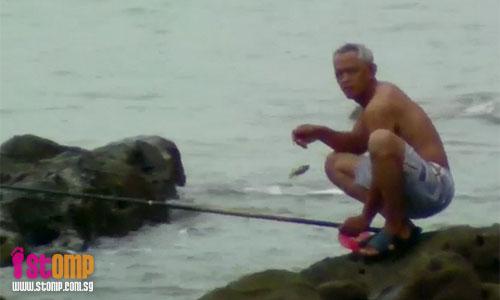
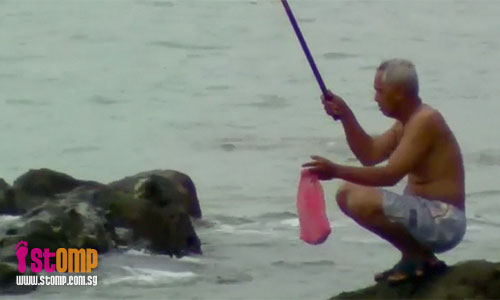
Man fishing illegally at Labrador beach

Man fishing illegally at Labrador beach
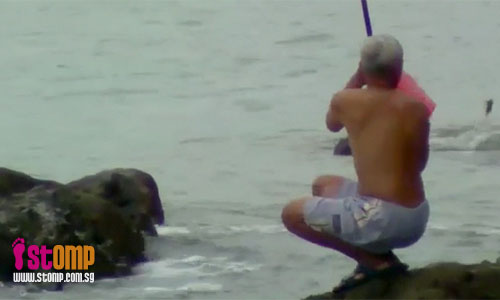
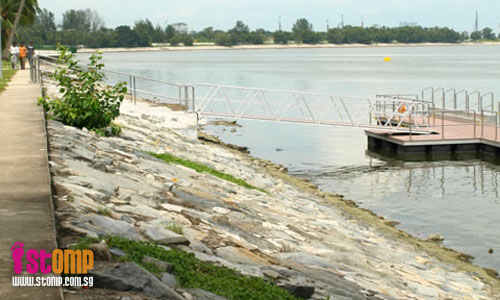
STOMPer Fatt caught this man fishing illegally at Labrador Nature Reserve Beach yesterday morning (May 9).

He said:

"I was at Labrador Nature Reserve on Saturday morning.

"This man was happily fishing from the Nature Reserve Beach.

"We should do more enforcement at our Nature Reserves or else we will have not much left to reserve for our future generations.

"Our nature reserves need more protection and effective enforcement."

Man fishing illegally at Labrador beach

Do check out the video posted on STOMP.

As far as I know, fishing is permitted only from the jetty, so this angler is breaking the law.

Some people might argue that it's just one person with a makeshift fishing pole, and that the impact on marine life is minimal. One old man won't decimate the fish there.

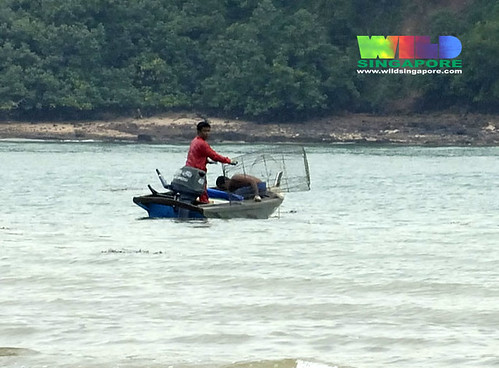
Still, if we do not make an active effort to curb these illegal practices on our protected shores, what sort of message are we sending to the greedier and more unscrupulous people out there? Will we see even more people descending upon the shores of Labrador with driftnets and bubu traps?


Man laying fish traps off Berlayar Creek;
(Photo by Ria)

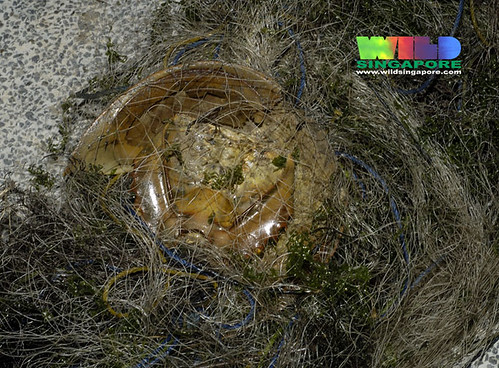
Time and time again, I've seen the ugly impacts of unregulated exploitation of marine life, from abandoned nets and fishing lines that entangle and kill creatures, to people decimating an entire shore with their baskets and trowels.


Dead horseshoe crab trapped in abandoned net;
(Photo by Ria)

While I believe that it is possible for some level of sustainable fishing and harvesting to occur in local waters, I really doubt that those in the fishing community will ever get their act together and be more pro-active and united in conserving fish populations.

To be honest, even though Labrador is gazetted as a nature reserve, it is far from healthy, as it has been affected to some degree by surrounding development, pollution, dumping and poaching. I'm sure the last thing it needs is more fishermen blatantly flouting the law and using their selective vision to ignore the No Fishing signs.

World Migratory Bird Day


What is World Migratory Bird Day?

World Migratory Bird Day is a global awareness-raising campaign highlighting the need for the protection of migratory birds and their habitats. On the second weekend each May, people around the world take action and organise public events such as bird festivals, education programmes and birdwatching excursions to celebrate World Migratory Bird Day.
"Barriers to migration" - WMBD theme for 2009

Year by year in autumn and spring majestic avian flocks depart for their long journeys following the call of the wild and paths of their ancestors. For some, it is a long, exhaustive and dangerous journey, sometimes stretching thousands of kilometers from the Arctic to the southern tip of Africa and beyond. Migratory birds have to cope with a scarcity of food, stopover sites that are shrinking in area, predators, hostile weather and the expanse of seas, huge mountains and endless deserts. Yet, humans have created additional obstacles to further complicate their journeys.

Dazzling spotlights from city skyscrapers, tall glass windows and guy wires of television towers can be invisible to birds and cause collisions that result in bird fatalities. Proliferating communication towers and masts, wind turbines, tall buildings, power lines, and fences kill or harm huge numbers of birds each year and represent increasingly fatal barriers which have a detrimental impact on entire populations of migratory birds.

Although kills like these are often unintended and frequently avoidable - thousands of new structures are built each year, often along the migration paths of migratory birds. Many of the world's coastlines and mountaintops, utilized for the generation of wind power, reside along some of the world's best known and major migration routes. New wind turbine developments are still being planned around the world, sometimes without a detailed assessment having been carried out on the potential environmental impacts they may cause , let alone the effect they could have on migratory birds.

The aim of World Migratory Bird Day (WMBD) 2009 is to raise awareness on some of these man-made barriers to migration and to inform people about the impact these structures can have on migratory birds and on their migration. A "truly green" development in renewable energy, architecture and urban planning is one, which aims to minimize all possible environmental impacts, including those on migratory birds and other species.


- Taken from the World Migratory Bird Day website

Do visit the site to find out more about the various barriers to migration, and how each of these barriers can take a heavy toll on migratory birds.

In Singapore, the most obvious barrier to migration would be the threat posed by windows and tall buildings.
Windows of all sizes and types, even small and narrow windows, from those found on tall buildings to those used in residential houses are very dangerous for birds. Ornithologists usually call them “invisible killers” due to the large number of deaths and injuries they cause regardless of species, age, sex and the conditions in which collisions occur. Attracted by the reflection of trees or plants located near the windows, birds try to pass through them, sometimes, at top speed. This can lead to fatal or other injuries or simply exhaustion as they attempt to overcome the invisible barrier and end up falling to the ground and thus becoming easy prey. Predators such as cats often lie in wait for their victims to quickly remove them. Moreover, some studies show that about half of those birds, which manage to fly away, die later due to injuries received. These facts are often unknown to those observing bird strikes, as they tend to think collisions do not actually harm birds and that they are able to fly away without any lasting damage.

Over at the Bird Ecology Study Group, there are 2 articles that mention blue-winged pittas (Pitta moluccensis) crashing into windows; while 1 survived and was subsequently released, the other was already dead when discovered. The blue-winged pitta is an uncommon winter visitor and passage migrant in Singapore, and it is likely that other migratory bird species are also affected by collisions with glass windows.

The Bird Ecology Study Group has more articles on birds and glass windows, including incidents involving pied triller (Lalage nigra) and laced woodpecker (Picus vittatus). There are even more anecdotes of bird-glass collisions in the following posts:

Birds and glass windows - 1
Birds and glass windows - 2
Birds and window panes

The most interesting incident however, has to be this one, where a large raptor crashed into a window with so much force that the glass broke!

Another possibly significant barrier to migration in Singapore is light pollution.
The luminous glow of artificial light over cities and towns obscuring the stars at night, which astronomers describe as 'light pollution', takes a large toll on bird populations as well as distracting and confusing them during their migration. Birds are frequently deceived by bright lights on misty and stormy nights, when their usual points of reference – the stars – become invisible. In these cases, bright artificial lights caused by our ever-expanding urban landscapes attract migratory birds, leading to their disorientation, which in turn, can lead to changes in their usual flight path and migratory course. Following the wrong cues, they can be sent off course and their precious energy stores, which are needed to complete the onward journey are squandered. Light pollution also prevents birds from choosing the ideal stopover sites and some get involved in endless "lit-beam circling" until they drop from exhaustion or collide with surrounding objects.

As far as I know, such a phenomenon is not well-studied locally, although I won't be surprised if there is some impact on birds. On more than one occasion, I have looked up at night to see birds flying around the bright lights of tall skyscrapers, although I was unable to identify the bird species. I wonder if there is any chance of finding bird carcasses scattered around buildings in the city centre, especially when the migration season is at its peak.

Migratory birds all over the world already face a vast multitude of threats, from destruction and fragmentation of breeding and winter habitats and loss of vital stopover and feeding grounds, to deliberate hunting by humans. The effects of climate change will no doubt affect many more species. Many of these birds already face seemingly insurmountable challenges, undertaking incredible voyages that take them across vast expanses of sea and desert, and above the peaks of the highest mountains.

May we continue to be amazed and inspired by these natural wonders for many more generations to come, and may we find it within ourselves to grant these long-distance travellers safe passage.

Related post: Migration (25th March, 2009)

Saturday, May 9, 2009

Litter at sightseeing spot near Singapore Flyer spoils Singapore's clean image

Litter at sightseeing spot near Singapore Flyer spoils Singapore's clean image
It is a disgrace to see the area around the Singapore Flyer and Marina Barrage littered with rubbish, says STOMPer Winter.

Apart from the image it projects, the STOMPer is also worried that not enough is being done to prevent the swine flu or other diseases from spreading.

In an email dated May 9, Winter says:

"The river bank separating Singapore Flyer and Marina Barrage was seen filled with rubbish along the coast.

"Empty drink bottles, paper cups and plastic bags were seen along the river bank.

"Singapore Flyer is a tourist attraction and this will reflect badly on Singapore's image.

"Also, in times of the swine flu, it is best that not only the shopping centres or public toilets be kept clean, the river banks should be kept clean to prevent the spread of disease and also to keep our water clean."

Litter at sightseeing spot near Singapore Flyer spoils Singapore's clean image

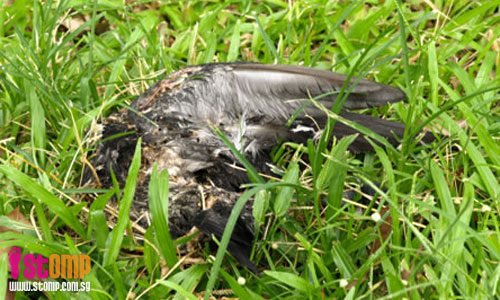
I'm not sure what the dead bird in the last photo has to do with littering.

I really wonder if it's going to be cost-effective to attempt to treat the water from the Marina Reservoir to meet potable water standards. After all, given that the river was all but dead until the 1980s, and I doubt people are ever going to wake up and stop tossing trash into their water supply, maybe it would be better to use the Marina Reservoir just for our non-potable water needs. Unless of course, we take littering as a problem more seriously, and clamp down even harder on idiotic litterbugs.

Family of monkeys make use of playground

Family of monkeys make use of playground
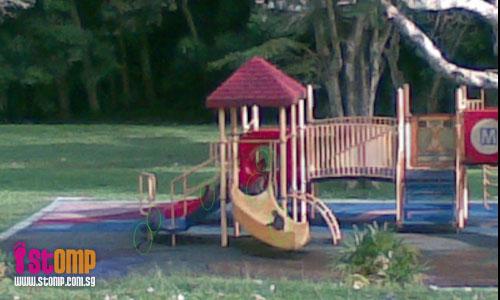
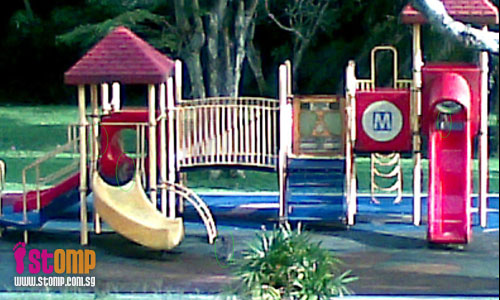
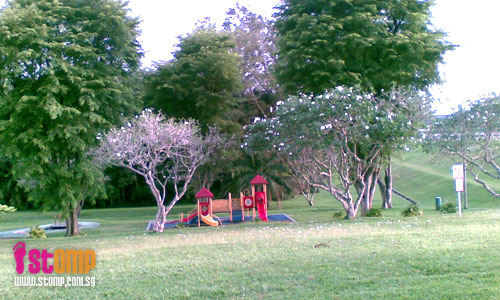
STOMPer Andre was at Lower Pierce Reservoir with his girlfriend Vita when they both noticed this family of monkeys utilizing this playground there.

In his email to STOMP today (May 9), the STOMPer sent in these modified pictures and wrote:

"Since it was Vesak day, I decided to go down to Lower Peirce Reservoir with my girlfriend Vita to commune with nature, as it was away from our congested city.

"I was really amazed that a family of monkeys was practically utilizing the playground from using the slide to making use of the ladder and monkey bar.

"It was really amusing watching them in action that I did not realise an hour whizzed past me.

"Upon closer inspection I was speculating as to whether the playground could have been made for the resident monkeys?

"As the playground was located down slope and was not accessible to humans as there was no pathway but grass surrounding the playground.

"Whether the monkeys enjoyed themselves or not, we definitely enjoyed ourselves watching them."

Family of monkeys make use of playground

Gecko gets free wild ride on bus

Gecko gets free wild ride on bus
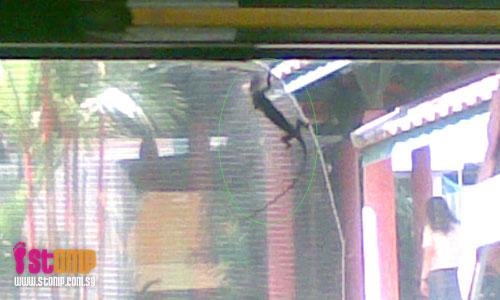
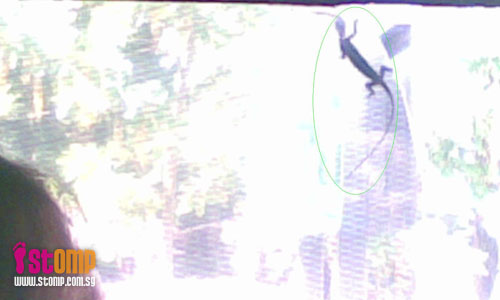
This green tree gecko got a free ride on this bus travelling from Upper Thomson Road to Ang Mo Kio, according to STOMPer Andre, who witnessed its sheer tenacity and determination to cling onto the vehicle.

In an email to STOMP today (May 8), the STOMPer sent in these modified pictures and wrote:

"After a nature visit to Lower Peirce Reservoir located at Upper Thomson Road my girlfriend and I took Bus 169 to Ang Mo Kio for lunch.

"We were really amused with a luminous green tree gecko which was about 25 cm(head to tail) clinging on to the window throughout the journey till it reached Ang Mo Kio bus terminal where we spotted it jumping off about a meter to a low branch.

"We were really impressed by its sheer determination of travelling so dangerously to reach its destination for free. A free ride indeed on Vesak Day."

Gecko gets free wild ride on bus

It's a changeable lizard (Calotes versicolor), not a 'luminous green tree gecko'.

It is very interesting behaviour, and I wonder if this is one way in which an invasive species can quickly spread into new areas.

The changeable lizard is not native to Singapore, and first appeared only in the 1980s, presumably having stowed away on ships and motor vehicles arriving from Thailand or the northern states of Peninsular Malaysia, where this species is native. Having established breeding populations in Singapore, it soon spread throughout the country, and is now found everywhere, even on the smaller offshore islands. Unfortunately, its success has come at the expense of its relative, the green crested lizard (Bronchocela cristatella). Through competition and possibly predation, the changeable lizard has displaced the green crested lizard in much of Singapore.

I wonder if the spread of this introduced species in Singapore was inadvertently facilitated by motor vehicles. It's not as far-fetched as it seems. After all, whether it's grass seeds lodged in tyre treads, or snakes stowed away in cargo, we have unknowingly assisted many species in crossing continents and oceans, enabling them to colonise new areas far beyond their native range.

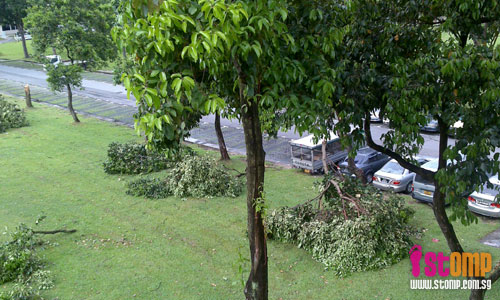
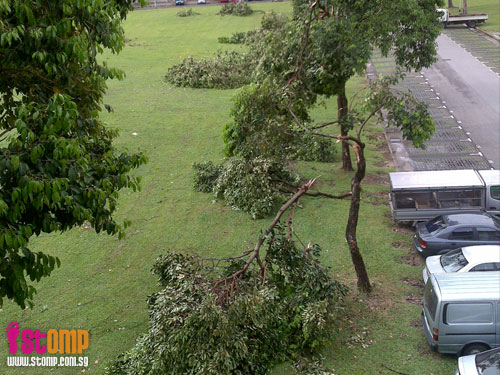
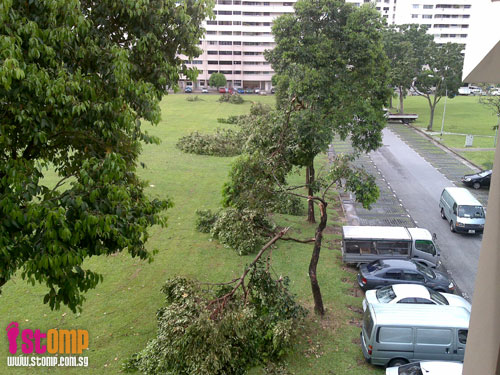
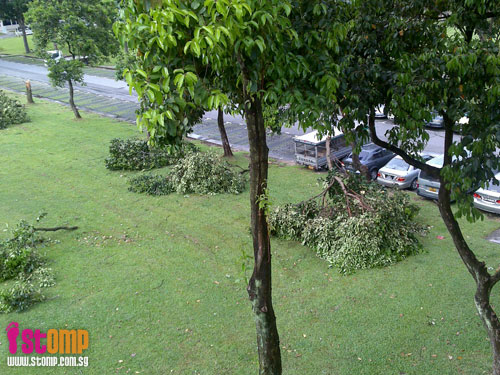
Destruction in Ubi Ave left behind by thunderstorm

Destruction in Ubi Ave left behind by thunderstorm
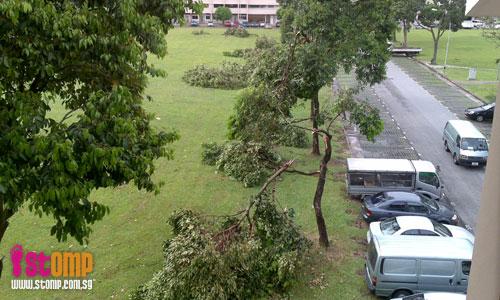
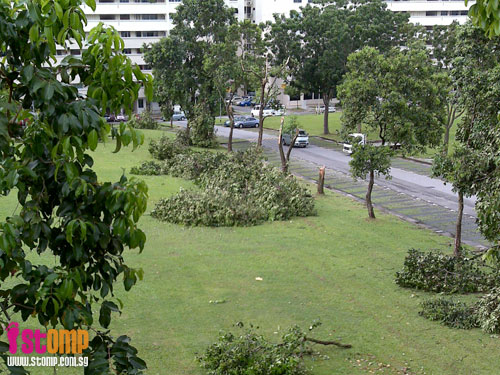
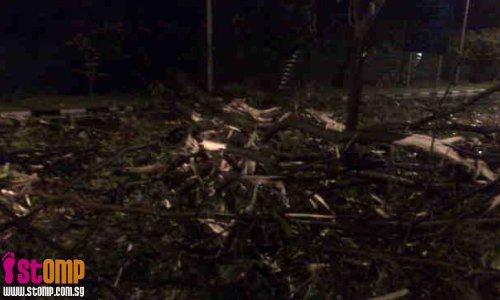
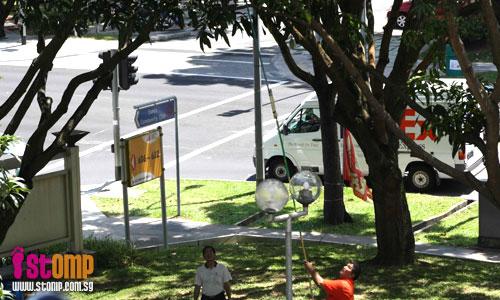
This was the scene left behind at Ubi Avenue 1 by the thunderstorm this morning (May 9).

STOMPer Lim, who took these photos, said:

"There was a heavy storm this morning (May 9) which caused many trees at Ubi Ave 1 to fall apart.

"Can the authorities please send someone to clear the field and check the stability of trees to prevent a similiar occurrence?"

Destruction in Ubi Ave left behind by thunderstorm

Uninvited guest on Vesak Day

Uninvited guest on Vesak Day
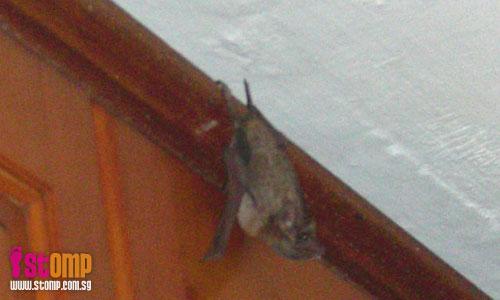
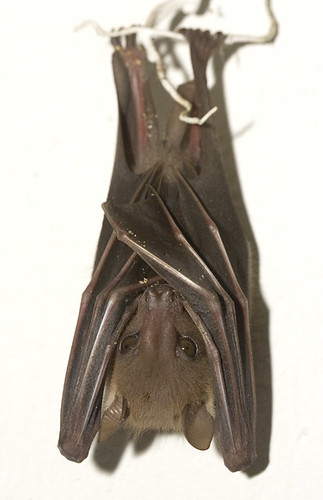
Guess who decided to drop by STOMPer Meg's home on Vesak day? It was a friendly, though uninvited, little bat!

Said the STOMPer:

"At 4am, I woke up to a faint chirping, only to find it hiding near my kitchen ceiling.

"I called all pest controllers only to find out none are specializing in capturing this animal.

"It's still in my house."

The photo is a little fuzzy, but still clear enough to show that this is a pouched tomb bat (Saccolaimus saccolaimus), a common and widespread species in Singapore.


Pouched tomb bat, Singapore;
(Photo by kwokwai76)

The pouched tomb bat roosts in colonies within rock crevices, hollow trees, and buildings, and like many other bat species, emerges at dusk to feed on insects. It goes by several names; pouch-bearing bat and pouched bat are other names for it, Wikipedia lists it as the naked-rumped pouched bat, while in Australia it is known as the bare-rumped sheathtail bat.

Regardless of its common name, this is a species with a wide distribution, from India and Sri Lanka all the way to New Guinea and northern Australia.


Pouched tomb bat, Singapore;
(Photo by kwokwai76)

The pouched tomb bat belongs to the family Emballonuridae, a family of 47 species of bat found throughout the tropics and sub-tropics, and commonly known as the sheath-tailed or sac-winged bats. Both names allude to the unique morphology of these bats.

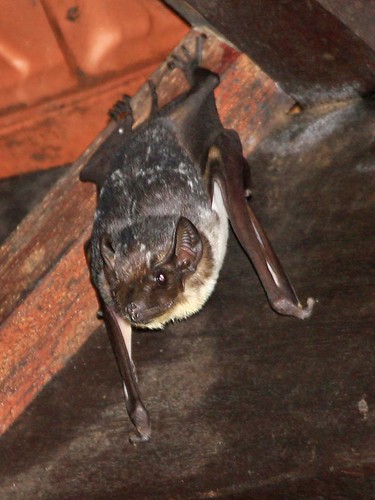
In most bat species, the hind legs are joined together by a membrane called the uropatagium, which often also encloses the tail. You can see an example below.


Bicoloured leaf-nosed bat, Bukit Timah Nature Reserve;
(Photo by Leong Tzi Ming)

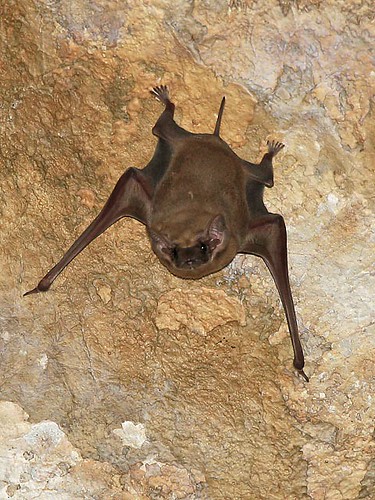
In the emballonurid bats, however, the tip of the tail protrudes from the middle of the uropatagium.


Black-bearded tomb bat (Taphozous melanopogon), Thailand;
(Photo by kwokwai76)

In flight, the bat can further extend the uropatagium by stretching its legs; the loose sheath around the tail easily slides back and forth over the tail vertebrae. This unique ability to control the size and shape of the uropatagium gives the emballonurid bat exceptional control over its steering and turning capabilities while pursuing insects in the air. It's a shame there aren't any readily accessible photographs of the tail of an emballonurid bat to illustrate this.

The other common name of sac-winged bats is due to the presence of glandular sacs in the wings of many species. These glands may play a role in scent-marking and communication. The pouched tomb bat lacks wing sacs, but has a large glandular throat pouch instead.


Wing sac of black-bearded tomb bat, Sabah;
(Photo by CM Francis)

In Singapore, besides the pouched tomb bat, 2 other species of sheath-tailed bat are present, the lesser sheath-tailed bat (Emballonura monticola) and the black-bearded tomb bat (Taphozous melanopogon), both of which are much more rarely encountered.

Approximately 32 species of bats have been recorded from Singapore, belonging to 8 different families: the fruit bats (F. Pteropodidae), horseshoe bats (F. Rhinolophidae), leaf-nosed bats (F. Hipposideridae), false vampire bats (F. Megadermatidae), slit-faced bats (F. Nycteridae), sheath-tailed bats (F. Emballonuridae), free-tailed bats (F. Molossidae) and vesper bats (F. Vespertilionidae). It is likely that out of these 32 species, some are already locally extinct, while yet more species might be present but unrecorded. While many of these bats are restricted to forest environments, several of them have proven capable of adapting to urban environments, roosting in buildings or beneath bridges, and within tunnels and drain culverts.

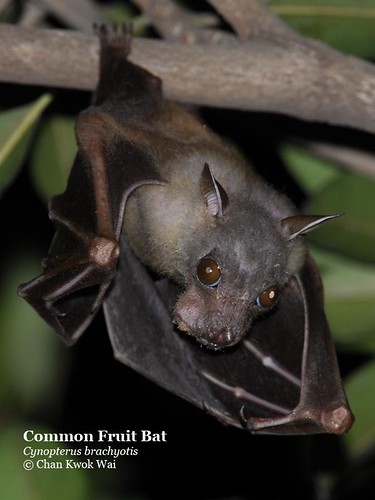
2 of the most commonly encountered bats in urban Singapore are the common fruit bat (Cynopterus brachyotis) and the lesser Asian house bat (Scotophilus kuhlii).


Common fruit bat, Singapore;
(Photo by Marcus)

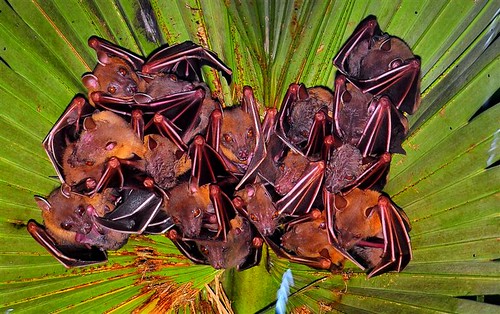
The common fruit bat, otherwise known as the lesser dog-faced fruit bat, feeds on fruit and nectar, and is known to roost in trees as well as in buildings. Sometimes, these bats will roost beneath large leaves of plants such as bananas and palms, and construct a tent-like structure by chewing along the midrib of the leaves, creating a shelter that shields the bats from sunlight and rain.


Common fruit bats roosting, Lower Peirce;
(Photo by NatureInYourBackyard)


Common fruit bat feeding on chiku (Manilkara zapota) fruit, Singapore;
(Photo by kwokwai76)


Lesser Asian house bat;
(Photo from Hong Kong Biodiversity Database)

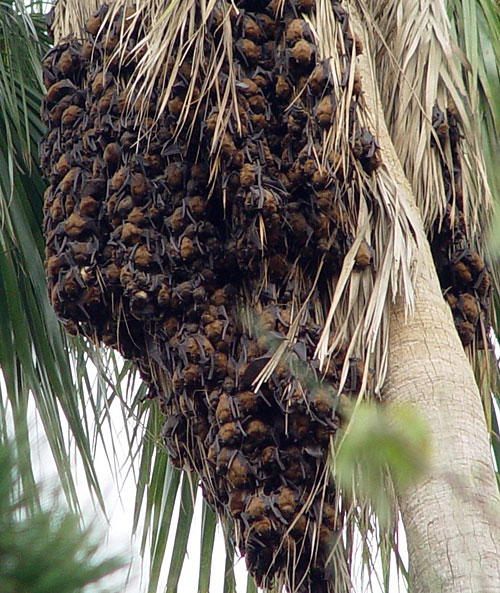
The lesser Asian house bat is the most common of our insectivorous bats, and is not fussy where it comes to choosing a roosting site; large colonies of up to several hundred bats can be found in buildings, hollow trees, and beneath the leaves of palm trees. On more than one occasion, I've seen these bats flying around lamp posts, feasting on the insects drawn to the light.


Large colony of lesser Asian house bats roosting in palm tree;
(Photo by Chen Shiang-Fan)


Lesser Asian house bat, Singapore;

The Malayan flying fox (Pteropus vampyrus) is one of the world's largest bats, with a wingspan of up to 1.5 metres. This species used to be common, but due to widespread hunting and loss of fruit trees, the population has declined greatly. The current status of this species in Singapore is a little confusing. According to A Guide to the Threatened Animals of Singapore, which was published in 1995, populations still exist in the Central Catchment Area, Pulau Ubin, Pulau Tekong and the Singapore Botanic Gardens.


Malayan flying fox, Disney's Animal Kingdom Park;
(Photo by Scottwdw)

However, my copy of Wild Animals of Singapore, which was published last year, doesn't include the Malayan flying fox in the Species Identification Guide, and lists it as a visitor to Singapore in the checklist. This appears to be corroborated by the Ecology Asia website, which states that 'there are no known roosts in Singapore, but visits by small flocks from neighbouring countries occur when there are trees fruiting in the Central Catchment Forest.'


Malayan flying fox, Oakland Zoo;
(Photo by Thomas Hawk)

Not many people seem to be aware of the ecological value of bats. The insectivorous species are significant insect predators, while others play an indispensable role in pollination and seed dispersal. Many people are surprised when I tell them that durians are pollinated chiefly by bats!

Bats can be very challenging to study; after all, many species are small and almost impossible to identify on the wing, and for many of us, the most we will ever get are fleeting glimpses as they flit around at high speed. Good luck trying to identify that nondescript brown blur that just flew past. Many of their calls occur at frequencies beyond our hearing abilities, necessitating the use of special equipment. Not to mention that they are nocturnal, a fact that presents even more challenges to researchers trying to study bat ecology and behaviour.

Using mist nets can provide valuable data, but might still be inadequate in constructing a comprehensive overview of bat numbers and diversity. Different species of bats fly at different heights, and some might go about their nightly activities above the forest canopy, well beyond the range of any net.

There's plenty to discover about Singapore's bats. An article published earlier this year revealed the rediscovery of the bicoloured leaf-nosed bat, a species thought to be extinct locally, as well as the discovery of Hardwicke's woolly bat (Kerivoula hardwickii), a new species record for Singapore.

T. M. Leong & K. K. P. Lim. 2009. Noteworthy microchiropteran records from the Bukit Timah and Central Catchment Nature Reserves, Singapore. Nature in Singapore, 2, 83-90.

Before that, a survey of bats had shown the presence of 3 species not previously recorded in Singapore, the Malayan slit-faced bat (Nycteris tragata), Blyth's horseshoe bat (Rhinolophus lepidus), and lesser tube-nosed bat (Murina suilla), but also suggested that 8 insect-eating species had become locally extinct. 1 of those species thought to be extinct was the bicoloured leaf-nosed bat, which if you recall, was subsequently rediscovered.

Pottie, S. A., Lane, D. J. W., Kingston, T. & Lee, B. P. Y-H. 2005. The microchiropteran bat fauna of Singapore. Acta Chiropterologica, 7(2), 237-247.

Another very interesting study looks at the decline in bat diversity in Singapore. By taking into account bat species found in Peninsular Malaysia, Sumatra and Borneo, but not in Singapore, the researchers suggest that the decline in bat species has been much more calamitous than 19th and 20th century records would suggest. There are also possible implications for species loss elsewhere in tropical Southeast Asia, where the loss and fragmentation of rainforests threaten the survival of numerous bat species.

Lane, D. W. J., Kingston, T. & Lee, B. P. Y-H. 2006. Dramatic decline in bat species richness in Singapore, with implications for Southeast Asia. Biological Conservation, 131(4), 584-593.

Before ending off, I guess it's only fair that I try and come up with some practical solutions for the person with a bat in her kitchen. It might be possible to close the door but leave the windows open, and then try to chase the bat out of the house. It might be better to try doing that in the late afternoon or early evening, when the bat is ready to fly off for a night of foraging anyway.

Under no circumstances should one try to catch the bat with bare hands; in the struggle, the thin bones of the bat might be snapped in two, or its delicate wings might be torn. Besides, bats have sharp teeth, and I won't be surprised if they use them in self-defense once in a while. Unlike in other countries, we don't have to be afraid of catching rabies from being bitten by a bat. Nonetheless, there are a number of other potentially dangerous diseases that may be transmitted between bats and humans, so like all other wild animals, it is best to keep one's distance and to take the necessary precautions when coming into contact with wildlife.

Still, I know of people who have small flocks of common fruit bats roosting in their homes, which I have to admit is rather neat. Can't imagine the noise made by the squabbling bats and the shower of guano though...

Friday, May 8, 2009

Oil spill off Sentosa?

Kok Sheng just alerted me that an oil spill has occurred off Sentosa.

Why isn't this in the news? Is it so minor that there is no mention of this incident even on the Maritime and Port Authority of Singapore (MPA) and National Environment Agency (NEA) websites?

Kok Sheng first pointed out this link on SustainableShipping.com that dates to 4th May 2009, entitled "Bunker spill off Singapore cleared". However, as you've probably realised by now, the news is accessible only to subscribers.

After a bit of Googling, I found another link that dates to 4th May, this time on Bunkerworld.com. Entitled "Bunker barge 'not at fault'", once again, I was frustrated to see that access was restricted to subscribers.

It's certainly very distressing when such important news is not freely available. I'm no conspiracy theorist, but why are the mass media and relevant government agencies silent about this? Surely we ought to know the facts about what happened?

I finally found a link that allowed me to find out more about this incident, on Portworld.com. I am eternally grateful to Google.
Bunker spill off Singapore cleared

A minor bunker spill off Singapore has been successfully cleared over the weekend, the port authority said Monday.

Singapore-registered bunker barge Global Duri was supplying bunkers to a Panama-registered vessel when 300 litres of bunker fuel was spilled on Friday.

The spill occurred at the Western Working Anchorage where the reefer cargo ship MV Meita Maru was anchored, some 800 metres from Sentosa, an island in the southern part of Singapore.

According to Maritime and Port Authority of Singapore (MPA), clean-up operations were successfully completed on Saturday.

"There are no more signs of spilled oil at the anchorage and fairway," an MPA spokesperson told Bunkerworld Monday.

MPA had dispatched five patrol and emergency response craft to the affected area, with the first craft arriving within 15 minutes after the incident were reported. Three contractor craft were also deployed.

Singapore's National Environmental Agency (NEA) and Sentosa Development Corporation (SDC) have also confirmed that the rockbunds off Labrador Park and Sentosa that were affected by some light patches of oil have been cleaned.

Sentosa's beaches, which are popular with locals and tourists, were not affected, the SDC said.

Siti Adawiah, 4th May 2009 03:28 GMT

By the way, anyone else noticed that the websites for SustainableShipping.com, Bunkerworld.com and Portworld.com all appear quite similar to one another? Are they run by the same group of people, or did the owners of these sites engage the services of the same web designers?

I did a search on Google, and I've found out the location of the Western Working Anchorage:
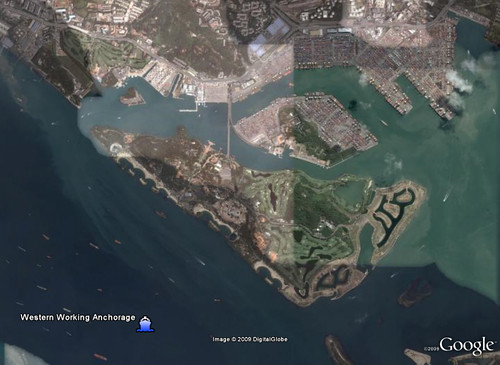
Western Working Anchorage

P1060547
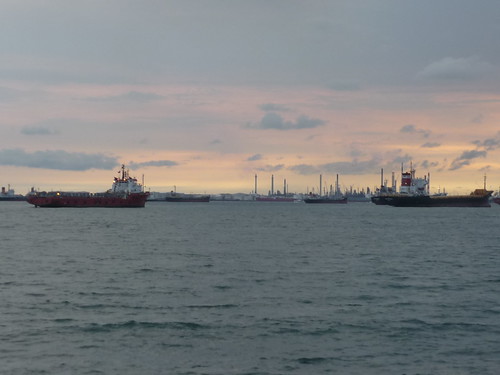
I suppose it might be somewhere in this photo taken from Siloso Beach.

I'm not surprised that any oil that was spilled in that area would drift towards Labrador Park and Sentosa.

There is some cause for concern about the impact on the shores; while the report states that the oil has been cleaned up, I'm worried that the marine life may have been affected.


Labrador contains our last mainland reef, as well as a natural rocky shore and seagrass meadows.
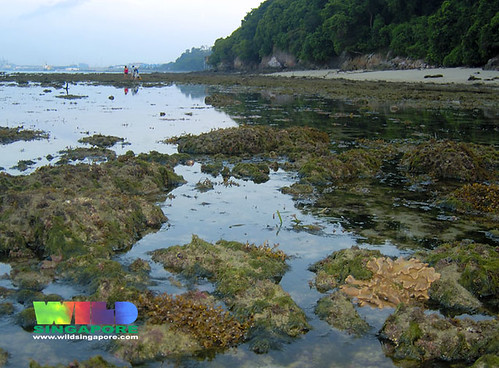

There's also the beautiful Tanjung Rimau on Sentosa. People never fail to be amazed at the wonderful variety of marine life that can be found here on Sentosa.
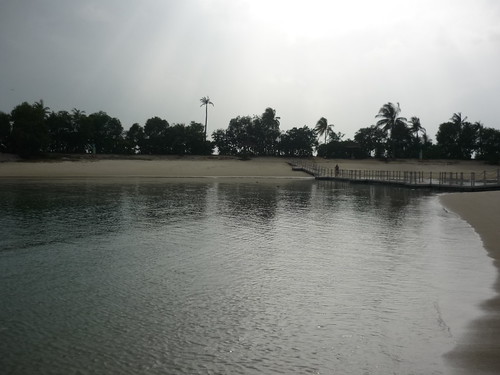
P1170566
Not to mention the man-made lagoons along Siloso Beach, which are actually full of surprises.

This is just the most recent incident involving maritime traffic in Singapore; given that our waters are so heavily utilised, it's only a matter of time before someone goofs up, resulting in collisions or spillage.

The last oil spill occurred last year, in early April 2008. An oil slick of unknown origin appeared along the beach at East Coast Park. While I don't think we ever determined where the oil slick came from, it only goes to illustrate the potential for ecological disaster occurring due to the large number of ships and boats plying our waters. So far, we have been spared from catastrophes like the Exxon Valdex oil spill that struck Alaska in 1989, or the much more recent oil spill that took place in Queensland in March this year.

What still bugs me is the lack of any news reports from the local media and government agencies. Don't we have the right to know about incidents like this?

I wasn't planning to visit Sentosa these few days, but I think I'll pay a visit to Siloso Beach one weekend morning, to see if the marine life has been affected in any way by this spill.

UPDATE: Joseph Lai was on Sentosa on 4th May, and he has reported what he saw that day. It doesn't look as bad as I feared, but I'm not heaving a sigh of relief just yet.
Thursday, May 7, 2009

Strong winds cause big tree to collapse and fall against condo perimeter

Strong winds cause big tree to collapse and fall against condo perimeter
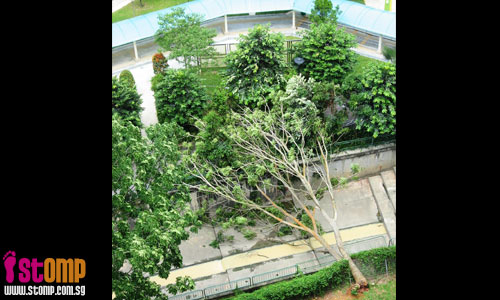
Strong winds from last night's storm weakened this big tree, resulting in it collapsing the next morning. Thankfully, no one was hurt.
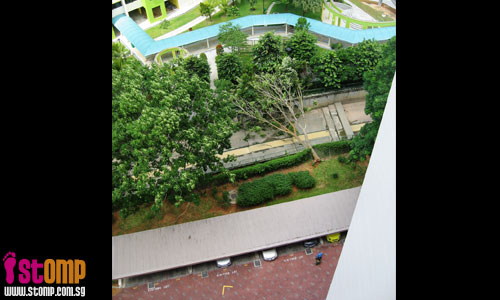
STOMPer SG who lives in the Condo, Clearwater, along Bedok Reservoir View, witness the tree collapsing this morning (May 7).
Says this STOMPer:

"I live on the 14th floor, and saw this big tree collapsing in the morning.

"It was weakened by last night's strong winds, and only collapse this morning.

"The tree is actually in the premise of my condo.

"It fell across a drain and landed against the perimeter of the condo.

"Luckily no one was hit."

Strong winds cause big tree to collapse and fall against condo perimeter

Sunday, May 3, 2009

Tree falls and blocks road exit on BKE

Tree falls and blocks road exit on BKE

Motorists travelling on the BKE in the early hours of the morning today(May 3), were inconvenienced by this fallen tree which completely blocked off the Woodlands Avenue 3 exit.

STOMPer Mr.Khoo, who was driving along the BKE, says:

"I think the tree fell around 2 am. It was probably struck by lightning due to the heavy rain.

"The tree completely blocked off the Woodlands Avenue 3 exit.

"Motorists could not use the exit at all.

"I helped the police to re-direct the traffic. But there were some motorists who still wanted to go straight.

"Don't know what they were trying to do.

"The LTA was contacted and the tree was removed awhile later."

Friday, May 1, 2009

People caught plucking mangoes claim they are RC members

People caught plucking mangoes claim they are RC members
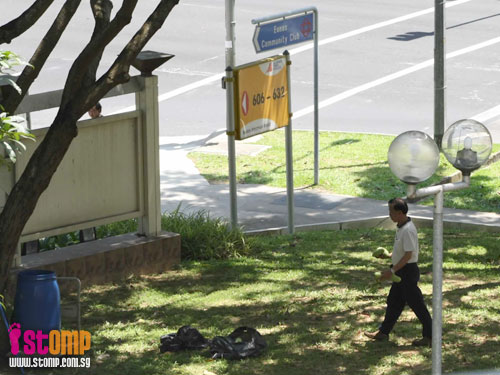
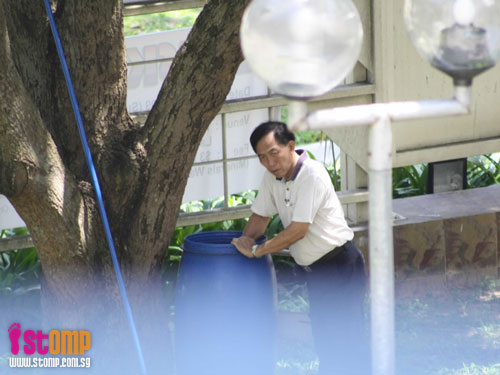
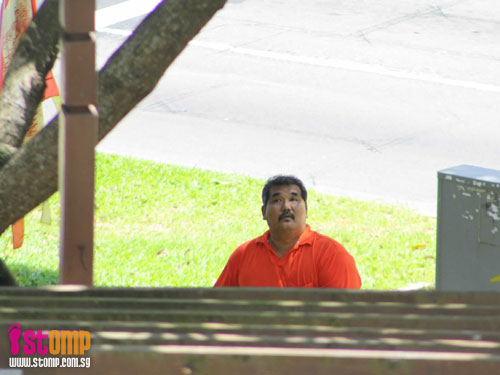
The men would pluck the ripe mangoes from the trees near Block 629 Bedok Reservoir Road and place them into bags or containers. When confronted, they claimed to be RC members.

STOMPer Ong, who took these photos, said:

"Every time the mangoes outside Block 629 Bedok Reservoir Road are ripe, there are people who claim to be from the RC who would come and pluck the mangoes.

"I asked them once, and they told me they were RC members.

"They would always arrive with containers and plastic bags.

"I would like to know, if the mangoes do belong to the RCs, does that give them the privilege to pluck the mangos?

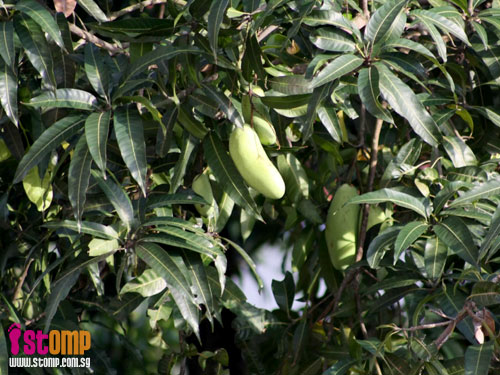
"Looking at the fat mangos below, I have a feel it's unfair because I have not got to taste the mangoes before."

According to him, the plucking has been going on since last year, and it has become more frequent lately.

People caught plucking mangoes claim they are RC members

Related article: Mango season hits Singapore streets (19th April 2009) (Mirror)