Friday, May 16, 2008

What is a nudibranch?


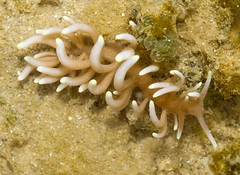
Upper left: Glossodoris atromarginata, Labrador; Upper right: Discodoris boholiensis, Sentosa;
Lower left: Chromodoris lineolata, Sisters Islands; Lower right: Hypselodoris infucata, Changi;
(Photos by Ria)

The name 'nudibranch' originates from a combination of the words nudus (Latin - naked) and brankhia (Greek - gills). Indeed, many species, like the four shown above, have a bushy tuft of external gills on their backs.

One of the most famous nudibranchs is the very large and colourful Hexabranchus sanguineus, a widespread species in the Indo-Pacific, although it is not recorded from Singapore waters.
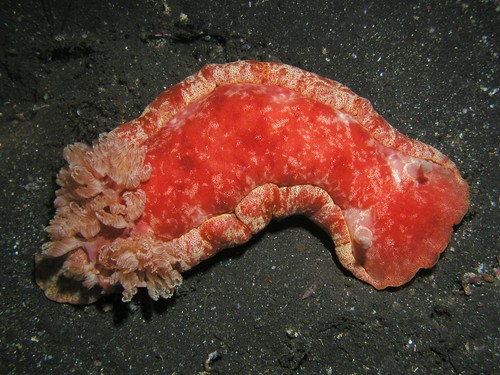

(Photo by Chika)

This species is commonly known as the Spanish dancer, for very obvious reasons:


FAMILY TIES

Nudibranchs are essentially a group of marine gastropods that have in the course of evolution lost their shells. Below are some of their close relatives:


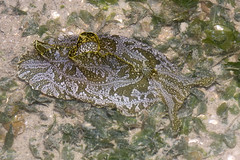
Upper left: zoned paper bubble shell, Hydatina zonata; Upper right: ornate leaf slug, Elysia ornata;
Lower left: moon-headed side-gilled slug, Euselenops luniceps; Lower right: geographic sea hare, Syphonota geographica;
(Hydatina by Chay Hoon, others by Marcus)

Not all of these nudibranch relatives have lost the shell; the zoned paper bubble shell and its relatives still possess a shell, whereas some of the sea hares retain a tiny shell that's partially or entirely enclosed within their soft bodies.

These various groups, together with the nudibranchs, usually fall under the generic term 'sea slugs'. However, despite their appearances, they are not at all closely related to terrestrial slugs. The onchidiid slugs commonly found on rocky shores and mangroves are actually close cousins of the land slugs that have successfully recolonised the seashore.
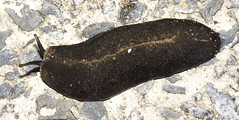

(Photos taken by Marcus)

WHAT DO NUDIBRANCHS EAT?

Nudibranchs are all carnivorous, and tend to be specialists; many species feed on only one particular prey species. Their diet usually consists of sessile organisms, which can't really run away from a prowling nudibranch. Animals as diverse as cnidarians, bryozoans, sponges, barnacles, and tunicates are food for various species of these brightly coloured slugs.


Here in Singapore, Jorunna funebris is believed to feed upon a certain species of blue sponge. (Photo by Ria)

One particular species of nudibranch from Florida (Aeolidiella stephanieae) is being cultured as an effective and reef-safe means of biological control against the glass anemone (Aiptasia spp.), an unwanted 'pest' species that can quickly reach plague proportions in a reef aquarium. These little nudibranchs are supposed to clear up glass anemone infestations, while leaving all other tankmates alone.

Other nudibranchs however prey on motile organisms.


The bizarre-looking Melibe has an expandable oral hood, which it uses to engulf small crustaceans.


Some nudibranchs even prey on other nudibranchs! While diving at Pulau Hantu, Chay Hoon documented Gymnodoris rubropapulosa feeding on Chromodoris lineolata, and discusses her encounter here and here.


It appears that Gymnodoris are such voracious predators, they are even cannibalistic. (Photo by Ria)

Perhaps most interesting are the relationships that some nudibranchs have with zooxanthellae. Most would know how corals, among many marine organisms, form a symbiotic relationship with zooxanthellae, which are tiny single-celled dinoflagellates (otherwise known under the catch-all term of 'algae'). The zooxanthellae provide their coral hosts with energy through photosynthesis, while the coral provides shelter, nutrients and carbon dioxide for the zooxanthellae.

Some nudibranch species which feed on corals and other cnidarians are capable of keeping the zooxanthellae, which they ingest together with their prey, intact and alive. Others simply inadvertently ingest free-living zooxanthellae in the water. The zooxanthellae continue to grow, reproduce, and photosynthesise within specialised tissues in the nudibranch, and actually provide food for their new host!

Here are two local examples of such solar-powered slugs:


Left: Pteraeolidia ianthina feeds on hydroids; Right: Phyllodesmium briareum feeds on soft corals;
(Pteraeolidia by Ria, Phyllodesmium by Marcus)

These 2 species, among many others, possess fingerlike projections called cerata on their dorsal region. The zooxanthellae are stored within the cerata, and here they receive maximum exposure to sunlight. While the nudibranchs cannot survive indefinitely without feeding, this study has shown that starved individuals survive longer in constant sunlight than if they were kept in constant darkness, hinting that the zooxanthellae do help meet some of the nudibranch's nutritional requirements.

WHY ARE THEY SO COLOURFUL?

In the marine environment, being colourful is usually a form of advertising; in the case of the nudibranchs, which have poor eyesight and hence do not use their colours to attract mates, their bright coloration is a very clear signal to other marine creatures which might want to take a bite out of these soft-bodied molluscs: "Do Not Eat!"

Nudibranchs have evolved a wide array of defences. Some are well-camouflaged to blend in with the coral rubble:

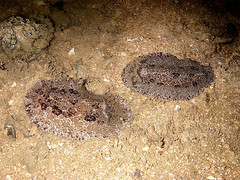

Upper left: Dendrodoris tuberculosa; Upper right: Discodoris lilacina;
Lower left:: Atagema spongiosa; Lower right:: Platydoris scabra;
(Dendrodoris by Siyang, Discodoris by Ron, Atagema and Platydoris by Ria)

Many species synthesis their own toxins, while others actually sequester chemicals found in their prey, which they then incorporate into their own bodies. What's interesting is that while some nudibranchs simply absorb and use the chemicals found in their prey, others actually metabolise chemical compounds in their prey, modifying these compounds into a more potent form. The result is that most nudibranchs are distasteful, even toxic; any fish that dares to take a nibble will soon learn to avoid repeating the act with other nudibranchs. The bright colours thus serve as a warning to potential predators.

Some species, such as the two Phyllidiella species shown below, can also release noxious chemicals into the water if disturbed.


Phyllidiella nigra (bottom, with purple tubercles) and Phyllidiella pustulosa (top, with blue tubercles)
(Photo by Ria)

The Sequestering of Secondary Compounds from Sponges by Nudibranchs

Some nudibranchs don't just absorb toxins from their prey, they actually 'borrow' the stinging cells found in their prey, and use these cells for defence!

These nudibranchs feed upon cnidarians such as sea anemones or hydroids, and the stinging cells (or cnidocytes) of their prey are actually passed to the cerata, undischarged, and stored within special sacs in the tips known as cnidosacs. The cnidocytes remain fully functional, firing away with tiny venom-filled barbs upon contact with another animal. Brushing against these nudibranchs can be just as painful as getting stung by the actual sea anemones or hydroids that these slugs feed on.


Cerberilla asamusiensis (left) and Cuthona sibogae (right) are some of those species that probably should never be handled with bare hands. (Cerberilla by Ron, Cuthona by Ria)

If you're interested in reading more about Singapore's nudibranchs, check out the following article at Singapore Celebrates our Reefs!.

Coming up, are nudibranchs suitable for aquariums?

This is part 2 of a 5-part series on nudibranchs, inspired by a feature article on nudibranchs on the National Geographic website.

Part 1: Nudibranchs are beautiful
Part 2: What is a nudibranch? (this post)
Part 3: Are nudibranchs suitable for aquariums?
Part 4: Nudibranchs for the aquarium
Part 5: Nudibranchs: Stowaways and Hitchhikers

Nudibranchs are beautiful

Don't believe me? Check out this wonderful feature on the National Geographic website.

The photo gallery by world-renowned underwater photographer David Doubilet is simply stunning:

NatGeoNembrotha

The accompanying video is a must-see too.

Look who's featured in the gallery:

NatGeoJorunna
Jorunna funebris

This species is actually quite commonly seen on Singapore's shores!


Jorunna funebris on Sentosa (Photo by Ria)

There's an amazing variety of shapes and colours among the nudibranchs that can be found in Singapore. Here's some pictures taken by several friends:


Armina semperi (Photo by Marcus)


Melibe sp. (Photo by Ria)


Glossodoris atromarginata (Photo by Ron)


Phyllidia ocellata (Photo by Jun)


Cuthona sibogae (Photo by Chay Hoon)


Ceratosoma sinuata (Photo by Ria)


Flabellina rubrolineata (Photo by Jun)


Discodoris boholiensis (Photo by Ron)


Chromodoris lineolata (Photo by Marcus)


Gymnodoris rubropapulosa (Photo by Chay Hoon)


Phyllidiella pustulosa (Photo by Ron)


Pteraeolidia ianthina (Photo by Ria)

What I have shown here is just a tiny fraction of the great diversity of nudibranch species which can be found in Singapore's waters. Nudibranchs are so colourful, but they are often quite well-camouflaged, or tiny and really easy to miss if you're not looking hard enough.

Coming up, just what exactly are nudibranchs? What do they eat? And why are they so colourful?

This is part 1 of a 5-part series on nudibranchs, inspired by a feature article on nudibranchs on the National Geographic website.

Part 1: Nudibranchs are beautiful (this post)
Part 2: What is a nudibranch?
Part 3: Are nudibranchs suitable for aquariums?
Part 4: Nudibranchs for the aquarium
Part 5: Nudibranchs: Stowaways and Hitchhikers

Monday, May 12, 2008

Not again.

Update: Check out Ria's wildfilms blog, which illustrates the difficulties of implementing such a proposal. I like this part:

Indeed I wonder about the writer's seeming obsession with 'doing something' with the shores and water around Changi? These areas are NOT 'unused' or 'underutilised'. They are in fact used for critical elements of Singapore's national and economic needs.

The writer's continuing disregard for basic realities of the area is also rather puzzling. Particularly since these have been highlighted earlier.

Guess who has yet another letter published in the Straits Times Forum today...

Make Changi 4th runway float on the sea (mirror)

THREE years ago, many Singaporeans doubted a floating platform the size of a football field could ever be built and be safe to use. Three years later and thanks to Ministry of Defence approval, we have shown the world with the spectacular 2007 National Day Parade on the Marina Bay floating stadium, anything can be done when we put our hearts and minds to it.

It is time for us to take our industrial shipbuilding expertise on floating platforms and take it to a higher level. We should build the world's first 5km by 0.2km floating platform as the fourth runway at Changi Airport. The floating platform can be attached to the mainland and extend it out to sea.

A normal airport occupies a huge amount of land resource, but as one can see most of Changi Airport comprises grass fields. The terminal buildings, taxiways and runway occupy less than 40 per cent of the total land area. In land-scarce Singapore, we must find ingenious ways to use all our land resource to the fullest.

For Singapore to become the major aviation hub in Asia and South-east Asia, we need a massive amount of land to cater to the industry's growing needs. The Changi cargo and aircraft maintenance area is bursting at the seams. A limited land resource will seriously hinder our growth and potential. If we can push the fourth runway out to sea, we can also convert the first and second runways to sea-based form and free up land for other uses.

Many would have deemed this idea impossible. But the old Kai Tak Airport in Hong Kong used a single 3km runway that stretched out to sea. The United States has operated one of the largest aircraft carriers in the world for decades now, and the landing strip is less than 200m long and 60m wide. The largest super tanker in the world is more than 400m by 70m and these floating giants are made safer and stronger than is generally known. Figures will show that floating runways will be cheaper than using reclaimed land.

Syu Ying Kwok

I have too many matters to attend to, and I'm seriously not going to bother responding to this one.

Saturday, May 10, 2008

NYEF 2008

NYEFEventOutlinePoster

Today was a busy day for our shores; not only did Team Seagrass head down to Pulau Semakau, but there was a Kusu Island ReefWALK and a Chek Jawa intertidal walk taking place today as well. I on the other hand went down to attend this year's National Youth Environment Forum (NYEF), hosted by Environmental Challenge Organisation (Singapore) (ECO Singapore), as a representative of the Naked Hermit Crabs.

As stated on ECO Singapore's website, the NYEF
is a public discussion format that that allows youths to voice their opinion about environmental issues in front of an audience. Participants will share their comments and opinions with one another lead by a facilitator whose job is to provide the necessary background information, set the ground rules of participation and generally control the discussions.

Aside from the forum providing an educational and interactive platform for youth to voice their environmental concerns, participants are expected to come up with an action plan to carry out proposed solutions to be carried with the support and partnership with a relevant NGO, special interest group or educational institution.

The objectives of the forum are to:
1. Provide a platform for interactive discussions between the youth, experts, activists and NGOs on topics that have been identified by the youth themselves as being critical to the environment.

2. Enable the participants to deliver an action/development plan to tackle issues.

3. Facilitate collaboration between participant action plans and relevant NGOs/Special interest groups.

Saturday, May 3, 2008

Secret Shores of Singapore

P1010246

Update: Check out Ria's post on her talk at the wildfilms blog.

Today, I went down to the Singapore Botanic Gardens, as Ria was giving a talk on the Secret Shores of Singapore.

On my way to the talk venue, as I was walking down Upper Palm Valley Road, there was a loud commotion in the vegetation just next to the footpath. There was a loud rustling of leaves, and a cicada suddenly fell to the ground, followed by a small shower of dead leaves and bits of twigs. Closer inspection of the shrubs at eye level revealed a plantain squirrel (Callosciurus notatus), which seemed to be frantically searching for something. Perhaps it was looking for the cicada, which had now vanished.

Right in front of the Botany Centre, there was another rustling in the shrubs beside me; another plantain squirrel. This is Singapore's most common squirrel species, and can be commonly found even in urban parks and gardens.

Almost simultaneously, I registered the presence of a common sun skink (Eutropis multifasciatus) on the ground next to the footpath. 2 squirrels and a lizard within 15 minutes of reaching the Botanic Gardens, and I wasn't even actively looking for them.

P1000999

Ria gave an engaging talk, similar to those she has given before, but with a new focus on Cyrene Reef. How timely that today's edition of the Straits Times has an article featuring the discovery of the sea star Pentaceraster mammillatus, a new record for Singapore.

P1010259

Some of the questions asked by members of the audience at the end of the talk were quite interesting. The one that really left an impression on me was about the potential threat posed by various marine organisms to human life. After all, many marine creatures are highly venomous, and an encounter with any one of them under the wrong circumstances can prove fatal to anyone exploring the shores. These include:


Jellyfish, which can really spoil a diving trip, but at least we don't seem to get the insanely venomous box jellyfish (Cubozoa) in our waters.


Estuary stonefish (Synanceia horrida), which have been found from time to time.


Sea snakes. The yellow-lipped sea krait (Laticauda colubrina) is not uncommonly seen around reefs.


Stingrays such as the blue-spotted ribbontail ray (Taeniura lymma) and mangrove whipray (Himantura walga) can often be spotted in shallow waters at low tide.


Cone snails (Conus spp.) were mentioned, but live specimens seem to be very rare in our waters these days.

Among those of us who regularly explore our shores, there have been stonefish and stingray incidents in recent years. But hey, so far nobody has died, and we still have all our fingers and toes.

I'm sure all the people who attended had an enjoyable time, are now more aware about the richness of our shores, and the challenges faced by our marine biodiversity.

A group of girls from Raffles Junior College approached Ria after the talk. It turns out that they are interested in making a short film about the marine life that can be found along the natural shores of Sentosa. Great to hear that more youths are expressing an interest in our local biodiversity. I'm now waiting for them to email me so I can pass them the tide tables for this month.

Still to come: Exploring the rainforest, and life around the Symphony Lake.

This is part 1 of a 3-part series on a trip to the Singapore Botanic Gardens on 3rd May, 2008.

Part 1: Secret Shores of Singapore (this post)
Part 2: coming soon
Part 3: coming soon

Wednesday, April 30, 2008

I'm in the papers again

It took them a while, but my reply to Clinton Lim's suggestion to use ferries as public transport has finally been published.

Commute by sea? It's a ferry tale (mirror)

I REFER to Mr Clinton Lim Eng Hiong's letter, 'Tired of jammed roads? Go to work by sea instead' (April 23). While ferries have proven to be an effective means of transport in many coastal cities, there are many complex challenges in Singapore's context which would make it difficult to effectively implement a similar system here.

Ferry transport works best when the distance between two points is shorter over water than if a detour has to be made over land. This is best seen in cities surrounding large bays like in the San Francisco Bay Area, or where cities are spread out over a cluster of islands, such as in Hong Kong.

Anybody with a map of Singapore can tell that the island is roughly shaped like a lozenge. In the north, the causeway linking Singapore to Johor Baru prevents sea transport via the Straits of Johor. Taking this into account, the distance covered over land is usually shorter than by sea. As an example, people intending to take a ferry from Punggol to Jurong would have to skirt the entire eastern and southern coastline of Singapore.

Although the seas might not appear to be as congested as our roads, there are laws and regulations for our busy port and shipping lanes which will affect the speed and routes taken by any ferry service, which means that taking the shortest direct route over water will not always be possible.

Sea-going vessels are usually unable to match land vehicles in terms of speed. Faster boats are available, but the wake produced by these boats can be large, which not only disrupts other boats nearby, but also accelerates coastal erosion. For this reason, it can be expected that such ferries will not be allowed to achieve top speed until they are some distance from other boats and shores that might be impacted. This adds further to the distance to be travelled, and time taken, since they will have to cruise along at low-wake speeds for portions of the route.

The large size of high-speed ferries necessitates deep water and proper jetties for safe transfer of passengers. Creation and maintenance of such areas requires regular dredging which will affect water quality and thus the coastal environment.

Clinton Lim might not be aware that Clifford Pier has been closed since 2006, due to construction of the Marina Barrage. And in the West Coast area, which is heavily congested, it is unlikely that deepwater access with good land links can be freed up easily.

The effects of bad weather are more obvious on maritime traffic than on land; storms can have a serious impact on the speed of boats, and it does not require very strong winds to create choppy waters that can make a ferry ride a very unpleasant affair for passengers. Small craft, such as the bumboats that ply the waters between Changi and Pulau Ubin, can be unstable, and I have seen how even that short 10-minute journey can be too much for some people to stomach.

Looking into all these factors, it appears that a system of ferry services will neither be very efficient nor cost-effective, when compared to travelling overland. At present, the only place where ferry services might be feasible is in the Singapore River and Kallang Basin, although the extensive road network and numerous bridges would render such a service redundant and practical only in certain areas. Any ferry service would probably be seen more as a slower, scenic pleasure cruise rather than as an effective complement to our existing road and rail infrastructure.

While I wholeheartedly support the need to tackle congestion on the roads, any proposed solution will need to take into account Singapore's geography, and the various issues involved that will affect the practicality and feasibility of such proposals.

Kwan Wei Ming Ivan

2 letters published within the span of 9 days. I hope I don't have to keep doing this. I think I'll pass the job of writing the next rebuttal (whenever that may be) to someone else.

Sunday, April 27, 2008

Chek Jawa with the Naked Hermit Crabs, April 27 2008

Update: You can read more at Adventures with the Naked Hermit Crabs, and see some of the delightful new guestbook entries. Ria has also written about our voyeuristic tendencies and a sneak peek into the private lives of the hornbills over at the wildfilms blog.

Today, I spent yet another lovely afternoon on Pulau Ubin, guiding visitors around the Chek Jawa boardwalk with a few other Naked Hermit Crabs. Alas, my camera has gone a little bit crazy since my Semakau trip, so I didn't get to take any photos. The small handful of photos I took with my handphone camera will be shown further down, but let me warn you in advance, they do not depict a pretty sight.

Wednesday, April 23, 2008

Another day, another letter

I... I need to go lie down for a while.

Here's another letter to the press that ignores a lot of basic facts, though to be honest, the ideas aren't as ridiculous as those expressed by a certain other person.

Tired of jammed roads? Go to work by sea instead (mirror)

ON SATURDAY, it was reported that there were 4.779 million train and rides a day in the first quarter, up 7 per cent over last year ('Buses, MRT see jump in ridership'). While the growth in public transport ridership is significant, it is not known if the rise has been at any real expense to car trips.

With more than 800,000 cars on the roads currently, the intention to increase the population to 6.5 million could well put another 250,000 or more vehicles on already congested roads.

The Land Transport Authority has taken action to manage traffic congestion in the city during peak hours by ensuring vehicular growth is met by a corresponding increase in the number of expressways, tunnels, MRT lines, electronic road pricing (ERP) gantries and charges.

After many years in service, I wonder if ERP is effective in alleviating traffic congestion or is it just 'rearranging furniture'.

In land-scarce Singapore, do we fully harness all resources available to meet public transport challenges? I think not. So far, we have looked only landwards. We need to take a more holistic, innovative approach - by looking to the sea.

Singapore is, after all, an island. Why not explore the idea of ferrying thousands to and from work daily via a Park 'n' Cruise scheme, to supplement the existing rail and road transport system?

This refreshing mode of transport will be guaranteed not to encounter traffic jams, be squeezed out of bus lanes or cause the motorist to be fined for not having a valid CashCard as he passes the ERP gantry.

With the Government providing the infrastructure - carparks and ferry terminals - the bus shuttle service and plying the route can be left to private enterprise.

I can already envisage Clifford Pier and the soon-to-be- made-over Singapore Cruise Centre at HarbourFront as two hubs of this ferry service, with terminals stretching from Woodlands to Punggol, Pasir Ris, Tampines, Bedok, Siglap, Marine Parade and West Coast, for a start.

I hope any feasibility study of this suggestion will be favourable, enabling at least part of our transport system to be left perpetually in 'cruise control'. This will also contribute to the Government's expectation that, by 2020, 70 per cent of trips in the morning peak period is by public transport.

Clinton Lim Eng Hiong

I guess he means well, even if he isn't quite aware of some of the basic facts.

Ria did another post on the wildfilms blog highlighting the problems that affect the feasibility of implementing a ferry transport system in Singapore.

I've sent in a reply:
Public transport by sea? A Ferry-tale for Singapore

I refer to Clinton Lim Eng Hiong's letter on Wednesday, "Tired of jammed roads? Go to work by sea instead" (Straits Times, 23 April 2008). While ferries have proven to be effective means of transport in many coastal cities, there are many complex challenges in Singapore's context which would make it difficult to effectively implement a similar system here.

Ferry transport works best when the distance between two points is shorter over water than if a detour has to be made over land. This is best seen in cities surrounding large bays like in the San Francisco Bay Area, or where cities are spread out over a cluster of islands, such as in Hong Kong.

Anybody with a map of Singapore can tell that the island is roughly shaped like a lozenge. At the north, the causeway linking Singapore to Johor Bahru prevents sea transport via the Straits of Johor. Taking this into account, the distance covered over land is usually shorter than by sea. As an example, people intending to take a ferry from Punggol to Jurong would have to skirt the entire eastern and southern coastline of Singapore.

Although the seas might not appear to be as congested as our roads, there are laws and regulations for our busy port and shipping lanes which will affect the speed and routes taken by any ferry services, which means that taking the shortest direct route over water will not always be possible.

Sea-going vessels are usually unable to match land vehicles in terms of speed. Faster boats are available, but the wake produced by these boats can be large, which not only disrupts other boats nearby, but also accelerates coastal erosion. For this reason, it can be expected that such ferries will not be allowed to achieve top speed until they are some distance from other boats and shores that might be impacted. This adds further to the distance to be travelled, and time taken, since they will have to cruise along at low-wake speeds for portions of the route.

The large size of high-speed ferries necessitates deep water and proper jetties for safe transfer of passengers. Creation and maintenance of such areas requires regular dredging which will affect water quality and thus the coastal environment.

Clinton Lim might not be aware that Clifford Pier has been closed since 2006, due to construction of the Marina Barrage. And in the West Coast area, which is heavily congested, it is unlikely that deepwater access with good land links can be freed up easily.

The effects of bad weather are more obvious on maritime traffic than on land; storms can have a serious impact on the speed of boats, and it does not require very strong winds to create choppy waters that can make a ferry ride a very unpleasant affair for passengers. Small craft, such as the bumboats that ply the waters between Changi and Pulau Ubin, can be unstable, and I have seen how even that short 10-minute journey can be too much for some people to stomach.

Looking into all these factors, it appears that a system of ferry services will neither be very efficient nor cost-effective, when compared to travelling overland. At present, the only place where ferry services might be feasible is in the Singapore River and Kallang Basin, although the extensive road network and numerous bridges would render such a service redundant and practical only in certain areas. Any ferry service would probably be seen more as a slower, scenic pleasure cruise rather than as an effective complement to our existing road and rail infrastructure.

While I wholeheartedly support the need to tackle congestion on the roads, any proposed solution will need to take into account Singapore's geography, and the various issues involved that will affect the practicality and feasibility of such proposals.

Kwan Wei Ming Ivan

Seriously, I wish more people would stop and think more about the feasibility of their ideas, and do a bit more research, before sending in their letters to the press.

Tuesday, April 22, 2008

Dam(n) these silly ideas...

Syu Ying Kwok just doesn't get it, does he?

I was quite pleased to see that my reply to his letter proposing the creation of a giant freshwater reservoir by damming up the sea around Pulau Ubin, Pulau Tekong and Changi has been published.

However, to my chagrin, it did not take him long to reply to my letter, in the online comments. And his wordy reply simply shows that he still doesn't understand the realities of the situation.

My letter has been published

Back from Pulau Semakau, and I've just discovered that my rebuttal to Syu Ying Kwok's letter has been published. Unfortunately, it was published online, which means that those who only read the print edition won't get to see why the original idea was simply rubbish.

Sunday, April 20, 2008

Lizard on TV


Update: Liana has blogged a quick summary of our segment on Rouge over at Adventures with the Naked Hermit Crabs

For the past week, I have been getting a huge number of messages from friends and acquaintances, through SMS, MSN Messenger, and even Facebook, telling me that I've been spotted on television. I am a little surprised by all the attention, especially when you consider that I make an appearance for less than 5 seconds on the promo trailer for tonight's episode of Rouge.

When I agreed to be interviewed on the show together with November three weeks ago, little did I know just how many people would find out, and how they would react. It seems even my parents have had their friends calling them to ask if their son was really appearing on national television.

But I suppose at the very least, this is a great opportunity to promote the wonderful work that so many of us are doing to raise awareness of our shores and their natural splendours.

Here's the synopsis from the Channel 5 programme schedule:
Can You Save The World?

What have you done to save the world?

This week on Rouge, we say "we can" to saving the environment, helping the poor and the disabled. Join special guests from ONE (SINGAPORE), President and Class 95 deejay Vernetta Lopez and co-founder Micheal Switow as they share with us how to make poverty history.

Social entrepreneur Lois Ng tells us more about Studio You and Rouge joins the Naked Hermit Crabs in a search of some marine life along the shores of Singapore.

Rouge will broadcast tonight, 20 April (Sunday) on Channel 5 at 10pm. I'll be sitting in front of the television screen, seeing how I make a fool out of myself. I think I am going to go down in history as the guy who revealed to Eunice Olsen that the giant reef worm happens to belong to the genus Eunice.

You can read about our experience in the television studio in one of my previous posts or over at Adventures with the Naked Hermit Crabs. November also blogged about her experience being filmed on Pulau Semakau over at the Midnight Monkey Monitor, while Ria documents the wonderful time they had that morning at the Wildfilms blog.

Chek Jawa mornings


I had another enjoyable morning at Chek Jawa today, giving Gerald and Ai Kit from my NIE GESL group a brief introduction and tour of the Chek Jawa boardwalk.

Friday, April 18, 2008

Dam(n) ideas...


Sometimes, I read of downright silly, hare-brained schemes to put our nature areas to "better" use. Some people, still woefully ignorant of the ecological, recreational, and even spiritual value of our wild places, are capable of coming up with some ridiculous ideas. Race tracks on Pulau Ubin? Yes, the idea has been proposed before. Building Disneyland in Sungei Buloh? As ludicrous as it is, someone was actually dumb enough to suggest that.

But I was extremely appalled to read this in the Forum section of today's Straits Times:

*Facepalms*

Among my circle of friends and associates who are passionate about the environment, I am known for spending a fair amount on time on STOMP . I started out simply by virtue of there being so much misinformation and misguided views, that I was compelled to correct a lot of wrong assumptions, provide accurate factual information about wildlife spotted by contributors, and try to provide an intelligent and rational voice of reason, which is quite a tall order considering how so many of the comments made there appear to be left by individuals with a collective IQ lower than a coral polyp. The comic below describes my relationship with STOMP very well:


I post at STOMP under the nom de plume of varanus_salvator, and over the course of nearly a year, I guess I have done a fair bit in trying to raise awareness about Singapore's biodiversity, and trying to cultivate a sense of tolerance and coexistence with the various organisms that manage to live alongside us. I try my best to distance myself from the bulk of the posts, choosing to focus on topics related to wildlife, the environment, and animal welfare issues. It can be tough work, considering that I often find myself fighting an uphill battle against great ignorance or sometimes plain stupidity. But if I don't do it, no one will, and at the very least, I like to think that most of the people who read my comments will come away having learned just a bit more.

Today though, I came upon a post that seriously made me question the intelligence level of STOMPers. It's such a ludicrous idea, so ridiculous and so preposterous that it's simply mind-blowing. For the first minute or so after reading it, I could only gawk at the computer monitor, at a loss for words in the face of such sheer stupidity.

The post? If Disneyland came to S'pore...

Turns out that some ignorant fool named Samuel drove past Sungei Buloh, and thought that the open space would be an excellent place to build Disneyland, if it ever came to Singapore.

STOMPer Samuel was driving along the Sungei Buloh area and saw the vast land reserve there. He envisioned what Disneyland would look like if it were built there and sent pictures of what he came up with to STOMP.

In the email which he sent to STOMP yesterday (Apr 14), he wrote:

"I took two pictures of the vast space there and thought to myself that we could actually build a Disneyland there.

"How wonderful will that be!

"I edited one of the pictures with 'Disneyland' built over the area."


The post came complete with crappy Photoshop job:

Disneyland in Sungei Buloh?
Seriously, WTF?!

I have to say, it really is quite painful to wrap my mind around this whole idea that a fellow Singaporean actually thinks Sungei Buloh (of all places) is the perfect place to build Disneyland.

I admit, I am somewhat biased against theme parks, though I did enjoy myself at Ocean Park in Hong Kong on the two occasions I visited the place. But I am not against having Disneyland in Singapore, provided it does prove to be a worthwhile strategy in generating tourist dollars and income, and of course, provided the environmental costs are reasonable, and within tolerable limits.

My biggest problem with Samuel's crazy idea? It's the friggin' location, damn it.

Sungei Buloh is famous in the region, if not throughout the world, as being a vital place for migratory birds to stop and refuel on their long journeys between their breeding grounds in the north, and their wintering grounds in the southern hemisphere. Besides that, it is home to a wide variety of mangrove and wetland species, and I have a fondness for the place; after all, it's a great place to find and photograph Malayan water monitors.

Despite its significance on a global scale, sustaining the flocks of waders and shorebirds that would otherwise perish if not for the mudflats, and its value to many Singaporeans, our dear friend is apparently completely ignorant, unaware, and oblivious to Sungei Buloh's value in this regard.

The exchange of comments is really quite remarkable. Some are generally supportive of having Disneyland. Thankfully, there are many other comments made by people who share my view:

colugo111 said on 15 Apr, 2008
I don't want to see our ASEAN Heritage - Sungei Buloh Wetland Reserve get destroyed by all these things

emergency999 said on 15 Apr, 2008
save sungei buloh ..why not built disneyland next to your hdb block better what? dream on bro...!!

shalalala said on 15 Apr, 2008
conserve nature and SB.
u go and bild your own disneyland in your dreams

tosplant said on 15 Apr, 2008
WTH, u better leave Sungei Buloh alone.


Here's what I had to say about this silly idea:

varanus_salvator said on 15 Apr, 2008
Oh, God forbid we create yet another contrived theme park. What's up with our fixation with artificial human constructs? First it was the obsession with golf courses, now it's theme parks and resorts.

Aren't the upcoming IRs enough already? Besides, Sungei Buloh is already globally recognised as an essential stopover for migratory birds. I think that beats the fame of having a Disneyland.


Samuel finally spoke up, and under the nickname of samdisk23, tried to give a series of justifications for his idea:

samdisk23 said on 15 Apr, 2008
Read this article "Tokyo Disneyland eyes new facility in Asia" at this link http://sg.biz.yahoo.com/080415/1/4fu1e.html
"The operator of Tokyo Disneyland said Tuesday it was considering opening a new facility in Southeast Asia as fans flocked to the theme park on its 25th anniversary." We might well have a DisneyLand in Singapore!!!!!

samdisk23 said on 15 Apr, 2008
Vote for DisneyLand Singapore!!!!!

samdisk23 said on 16 Apr, 2008
Read this article "Tokyo Disneyland eyes new facility in Asia" at this link http://sg.biz.yahoo.com/080415/1/4fu1e.html
"The operator of Tokyo Disneyland said Tuesday it was considering opening a new facility in Southeast Asia as fans flocked to the theme park on its 25th anniversary." We might well have a DisneyLand in Singapore!!!!!

samdisk23 said on 16 Apr, 2008
Just imagine if M'sia win the bid for Disneyland in Johor, it will greatly affect the operation of IR & Genting in Singapore. If there's a bid, we must win at all cost. With best regard.

samdisk23 said on 16 Apr, 2008
I believe we turned down the offer by Disneyland in the 90s, if we turn down the offer again, we might never had the chance again....


Fair enough, but he seems to suffer from poor comprehension skills; he is so utterly clueless, that he doesn't realise that the problem all of us have with his idea is not Disneyland per se, but where he wants Disneyland to be built.

varanus_salvator said on 16 Apr, 2008
samdisk23: Point taken already, geez. You didn't have to repeat your post.

The main reason why Samuel's idea is so ludicrous is not that he suggested having Disneyland in Singapore (by all means, stick one in Singapore if it's feasible), but because of his ridiculous choice of location.


His reply almost made me contemplate murder. I swear, if there was some way I could cause great physical pain, I would have given him a hard whack on the back of his head.

samdisk23 said on 16 Apr, 2008
to varanus: sungei buloh is the best location because do you not know that there will be fireworks show by DisneyLand? try that in the city area and i think you will get a lot of complaint....


...

...

...

...

SERIOUSLY??! IS THAT THE BEST EXCUSE HE CAN GIVE??!

I hope you can understand why I really felt this urge to cause grave bodily harm. I mean, I've encountered way too many stupid people, but this was so breathtaking in its stupidity and inanity that my despair turned into genuine rage.

samdisk23 said on 16 Apr, 2008
when people think of IR & Genting, naturally people think of gambling, and we don't want to give an impression to other countries that Singapore is a gambling country, so we need themepark such as DisneyLand to balance off the equation... with best regard.


Of course, Samuel STILL fails to understand the whole problem with his idea. It's not Disneyland, but where he wants it to be built. He completely fails to comprehend the ecological and recreational value of Sungei Buloh, and he fails to take into account the surrounding land uses. The area around Sungei Buloh is a mixture of low-rise industrial complexes and workshops, empty scrubland, farms, and military training areas where access is restricted. I can just see this place being perfect for a Disneyland. RIGHT.

Samuel also apparently never paused to think about the uproar it would create among nature lovers, not just in Singapore, but possibly worldwide. After all, I am sure that Sungei Buloh does attract a number of tourists who visit and indulge in some birdwatching, or to simply experience the natural beauty of our tropical wetlands. Bulldozing Sungei Buloh to make way for yet another theme park... yeah... that would totally go down well with nature lovers everywhere... But then again, it appears he doesn't even care about all the vital habitat that would be destroyed in the first place.

I was relieved to see a renewed flurry of rebuttals in favour of protecting Sungei Buloh. And not only did this particular comment by colugo111 make a strong case against touching Sungei Buloh, it proved to be quite incisive in discerning what might just be Samuel's true agenda in his selection of site:

colugo111 said on 16 Apr, 2008
samdisk23, I guess u must be Stomper Samuel who contributed to this article. I agree Disneyland in Singapore is a good idea. But it is ridiculous to put a theme park at Sungei Buloh. Sungei Buloh is already a world-renowned site as a stopover for migratory birds, as well as an ASEAN Heritage Site. It's pathetic of you to keep saying it's the best site for the theme park.

Maybe I know why... It's opposite Danga Bay in Johor Bahru. And the Johor Sultan's palace is also located across the Straits. So you want to make a show-off to the Malaysians I suppose.


If colugo111's hypothesis is correct, that Samuel simply wants to be able to thumb his nose at the Malaysians and sneer at them from across the Straits of Johor, it then makes him even more childish and even more pathetic.

littlehammie said on 17 Apr, 2008
Leave my beloved Sungei Buloh alone! Grr... Spare a thot for the poor critters who call Sungei Buloh home.


I could have come up with a long reply that would rip his idea to shreds, but I had better things to do. So, all I said was this:

varanus_salvator said on 18 Apr, 2008
4 words to you, Samuel:

LEAVE SUNGEI BULOH ALONE.


I'm really hoping that this will be the final word in this debacle, and that this topic will just die and fade away, just like it should have right at the very beginning.

I'm getting quite worried, if this is the way people these days think. A lack of basic research and fact-finding, a lack of consideration of all the other external factors, the costs, and the stakeholders involved. And of course, a complete lack of comprehension skills. Sure, have Disneyland, but I can think of way better places to build it than in Sungei Buloh, without all the ecological destruction.

Two words to summarise this absolutely dumb idea, and the contributor's weak attempts to argue his case:

EPIC FAIL.

Wednesday, April 2, 2008

Geography fieldtrip at BTNR


Part of my Geography course in NIE requires us to formulate and carry out a fieldwork package. One of the groups decided to devise a package based on tropical rainforests, so we rushed down to Bukit Timah Nature Reserve immediately after our Educational Psychology class.

By the time the entire class had gathered, it was already past 5 in the evening. I did not really get the chance to fully explore and enjoy the place, though I have to admit, my energy level was quite low after an entire day of classes anyway.

Bukit Timah Nature Reserve

When we first arrived, we milled around the boulder at the entrance to the nature reserve and took photos, which was where some of us spotted the slender squirrel (Sundasciurus tenuis) that was climbing up and down one of the trees beside the footpath. As usual, I was unable to snap any pictures of such an agile and active small mammal.

Bukit Timah Nature Reserve

The first activity involved us filling in answers on a handout, with answers derived from the information panels found within the Visitor Centre.

Bukit Timah Nature Reserve

Following that, we were supposed to do some activities along the South View Path, and learn about some of the special adaptations of rainforest plants, but unfortunately, it soon began to rain quite heavily, and we had to return to the Visitor Centre. It was quite a downer for the group, who had done quite a bit of planning. But such is the nature of outdoor field trips; one is always subject to the whims and fancies of the weather.

Bukit Timah Nature Reserve

So we sat inside the Visitor Centre and discussed various aspects of fieldwork, and summarised our experiences over the past 4 sessions of outdoor field trips. A/P Ivy Tan and I really work on the same frequency; she mentioned a lot about the various guided walks that one can participate in at many of our nature areas. Maybe she might be interested in the upcoming Naked Hermit Crabs walks in Sentosa this June.

It was just slightly past 6.15 when we finished, and the rain had cleared up, so we decided to at least walk through Hindhede Nature Park. Unfortunately, I did not manage to spot any wildlife along this entire stretch. It's at times like these that I wish I knew more about the specific plants that can be seen along the trails; pretty much all I could identify was the fishtail palm (Caryota mitis).


The view of the old quarry is great though. Now all we need is a nesting colony of grey herons (Ardea cinerea) and little egrets (Egretta garzetta), or even a couple of white-bellied sea eagles (Haliaeetus leucogaster), just like on Pulau Ubin.

QCG520_2008
(Photo courtesy of Ivy Tan)
Here's 18 of us future Geography teachers, accompanied by one of our tutors, Associate Professor Ivy Tan. Too bad Jennifer was sick, and Valerie had an old back injury, so they could not join us.

Bukit Timah Nature Reserve

At least it wasn't a total washout in terms of wildlife. When we returned to the carpark, there was a trio of long-tailed macaques (Macaca fascicularis), which included a youngster.

Bukit Timah Nature Reserve

Thankfully, they were just cautiously foraging, and were not being fed by the other people in the carpark. Feeding of wildlife tends to cause plenty of trouble, and in Singapore, more often than not, it is the monkeys who are on the losing end. Here is a webpage that explains why wild monkeys should never be fed.

Bukit Timah Nature Reserve

Further down Hindhede Drive, on our way out towards Bukit Timah Road, we encountered even more macaques.

Bukit Timah Nature Reserve
Including this mother and infant.

Bukit Timah Nature Reserve Bukit Timah Nature Reserve
The baby monkey started to suckle while we were there. Isn't it simply adorable?

While we were watching the monkeys, I noticed a flash of movement, as across the road, a white-throated kingfisher (Halcyon smyrnensis) swooped towards the grass, picked something up in its large red beak, and then flew off. But the focus of our attention was still on the macaques, the second most common primate species found in Singapore (after human beings, of course).

We'd spent less than 2 hours hanging around the outskirts, and we already managed to spot 2 of Singapore's indigenous forest mammals. I'm just wondering when I'll have the opportunity to properly explore every available trail in the reserve, the way I've spent an entire day from dawn to dusk at Sungei Buloh Wetlands Reserve.