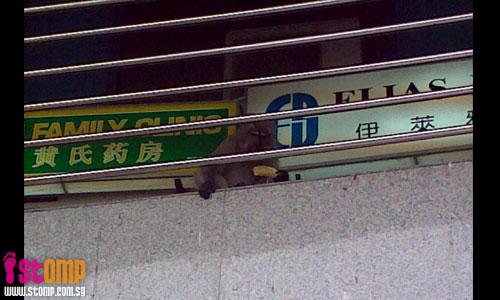
Some of you might recall this post on STOMP, where a resident living in a bungalow in the Swiss Club area had trapped and drowned several squirrels. I was wondering if the authorities had anything to say about the matter; after all, the Wild Animals and Birds Act makes it illegal to catch or kill virtually all wild animals and birds found in Singapore.
However, there was a comment on the original post on STOMP that greatly disturbed me.
Tuesday, April 21, 2009
Monday, April 20, 2009
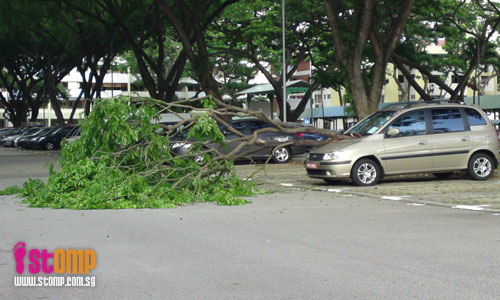
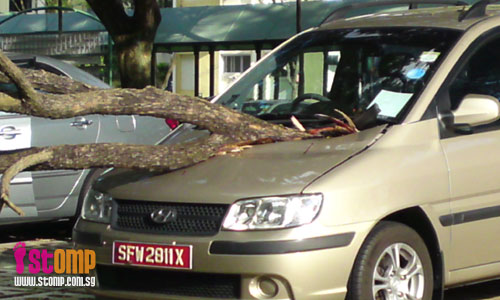
Huge branch smashes into car windscreen
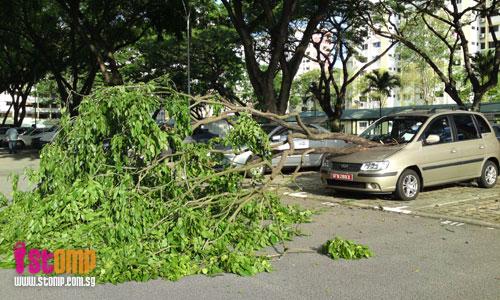
STOMPer Naz witnessed a tree branch falling onto the a car in an open HDB car park on Saturday at 5:20pm and was shocked as there was no wind or rain when the branch fell.
In an email to STOMP, the STOMPer wrote:
"I just want share with fellow STOMPers on this shocking sight!
"On 18 april,a tree branch fell onto a car even though there was no wind or rain.
"This happened at the carpark around 5.20pm and I saw other passers-by taking pictures too.
"I think that it is quite unlucky for the owner of the car.
"The branch was cleared when I passed by the area at 9pm and the car was nowhere in sight."

Monday Morgue: 20th April 2009
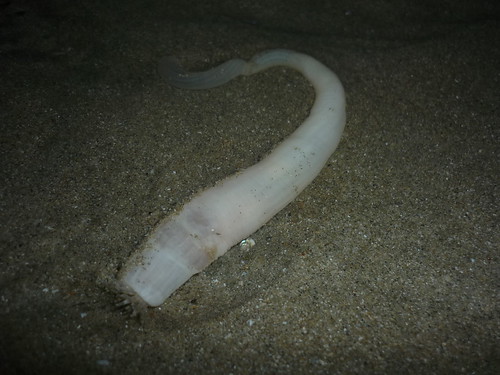
Peachia anemone (Peachia sp.)
Changi, 17th August 2008
I'm not sure if this anemone was alive or not, but it definitely wasn't reacting to gentle touching with a finger.
Wild Fact Sheets
Tree of Life web project
Sunday, April 19, 2009
Strong winds? Two trunks are better than one
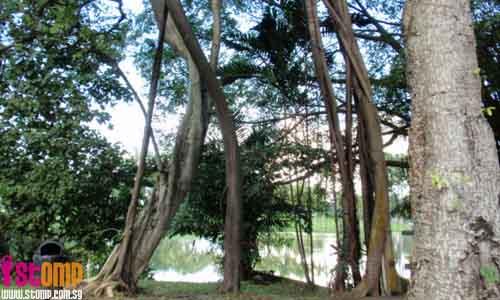
This pair of trees at Jurong Park have engaged in a 'marriage of necessity', intertwining their trunks, all the better to withstand strong winds.
Here's what the amused STOMPer had to say of his find:
"These were two separate trees growing side by side and they were originally quite happy with their individual lives.
"As this area was prone to strong winds the two trees decided to get "married" and the trunks became intertwined over time.
"Now the two trees can withstand any strong gale as they can support each other. If two heads are better than one, certainly one trunk is better than two."

I'm no botanist, but I think it's unlikely that the trees are growing together because of strong winds. Does anyone living in the area wish to investigate further and take better photos?
Native parrots of Singapore

Long-tailed parakeets, Singapore Botanic Gardens;
(Photo by Lip Kee)
Parrots are commonly thought of as iconic birds of the tropics. Southeast Asia does have a very high number and diversity of parrot species, although most of its diversity is heavily concentrated in the myriad Indonesian islands that lie between the Greater Sundas and New Guinea. 12 parakeet species belonging to the genus Psittacula and 2 species of hanging parrot (Loriculus) are found in the general area covering the Indian subcontinent, Indochina, and nearby islands such as the Andaman and Nicobar Islands. In comparison, the Sundaland region itself, encompassing the Malay Peninsula, Sumatra, Borneo and Java, seems a little poor in parrot species, with a total of 5 species; 2 Psittacula parakeets, the endemic monotypic Psittinus, and 2 hanging parrots.
This post will give a brief introduction to the 3 native species of parrot in Singapore.
Long-tailed Parakeet (Psittacula longicauda)

Male long-tailed parakeet, Singapore Botanic Gardens;
(Photo by hiker1974)
The long-tailed parakeet is the most common native parrot, and can be found in many parts of Singapore, from forests to parks and secondary scrub, wherever there are sufficient tall trees to serve as nesting and roosting sites. This species has a relatively wide distribution, from the Andaman and Nicobar Islands in the Indian Ocean to the Malay Peninsula, Sumatra and Borneo. Populations also exist on many of the surrounding smaller islands. The female lacks the long tail feathers of the male, and the reddish coloration on the head is limited to the cheeks.

Female long-tailed parakeet, Singapore Botanic Gardens;
(Photo by Lip Kee)
Flocks can be spotted in the Changi Village area, where they now have to jostle for nest sites with 2 introduced parrot species, the red-breasted parakeet (Psittacula alexandri) and Tanimbar corella (Cacatua goffiniana). Similarly, the flock at the Botanic Gardens has to compete with red-breasted parakeets and rainbow lorikeets (Trichoglossus haematodus). In fact, it is likely that competition for resources with its introduced relative is leading to the native species being displaced; my personal observation is that the red-breasted parakeet appears to be more common than the long-tailed parakeet in the Changi and Pasir Ris area.
Blue-rumped Parrot (Psittinus cyanurus)

Male blue-rumped parrot, Taman Negara;
(Photo by John Wright)
This is a rare species restricted to the forests of the Central Nature Reserves. Elsewhere in its range, which includes the Malay Peninsula, Sumatra, and Borneo, this species is known to inhabit cultivated areas such as oil palm plantations. The most obvious difference between the sexes is that the male has a blue head while that of the female is brown.

Female blue-rumped parrot, Tawau;
(Photo by Wong Tsu Shi)
Blue-crowned Hanging Parrot (Loriculus galgulus)

Male blue-crowned hanging parrot, location unknown;
(Photo by Jonathan Cheah)
Like the blue-rumped parrot, this species has its stronghold in the Central Nature Reserves, although it can also be encountered in the Singapore Botanic Gardens, and occasionally elsewhere in suburban and urban Singapore, especially when there are trees flowering or fruiting.
The blue-crowned hanging parrot, like all other members of its genus, is often seen hanging from branches while feeding and roosting, hence the name. The easiest way to tell females apart from the males is that the females lack the dark blue feathers on the crown and the red throat patch.
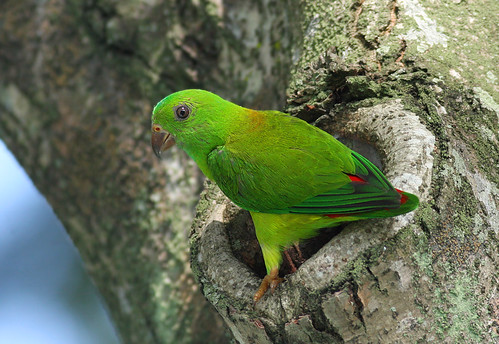
Female blue-crowned hanging parrot, Bukit Panjang;
(Photo by kampang)
Its distribution is similar to that of the blue-rumped parrot, being found on the Malay Peninsula, Sumatra and Borneo, and it has also been introduced to the Jakarta area on Java. This is a species that has been heavily exploited for the pet trade.
These 3 native species of parrot have been joined in recent decades by a wide variety of newcomers. Having escaped or been released from captivity, many of these other parrot species have begun to establish themselves in Singapore, and are now breeding. Others have been known to occur locally for several years, but breeding has yet to be recorded; these populations are being sustained by fresh escapees or releases. Many more have been sighted as lone individuals, and in the absence of breeding partners, are unlikely to become a long-term component of Singapore's avifauna. But further discussion on these non-native parrots is best left for another time.
Friday, April 17, 2009

Wednesday, April 15, 2009
Tuesday, April 14, 2009
Strange insect spotted at Botanic Gardens
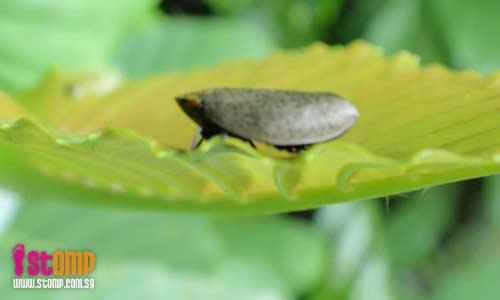
This strange brown insect was spotted emerging from a cocoon at the Singapore Botanic Gardens. The STOMPer, who spotted it, wonders what it is.
In an e-mail, he says:
"While trekking through the trails of the tropical rainforest at Botanic Gardens I came upon this white-coloured cocoon on the bottom of a large leaf.
"On looking closer, I found a black insect with brown eyes on the top of the leaf which could possibly had emerged a short while earlier from the cocoon."
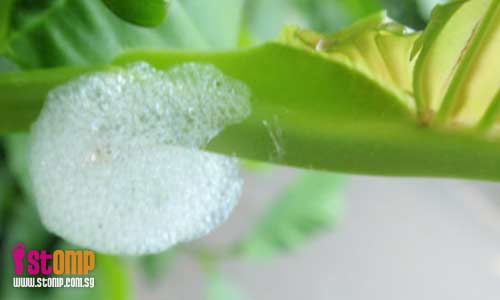
The insect looks like it's a froghopper (Cercopoidea). Like their close relatives the leafhoppers (F. Cicadellidae) and treehoppers (F. Membracidae), froghoppers are herbivorous bugs with piercing mouthparts, which they use to suck the sap of plants.
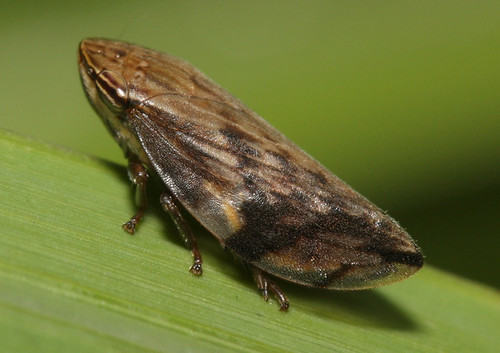
Unidentified froghopper, Pulau Ubin;
(Photo by Marcus)
Froghoppers are famous for a trait seen in the nymphs of most species; the nymphs create a thick and white foam out of plant sap (the 'white-coloured cocoon' in the original post). They hide in this protective froth, not only for protection from predators, but also to seek refuge from extreme temperatures and to conserve water. Hence another common name for these bugs is spittlebug.
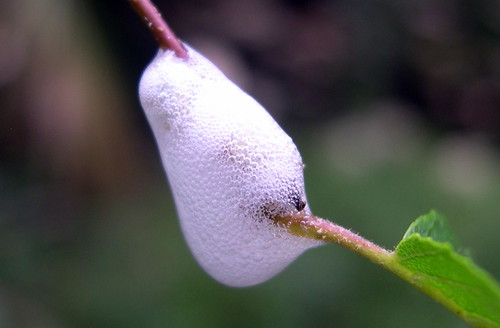
Nest of 'spittlebug', Florida;
(Photo by rc6750)
Greater Bird of Paradise spotted at ECP
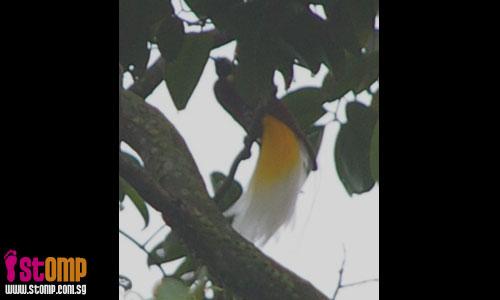
STOMPer Slow saw this gorgeous Greater Bird of Paradise at East Coast Park on Apr 12 and wonders if it is lost. She says:
"Think someone lost their Greater Bird of Paradise.
"Spotted one yesterday (Apr 12) morning at East Coast Park near Bedok Jetty.
"It was calling quite loudly around 7.30a.m."
On Sunday night, Gloria Seow left a message on the wildbirdSingapore Yahoo! Group:
Was at East Coast Park at 730am near Bedok Jetty when we heard a strange call. Upon investigating, we spotted the Greater Bird of Paradise (43cm) w our naked eyes and managed a few shots - see picture. Went back to the car to get the big camera but the bird had already flown into the grove of trees even after waiting around for it for 1/2 hr.
We checked - its a CITES II species - meaning that one requires an export licence but no import licence. Sad that these birds can still be traded legally. Glad that it has escaped!
A bird of paradise? In Singapore? What an unexpected surprise!
This bird was definitely an escapee. I wonder who might be owning and rearing birds of paradise here in Singapore.
The greater bird of paradise (Paradisaea apoda) is a native of the forests of southwest New Guinea and the nearby Aru Islands. Here's a nicer photograph of a male:
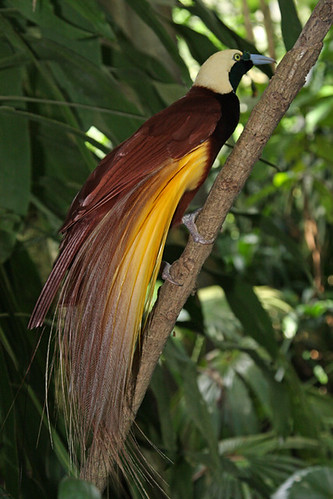
(Photo by Bertrand Linet)
Compared to the male with his dazzling array of plumes, the female is much more drably-coloured:
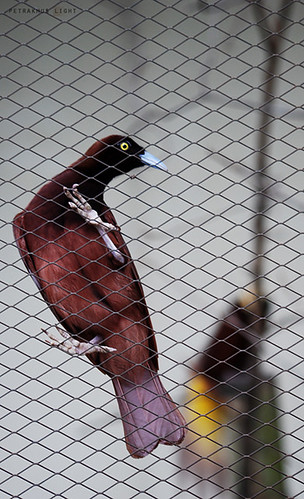
(Photo by petrakhus light)
This species is not considered endangered, and is listed as a species of Least Concern in the IUCN Red List of Threatened Species. A species is thought to be of Least Concern when it has been evaluated against the criteria and does not qualify for Critically Endangered, Endangered, Vulnerable or Near Threatened. Widespread and abundant taxa are included in this category.
However, as mentioned by the person who submitted this post to STOMP, this species is on Appendix II of the Convention on International Trade in Endangered Species of Wild Fauna and Flora. Which means that:
- An export permit or re-export certificate issued by the Management Authority of the State of export or re-export is required.
- An export permit may be issued only if the specimen was legally obtained and if the export will not be detrimental to the survival of the species.
- A re-export certificate may be issued only if the specimen was imported in accordance with the Convention.
- In the case of a live animal or plant, it must be prepared and shipped to minimize any risk of injury, damage to health or cruel treatment.
- No import permit is needed unless required by national law.
As a signatory to CITES, Singapore has in place laws to regulate the trade in endangered species. According to the legislation, on top of the above criteria listed by CITES, an import permit is also necessary before a CITES-listed species can be brought into Singapore. You can find out more by reading all about the Endangered Species (Import and Export) Act.
However, as stated in a reply to Gloria's message:
You're so lucky to see this bird, though not at the right habitat..Yes they are classified as App II of CITES which allows trade with the issuance of permits. However the catch is, Indonesia and PNG does not allow any export of the species. They are protected by domestic law in these range countries. So legal export is impossible, technically.
However over 150 individuals from the genus Paradisaea, Cicinnurus and Seleucidis have been imported here from the Solomon Islands and African countries like Liberia, Guinea and Ivory Coast in 2005. They were all declared as captive bred specimens. How far this is true we do not know. Its hard to imagine a war torn, famine stricken countries in Africa have the means and resources to breed these birds like bantam chickens. But they manage somehow, i guess. Wonders never cease..
So it seems that the legal status of birds of paradise in private collections in Singapore appears to be quite suspicious.
The birds of paradise consist of 40 or so species distributed in New Guinea, eastern Indonesia, northern Australia and surrounding islands. The males of many species are extremely colourful, and they are known for their extravagant displays, as can be seen from the next couple of video clips:
A couple of other exotic birds have made an appearance in Singapore; a toco toucan (Ramphastos toco) was spotted roaming Seletar Hills last October and this January, while there were 4 reports in August and September last year of a grey crowned crane (Balearica regulorum) in the Jalan Kayu area. The Bird Ecology Study Group has noted other exotic species, such as Narcondam hornbill (Rhyticeros narcondami), southern ground hornbill (Bucorvus leadbeateri), palm cockatoo (Probosciger aterrimus), rainbow lorikeet (Trichoglossus haematodus), pin-tailed whydah (Vidua macroura), red avadavat (Amandava amandava), mandarin duck (Aix galericulata) and radjah shelduck (Tadorna radjah). It is most likely that these were escapees or even deliberate releases from captivity.
Quite a number of our non-native birds are present because of the trade in birds as pets. These include many species of parrot, some of which have become established locally, such as the Tanimbar corella (Cacatua goffiniana) and yellow-crested cockatoo (Cacatua sulphurea), red-breasted parakeet (Psittacula alexandri) and rose-ringed parakeet (Psittacula krameri). There are breeding populations of non-native songbirds such as the sooty-headed bulbul (Pycnonotus aurigaster), red-whiskered bulbul (Pycnonotus jocosus), white-crested laughingthrush (Garrulax leucolophus), hwamei (Garrulax canorus) and Japanese white-eye (Zosterops japonicus) in various parts of Singapore. As a hub for the exotic pet trade, both legal and illegal, it is not surprising that so many non-native species are popping up in Singapore. I can understand parrots and songbirds being sold and kept as pets, but it's truly amazing to hear of birds of paradise, hornbills and toucans being reared by private individuals.
Interestingly enough, the Oriental white-eye (Zosterops palpebrosus), a former native that was wiped out before the 1970s, has made a comeback of sorts, thanks to the establishment of a feral population that originated from escapees.
The population of Oriental pied hornbill (Anthracoceros albirostris) seen around the forests and woodlands of the Central Catchment Area, Toa Payoh and Yio Chu Kang are possibly hybrids; among the original founders were a pair of escapees belonging to different subspecies, one belonging to the northern race (Anthracoceros albirostris albirostris) and the other belonging to the southern race (Anthracoceros albirostris convexus). So these hornbills are actually of captive origin, unlike those found in Pulau Ubin and Changi, which are descended from wild birds that flew over from Johor.
The lone female rhinoceros hornbill (Buceros rhinoceros) and its former partner the female great hornbill (Buceros bicornis) that until recently used to fly around the Bukit Timah area are also ex-captives.
While the chances of most of these escapees breeding and establishing populations in Singapore are slim, one cannot discount the possibility that given certain conditions, successful breeding can occur. Escapees and exotic species certainly do add quite a fair bit of variety to our bird lists, but my greatest worry is whether all these introduced species will negatively impact our native birds.
Durian Loop better than Botanic Gardens
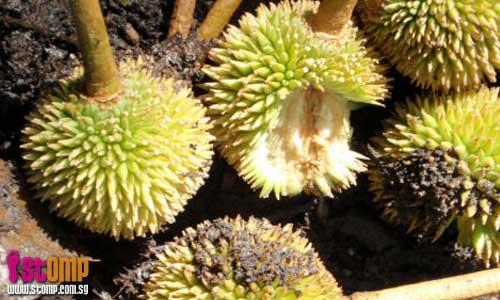
A STOMPer prefers the rich fauna that he encounters on the Durian Loop off Bukit Timah Road, to the manicured lawns of the Botanic Gardens.
In his email:
"The Botanic Gardens with its manicured lawns and artificial gardens, though beautiful, do not impress me.
"I find it more fascinating to walk through the Durian Loop near the Murnane Service Reservoir at Jalan Kampong Chantek.
"Here I come across a rare spider, a rare butterfly or a rare snake occasionally."
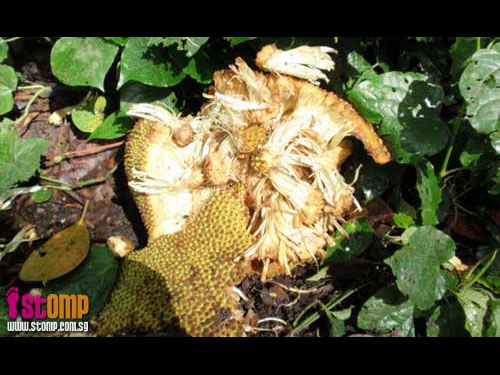
I found this jackfruit on the forest floor. It's half-eaten by birds and monkeys. They have devoured the yellow pulp, leaving behind the seeds. Soon the rotting smell will attract flies.
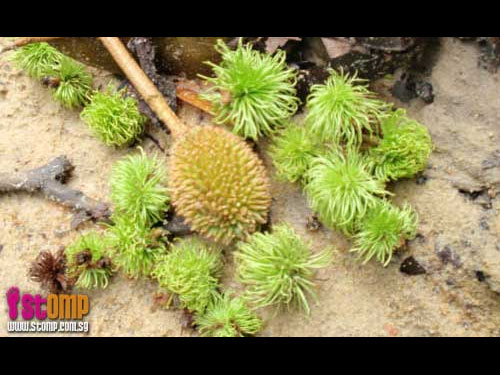
After a heavy shower, some young rambutan fruits have fallen to the ground. The monkeys avoid them because they are unripe.
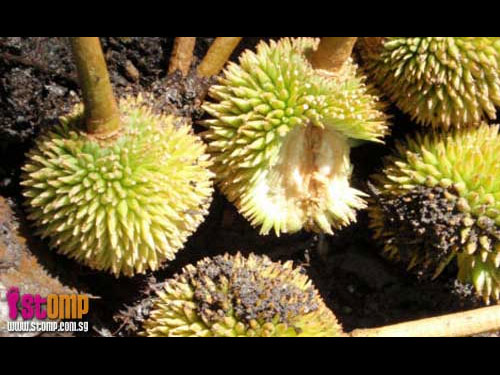
Some durians have fallen before maturity due to the downpour. A young monkey bit into the thorny fruit and promptly abandoned it when it found no juicy flesh. The best connoisseurs of durians are the fast-moving squirrels who have an uncanny nose for the best-tasting durians. If you find a durian with holes and jagged edges, it's probably the work of a squirrel that has taken the first bite. The durian is also probably the best-tasting of the lot.
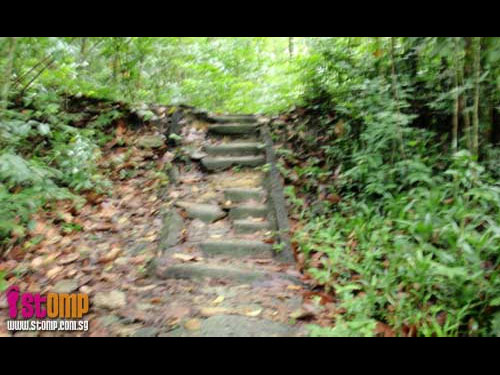
A forest path with its steps damaged by the constant pounding of tropical rainstorms.
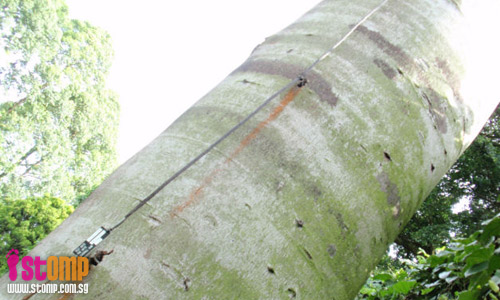
Did lightning strike this tree?
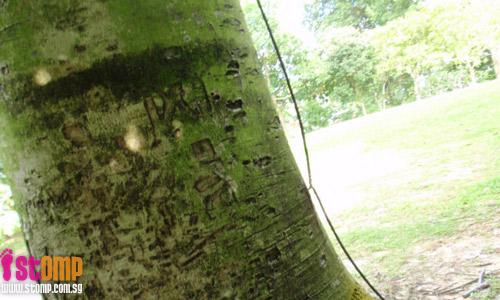
At least one STOMPer thinks so, as he came across this tree along Cluny Road.
The STOMPer then proceeds to deem lightning the enemy of trees, based on his conjunction that it had been struck by it.
In his email to STOMP, he says:
"These two pictures were taken near a Locust tree (Hymenaea courbaril) which can grow to a height of 50 m.
"This tree is found near the NParks HQ at Cluny Road. On the sides of the tree you can see metallic wires running from the crown to the base."
Beautiful swans at the Botanic Gardens

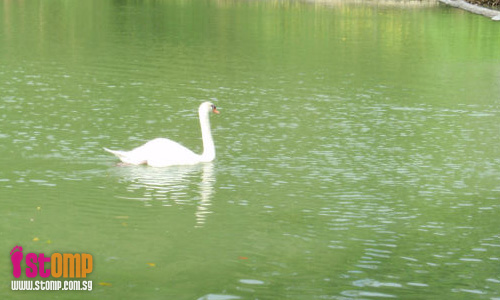
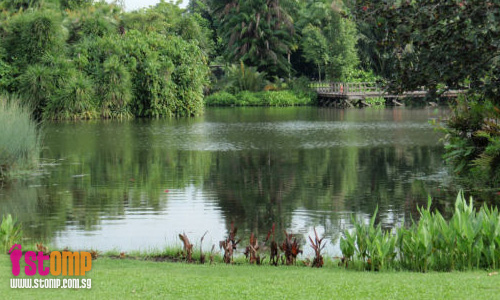
A STOMPer sent in pictures of different types of swans he saw at the Botanic Gardens.
In an email to STOMP today (April 14), the STOMPer says:
"These pictures were taken at the Singapore Botanic Gardens.
"A male swan is called a cob, a female swan is called a pen and a baby swan is called a cygnet.
"The swan is the largest aquatic bird and it moves gracefully in water. It is long-necked and web-footed. In the picture, you can see a tortoise and two black swans.
"The swan has a red beak and black swans are only found in the Eco Lake in our Botanic Gardens.
"The white swan (as seen in the picture) is found in the Swan Lake nearer to Napier Road. You can see its reflection in the water.
"In one of the pictures, you can also see two tortoises. After swimming in the water, they decided to dry themselves on the wooden plank beside the wooden bridge.
"The Swan Lake is very peaceful in the early morning. Sometimes you can see newlyweds coming here with their photographers to take some photos of their most memorable day."
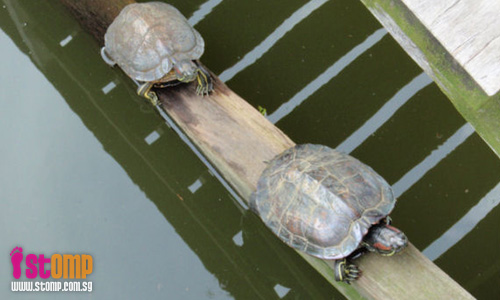
When will this particular person learn that the red-eared slider (Trachemys scripta elegans) is a turtle, not a tortoise?
The mute swan (Cygnus olor) is the species that most commonly comes to mind when we think of swans. A native of much of Europe and Central Asia, it has been introduced to other parts of the world, most notably in North America, where it has stirred up a fair bit of controversy; to some, it is a non-native species whose numbers should be controlled by culling, a view that faces much opposition from animals rights organisations and many individuals.
The black swan (Cygnus atratus), on the other hand, hails from Australia, and has recently established itself in New Zealand due to deliberate introduction as an ornamental bird, and also via natural dispersal from Australia. However, a prehistoric subspecies of black swan once existed on New Zealand and the Chatham Islands, but disappeared possibly due to hunting by human settlers. The black swan is also commonly reared in Europe.
There are 4 other species of swan, but they are much more rarely seen in captivity. They are the black-necked swan (Cygnus melancoryphus) of southern South America, the whooper swan (Cygnus cygnus) of northern Eurasia, the trumpeter swan (Cygnus buccinator) of North America, and the tundra swan (Cygnus columbianus) of both North America and northern Eurasia.
As mentioned by the person who submitted the post to STOMP, the 2 species of swan of the Singapore Botanic Gardens actually reside in different areas; the mute swans live at the Swan Lake, while the black swans are found over at the Eco-Lake.
'Dangerous' plants removed from polyclinic grounds
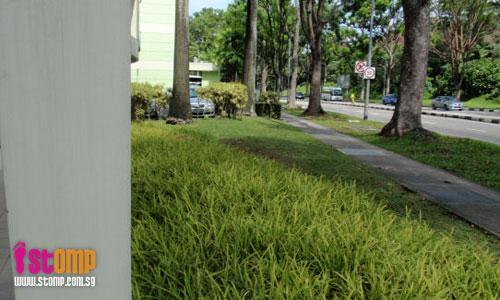
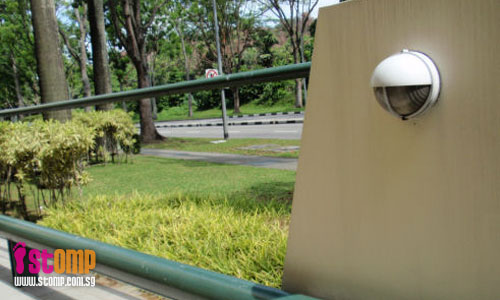
A STOMPer who said that there were dangerous plants around Bukit Batok polyclinic in an earlier email, passed by the place and said that the plants have been completely removed.
"This was thanks to the report in STOMP," said the STOMPer.
In his email today (Apr 14), the STOMPer wrote:
"I refer to your report on 2 April: Dangerous plants at polyclinic says STOMPer.
"Today when I passed the polyclinic, I was surprised that the dangerous plants were completely removed.
"In their place were some new plants with leaves that were not sharp. Thanks to STOMP for the report.
"The polyclinic authorities have seen the danger of such plants and now parents who bring their kids to the polyclinic can have peace of mind. This is good work done by the polyclinic authorities."
Earlier article:
Dangerous plants at polyclinic, says STOMPer
Related posts: Dangerous plants at polyclinic, says STOMPer (2nd April 2009)
Be careful the next time you're at Clarke Quay (12th March 2009)
Why plant chilli in area accessible by kids? (11th March 2009)
Dead leaves dangling from palm tree can crack your skull! (28th January 2009)
Monday, April 13, 2009
Celebrate nature, the Senapang Trail way

A STOMPer sends in these pictures of a forest trail between the Bukit Timah Nature Reserve and Rifle Range Road, and says there is much beauty to be appreciated in the area.
In his email to STOMP, he says:
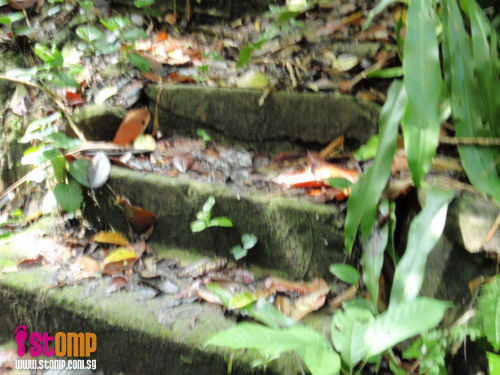
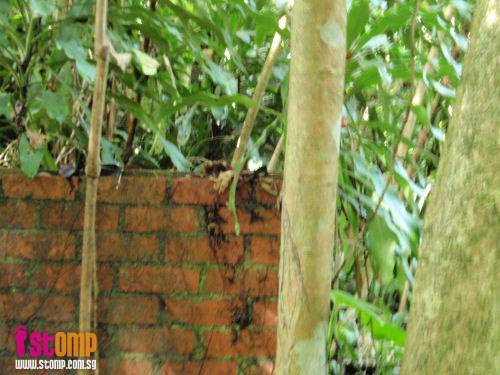
"These pictures were taken at the Senapang Trail between Rifle Range Road and the Bt Timah Nature Reserve. The steps to a house of an erstwhile squatter. The kitchen wall is still standing although the squatter has moved out.
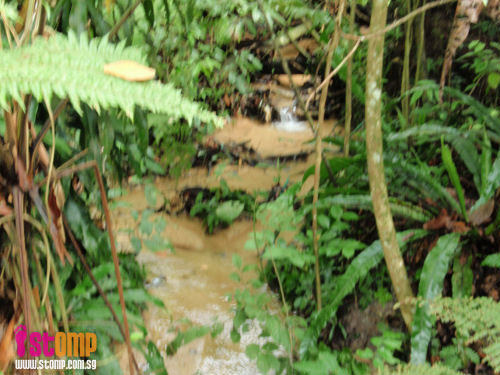
"The brook that flows through the forest floor and cuts out a path for the river bed. The water is clear and monkeys come here to drink whenever they are thirsty.
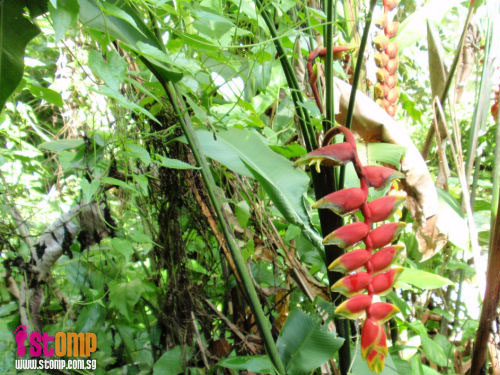
"The main picture is that of the Heliconia rostrata, bearing scarlet bracts, which stands out in the midst of green plants and trees. This is a very hardy plant and has adapted well to forest survival.
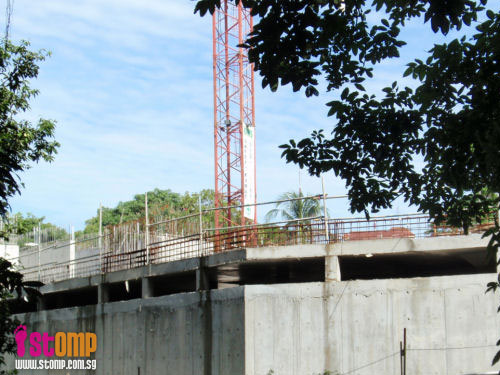
"At the end of the trail I came upon a concrete block of building in the process of being built. The cranes were moving and the lorries were moving in and out. I wonder why the Building and Construction Authority has approved a licence for developers to build condos within a stone's throw of the nature reserve.
"Soon the building will be completed and residents will move in. The monkeys from the forest will invade their gardens and the inevitable conflict between man and beast will escalate. Man and fauna need to coexist peacefully and I hope BCA will not allow more condos to go up near the forest reserve."
Sights of nature along the Durian Trail

A STOMPer, who recently took a walk at the Durian Trail in Bukit Timah, would like to share pictures of the interesting things he saw there.
He says that the natural sights he witnesses and the insects or animals he spots along the way help he relax and escape from his hectic lifestyle.
In an e-mail, he says:
"What I found at Durian Trail off Jalan Kampong Chantek:
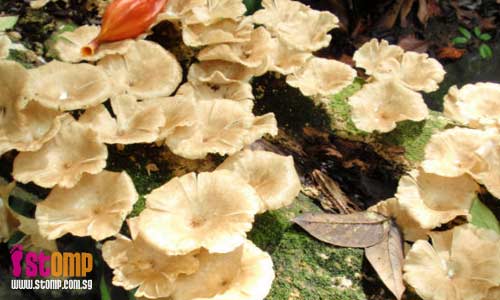
1) Some yellow fungi growing on a dead tree trunk.
2) Some brown fungi that grow on rotting wood, dung and decaying vegetation.
3) A brown butterfly with a green eye. It has some white spots on its brown wings.
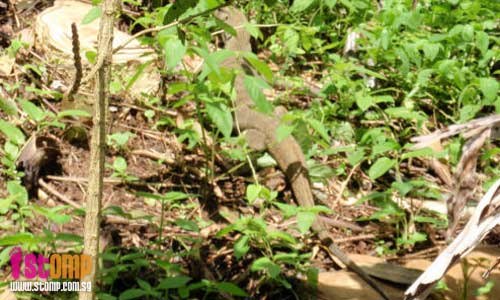
4) A monitor lizard that lives in the forest and feeds on birds and squirrels.
"I have always enjoyed taking a morning walk through the Durian Trail near the Murnane Reservoir.
"Usually, I meet snakes, monitor lizards, monkeys and squirrels.
"The paths can be slippery after a heavy shower. Taking a walk is one way to de-stress my hectic life."

Monday Morgue: 13th April 2009
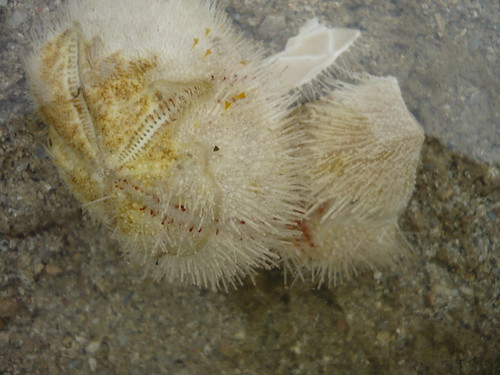
Sea urchin (C. Echinoidea)
Pulau Semakau, 22nd April 2008
Wild Fact Sheets
A Guide to Seashore Life
The Echinoid Directory
Echinoids.nl
Could it be the Maretia heart urchin (Maretia planulata)?
Sunday, April 12, 2009
Spot the difference in size of this 20 cent coin and this huge snail!

Look closely and you'll be able to spot how big this snail is. A STOMPer spotted this creature at Bukit Brown cemetry and couldn't resist sharing it with STOMP.
Francis says:
"I just saw this huge snail at Bukit Brown Cemetry today (April 12).
"I've never seen a snail that big in size before! It's close to palm size."
This is the giant African land snail (Achatina fulica), a native of Kenya and Tanzania that has been introduced to many tropical countries, including Singapore.
Here's another photo showing how large this snail can get:
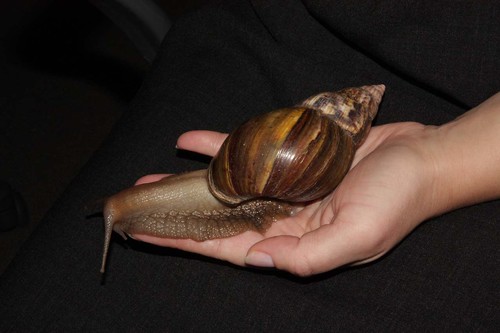
(Photo by settka)
It's actually considered to be among the 100 worst invasive species. The page on this species over at the Global Invasive Species Database explains in detail the many ways in which it can wreak ecological havoc when introduced.

Giant African land snail, Singapore;
(Photo by travellingzenwolf)
Locally, this species is extremely common in most urban and suburban areas, and can often be seen crawling on the pavement especially at night or in the morning. First recorded in Singapore in the 1920s, it is not known how it arrived here, although it is plausible that trade between East Africa, India and Malaya helped expedite the process. This 1931 article from the Hong Kong Naturalist does give a little background information about how this African snail made its way to Asia.
Subscribe to:
Posts (Atom)