Thursday, May 21, 2009

Mynah laid eggs in my air-con wallboard!

Mynah laid eggs in my air-con wallboard!
STOMPer Steven was disturbed every night by the incessant chirping of a mynah and realised that the sounds were coming from his air-con unit.

This STOMPer says:

"I have been interrupted by a Mynah bird every night.

"I pulled out my air-con and I saw alot of dry grass inside my wallboard.

"When I cleared the grass , I found two eggs, but one had already broken .

"So I decided to put the egg back in the hole after I cleared the grass.

"I realised that the mynah had flew back again every day because there was still one egg inside the board.

"I am waiting for the egg to hatch and the bird to fly off , then I will seal up the hole."

Mynah laid eggs in my air-con wallboard!

Looks like this particular pair of common myna (Acridotheres tristis) have chosen quite an interesting spot to raise their brood. I'm not sure if the mynas will still continue to tend to the egg after the disturbance, although I won't be surprised if they do rebuild the nest and cram in more nesting material.

Wednesday, May 20, 2009

Cement here, there, everywhere. Where's the greenery, Town Council?

Cement here, there, everywhere. Where's the greenery, Town Council?
STOMPer Adam is concerned that town councils are cementing many areas in housing estates, leaving no room for grass and plants.

He said in an email to STOMP today (May 20):

"Town councils should follow the government's Clean & Green policy.

"West Coast Town Council has been cementing large areas of lawns and green spaces.

"Sadly, other town councils are doing the same.

"Cutting down trees and turning green spaces into concrete should not be in the town councils' plans.

"Town councils can beautify HDB estates by proper maintenance of trees and green spaces."

Cement here, there, everywhere. Where's the greenery, Town Council?

Poisonous or edible mushrooms? This knowledge can save your life

Poisonous or edible mushrooms? This knowledge can save your life
Knowing the difference between edible and poisonous mushrooms can save your life, says a STOMPer, who spotted these wild and poisonous mushrooms in a garden.

He warns that poisonous mushrooms usually turn red when boiled and reminds everyone to be aware of what they are consuming.

In an email, the STOMPer says:

"This wild mushroom (pictured above) is highly poisonous and it grows freely beneath your garden plants. It sprouts up early in the morning and by late afternoon it shrivels and droops at an angle.

"Mushrooms are the fruits of fungus. The fungus itself is a net of threadlike fibres called a mycellium, growing in soil and decaying matter.

"The function of a mushroom is to produce spores which are the "seeds" of the fungus.

"The spores fall off to blow away on the wind or be carried by animals, water or insects. If a spore lands in a suitable spot, it germinates and grows into a new mycellium.

"Some mushrooms are extremely poisonous and are often fatal if ingested by humans. They contain organic toxins that destroy cells in the central nervous system, blood vessels, kidneys and liver.

"The mushrooms sold in our wet markets are the shiitake mushroom and the oyster mushroom. The shiitake is dark brown in colour and has an umbrella shaped cap and tan gills. The oyster mushroom resembles a fan and is usually beige brown in colour. It can be eaten raw in salads.

"Poisonous mushrooms are brightly coloured, usually red or yellow. Poisonous mushrooms will turn slightly red when boiled.

"Such simple knowledge may be a matter of life and death for you if you are not careful.

"Here is a picture of an edible mushroom."

Poisonous or edible mushrooms? This knowledge can save your life

I'm afraid that the person's assertion that poisonous mushrooms will turn red when boiled is complete nonsense. There are no hard and fast rules where it comes to identifying poisonous mushrooms. There are poisonous mushrooms which closely resemble perfectly edible species, and as far as I know, there is nothing in the literature which states that poisonous mushrooms turn red when boiled. The Wikipedia page on mushroom poisoning has a list of folk traditions on how to differentiate poisonous mushrooms from edible ones, and it would be extremely foolhardy to depend solely on such dubious advice. Dispensing erroneous advice that is not backed up by any actual scientific evidence is downright irresponsible.


(Photo by Zetrax)

Identifying mushrooms requires close and intimate knowledge of the mushroom species that may be found growing in a particular geographic area. Such knowledge does not come easily, and typically requires lots of reading, consultation with experts, and spending time out in the field examining the various species of mushrooms.

Like almost every other taxonomic group, fungi are not exactly the most well-studied organisms around, and it is more than likely that in any given area, there are mushroom species that have yet to be scientifically described, let alone tested for edibility.


(Photo by naturecord)

Comprehensive identification guides have been written for many parts of the world, enabling mushroom pickers to confidently identify which ones are safe to eat and which ones spell a trip to the emergency room, although as far as I know, such a guide has not been published for Singapore's mushroom species; I think the closest equivalent would be A Guide to Tropical Fungi, which was published in 1990. The usefulness of these guidebooks is very much constrained by geography; the mushrooms of North America and Europe are relatively well-known compared to those found in tropical South-east Asia, and a guide written specifically for people living in the northern United States of America would definitely be all but useless in trying to identify mushrooms in Singapore. Even with a guidebook in hand, identification of mushroom can be tricky, and not every mushroom encountered in the wild might be listed in a guidebook. Because fungal spores can be dispersed over great distances, it is possible to encounter a mushroom species not typically known to occur within a particular area. And as the climate changes, and the distribution of certain species shifts in response to these changes, it is likely that a guidebook that was written several decades ago would become obsolete to some degree.


(Photo by Miko 姫)

Here's an excerpt from Poisonous mushrooms of the northern United States and Canada, which gives extremely valuable advice in making sure that one does not unwittingly pick and consume poisonous mushrooms.
No single test or rule can be used to determine the edibility of any mushroom or any fungus. Each species must be carefully studied and learned so that edible species can be separated from those that are poisonous. If you are unfamiliar with the structure and identification of fungi, study reliable literature, enroll in a course on mushroom identification, or join a mushroom club or society. As you learn to identify mushrooms and other fungi, have each identification checked by an authority so you know it is correct. In other words learn something about the subject before you start collecting for food. After some of the common species are learned, additional ones can be studied and added to those you already know. In a few seasons you will be able to identify and collect one or more edible species.

Some general tests for determining the edibility of fungi are strictly superstition and are entirely unreliable. One of these is the belief that garlic cloves or silver coins turn blue or black when they are cooked in the same pan with poisonous mushrooms. Nevertheless, there are several useful guidelines that can be followed, which greatly reduce the risk of being poisoned. Some of these guidelines that make collecting fungi for food a less dangerous hobby are listed below.
  • Be absolutely sure of the identification of the species you are collecting for food.

  • Collect each specimen carefully and remove the entire fruit body from the substratum to check its identification. Several species of mushroom may grow together and it is easy to become careless and make a mistake, especially in a good season.

  • Collect only one species at a time. If you collect more than one species, keep each in a separate container or package.

  • Do not collect overmature or spoiled fruit bodies. Only fresh, young specimens are good for food. As mushrooms age they often decay and are not suitable for eating.

  • Keep specimens clean by removing excess soil and debris, but do not cut away parts of the mushroom, or other identifying features. Note the substratum and habitat where the fruit bodies are collected, and be sure of the location.

  • Collect and transport specimens in a sturdy, well-aired container, such as a market basket.

  • On reaching home, put specimens in a cool, dry place, preferably a refrigerator. If specimens are wet or soiled, place or wrap them them in a dry, clean package or container.

  • Clean and process or eat the specimens as soon as possible after you arrive home. Mushrooms and other fungi deteriorate rapidly and should not be kept longer than 24 hours before processing or eating. As you prepare the specimens, cut each lengthwise and check for spoilage or insect damage.

  • Do not eat wild mushrooms raw.

  • Eat only one kind of mushroom at a time. Do not overeat.

  • The first time you sample a species of mushroom, eat only a small amount and observe your reaction to it. Save a few intact fresh specimens for identification in case you become ill.

  • Learn as much as you can about the various kinds of poisoning and the related symptoms.

  • If you do experience symptoms of poisoning, empty your stomach as soon as possible and seek medical aid.

  • Report all poison cases. Your experiences may prevent others from making similar mistakes.


(Photo by redpolkadot)

I don't have a copy of A Guide to Tropical Fungi, and have never browsed through it before, so I have no idea how much attention is given to differentiating poisonous and edible species found in Singapore. At the same time, however, I'm sure that the following piece of advice works just as well: Don't pluck and eat wild mushrooms. You can't get any more straightforward than that.

Unsightly dead plants at AMK Hub spoils S'pore's green and clean image

STOMP20052009(1)-001Unsightly dead plants at AMK Hub spoils S'pore's green and clean image
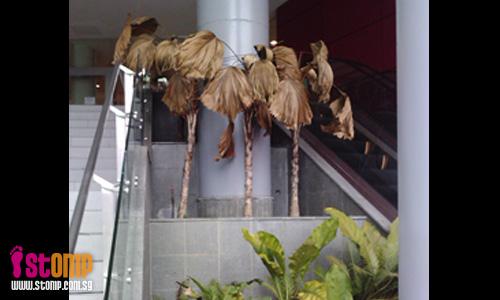
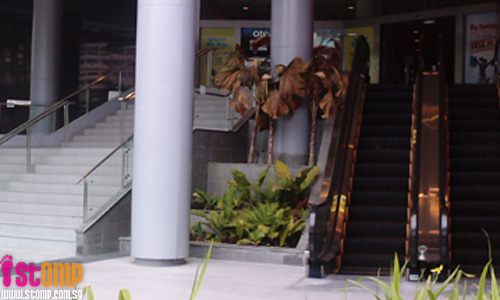
Singapore is a clean and green country but look at the unsightly dead plants at AMK Hub, says STOMPer Sherly Boscura.

"I am a foreign student in Singapore doing my work attachment.

"Singapore is a clean and green country but look at the disgusting sight of dead plants at AMK Hub.

"I am wondering if the mall management is aware of it. Plants should be regularly maintained. They should not be left to survive by themselves.

"Having said that, I wish to say that the mall has a clean environment to shop in."

Unsightly dead plants at AMK Hub spoils S'pore's green and clean image

Monday, May 18, 2009

Pest control efforts intensified to curb Woodlands Circle rat problem, says TC

Rats run wild in Woodlands Circle!
Sembawang Town Council says they have further stepped up and intensified their pest control efforts with regard to the rat problem at Block 731 Woodlands Circle.

In an earlier post dated May 17, STOMPer Samme wrote in saying he was disgusted by the rat problem at Block 731 in Woodlands Circle. The STOMPer was hoping for action from the authorities.

In an email to STOMP today (May 18), a spokesperson from Sembawang Town Council said:

"We thank STOMPer Samme for the valuable feedback.

"Our pest control contractor carries out fortnightly treatment to the estate. With the feedback received from the resident, we have, in addition to our fortnightly treatment, further stepped up and intensified our pest control efforts.

"The Town Council will continue to monitor this situation closely and we seek the co-operation of residents to keep their common areas clean.

"Should STOMPer Samme require further assistance, please call our office at 63683100."

Related article:

Rats run wild in Woodlands Circle!

Rats run wild in Woodlands Circle!

Related posts: Rats run wild in Woodlands Circle! (17th May 2009)
Rat plays peek-a-boo at East Point Banquet food court (11th March 2009)
Dead rat found lying on Maxwell Market performers' stage (9th March 2009)
Shocking to find rat at Changi Airport's T3! (8th March 2009)

Monday Morgue: 18th May 2009

P1080991
Bicoloured fan shell (Pinna bicolor)
Changi, 13th November 2008

Wild Fact Sheets
Online Guide to Chek Jawa
Species Bank
Indo-Pacific Molluscan Species Database at The Academy of Natural Sciences
SeaLifeBase

Sunday, May 17, 2009

The many faces of Choa Chu Kang Park

The many faces of Choa Chu Kang Park
A STOMPer would like to share these pictures he took at Choa Chu Kang Park with fellow STOMPers.

In an email to STOMP today (May 17), the STOMPer says:

"These pictures of the sun setting were taken at dusk at the Choa Chu Kang park connector, which links Bukit Gombak and Choa Chu Kang Park.

"The setting sun casts an orange glow across the sky as the sun slowly sank below the horizon. Many birds flew home to roost for the night.

"In another picture, you'll see a small tree bearing green fruits known as camias (Averrhoa bilimbi). The fruit has a smooth skin and is full of juicy pulp. The fruit can be eaten raw but is usually used to make sambal, pickles and chutney. It is also added to fish curry to provide acidity, and can be used to make jam if sugar is added.

"In the last picture, you'll see a decapitated carcass of a brown bird lying on the ground. It was badly mauled by some cats which were seen loitering near a block of flats beside the Park connector.

"As a foul odour was emitted, it was obvious that the bird had been killed many hours earlier.

The many faces of Choa Chu Kang Park

Rats run wild in Woodlands Circle!

Rats run wild in Woodlands Circle!
STOMPer Samme is disgusted by the rat problem at Block 731 in Woodlands Circle. The STOMPer is hoping for action from the authorities.

Samme said to STOMP via email yesterday (May 16):

"Countless complaints = Zero resolution.

"Do we need a case of Rats' Flu to bring awareness to the authority?"

Rats run wild in Woodlands Circle!

Update: Pest control efforts intensified to curb Woodlands Circle rat problem, says TC (18th May 2009)

Related posts: Rat plays peek-a-boo at East Point Banquet food court (11th March 2009)
Dead rat found lying on Maxwell Market performers' stage (9th March 2009)
Shocking to find rat at Changi Airport's T3! (8th March 2009)

Saturday, May 16, 2009

Happy 100 episodes, I and the Bird!


I and the Bird, currently the longest-running nature-related blog carnival, has just celebrated its 100th edition with a mega post over at the Nature Blog Network.

As mentioned on the I and the Bird homepage:
I and the Bird is a carnival celebrating the interaction of human and avian, an ongoing exploration of the endless fascination with birdlife all around the world. It is also a biweekly showcase of the best bird writing on the web published on alternating Thursdays.

There's a submission by yours truly in this latest edition, which is written in the form of an awards show; Call of the Koel wins the Sympathy for the Devil Award.

By the way, I forgot to mention that my post on the native parrots of Singapore appeared in I and the Bird #99, which was hosted over at Migrations.

Blog carnivals are an excellent way to link up with like-minded individuals, writing about a common interest. Being a truly cosmopolitan group, birds can be found virtually everywhere on the planet, and a typical edition of I and the Bird features blog posts by people based in all sorts of places, from the frigid Alaskan tundra to the tropical forests of Sri Lanka. The Bird Ecology Study Group has participated in numerous editions of I and the Bird, and has done much to share information about the behaviour of many Southeast Asian birds. After having followed the blog carnival for years, I decided to join in and do my part in raising the profile of Singapore's avifauna.

There are quite a few other nature-related blog carnivals that one can participate in; these include Scientia Pro Publica, Carnival of the blue, Circus of the Spineless, and Festival of the Trees. Others, like The Boneyard, Linnaeus' Legacy, Oekologie, and Tangled Bank, lasted for a while, but appear to be currently defunct.

Running a blog carnival and maintaining it requires a fair bit of effort and commitment, and 100 editions is a very impressive milestone for I and the Bird. So head down to Nature Blog Network and check out the amazing list of participants in this centenary edition, all of whom have much to share about the unique relationships we have with wild birds.

Beautiful nature found in the heart of Bukit Batok

Beautiful nature found in the heart of Bukit Batok
Bukit Batok Nature Park is a place where one can learn many interesting facts about nature, says a STOMPer who was there for a walk recently.

He took these pictures of some flora and fauna he spotted and shares some knowledgeable information regarding them.

He says:

"These pictures were all taken at the Bt Batok Nature Park one afternoon.

"The white-crested laughing thrushes usually appear in groups of four to five.

"Although they are wild, they appear to be friendly and would come close to humans. They communicate with one another with a musical, chirping sound which humans cannot understand.

"I took a picture of a green creeper growing on a tree trunk. If this is not removed, the fully grown creeper with its leaves can choke up the tree.

"I also saw some white mushrooms growing on the forest floor. They are poisonous and should not be eaten.

"There was a ginger plant (Zingiber officinale), which produces pale yellow flowers and the fruits are orange and spherical. About 8-10 fruits appear on a single stalk. The fruits are thin-walled capsules and 3-valved with many small black seeds.
"The lake in the park was formerly a granite quarry. The lake is now teeming with fish and tortoises.

"In the background you can see the soil erosion because of the constant pounding of the quarry walls by the rain in recent weeks."

Beautiful nature found in the heart of Bukit Batok

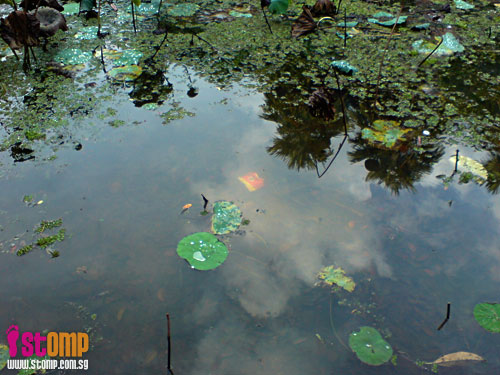
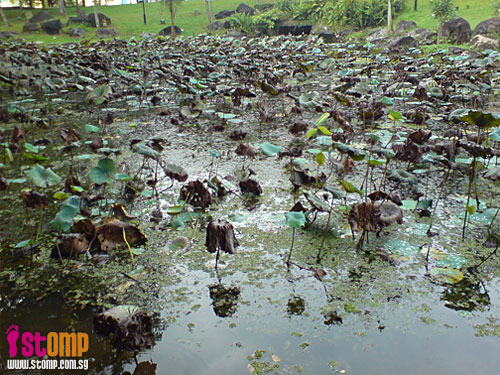
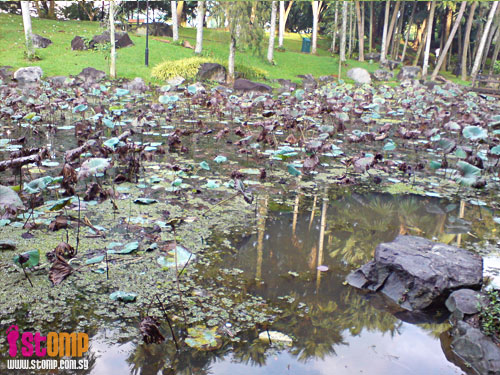
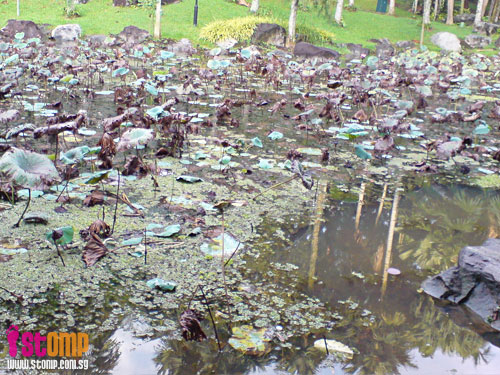
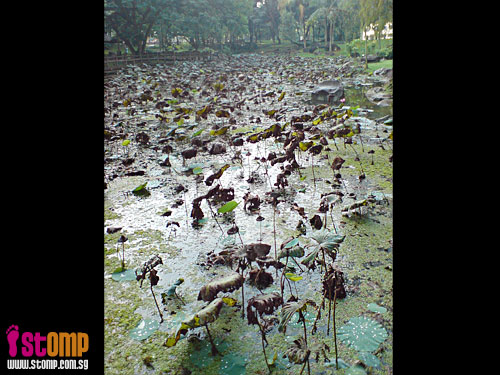
So depressing to look at this Bishan Park lotus pond

So depressing to look at this Bishan Park lotus pond
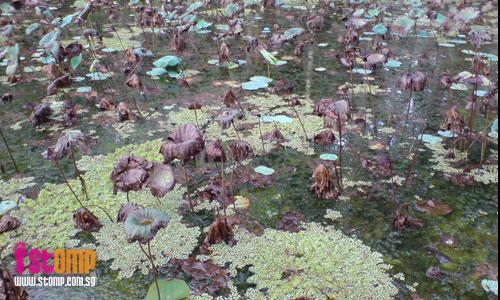
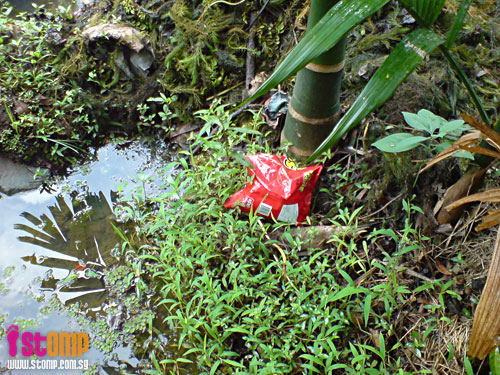
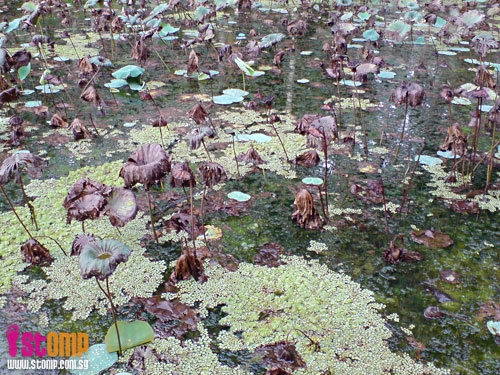
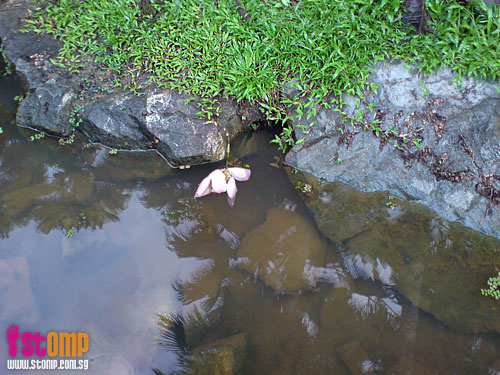
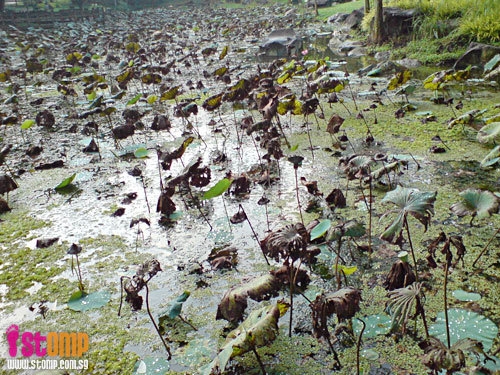
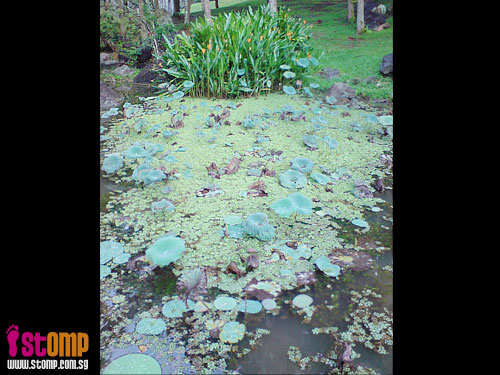
This sight of this lotus pond in Bishan Park is so depressing and it does not help that people throw rubbish in there, says STOMPer Vivian.

In an email to STOMP today (May 16), the STOMPer wrote:

"I would like to share some depressing photographs of the lotus pond at Bishan park.

"Why do we have a lotus pond if nobody bothers to maintain it?

"It doesn't help that people throw rubbish into the park. Where is the cleanliness and greenery?

"I don’t see it."

So depressing to look at this Bishan Park lotus pond

Friday, May 15, 2009

A walkway in Dunearn Close that no one uses

 A walkway in Dunearn Close that no one uses
Overgrown trees make it hard for pedestrians to use this Dunearn Close walkway, says a STOMPer.

In an email to STOMP yesterday (May 14), the STOMPer said:

"This picture was taken at Dunearn Close, outside a row of private bungalows beside the Adam Road Food Centre.

"The trees here are overgrown with leaves, and some of the branches are so low that pedestrians have to duck their head whenever they walk beneath the trees.

"Some prefer to walk on the main road to avoid the branches, making them vulnerable to being knocked down by passing vehicles.

"I hope the authorities will trim the branches so that the walkway can then be used by pedestrians."

Wednesday, May 13, 2009

Lightning, then tree crashes into dad's van: He loses sole source of income

Lightning, then tree crashes into dad's van: He loses sole source of income
STOMPer Nazrah's dad, a school bus driver, lost his sole source of income after lighting struck a tree and caused it to crash into his van.

In an email to STOMP today (May 13), the STOMPer says:

"Recently on May 9, Vesak Day, there was a freak accident along Ubi Ave 1.

"I believe lightning hit this particular tree at the carpark, and caused it to tumble and hit my father's van.

"The van is now badly damaged. Many other cars around the carpark also suffered the same fate. A lot of other vehicles in the carpark have many scratches due to tree branches grazing them.

"I also heard that someone's third floor window balcony broke into pieces after a tall tree tumbled down on it.

"What frustrated me most is that after meeting with the town council, HDB board, and my father's insurance company, none could offer any form of help when we were seeking compensation.

"Why is that so?

"Instead, they asked us to engage a lawyer and make further complaints to the LTA or NEA, or settle the bills ourselves. I believe damages cause by lightning falls under the category of accidents.

"It really saddens me as my father is a sole-breadwinner and self-employed school bus driver who uses the van to provide us with bread and butter.

"Seeing my father having to 'beg' insurance for his claim for the damaged van is really heart-wrenching."

Sunday, May 10, 2009

Finds with Spines on Siloso

P1190856

I have to admit, I have a vertebrate bias. Here on this islet off Siloso Beach, I encountered many familiar species of fish, fishes that I'd grown accustomed to seeing in these murky waters. But as I've realised time and time again, Siloso Beach has yet to reveal all of its fishy secrets.

Seeing Stars on a Siloso Shore on Sunday

P1200084

While others were busy checking out the shores of Pulau Hantu, I headed down to explore a shore I've become very fond of.

Every time I take a closer look at the islets off Siloso Beach, I never fail to be amazed at the vast array of interesting creatures that survive in these waters. But my motive for visiting this shore was also to see if there was any visible impact from the oil spill that recently occurred in the area.